VPS vs VPN: The Enterprise Guide to Virtual Infrastructure
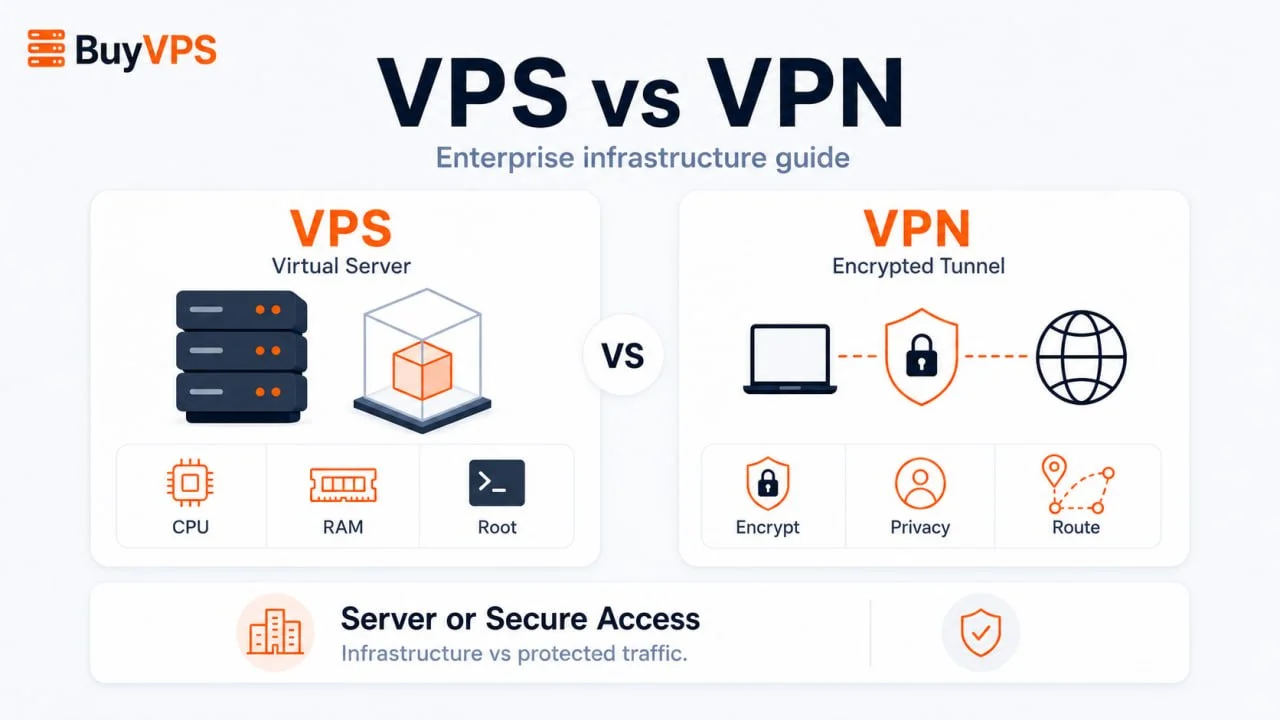
Navigating the complex, ever-evolving landscape of modern IT infrastructure requires a precise, mathematical understanding of the tools that power and protect your digital assets. For growing businesses, rapid-scaling tech startups, and established enterprise organizations, the ongoing architectural debate of VPS vs VPN is not about choosing a simple winner. It is about deeply understanding how raw compute power and localized network security interact at a foundational level.
Technical overview
As your daily operations scale and your user base expands globally, choosing the right virtual private architecture directly dictates your application performance, your legal data sovereignty, and your engineering team’s ability to operate securely on a global scale. When evaluating the intricacies of VPS vs VPN, technical clarity is absolutely essential for long-term fiscal planning and disaster recovery preparation.
In an era where a single hour of unplanned server downtime can cost an enterprise hundreds of thousands of dollars, and a minor data breach can destroy a decade of hard-earned brand equity, infrastructure is no longer just an IT department line item. It is the core engine of your business. Understanding exactly how and when to deploy these virtualization tools will separate agile, resilient companies from those that collapse under the weight of their own technical debt.
The “Virtual Private” Confusion: Why These Acronyms Are Mixed Up
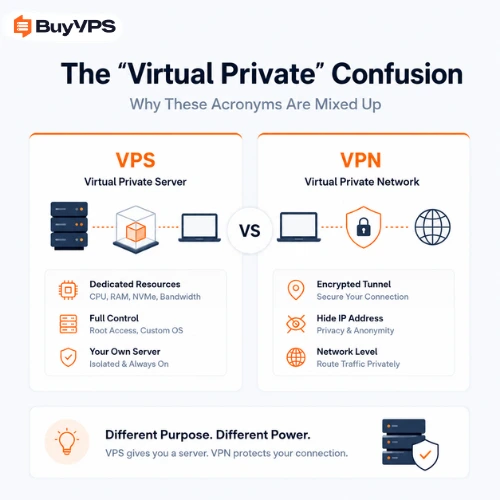
It is incredibly common for business leaders, financial officers, and even junior developers to confuse these two distinct technologies because they share the exact same virtual private prefix. However, this industry naming convention simply describes the underlying hardware virtualization, not the final deliverable product or its specific position within the Open Systems Interconnection (OSI) networking model.
Both VPS technologies use advanced, highly complex software abstraction layers to carve out an isolated, deeply virtual private experience from a much larger, shared public resource. The critical, defining difference lies in what exactly is being virtualized by the software. One technology virtualizes physical computing hardware (like CPUs, RAM, and motherboard buses) into a functional virtual server, while the other virtualizes local network transit routes into an encrypted virtual network. Understanding this fundamental hardware-versus-network paradigm helps permanently clear up the VPS VPN confusion that plagues so many procurement departments.
The Evolution of Virtualization Technology
To truly grasp why these acronyms overlap, we must look at how digital infrastructure has evolved over the past two decades. In the early days of the commercial internet, if a company needed to launch a database or an application, they had to purchase a massive, incredibly expensive physical server. This machine lived in a cold room, required massive electricity, and often sat completely idle for hours, wasting valuable compute cycles.
The invention of hardware virtualization changed everything. Software engineers figured out how to use hypervisor code to trick one physical machine into believing it was actually ten different machines. This breakthrough allowed companies to utilize 100% of their hardware capacity. This exact same software logic of creating isolated logic layers was eventually applied to network cables, allowing network engineers to create secure, invisible tunnels through the open internet. This shared heritage of software abstraction is exactly why both tools share the “virtual private” name today.
Key Differences Between VPS and VPN at a Glance
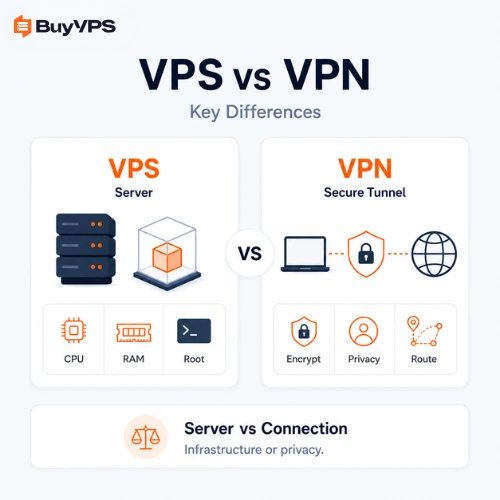
To put this technological divide into the simplest architectural terms: a VPS is a concrete destination, and a VPN service provides a secure tunnel to reach a destination safely.
A VPS gives you a dedicated server environment located physically in a highly secure, climate-controlled data center to host your proprietary databases, customer-facing web applications, and internal custom software. Conversely, a virtual private network utilizes advanced cryptography to encrypt your internet connection, ensuring your sensitive data remains entirely hidden from internet service providers, malicious packet sniffers, and third parties as it travels from your local computer to its final destination.
You host your valuable digital assets on a virtual machine, and you secure the transit of your employee data with a VPN connection. When looking at the VPN vs VPS debate, remember they solve fundamentally completely different engineering problems. One builds the secure fortress to house your data; the other builds an armored transport vehicle to drive to it.
What is a Virtual Private Server (VPS)?
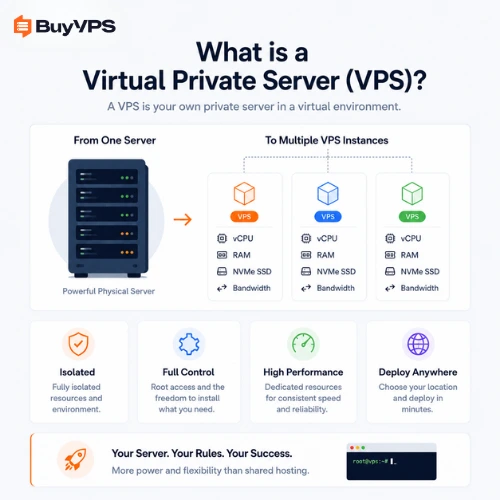
VPS stands for virtual private server. A VPS is a virtual machine that operates independently on a massive physical server, providing users with dedicated server resources and the absolute ability to install and manage their own software. A VPS provides dedicated resources such as CPU and memory, allowing businesses to run complex applications and services without the massive upfront capital expenditure required for a physical hardware investment.
This model essentially democratizes access to enterprise-level computing power. In the past, only massive corporations could afford the redundancy, redundant power supplies, and Tier-1 network uplinks required for high-availability web hosting. Today, virtualization allows businesses of all sizes to rent enterprise capacity on a highly flexible, month-to-month operational expense model to build their ideal private server environment.
How a VPS Works: Hypervisors and Resource Isolation
The absolute foundation of modern VPS hosting relies on a sophisticated, low-level layer of software known as a hypervisor. In enterprise environments, this is typically a Type 1 “bare metal” hypervisor (such as KVM for Linux environments, VMware ESXi, or Microsoft Hyper-V). This hypervisor sits directly on the motherboard of a powerful bare-metal machine and logically divides its massive physical resources to seamlessly create multiple virtual servers.
Unlike a budget-tier shared hosting plan where critical resources are fought over dynamically across a chaotic shared infrastructure, or a single shared server that arbitrarily pools memory among thousands of users, the hypervisor acts as a strict, uncompromising traffic cop. It guarantees that your specific virtual server receives its exact, mathematically dedicated allocation of CPU cores and RAM. Premium infrastructure companies provide dedicated server resources so your instance acts exactly like an independent, standalone dedicated server.
Furthermore, VPS hosting is considered significantly more secure than traditional shared hosting because each VPS is completely isolated from others, reducing the risk of data breaches and performance issues. This strict kernel-level partition ensures your data is locked away. If a neighboring virtual machine on the same physical rack experiences a massive, unexpected surge in web traffic or falls victim to a devastating DDoS attack, the hypervisor ensures that their resource spike cannot bridge the gap to steal your server resources or crash your applications.
Top Enterprise Use Cases for a VPS
Enterprise organizations relentlessly leverage cloud resources and premium hosting services to host mission-critical workloads that demand absolute, unyielding reliability. A VPS is exceptionally beneficial for hosting high-traffic applications, running automated scripts, and seamlessly scaling rapidly growing websites.
A high-performance VPS service is the undisputed choice for hosting resource-intensive Software-as-a-Service (SaaS) platforms, massive global e-commerce databases that process thousands of transactions per minute, and highly complex containerized application clusters managed by orchestration tools like Kubernetes. Development and operations teams also rely heavily on a private server to build exact, pixel-perfect replicas of their live production environments. When hosting websites or utilizing advanced, proprietary hosting tools, a VPS provides the perfect isolated sandbox to test new code without jeopardizing live customer data.
Advantages and Limitations of VPS Hosting
The primary, undeniable advantage of a VPSis total administrative freedom. A VPS offers the customization and control of a dedicated server while remaining highly cost-effective, allowing enterprises to install their choice of software and manage deep backend settings exactly according to their technical needs.
By leasing a VPS, you are inherently granted complete root access and total admin access, allowing your senior network engineers to legally install their own operating system, tweak deep Linux kernel settings, and control the entire server environment from the ground up.
Additionally, VPS solutions are scalable, allowing businesses to easily adjust their cloud resources as their needs grow, which is particularly beneficial for handling increased website traffic or demanding application workloads. VPS hosting is easier to scale than traditional servers, enabling companies to order additional compute capacity as needed without the need to physically install or maintain physical server hardware on the data center floor.
However, this incredible power comes with a proportional increase in technical responsibility. Unmanaged hosting plan options require serious internal technical expertise to properly secure the operating system, configure complex firewalls, perform routine zero-day software patching, and manage complex command-line configurations across your virtual resources.
Deep Dive: Unmanaged vs Managed Cloud Compute
When provisioning a virtual private server, enterprises face a critical fork in the road regarding daily server administration. Choosing an unmanaged hosting plan means your internal IT department is entirely responsible for the health of the operating system. If a memory leak crashes the server at 3:00 AM, your engineers are responsible for diagnosing and fixing the issue.
Conversely, premium infrastructure providers offer fully managed tiers. In this scenario, the provider’s highly certified network engineers act as an extension of your team. They handle the proactive security patching, configure the initial server environment, and monitor uptime, freeing your developers to focus entirely on building your core software product rather than managing the underlying Linux architecture.
What is a Virtual Private Network (VPN)?
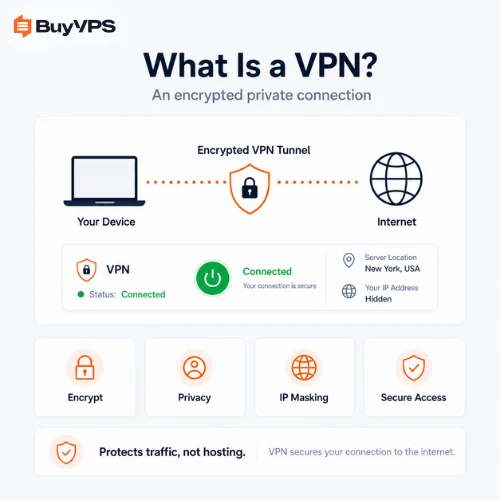
A virtual private network is a critical, foundational cybersecurity tool designed from the ground up to establish a secure connection over a traditionally unsecure network, such as the highly chaotic public internet. While a VPS server provides a physical destination for your applications to reside, a VPN service fundamentally masks your digital footprint at the network routing layer. It ensures that sensitive data cannot be intercepted, read, or modified by unauthorized third parties during global transit.
In the context of the OSI model, while your web applications operate at Layer 7 (Application), a robust corporate VPN connection secures data at Layer 3 (Network) or Layer 4 (Transport). This low-level encryption guarantees that every single packet of data leaving your device is shielded, regardless of what specific application generated it.
How a VPN Secures Data in Transit (Encryption Tunnels)
When an authorized employee connects to a corporate virtual private network, the proprietary VPN software (specifically the local VPN client installed on their physical device) intercepts and encrypts every single packet of data leaving their machine. VPNs use encryption standards such as Transport Layer Security (TLS) and Internet Protocol Security (IPsec) to strictly secure data, converting plain text into a highly complex cryptographic code that is only decipherable with a specific mathematically verified key.
This highly obfuscated data is then routed through an impenetrable encrypted tunnel directly to a remote, highly secure VPN server. By the time the data exits this remote VPN server to finally access the open web, the user’s original local network address is completely hidden, replaced entirely by the public VPN server’s ip address. A VPN creates this robust secure tunnel so your local internet provider, competing corporate entities, or bad actors operating on the same network cannot see, log, or manipulate your internet traffic.
Corporate Use Cases for a VPN
In the modern, highly distributed era of asynchronous remote work, a dedicated corporate VPN service is absolutely mandatory for business continuity, zero-trust architecture, and strict legal compliance. Public Wi-Fi security involves protecting personal data from interception on unverified networks using a VPN.
It provides essential secure remote access for globally distributed remote workers sitting on inherently unsecured public wi fi networks in airports, hotels, or coffee shops. By utilizing a VPN, these remote employees can establish a secure connection to internal corporate intranets, legacy billing platforms, and proprietary source-code databases exactly as if they were physically sitting on the highly secure office local network.
Furthermore, Quality Assurance (QA) teams heavily utilize global VPN server routing to test localized application functionality across different international server location points. This routing manipulation ensures that currency conversions, geographical firewalls, and language translations trigger correctly for users in specific regions. Without this specific hardware virtualization, utilizing public wi fi to access corporate assets is a massive, unacceptable security liability that will instantly fail SOC2 or HIPAA compliance audits.
Advantages and Limitations of VPN Infrastructure
The immediate, universally measurable advantage of deploying a virtual private network is the instant, undeniable enhanced security of your corporate perimeter. A VPN protects your remote workforce aggressively against man-in-the-middle attacks, DNS spoofing, and indiscriminate data snooping. Furthermore, a highly configured VPN secures connections seamlessly, operating silently in the background without disrupting the employee’s daily workflow or requiring them to memorize complex routing tables.
However, the incredibly heavy cryptographic mathematical processes required to actively encode and decode gigabytes of data can introduce slight network latency. If a rapidly growing company relies on a cheap, commercial VPN provider running an overcrowded VPN server fleet, this massive encryption overhead can result in frustrating bandwidth throttling and dropped connections for end-users trying to browse the web securely. To bypass these arbitrary limitations, modern enterprises often deploy their own dedicated hardware gateways to ensure maximum throughput.
VPS vs VPN: The Head-to-Head Comparison
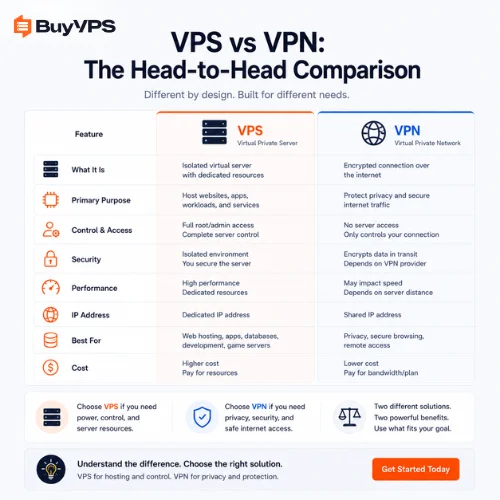
To make highly informed architectural decisions that protect long-term financial investments, technology leaders and systems architects must ruthlessly contrast these tools across several specific, operational metrics to truly understand the complex dynamics of VPS vs VPN. Relying on surface-level marketing definitions is woefully insufficient for enterprise capacity planning. We must evaluate exactly how these systems process CPU instructions, route packets, and defend network perimeters.
| Feature | Virtual Private Server (VPS) | Virtual Private Network (VPN) |
|---|---|---|
| Core Purpose | Hosting applications, running scripts, and managing databases. | Encrypting internet traffic and hiding origin IP addresses. |
| Primary Output | Raw compute power (CPU, RAM, NVMe Storage). | Network privacy and secure data transit over the public internet. |
| IP Address Handling | Provides a static, public ip address to host external services. | Masks your real ip address with the VPN server’s ip address. |
| Data Protection | Secures data at rest via isolated storage silos. | Secures data in motion via an encrypted tunnel. |
| Target User | Developers, system administrators, and business owners. | Remote workers, privacy-conscious users, and IT security teams. |
Core Purpose: Compute Power vs. Network Security
When critically evaluating VPN vs VPS at the foundational architectural layer, the baseline purpose could not be more different. A virtual private server exists specifically to supply the raw processing muscle required to keep your revenue-generating applications online, process complex database queries, and serve dynamic content to the public. It is an engine of creation, explicitly designed for hosting websites, compiling code, and deploying proprietary hosting tools.
A virtual private network exists purely as a defensive transit mechanism, ensuring that the pathway between your remote users and their intended corporate destinations remains a strictly private network that is utterly unreadable to malicious actors, automated botnets, and packet-sniffing algorithms. It does not process application logic. It does not store user data. It only utilizes virtualization technology to encrypt the transit of information from point A to point B.
How They Handle Data Privacy
A VM excels specifically at protecting data at rest within a secure, highly controlled server environment. Because of strict, mathematically enforced hypervisor partitioning at the bare-metal hardware level, malicious code executing on a neighboring virtual server physically cannot bridge the virtualization gap to access your proprietary files or memory banks. Your secure data remains permanently locked within your isolated instance.
A virtual private network, conversely, excels at protecting secure data in motion. It acts as an armored transport mechanism, transporting your highly confidential corporate communications safely across the highly chaotic, fundamentally unsecure public internet through an impenetrable encrypted connection. A robust, enterprise-grade infrastructure requires both elements to function properly: securing the data exactly where it lives using VPS technologies and securing the data as it travels using an encrypted tunnel.
Performance Impact and Network Latency
Upgrading your legacy application hosting to a highly optimized virtual private server almost universally improves overall application speed by granting your software unthrottled, direct access to dedicated disk read and write speeds alongside dedicated computing server resources. Because you are isolated from other tenants, there is no “noisy neighbor” on the shared infrastructure to arbitrarily steal your processing time or crash your web portal.
Implementing a VPN service, however, inherently introduces minor, unavoidable network latency. Because every single packet of data must physically travel to a remote VPN server for complex cryptographic encryption and decryption before reaching its final destination, the extra routing hops naturally take milliseconds longer to execute. This encryption overhead is a common, widely accepted trade-off when evaluating VPN vs standard open internet routing, but it must be heavily factored into the user experience design for latency-sensitive applications like video conferencing or VoIP systems.
Deployment and Maintenance Requirements
Deploying a VPS server is a hardcore infrastructure engineering task. It requires a seasoned IT professional to provision the hardware, securely install the required Linux or Windows operating system, configure the complex web server daemons, and aggressively maintain the backend architecture against zero-day exploits using administrative root access. It is an ongoing, daily engineering commitment that requires deep technical knowledge.
Deploying a commercial virtual private network is generally a much lighter, automated user-level task. It typically only requires standard employees to install a lightweight, pre-configured VPN client application on their corporate laptop or mobile device. From there, the software handles the complex handshakes, and the user simply clicks a button to establish the encrypted connection and achieve immediate secure access to the corporate intranet.
Cost, Scalability, and Administrative Overhead
The financial cost structures of these distinct technologies cater to entirely different operational expenses. A VPS is typically billed at a highly predictable, flat monthly rate based entirely on the total mathematical amount of cloud resources you have explicitly provisioned. If you rent 16 cores and 64GB of RAM, your bill remains static. This makes financial forecasting and budgeting highly predictable for IT departments.
Enterprise VPN service solutions procured from a standard SaaS VPN provider are frequently billed on a strict per-user licensing model. This model requires continuous budget adjustments and administrative overhead every single time your human resources department hires new remote workers or offboards departing staff. This scaling cost is exactly why many large enterprises eventually pivot to hosting their own network solutions.
The Overlap: What VPS and VPN Have in Common
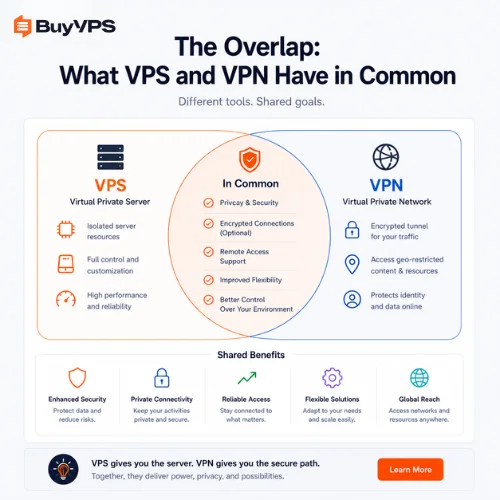
Despite serving fundamentally distinct technical purposes in the overarching corporate IT stack, these technologies share crucial engineering DNA. This shared baseline makes them highly complementary when building resilient, highly secure environments for modern business operations and strict data compliance.
The Foundation of Virtualization
Both solutions rely heavily on advanced, low-level software abstraction to completely bypass the rigid, physical limitations of traditional hardware. A virtual private server tricks a single, massive physical server into acting as dozens of completely independent, isolated machines. It partitions hardware components like RAM and CPU cores to create dedicated virtual resources that operate independently of one another.
Similarly, a virtual private network tricks the wider internet routing protocols into believing your physical device is located in a completely different city or sovereign country. Both utilize this brilliant virtualization technology to create flexible, highly isolated architectures that can be deployed, modified, and destroyed in mere seconds via automated code. These modern VPS technologies and virtual routing protocols form the absolute backbone of the modern cloud computing era.
Controlled Access and Remote Architecture
Furthermore, both vital tools are built specifically to facilitate seamless remote access for distributed engineering teams. A senior system administrator uses an encrypted SSH connection to maintain absolute secure remote access while securely managing a virtual private server physically located in a distant, heavily guarded data center.
Similarly, a virtual private network provides essential secure access for that exact same administrator to securely reach internal corporate staging networks from anywhere on the globe. This enhanced security allows them to manage complex remote servers seamlessly from a hotel room or an airport lounge without ever exposing their highly privileged credentials to vulnerable local networks.
Advanced Architecture: Combining VPS and VPN
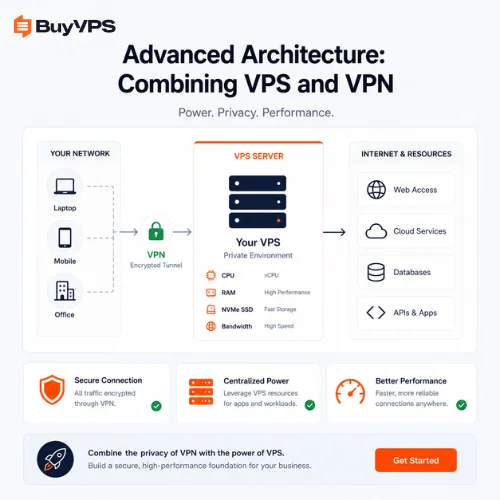
The true, revenue-protecting power of modern infrastructure is fully unlocked when enterprise organizations stop viewing these services as mutually exclusive options. Instead, architects must begin intelligently layering these tools to build impenetrable digital fortresses, leveraging highly integrated VPS VPN deployment strategies.
Hosting a Private Enterprise VPN on a Bare Metal VPS
Relying entirely on a third-party commercial VPN provider introduces significant corporate risk, as you have absolutely no visibility into their internal server logging policies or their bandwidth restrictions. Sophisticated organizations solve this critical vulnerability by renting a high-performance virtual private server from an enterprise provider and manually installing open-source VPN software directly onto the machine using their root privileges.
This brilliant maneuver transforms the virtual machine into your very own VPN gateway, granting your security engineering team total, unmitigated control over network bandwidth and access logs entirely on their own server. You can aggressively run your own VPS to filter and manage all internal internet traffic, effectively building your own VPN to bypass public restrictions and guarantee absolute data privacy. Operating your own VPN on dedicated hardware is the ultimate enterprise security measure, completely removing third-party data brokers from your corporate equation.
Securing VPS Server Access with a Corporate VPN
Alternatively, an existing corporate virtual private network is the absolute perfect tool to lock down your external virtual private server infrastructure. By utilizing strict Zero Trust architecture principles, network administrators can rigorously configure the server’s firewall to automatically drop all incoming traffic to critical management ports unless that traffic originates strictly from the company’s dedicated, static network address.
This configuration effectively makes your critical server environment completely invisible to the open public internet. Automated botnets and malicious brute-force algorithms simply cannot see that your server exists, drastically reducing your external attack surface to absolute zero.
Beyond VPS and VPN: Introducing the Virtual Private Cloud (VPC)
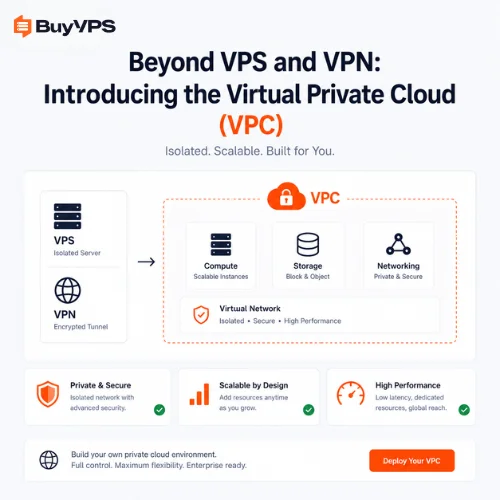
As organizations scale exponentially from hosting a few standalone servers into deploying highly complex microservice architectures and massive load-balanced application clusters, they must rapidly graduate beyond basic isolated instances. They must fully embrace enterprise networking concepts like the virtual private cloud.
How a VPC Isolates Cloud Infrastructure
A virtual private cloud allows your infrastructure team to seamlessly group multiple virtual private server instances into a highly secure, logically isolated private network completely contained within a public cloud provider’s physical data center. It essentially acts as an invisible, cryptographic fence securely wrapped around your entire fleet of cloud resources. You control the internal subnets, the network address allocation, and the specific routing tables, allowing you to replicate the complex security topology of a physical on-premise data center.
Why Enterprise Architectures Choose VPCs
Enterprise systems architects heavily leverage a virtual private cloud to create deeply segmented, highly rigid security tiers. For example, they will strategically place their lightweight, front-end web servers in a public-facing subnet explicitly designed to receive incoming global web traffic.
Simultaneously, they will intentionally bury their highly sensitive, proprietary customer databases deep within a strictly internal private network subnet that lacks any public internet routing whatsoever. The protected database servers can only be queried by the authorized front-end web servers via a highly localized direct connection, drastically reducing the total external attack surface and preventing direct database manipulation from outside threats.
Connecting Your Ecosystem: VPCs, Gateways, and VPNs
To actively manage these isolated virtual private cloud environments safely and efficiently, IT operations teams utilize advanced site-to-site VPN connection protocols. By installing a hardware VPN gateway at the physical corporate office and linking it directly over the internet to the cloud provider’s virtual VPN gateway, engineers establish permanent secure access to manage private backend servers without ever exposing those management interfaces to the open web.
How to Choose the Right Solution for Your Business
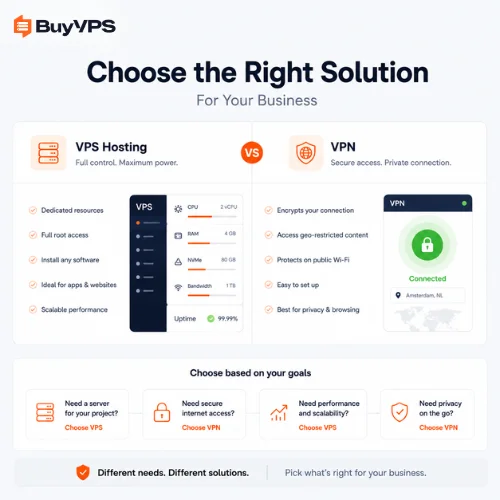
Selecting the absolute right technology stack requires ruthlessly aligning your immediate technical pain points with your company’s long-term business objectives, security compliance requirements, and operational budgets.
When Your Business Needs a VPS
You absolutely need to invest in a virtual private server if your primary organizational goal is hosting revenue-generating digital assets. If your current shared hosting environment is continuously crashing under the weight of holiday traffic, if your developers demand total admin access to compile custom software, or if you strictly require a dedicated server experience to run a highly demanding application, a virtual private server is the undisputed, mandatory solution.
When Your Business Needs a VPN
You absolutely need to invest in a virtual private network if your primary organizational goal is securing human user connectivity. If your executive team frequently uses highly unsecured public wi fi in international airports, if your remote developers need to bypass regional firewalls to remain completely anonymous online while testing localized code, or if your organization handles regulated sensitive data that legally mandates an encrypted connection during all global transit, a VPN service is an absolute necessity.
When Your Business Needs Both a VPS and a VPN
For rapidly growing, modern enterprises that take security seriously, the correct architectural answer is almost always a combination of both. You fundamentally require a powerful, high-throughput virtual private server to serve your dynamic applications to the global market, and you strictly require a robust, encrypted VPN server infrastructure to ensure your internal employees can maintain bulletproof secure remote access to manage that critical hardware safely.
Frequently Asked Questions (FAQs)
Is a VPS better than a VPN?
Neither technology is objectively “better” because they perform entirely different engineering functions within the IT stack. When looking at VPN vs VPS, you must realize their separate use cases. A virtual private server is a dedicated virtual machine used exclusively to host active websites, process databases, and run complex applications. A virtual private network is an encrypted secure tunnel used exclusively to encode your internet connection and hide your true physical network address. You physically cannot host a dynamic website on a standard consumer VPN service, and a standard virtual private server does not inherently encrypt your local laptop’s outbound web traffic.
Do I need a VPN if I have a VPS?
While not strictly required by the hosting provider to operate the machine, using a virtual private network alongside your VPS is a highly recommended security best practice. By establishing a verified secure connection to your corporate VPN server before logging into your remote virtual machine via SSH, you ensure that your highly privileged root access credentials are heavily encrypted and completely safe from interception on local, unsecured networks.
Can I use a VPS as a proxy?
Yes, absolutely. Because you are granted total, unmitigated admin access to the underlying operating system, you can easily deploy a private VPN server application directly onto your virtual private server. This configuration enables users to seamlessly route their local laptop’s internet traffic directly through their own server, effectively utilizing the datacenter ip address of the server to mask their own. This essentially allows you to deploy your very own VPN which enables users to remain highly secure and anonymous online.
Can a VPS be traced?
Yes. Unlike a commercial, privacy-focused VPN provider that is designed specifically to hide human identity and destroy access logs, a virtual private server is formally assigned a static, public ip address that is explicitly linked to your corporate hosting account and financial billing information. Any illegal activity or network abuse originating from a virtual private server can easily and quickly be traced directly back to the account owner by the infrastructure provider.
How do VPS and VPN architectures impact SOC2 and HIPAA regulatory compliance?
Achieving strict regulatory compliance requires absolute, mathematical control over exactly where your sensitive data physically resides and exactly how it travels over the network. A VPS directly assists with legal data sovereignty by allowing you to choose the exact geographical server location during deployment, ensuring that highly protected patient or financial records never cross illegal international borders. However, simply deploying a isolated infrastructure is legally insufficient. You must strictly pair it with a corporate virtual private network to guarantee that all administrative engineering access utilizes a heavily encrypted connection. Security auditors will relentlessly demand proof of this secure remote access before allowing your organization to pass compliance checks.
Does a VPN connection protect my virtual machine from Distributed Denial of Service (DDoS) attacks?
A corporate VPN service perfectly protects your internal management pathways, but it does not protect the public-facing services actively hosted on your VPS. If you are utilizing your hardware for web hosting or public API endpoints, the virtual server must expose a public network address to successfully receive legitimate website traffic. Malicious botnets can and will still target that exposed IP address. To successfully defend against this, you must rely entirely on the network-level Layer 3 and Layer 4 DDoS mitigation protocols provided directly by your premium hosting services, rather than relying on VPN software which only secures the internal administrative encrypted tunnel.
How does data center peering affect the performance of my own VPN hosted on a VPS?
When you engineer your own VPN on a bare-metal dedicated server or a high-end VPS your total network latency is directly dictated by the hosting provider’s physical network uplinks. If the data center has poor peering agreements with major global internet backbones, your remote workers will experience severe, unacceptable lag regardless of how powerful the cloud resources are. You must deliberately select an infrastructure provider that can provide dedicated server resources completely backed by premium, unthrottled Tier-1 network transit to ensure your custom VPN creates a high-speed, frictionless private network for your global engineering team.
Can my local internet provider see what I am doing if I route my traffic through a isolated infrastructure?
No. When you utilize a configured VPN client to establish a secure connection to your own server, your local internet provider can only see that you are sending heavily encrypted data to a specific physical server located in a remote data center. They mathematically cannot decrypt the packet payload to see your actual internet traffic or the final web destinations you are visiting. However, it is critical to understand that the data center provider hosting your VPS will theoretically be able to see the unencrypted outbound traffic exactly as it leaves the VPN server’s ip address to access the public internet. This highlights exactly why enterprises must partner with highly trusted, security-focused infrastructure providers.