


The infrastructure to support futures trading is highly sensitive to latency. A good VPS for futures trading is more than a server to host your trading software. Even 40ms of additional latency in the execution path of a trading strategy can easily wipe out the edge to that strategy.
Trading software and automated strategies require a trading VPS with predictable CPU scheduling and low-jitter network connectivity to execute trades and monitor the market.
While we’re not going to list out all of the possibly arbitrary features a trading VPS might have, this guide will outline what really matters and map that to actual hosting configurations. We cover hardware, virtualization, network, and support, and see how different hosting options measure up.
Comparing specifications across different hosting providers reveals significant variation in how resources are allocated and whether performance guarantees are enforceable. Understanding how your chosen provider handles broker API integrations and order routing protocols is essential when evaluating whether their infrastructure can support your specific trading workflow.
That means a single algorithmic strategy as well as many lower latency execution servers on multiple exchanges are covered by the same set of criteria. As always, we start with the fundamentals for live trading, and then see how BuyVPS's KVM-isolated VPS on AMD EPYC hardware in Amsterdam and New York datacenters stacks up.
Best VPS for futures trading: top providers compared
Not all VPS are created equal to handle the intense requirements of futures trading. A general-purpose server may share CPU time, buffer I/O to disk, and even have periods of high latency. But a trading position in play cannot tolerate such a setup. Serious traders require VPS access to physical and dedicated trading hardware.
First month $1
Then the normal monthly price. One per customer. No setup fee, and a 30-day performance guarantee on your first order.
See the plans“Excellent service! Thank you for providing the server so quickly. The service was fast, reliable, and exactly what I needed. Highly recommended!”
Experienced futures traders understand that millisecond delays can mean the difference between profit and loss, making dedicated resources non-negotiable for consistent performance. Traders allocate significant capital to their strategies, and protecting that money demands infrastructure that eliminates avoidable technical failures.
Automated futures trading bots demand pinned resources
When running a bot on the CME or ICE feeds it can fire off trades in microseconds.
Automated trading requires low latency and fast storage
New tick data arrives continuously, and with NVMe storage, prop firms can process this data in real time without the queue delays typical of spinning disks.
Most Trading Platforms such as Sierra Chart and NinjaTrader require full root access to install the software properly. Sierra Chart requires root access in particular as many trading strategies are written as custom DLL’s which require direct OS level access. Traders using sierra chart for order flow analysis often configure custom studies that require persistent file access, making root-level permissions essential for maintaining study data integrity across server reboots.
Enterprise grade uptime and risk controls
We offer a 99.8% uptime SLA, KVM isolated servers and edge filtered network to provide a solid foundation for your trading strategy. Risk management controls are only as good as the server they are running on. Our edge-filtered network provides an additional layer of protection against DDoS attacks and unwanted traffic, ensuring security remains uncompromised during volatile market conditions. Before deploying capital, traders should verify that their chosen provider's SLA terms include compensation clauses for downtime events.
Traders can configure real-time notifications and alerts to monitor server health metrics, ensuring they are immediately informed of any performance degradation or connectivity issues. Proactive system monitoring allows traders to detect anomalies before they escalate into execution failures that could compromise open positions. Traders depend on infrastructure reliability to ensure that stop-loss orders execute without delay, protecting capital during unexpected market moves.
- Dedicated CPU cores, no noisy-neighbour interference.
- NVMe RAID10 storage, fast data feed writes and reads.
- Full root access. You can install any platform (Sierra Chart or others) without any restrictions.
- IPv4 + IPv6 dual-stack, broker connectivity on either protocol.
This translates to specific requirements and we go through each of them in detail below.
Key specs futures traders must evaluate in a VPS
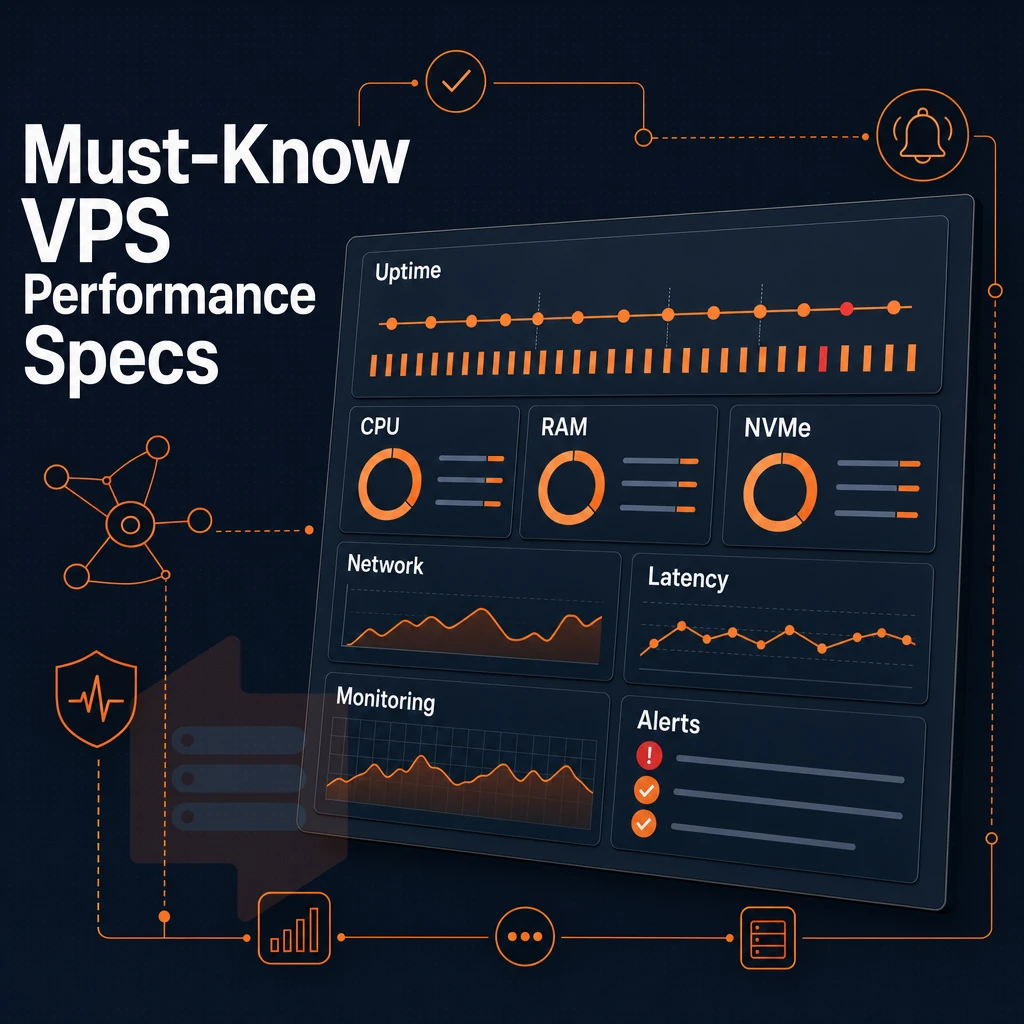
Not all VPS specs are created equal for futures trading. The following checklist outlines the key variables that impact execution speed, uptime and allow for 24 hour trading of automated futures strategies.
CPU and RAM: the foundation of execution logic
Shared vCPUs experience random latency spikes caused by other tenants using the same vCPUs as you. If you run NinjaTrader and several funded accounts, you need dedicated CPU cycles to guarantee performance, not a share of CPU cycles in a basic plan. Many prop firm traders running identical strategies across accounts find that shared infrastructure creates unpredictable slippage that compounds across positions. Selecting a plan that meets your broker's minimum technical requirements prevents order rejections caused by insufficient server capacity during peak trading hours.
RAM is also very important. A hard memory cap with no overselling means that your data feed and strategy processes will never starve while running. We recommend a minimum of 4 GB dedicated RAM per active platform instance.
Storage, network infrastructure, and broker connections
NVMe RAID10 storage for high-performance logging, tick-data, and fast restarts after updates.
| Spec | Minimum | Recommended |
|---|---|---|
| CPU | Shared vCPU | Pinned dedicated core |
| RAM | 2 GB | 8 GB+ with hard caps |
| Storage | SSD | NVMe RAID10 |
| Uptime SLA | 99.5% | 99.8%+ |
Virtualization and remote access
KVM with a separate kernel for each VPS is more isolated than container-based alternatives.
BuyVPS removes substantial risk and delivers a consistent trading environment on Dedicated plans: pinned CPU cores, memory hard caps, NVMe RAID10 storage with published IOPS numbers, multi-homed uplink connectivity, and KVM isolation.
Ninjatrader VPS setup: what your server needs
When renting a VPS for NinjaTrader, match the chosen server to the platform's requirements rather than simply choosing the cheapest offer.
OS and platform requirements
As NinjaTrader is a Windows application, the Virtual Private Server (VPS) needs to run with a Windows Operating System. Most hosting companies offer a range of Windows VPS images. Our default virtualization environment is based on Linux KVM for lower latency performance, though prop firms and other users do have the option to upload a custom ISO file (e.g. a licensed copy of Windows) for installation on the VPS.
When evaluating Windows hosting options, traders should compare the licensing models and support tiers offered by different service providers to ensure compatibility with their platform requirements.
The trading platform Sierra Chart is also used for low-latency trading of futures, offering deep market data.
RAM and resource sizing for charts and indicators
For NinjaTrader with multiple charts, indicators, and live data feeds, 4, 6 GB RAM is typically required under normal conditions, but RAM requirements rise quickly when also running automated trading strategies.
Algorithmic trading for futures and remote access
A VPS for automated futures trading is primarily used to keep your system running unattended while your local machine is powered off. For automated trading, low latency connectivity to the exchange gateways is more important than a fast CPU in your VPS. For community perspectives, see What VPS/setup are you using for your trading system?.
When it comes to managing your server on a day-to-day basis, you'll use remote desktop software (RDP on Windows servers, VNC sessions on others). Our BuyVPS platform includes an in-browser VNC console on all plans, so you can access your servers and run applications like Sierra Chart, a requirement for many prop firms, regardless of the local OS installed on your computer or device. With the platform specs defined, we now turn our attention to geography, which data center will host your orders closest to the matching engine.
This browser-based access proves invaluable when you need to monitor positions away from your home computer or primary workstation. Traders who rely on mobile internet connections or public Wi-Fi can maintain full control over their positions through this browser-based interface without installing additional client software. Real-time monitoring of open positions and order status becomes seamless when you can connect from any device without dependency on a single workstation. Prop traders often configure sierra chart with custom studies and automated order entry scripts that require uninterrupted remote access during active market hours.
Why choose BuyVPS for automated futures trading
Automated futures trading demands a trading VPS with consistent CPU, predictable RAM, and rock-solid uptime.
- Pinned EPYC Genoa cores. Our Dedicated CPU VPS eliminates noisy-neighbor contention. Your automated futures trading bots get the same CPU headroom on every bar.
- 122,959 4K read IOPS. NVMe RAID10 with PCIe-direct storage means data feed ingestion and processing logic run at measured, not marketed, speeds.
- Hard memory caps, low node density. No oversell. Serious traders running multiple accounts get the RAM they paid for, always.
- KVM isolation with a separate kernel per VPS. True security and reliability boundaries. No shared kernel risk.
- In-place upgrades, no IP rotation. Scale your plan without breaking broker connections or re-whitelisting API keys.
- Full root access, no renewal hikes. Install any trading platform or automation stack. Same price in year five as year one.
We operate from Amsterdam and New York, serving prop firms and traders alike on identical AMD EPYC hardware with engineer-level support since 2002. Compare plans at BuyVPS.com or reach our support team at support@buyvps.com to discuss the right setup for your strategy.
Frequently asked questions
Which forex VPS uses chicago infrastructure for ninjatrader futures data with no hidden costs?
NinjaTrader runs well on any KVM VPS with at least 4 GB RAM, a fast NVMe disk, and a low-latency connection to the CME or ICE data feeds.
BuyVPS delivers all three, including enough CPU headroom through KVM isolation with a separate kernel per VPS, plus NVMe RAID10 storage benchmarked at over 122,000 4K read IOPS and data center presence in New York, putting you within milliseconds of the major US futures exchanges.
In-place upgrades mean you can scale RAM or vCPU without changing your IP address or reinstalling NinjaTrader. This infrastructure design prioritizes reliability by eliminating single points of failure through redundant storage arrays and network paths that maintain connectivity during hardware maintenance windows.
Which best VPS trading option fits your needs?
The best trading VPS combines low-latency network routing, predictable CPU performance, fast NVMe storage, and a no-oversell policy that prevents noisy neighbors from stealing resources during volatile market opens. Dedicated-core VPS plans are the strongest fit for execution-critical strategies. BuyVPS offers both a Dedicated CPU tier with pinned AMD EPYC Genoa cores and a Standard CPU tier on EPYC Milan for traders who trade futures or forex, available in New York and Amsterdam, giving a choice based on how latency-sensitive their strategy is.
Does a VPS reduce slippage for futures traders?
Slippage in futures is largely a function of order-to-exchange round-trip latency. A VPS co-located close to exchange matching engines cuts that latency compared to a home broadband connection, which can add tens or hundreds of milliseconds of jitter. Hosting your trading platform on a New York VPS, for example, keeps you physically near US futures venues and on a multi-homed commercial network rather than a residential ISP.
What specs do i need for running automated strategies on futures bots?
A single automated bot typically needs at least 2 vCPU, 4 GB RAM, and 40-60 GB of NVMe storage for the platform, historical data, and logs. Running multiple bots or strategies in parallel with platforms like sierra chart pushes requirements higher, 8 GB RAM or more is common for multi-instrument setups. Prioritize a dedicated-core plan if your strategy is latency-sensitive, since pinned cores eliminate the CPU scheduling jitter that shared vCPU plans can introduce during peak load.
Can a VPS trading environment support multiple funded accounts?
Yes, and it is a common setup. Running multiple prop accounts from a single VPS keeps all sessions on one stable IP address, avoids the connectivity issues that disqualify traders under prop firm rules, and lets you monitor all accounts from one remote desktop session or via mobile access.
Make sure your VPS has enough RAM to run each platform instance independently, 2 GB per instance is a safe baseline. BuyVPS plans scale from 4 GB up to 192 GB RAM with in-place upgrades, so you can grow as you add accounts without changing your IP.
Is a Linux VPS suitable for futures traders and their platforms?
It depends on your platform. NinjaTrader, TradeStation, and most Windows-native charting tools favored by prop firms require a Windows environment, so you would need a Windows VPS or run those platforms under Wine, which is workable but adds complexity.
Python- or Java-based trading bots, algorithmic frameworks, and broker APIs from several providers that expose REST or FIX interfaces run natively and efficiently on Linux. BuyVPS supports Ubuntu, Debian, AlmaLinux, Rocky Linux, CentOS Stream, and Fedora for maximum performance, and also allows custom ISO uploads for traders who need a specific OS build.
Dedicated-core vs shared-vcpu trading VPS: what is the difference?
A shared-vCPU VPS assigns virtual cores that are time-sliced across multiple tenants, fine for most workloads, but CPU availability can fluctuate when neighboring VPS instances spike. A dedicated-core VPS pins physical CPU cores exclusively to your instance, eliminating that contention and delivering consistent, predictable latency on every tick.
BuyVPS's Chicago trading VPS infrastructure Dedicated CPU tier uses pinned AMD EPYC Genoa cores, while the Standard CPU tier on EPYC Milan suits lower-frequency strategies where occasional CPU scheduling variance is acceptable.
When it comes to futures trading, there are three variables to consider: latency, CPU consistency and server location. A good VPS service with pinned cores, NVMe storage and a relevant location (e.g. New York for US futures trading. Amsterdam for European contracts) can guarantee that the worst cause of slippage and downtime, your chicago infrastructure, is taken out of the equation.
The Platform must be compatible with your current system(s) and may run NinjaTrader, Sierra Chart or even be a custom algorithmic stack. Our VPS offers Full Root Access, a Stable Kernel and Adequate Dedicated Resources to Process Orders in Real Time without interference from other VPS accounts.
BuyVPS offers Dedicated CPU VPS plans with pinned AMD EPYC cores, NVMe RAID10 storage, and deployments in both New York and Amsterdam, built for exactly this workload. Review the available plans at BuyVPS.com and match your trading platform's requirements to the right tier.