

Finding the best VPS hosts comes down to one important question: how do they perform in reality, not just on paper? With so many options on the market, it's nearly impossible to separate the marketers' promises from actual performance.
Once they have been put to work under realistic loads. In the end, it is a matter of avoiding a host of problems that will cost you dear, in terms of time and effort.
This guide to VPS services cuts through the hype. We evaluated various providers for developers and for IT/infrastructure people, namely for their CPU, storage, network and virtualization, and for their support. These providers can be hyperscale providers with a global footprint (e.g. AWS, Azure), or more specialized providers. Beyond raw specifications, providers distinguish themselves through pricing structures, with some offering affordable plans that balance performance and cost for startups and small teams. Related: VPS hosting plans.
For workloads requiring elastic scalability and distributed infrastructure, cloud hosting platforms offer on-demand resource allocation that traditional VPS configurations cannot match. Providers with geographically distributed data centers enable lower latency for end users and improved redundancy for mission-critical applications. Selecting the right provider means evaluating how their hosting solutions align with your application's specific requirements for uptime, scalability, and technical support responsiveness. Each provider offers distinct advantages in terms of network uptime guarantees, backup policies, and the granularity of resource scaling options available to customers. See also: NVMe storage.
Additionally, hard memory caps (i.e. not oversold like most shared nodes) among other things.
What makes the best VPS hosts stand out in 2026
Most people searching for the best VPS hosting look for a number of features in VPS hosting and can get stuck in the headline numbers and marketing blurb. Additionally, Whether it will degrade in performance when other accounts on the same server start to use up all the resources. Understanding whether VPS hosting good for your use case requires examining how the provider allocates resources and whether performance remains consistent under load.
First month $1
Then the normal monthly price. One per customer. No setup fee, and a 30-day performance guarantee on your first order.
See the plans“Excellent service! Thank you for providing the server so quickly. The service was fast, reliable, and exactly what I needed. Highly recommended!”
How a VPS server differs from shared environments
As a Virtual Private Server (VPS) for example, a physical server is split up into virtual servers (or VPS’s) with each having its own kernel, RAM and storage space. This is very different from shared hosting where all accounts are sharing the same CPU, RAM and storage for example.
In shared hosting, all accounts share the server's CPU and RAM. With a VPS account, you get your own isolated section of the server.
Moving from shared hosting to VPS is significant. You get a dedicated server environment with full root access, letting you choose your OS, software stack, and even tweak the kernel, no landlord, no restrictions. Most providers include a web-based control panel for common tasks, though experienced developers often prefer direct SSH for granular configuration.
The criteria that actually matter
Evaluate these fundamentals first: compare what each provider offers in resource guarantees, hypervisor technology, and whether allocations are truly isolated or subject to oversubscription during peak usage.
- Virtualization type: KVM provides hardware-level isolation with a separate kernel per instance. Avoid container-based alternatives, they share the host kernel and limit what you can run.
- Resource model: Dedicated resources (pinned CPU cores, hard memory caps) eliminate the noisy-neighbor problem. Shared vCPU plans are acceptable for burst workloads, but confirm the provider enforces hard limits per node.
- Storage technology: NVMe over PCIe delivers measurably higher IOPS than SATA SSD. For database-heavy workloads, this gap is decisive.
- Network quality: Multi-homed uplinks, dual-stack IPv4/IPv6, and a published uptime SLA matter more than headline bandwidth numbers.
- Pricing transparency: Renewal hikes and migration fees erode TCO fast. Look for providers that publish consistent long-term pricing.
Why BuyVPS meets this framework
The architecture supports the above criteria by design.
VPS vs. Shared hosting services: why the upgrade matters
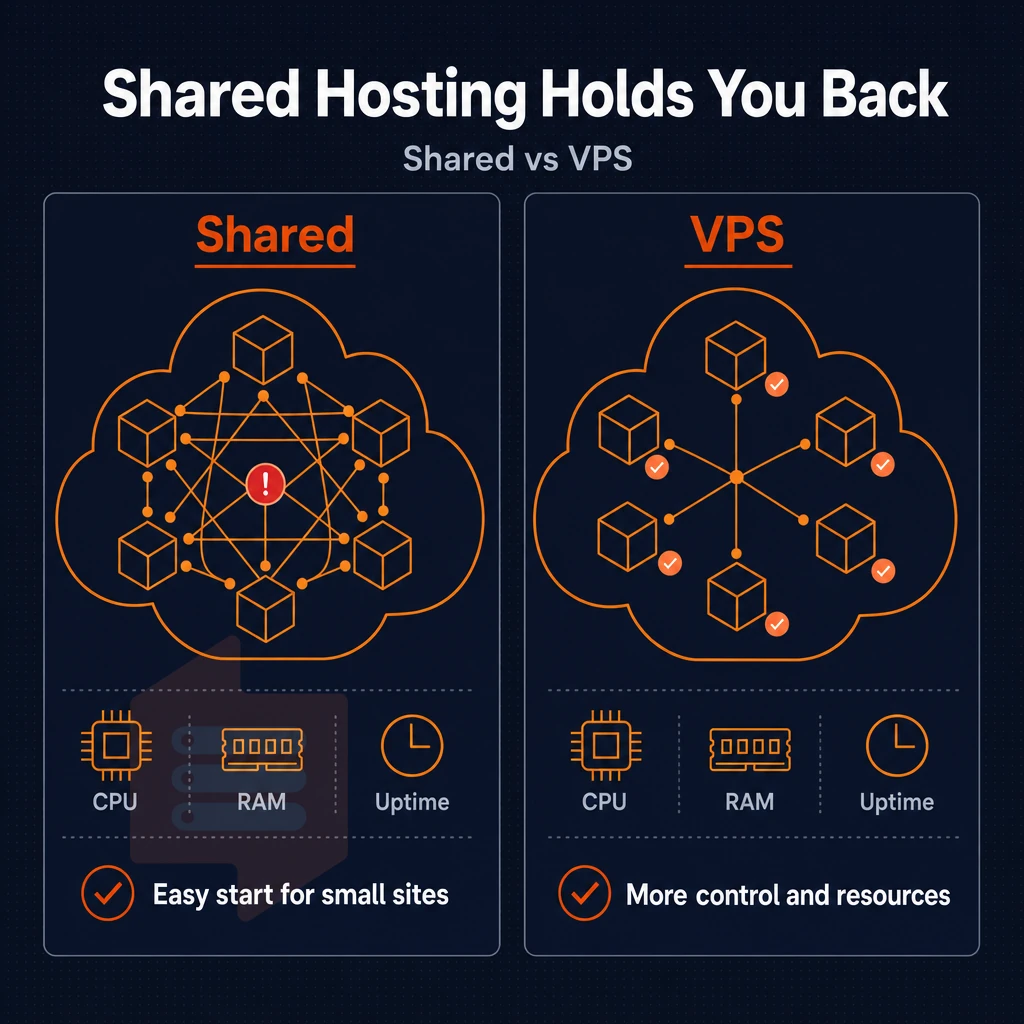
When first launching a site, it typically is hosted on a shared web hosting environment. Simple enough to get up and running with. But as traffic to the site increases, the architectural constraints of a shared hosting environment start to limit performance. Knowing what changes as you move to VPS services will allow you to make a decision before performance starts to suffer.
How resources are divided
Dozens of sites are hosted on the same physical server as you on a shared plan, each drawing on the site's share of the available CPU, RAM and I/O as needed. However, noisy neighbors can result in rapid spikes in latency for all sites on the server.
In contrast, VPS plans use hypervisor-level virtualization to create separate virtual servers. Each of which has a fixed amount of RAM (capped at the size of the allocation) that is not borrowed from elsewhere on the server as needed. This allocation model ensures predictable performance because each VPS operates within guaranteed server resources that cannot be borrowed or oversubscribed by neighboring instances.
VPS environments that use KVM, such as the ones provided by BuyVPS on their AMD EPYC servers, run each Virtual Server with its own kernel. So if one process on a VPS starts to misbehave, it can't affect another VPSes that are running on the same server. That's not the case with shared hosting.
Performance and security isolation
In a shared environment, there is a very flat attack surface. So even if one account gets compromised on a particular node, all of the other accounts on that particular node can also get compromised. A VPS is a fully isolated server environment where you have root access, you can set up your own firewall rules and there is no shared process space.
Organizations requiring SSL certificates for e-commerce or handling sensitive data often pair a dedicated ip with their VPS to ensure proper certificate binding and enhanced reputation management. Modern VPS providers often include ddos protection as part of their security stack, mitigating volumetric attacks before they reach your application layer.
A look at performance metrics shows that VPS plans are delivering less than 5 ms of latency to disk, as well as supporting multiple core processor implementations.
Shared hosting plans get throttled to protect other users on the server, whereas VPS users aren't. In measurements, BuyVPS delivers 122,959 4K read IOPS on NVMe RAID10 storage, numbers completely out of reach for most shared hosting plans. Modern VPS platforms rely on SSD storage configurations to hit these benchmarks, with NVMe drives offering substantially lower access times than spinning disks. Proper allocation of server resources keeps CPU cycles and memory available during traffic spikes, preventing the degradation common in oversold environments.
Dedicated hosting vs. VPS hosting: where each fits
Dedicated hosting provides you with a complete physical server (no virtualization layer) and maximum throughput. VPS (Virtual Private Server) hosting provides better isolation and performance than shared hosting, yet for a lower cost than dedicated hosting with faster provisioning than for a bare metal dedicated server.
| Dimension | Shared | VPS | Dedicated |
|---|---|---|---|
| Resource isolation | None, pooled | Hard caps per instance | Full machine |
| Root access | No | Yes | Yes |
| Scalability | Plan limits only | In-place upgrades | Hardware swap required |
| Uptime SLA | Typically unguaranteed | 99.8% (BuyVPS) | Varies by provider |
| Free VPS hosting | Sometimes offered | Rarely, avoid for production | Not available |
Bare metal servers are for those who require the absolute top end of single-tenant hardware, for the rest of us a VPS, complete with a dedicated ip address, is the sweet spot for growing workloads that have outgrown shared hosting. A VPS can handle the increases in traffic, supports custom software where required and also satisfies security and compliance requirements. Choosing the right VPS server configuration involves balancing CPU cores, RAM allocation, and storage type against your application's actual resource consumption patterns and growth projections.
Managed VPS hosting vs. Unmanaged: which is right for you
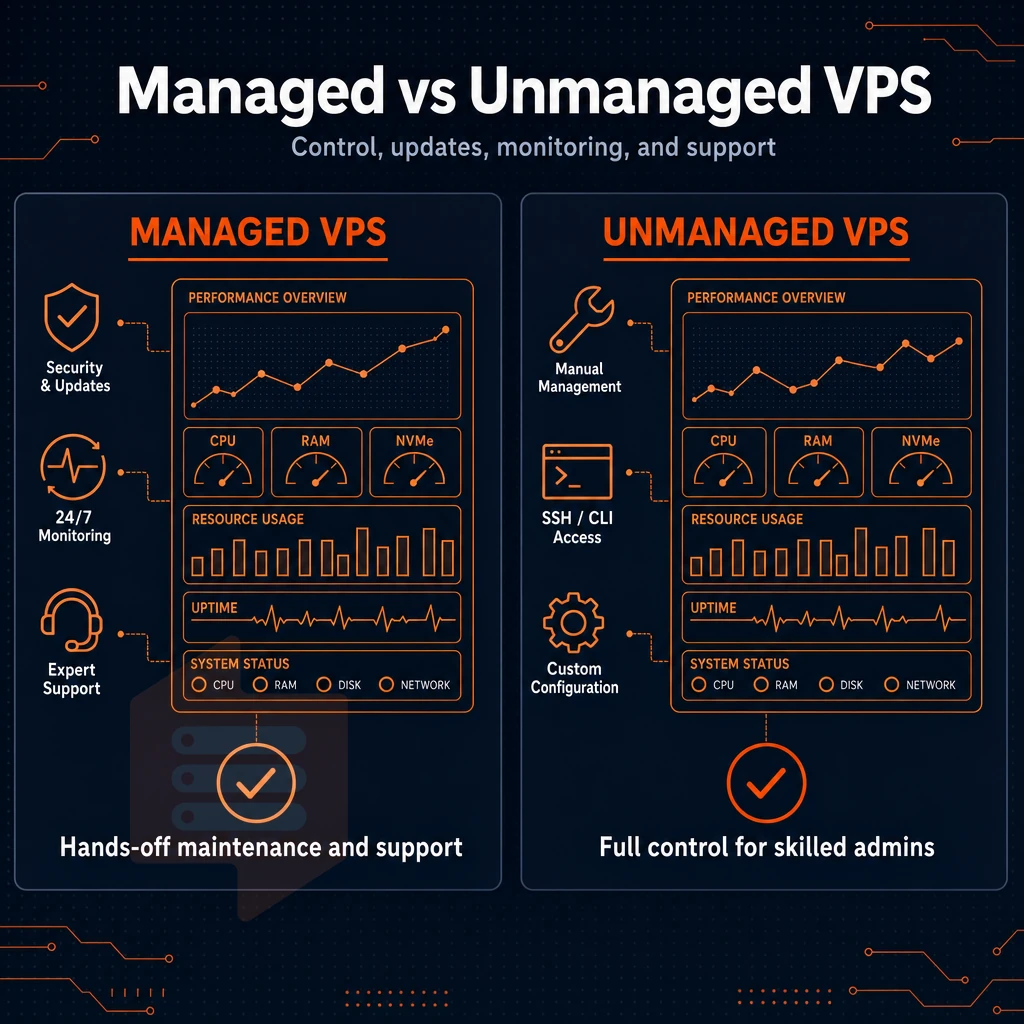
Managed or unmanaged VPS hosting is a first consideration when looking for the best VPS hosting options. The best choice depends on your team’s level of technical expertise and how much control they require over a server environment. Most managed providers bundle a graphical control panel interface that allows administrators to configure services, monitor performance metrics, and deploy applications without requiring deep command-line knowledge.
Understanding managed VPS web hosting
-
Identify what the web hosting provider covers
With a managed plan, the provider handles OS updates, security patches, and day-to-day server administration so you can focus on your application.
-
Assess whether your team has sysadmin capacity.
Managed VPS hosting suits businesses without dedicated Linux engineers, removing the command-line barrier entirely.
-
Weigh the trade-offs.
Managed services add overhead to VPS hosting prices. You gain convenience but lose some flexibility, since the provider controls which operating systems and software versions are supported. Evaluating what each provider offers in their managed tier, backup frequency, patch schedules, supported stacks, helps teams decide whether that convenience justifies the premium.
Unmanaged VPS hosting: best VPS choice for technical teams
-
Confirm you have the skills to self-manage.
Unmanaged VPS hosting puts you in full control. You handle kernel updates, firewall rules, and software configuration yourself. Developers and sysadmins generally prefer this model.
-
Use root access to build your exact stack.
With root access, you install any package, configure any service, and tune the OS to your workload. No restrictions, no intermediary.
Note: Full control means full responsibility. A misconfigured firewall or missed security patch is yours to fix, not the provider's.
-
Plan your server management workflow.
Set up automated patching, monitoring, and backups from day one. Unmanaged VPS hosting rewards teams that treat server management as a repeatable process, not an afterthought.
VPS hosting faqs: which model fits your workload?
Our BuyVPS solutions are unmanaged by nature, offering full root access to them, a variety of Operating Systems. Additionally, KVM isolation, allowing for a clean, unencumbered environment, to be managed by your technical team, should they be able to manage a Linux server. We strive to offer the highest performance and flexibility, for the price you are willing to pay, and thus do not charge for services that you would not require.
Key features to look for in the best VPS hosting plans
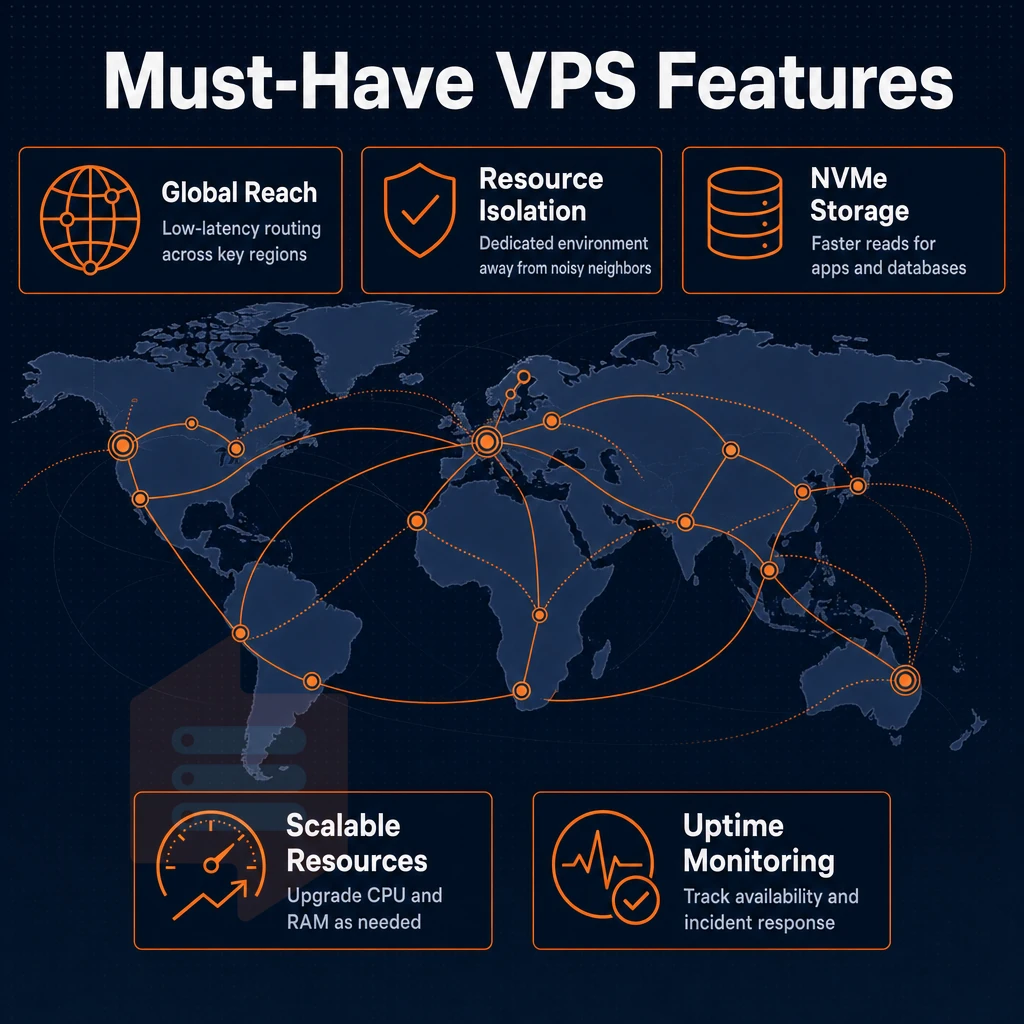
Not all VPS hosting plans are created equal, so run through this technical checklist before committing to a host.
Virtualization, storage, and network fundamentals
KVM is the minimum acceptable solution, as it gives each VPS its own kernel so a noisy neighbor can't affect your server. BuyVPS runs KVM with per-VPS kernel isolation on all plans.
Storage matters too. NVMe over PCIe delivers dramatically lower latency than SATA SSD storage through direct access. We provide NVMe in a RAID10 configuration, benchmarking at 122,959 IOPS at 4K read using fio.
Each serious plan is shipped with a dedicated IP address and full IPv4 + IPv6 dual-stack support. Note that while previously dual-stack support was considered a bonus for advanced users, today it is a required feature for any serious ecommerce, API or CDN (e.g. CloudFront) service.
Operating systems, control panel, and console access
A mature platform for server operating systems offers broad flexibility, Ubuntu, Debian, AlmaLinux, Rocky Linux, and more, including the upload of custom ISO images for hardened or specialized applications. BuyVPS supports all of these.
The friendly control panel with integrated VNC console allows for immediate recovery of servers that have been misconfigured without the need for submitting a ticket. In addition, our API access enables automation of provisioning, snapshot creation and reboots via your own tooling.
Scalability, protection, and uptime commitments
Scalable VPS plans should upgrade in place, no migration, no IP rotation, no downtime window to negotiate. BuyVPS handles upgrades within each tier this way.
DDoS protection at the network edge is a non-negotiable for anything public-facing. So confirm that this is included and not an add-on.
BuyVPS publishes a 99.8% uptime SLA, so make sure to check the SLA terms for the plans you are considering to buy, and note that anything not written down is not enforceable.
A free included domain rarely offsets poor infrastructure. What matters is the technical stack; domain registration is a commodity you can source elsewhere.
Types of VPS plans: standard, dedicated-core, and high-memory explained
Different workloads require different amounts of resources. Virtual Server hosting providers offer different types of plans based on three models of distributing resources: shared vCPU, dedicated-core, and high-memory. The wrong plan for a workload can result in you paying for resources you do not need, or that your workload needs but does not get.
Shared vCPU: cost-effective for moderate workloads
A VPS provides you with isolated RAM and storage for your website compared to shared hosting environments where websites are provided with no resource guarantees. Resources such as CPU cycles are provided in a shared pool but are suitable for most web applications, and staging environments. Moderate traffic sites are also supported.
The S-tier plan uses AMD EPYC Milan processors with DDR4 ECC RAM and NVMe SSD storage to deliver a solid model for teams that need reliable uptime but don’t require dedicated compute resources. Plans in the S-tier start at S-4 (2 vCPU, 4GB of RAM, 60GB of NVMe storage) and go up to S-64.
Dedicated-core VPS: pinned CPU for predictable latency
Shared vCPU servers can contain CPU contention or "noisy neighbors". In a Dedicated-core VPS you can even make sure your virtual server is using the physical cores, that are specifically dedicated to your virtual server instance. This gives your server consistent latency under load, instead of intermittent latency during periods of inactivity.
Our D-tier tier3 D-tier servers run on AMD EPYC Genoa processors with DDR5 ECC RAM and pinned cores. They cost somewhere between a standard VPS and a full dedicated server, delivering dedicated resources where it matters most: CPU scheduling.
- No CPU time-sharing with other tenants.
- Predictable benchmark scores across runs.
- DDR5 ECC memory for lower latency and higher bandwidth.
High-memory VPS: built for ram-intensive workloads
Many workloads including large PostgreSQL instances, Redis clusters and in-memory analytics workloads are RAM-bound rather than CPU-bound. To enable these workloads we provide a 1:8 RAM ratio at entry point (8 vCPUs, 64 GB RAM).
The H-tier is configured for this purpose. Unlike many other providers who add a free domain name and a day money back guarantee to their higher-tier plans and list additional features in fine print, we have concentrated on the essential features. These are: the maximum amount of usable memory per core, the fast NVMe storage in RAID10 configuration, and our no-oversell policy with strict hard memory caps per node.
Hard caps ensure no other tenant can reduce your allocated memory during a sudden spike, critical in cloud VPS hosting, where node density is typically hidden from the buyer.
Performance benchmarks: how to evaluate VPS speed and reliability
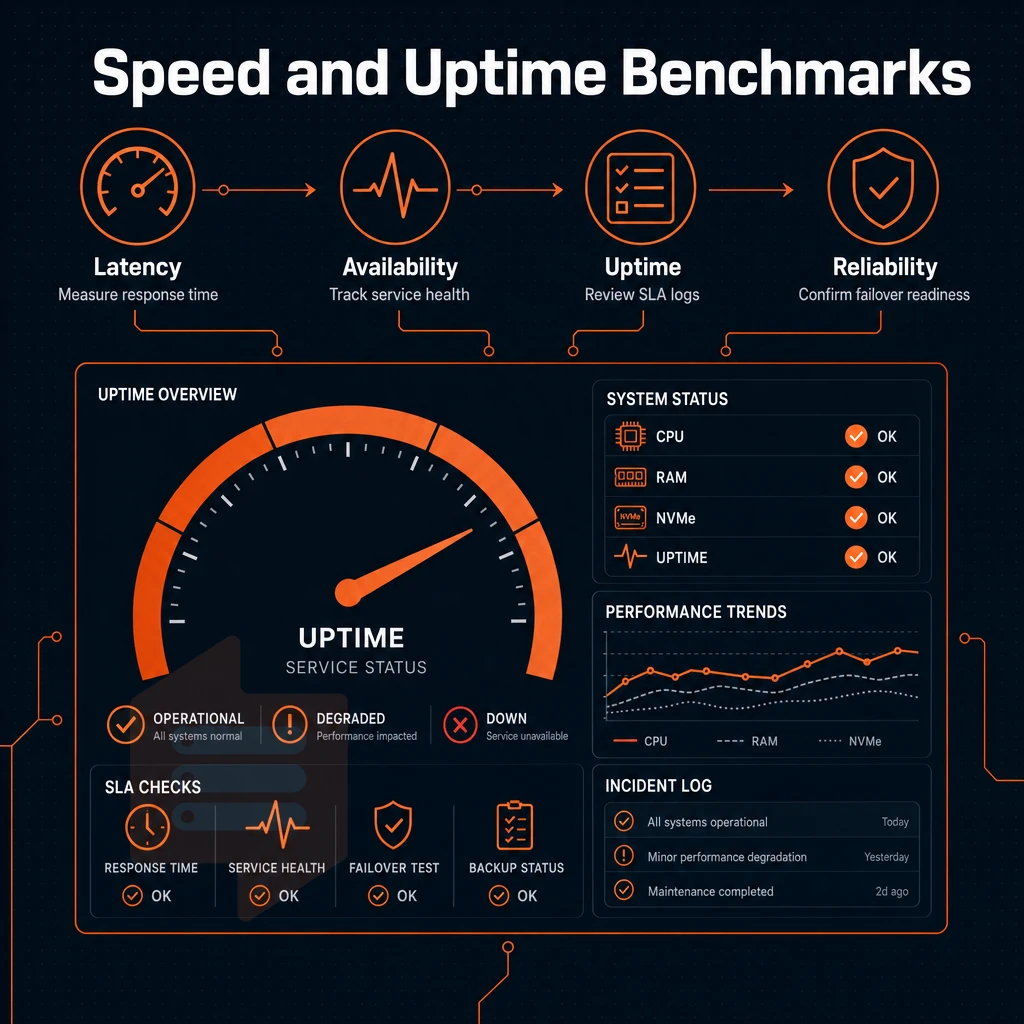
Marketing copy is easy to write, but reproducing benchmark data for Virtual Private Servers is much harder to fake. The only performance claims worth trusting are those backed by published methodology, test tools, and numbers others can independently verify.
CPU and memory benchmarks
It runs integer, floating point and memory access test cases.
A score doesn't show whether server resources are shared by dozens of users. If a server is oversold, peak scores may look fine but workloads degrade under constant load. Low node density with hard memory caps structurally fix this noisy-neighbor effect.
Disk i/o: where most providers hide the gap
Fio is commonly used to measure raw storage performance.
Cloud VPS hosting providers typically list the drives offered as ‘NVMe’ but don’t list IOPS numbers. Thus, a seemingly adequate NVMe SSD can actually deliver only 20,000-30,000 IOPS when used by multiple tenants (i.e. shared) and thus limited by the shared storage infrastructure and interconnects. Even if the SSDs are directly connected to the PCs via PCIe.
Database and network throughput
pgbench measures the real database load (i.e. transactions per second) and is a practical test for applications that have latency requirements for most queries, rather than burst requirements.
The network throughput also matters a lot. By having all plans with dual-stack IPv4 and IPv6 and with a dedicated IP for every server, there is no shared NAT overhead. For Cloud Servers, multi-homed uplinks allow to take advantage of the improved throughput by reducing single-path congestion. Lastly, the 99.8% uptime SLA is the contractual floor, while the real signal to monitor for consistency over time is the benchmark.
| Benchmark | Tool | What it measures | BuyVPS result |
|---|---|---|---|
| CPU performance | Geekbench 6 | Single- and multi-core compute | Published per tier |
| 4K random read IOPS | fio | Storage latency under real load | 122,959 IOPS (median) |
| Database throughput | pgbench | Transactions per second (PostgreSQL) | Published per tier |
| Network stack | Dual-stack + multi-homed | IPv4/IPv6 throughput, path redundancy | 99.8% uptime SLA |
To give you a decent basis for your decision, we have a simple decision rule: If a provider does not publish the methodology for his benchmark, the numbers will not hold under load. Therefore the best VPS for your production workloads is the one that can prove its numbers in writing, and not only in sales talk. Cloud hosting and global data centers mean nothing without the data to back it up.
Server locations: amsterdam and new york coverage for EU and US workloads
Latency is greatly affected by where your VPS is hosted. BuyVPS offers two data centers: Amsterdam for European locations and New York for the US East Coast.
Picking the right region
- Host your users who are geographically located close to you. As a hoster in Amsterdam you can serve your EU audience with very low round-trip times from all locations in Western and Central Europe. From New York your US East Coast users as well as all other audiences from the transatlantic region will get served with low round-trip times. Since there’s no premium to be paid for hosting in the other continental region, a hosting company that’s serving audiences on both continents can simply host one VPS per region. This hosting is identical in all aspects, including the control plane, to the hosting offered by BuyVPS. It also has identical pricing to the VPS hosting offered by BuyVPS.
- Don’t put different workloads on the same server when there’s a lot of latency difference. If you have roughly equal numbers of EU and US users, run them on separate instances rather than trying to serve both from the one region. Treating each VPS deployment as independent, with its own IP stack and configuration, is good practice.
Network and security setup
- Utilize multi-homed uplinks for both locations. In the event of an upstream failure, your VPS will remain online. This is one of the features which offer BuyVPS’s providers a significant advantage over single-homed servers.
- Edge filtering is enabled on the network boundary. As BuyVPS is applying abuse-policy-based edge filtering at both sites, there is no need to set this up manually. It is configured on a network level prior to any traffic reaching your server settings / application layer.
Note: If you need managed hosting or prefer to delegate server administration entirely, confirm that your chosen plan includes that support tier before deploying.
Verifying your choice
- Conduct a latency test prior to provisioning. Ping from within the desired Region for both Amsterdam and New York locations. Amsterdam should return latency below 20ms for Western European locations, while New York should return latency below 10ms for US East Coast locations.
- Verify that the server has dual-stack networking enabled (i.e. that both IPv4 and IPv6 addresses are available for connection). All of the BuyVPS plans come with both enabled, so you can verify that both addresses are reachable from the target geography before bringing the server online to production.
Common web hosting use cases for VPS in 2026
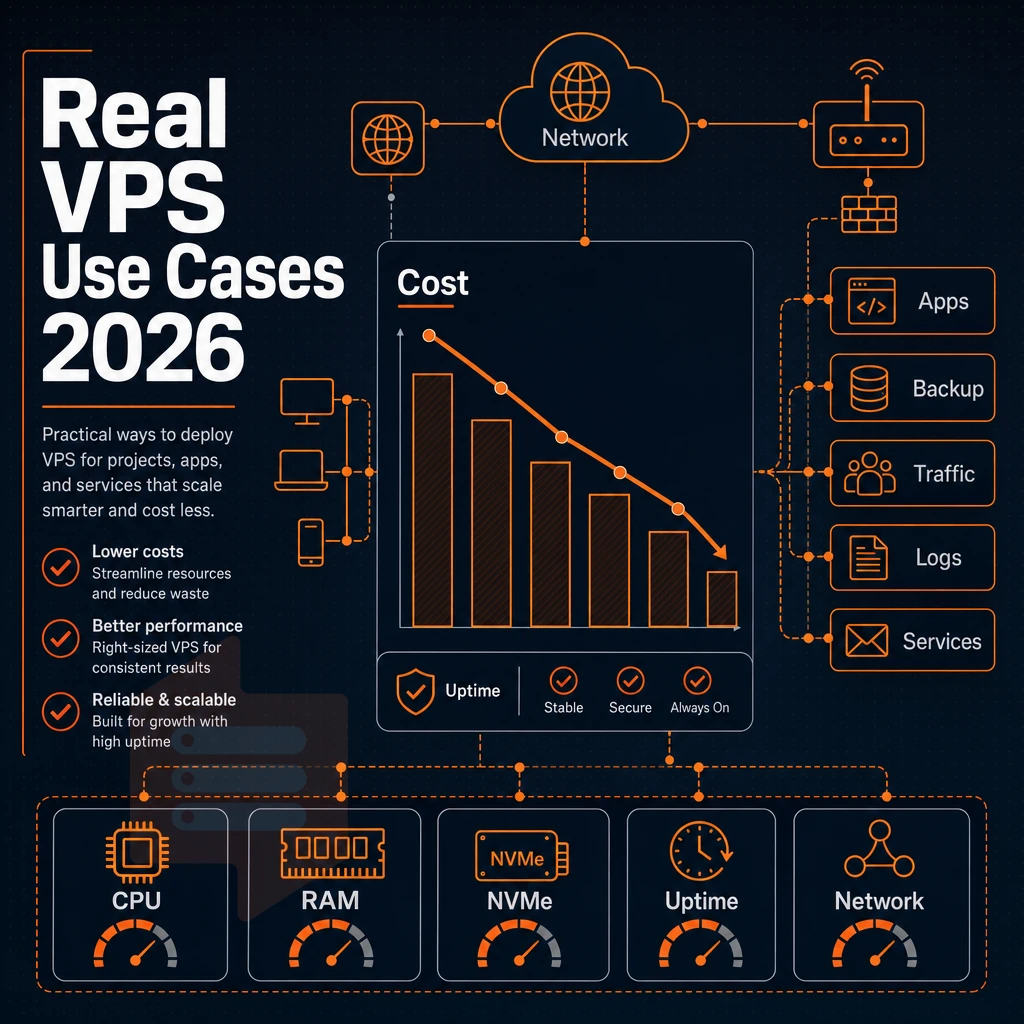
To place your VPS hosting workloads in the correct tiers from the start, recognize which real-world scenarios belong in which tier.
Web hosting for applications, apis, and ecommerce sites
For running a web server for a API written in Node.js or a PHP-based ecommerce platform (with a large amount of products) consistent CPU and fast storage is needed. Standard CPU VPS plans are usually fine for medium traffic. High-traffic storefronts with a large number of products are usually better off choosing dedicated-core plans from a reputable hosting provider that also offers reliable customer support, as they allow for pinned vCPUs, thereby eliminating the noisy-neighbor effect, especially during spikes in checkouts.
Many database-backed ecommerce sites are memory-hungry, and a high-memory VPS, something the better VPS providers actively recommend, keeps the working set in RAM, reducing disk reads and query latency under load.
Host multiple websites on a single VPS hosting plan
Many agencies and freelancers run multiple websites off the same plan using Nginx virtual hosts or Apache name-based hosting. Standard CPU VPSes with NVMe storage handle multiple websites efficiently, and isolating each site in its own directory with its own PHP-FPM pool ensures a traffic spike on one site won't affect the others.
Game servers and development environments
For services that host Minecraft servers, host FiveM servers, or host Palworld servers, they all typically need to run in low-latency single-threaded mode. Dedicated-core VPS plans that have pinned cores are typically the best fit. This ensures that even when the host node is very busy, the single thread will still get the high tick rate that is typically needed for such services.
You would typically use a standard cloud VPS hosting plan with unlimited bandwidth for development/staging environments, as they are easily spun up and down for a test of a new deployment, and then removed when no longer required. Root access and KVM isolation mean it is easy to manage and clean up after use.
DNS, VPN, and proxy server management setups
So a simple CPU VPS in Amsterdam and New York is good enough.
The best VPS hosting services for light latency-sensitive workloads focus on network quality over raw CPU power. The best VPS services offer multi-homed uplinks and dual-stack addressing on all VPS servers, a basic service offering that web hosting providers should offer by 2026.
KVM hosts run with a separate kernel for each VPS, NVMe storage in RAID10, and all hosted on IPv4 and IPv6 dual-stack networks in Amsterdam and New York. We can host all sorts of services, from game servers to production APIs.
How to choose the best VPS hosting provider for your needs

Finding the right VPS for your workload requires more than matching up a headline with a provider’s architecture. Go through these 7 check points before you sign up. For community perspectives, see Current best VPS hosting.
How to choose VPS hosting: assess workload and management style
Start by identifying your application's resource requirements and selecting a plan that allows for growth. A CPU-bound application like CI/CD runners, game servers, or real-time APIs needs pinned cores and fixed latencies, whereas a memory-intensive database, as any engineer among reputable VPS providers who has handled customer support tickets over uptime guarantees will confirm, requires high RAM. Map your expected peak load first, then find the closest plan.
Managed VPS plans are for management level, i.e. the OS is patched for security with corresponding updates, and the monitoring is enabled. Unmanaged VPS plans, in turn, are provided on an unmanaged basis and grant root access to the root user. Since there’s minimal overhead, most developers and engineering teams prefer to go with the unmanaged VPS plans in order to have complete control over the server.
Pricing transparency and upgrade paths
Many VPS providers charge introductory rates that double or triple at renewal, so always check published renewal pricing. Some providers, like BuyVPS, keep pricing transparent with no hidden fees.
Just as important are the upgrade paths. In-place upgrades, without migration and without IP rotation, allow for growth without downtime and changes to DNS. These need to be tested before a contract for hosting solutions is finalized.
Virtualization, storage, and support quality
KVM with per-VPS kernel isolation is standard. Noisy-neighbor risk with shared kernels. NVMe RAID10 with direct PCIe connection is the benchmark for storage. Most providers bundle spinning disk into “SSD” plans and don’t specify interface. So, you need to avoid those.
Check if support engineers or first-tier chatbots respond to tickets for an unmanaged VPS. While many VPS hosts offer 24/7 support, some are better than others. You can check for provider offerings for day money back guarantee to “test drive” an self-managed VPS offer. Note, however, that terms and conditions will apply so check before you buy.
Last but not least, confirm that your managed VPS or unmanaged server plan comes with a proper SLA. A 99.8% uptime SLA actually backed by real infrastructure is worth a lot more than an uncapped SLA that isn’t enforced.
Why choose BuyVPS for your VPS hosting needs
Among the best VPS hosts, BuyVPS stands out because every claim is backed by published benchmarks, not marketing copy. We operate KVM-isolated virtual private server hosting on AMD EPYC hardware across two data centers: Amsterdam and New York. Every VPS runs on a separate kernel. That is real isolation, not a shared hosting environment rebranded as VPS hosting.
- No-oversell architecture. Hard memory caps per node and low node density mean your dedicated resources stay yours, unlike shared hosting, where multiple websites share the same server pool.
- Dedicated CPU tier. Pinned EPYC Genoa cores deliver predictable latency for workloads that cannot tolerate noisy neighbors.
- Proven NVMe RAID10 storage. PCIe-direct SSD storage benchmarked at 122,959 4K read IOPS (fio median). The number is reproducible.
- Full root access on every VPS plan. Custom ISO upload, your choice of operating systems, complete server environment control, managed or DIY VPS, your call.
- In-place upgrades. Scale your VPS hosting plan without IP rotation or migration. The advertised price is the full price.
- Engineer-led customer support. Founder-run since 2002. Real engineers reply, no first-tier chatbots.
If you are evaluating the top VPS hosting providers for your workload, compare our VPS plans or reach out to our team to discuss which hosting solution fits your requirements.
Top questions about VPS hosting answered
VPS hosting FAQs For Buyers: Frequently Asked Questions About VPS Hosting. Learn when to upgrade your hosting plan and find leading VPS hosting services for your needs.
What do VPS hosting providers typically offer?
Most VPS hosting providers give you a dedicated slice of a physical server with guaranteed RAM, CPU and storage. VPS hosting typically gives you full root access and lets you choose from a variety of Linux distributions, running in an isolated environment on a hypervisor such as KVM.
Good VPS hosting would add support for IPv4 and IPv6 dual-stack networking, NVMe storage and a self-service control panel with API access. All plans at BuyVPS include these features. Hardware is provided by AMD EPYC processors, storage is made of NVMe RAID10 on all locations, Amsterdam as well as New York.
How do you identify the best VPS hosting provider?
- Check hardware transparency. The premier VPS hosting providers reveal details about the hardware in their VPS servers such as CPU generation, the type of RAM installed, storage information, published benchmarks (e.g. Geekbench, fio).
- Check for no-oversell and hard memory caps per node (headline numbers can be misleading). Low node density and constant performance under load is key.
- SLA and support quality. The minimum for serious VPS work is a 99.8% uptime SLA, delivered by human engineers, not by chatbot software.
Avoid any hosting company that won't disclose CPU generation or node density. Vague specs almost always mean oversold hardware.
When is a virtual private server the right upgrade from shared web hosting?
Shared web hosting, such as a shared server hosting environment, pools resources across many accounts. Eventually, as traffic increases, a “noisy neighbor” can cause response time to deteriorate. With VPS hosting, you are provided with guaranteed resources (such as CPU, memory) when the ceiling of a Shared Hosting environment becomes a problem.
Virtual private server hosting, or VPS hosting, suits developers and web professionals needing root access, custom software stacks, and consistent performance for databases and APIs. VPS hosting services also fit teams running staging sites or multiple websites that have outgrown shared hosting and need a dedicated server or the closest alternative, virtual private server hosting removes the shared-resource bottleneck entirely.
The key advantages of choosing the right VPS host
The best VPS hosting companies share a few core features: dedicated resources that distinguish them from shared hosting, KVM virtualization with a separate kernel per VPS, responsive customer support, and NVMe RAID10 storage with published benchmarks. Top-tier providers also offer full root access, dual-stack networking, and a user-friendly control panel.
Transparent pricing and in-place upgrades without IP rotation protect your budget and your infrastructure. BuyVPS offers the highest-rated VPS hosting provider, located in Amsterdam and New York, on top of AMD EPYC hardware, hard memory caps, and engineer-led support. When your workload has outgrown shared hosting, the right decision for virtual private server hosting, is based on the above provable specs.
Finding the best VPS hosting plan for your workload
When choosing a VPS hosting plan, match it to your website's load. Most web applications run fine on a standard tier of VPS hosting. Latency-sensitive applications benefit from a dedicated core, while data-heavy processing workloads need more memory, which many VPS hosting providers can accommodate.
Once you have determined the tier of VPS hosting that you require, choose a location in a region close to your users. For users based in the EU, Amsterdam is a good location. For users in the US, New York is the preferred location. Next, check out the SSD storage provided, the network uptime and most importantly, find out whether the VPS hosting provider provides engineer-level support or just a bunch of scripted responses.
The top-performing VPS isn't the cheapest option on the list, it's the one whose hosting solutions align with your actual requirements. For optimal VPS services backed by no-oversell hardware, pinned cores, NVMe RAID10 storage, and transparent pricing in both Amsterdam and New York, explore BuyVPS plans at buyvps.com/best-VPS/.
Frequently asked questions
Which VPS hosting services offer free cloud management features with great customer support?
The strongest options combine KVM virtualization, NVMe storage, and no-oversell policies.
Which top 10 VPS hosting services offer the best server management features?
A reliable top-ten list prioritizes performance, network quality, and support transparency over marketing claims. Key criteria when you choose VPS hosting include hypervisor type (KVM beats OpenVZ for isolation), storage technology (NVMe RAID10 outperforms SATA SSD), CPU generation, and verifiable published benchmarks. BuyVPS publishes Geekbench 6, fio, and pgbench results, a rare level of transparency. Narrow your shortlist to providers offering full root access, custom ISO uploads, and stable pricing with no renewal surcharges.
Which VPS provider is the most reliable?
Reliability comes down to three measurable factors: uptime SLA, storage redundancy, and network architecture. Providers running NVMe RAID10 with multi-homed uplinks and hard memory caps per node deliver the most consistent performance under real load.
When you choose a VPS server through BuyVPS, you get a 99.8% uptime SLA, KVM isolation with a separate kernel per instance, and low node density by design, all backed by responsive customer support, and all of which reduce the blast radius of noisy neighbors. Always verify that a provider's SLA is backed by a compensation policy, not just a marketing promise.
Which managed VPS hosting provider is good?
A good VPS provider gives you full root access, predictable performance, and support from engineers who can actually solve problems. BuyVPS fits that description: AMD EPYC processors, NVMe RAID10 storage with over 122,000 measured 4K read IOPS, and a support team of engineers rather than first-tier chatbots.
Locations in Amsterdam and New York cover the two most common deployment targets for European and US East Coast workloads . The no-renewal-hike pricing model means your budget stays predictable in year three just as it was in year one.
Managed VPS hosting vs unmanaged VPS hosting: what's the difference?
With an unmanaged virtual server, you get root access to a clean server and full responsibility for the OS, security patches, software stack, and monitoring. Managed VPS adds a layer of provider-side administration, the host handles OS updates, security hardening, and often application-level support.
Unmanaged is the right choice for developers and sysadmins who want control without paying for services they don't need. If your team lacks Linux administration depth, managed hosting reduces operational risk, though it typically costs more and limits customization.
When should i upgrade from shared hosting to VPS hosting?
Upgrade when shared hosting's resource contention starts affecting your users and server management overhead, slow page loads under traffic spikes, PHP memory limits you can't raise, or security constraints that block the software you need to run. A VPS gives you dedicated (or guaranteed-share) RAM, your own kernel, and the ability to install any package with root access.
At that point, even an entry-level VPS on KVM with NVMe storage will outperform a shared plan by a wide margin.
What should i look for in a VPS hosting plan?
Start with the hypervisor, KVM with per-VPS kernel isolation is more secure and more stable than container-based alternatives.
Confirm the provider enforces hard memory caps and low node density so a neighbor's traffic spike doesn't affect your instance.
When choosing a VPS host, you are looking for a combination of three things: the right hardware for your application, the right network, and the right price. A dedicated-core plan means that your CPU will not be sharing with noisy-neighbor applications.
However, such plans are only as good as the underlying storage. If the storage bottlenecks under real I/O load, then all is for naught.
The second takeaway is quite straightforward. Managed hosting offers control vs. convenience, while unmanaged hosting offers convenience vs. root-level flexibility. Pick what works best for your team.
BuyVPS runs KVM VPS on AMD EPYC hardware with NVMe RAID10 storage across Amsterdam and New York, no hidden fees, no overselling, no IP rotation on upgrades. If the specs in this guide match what you need, explore the plans at BuyVPS.com and pick the tier that fits.