
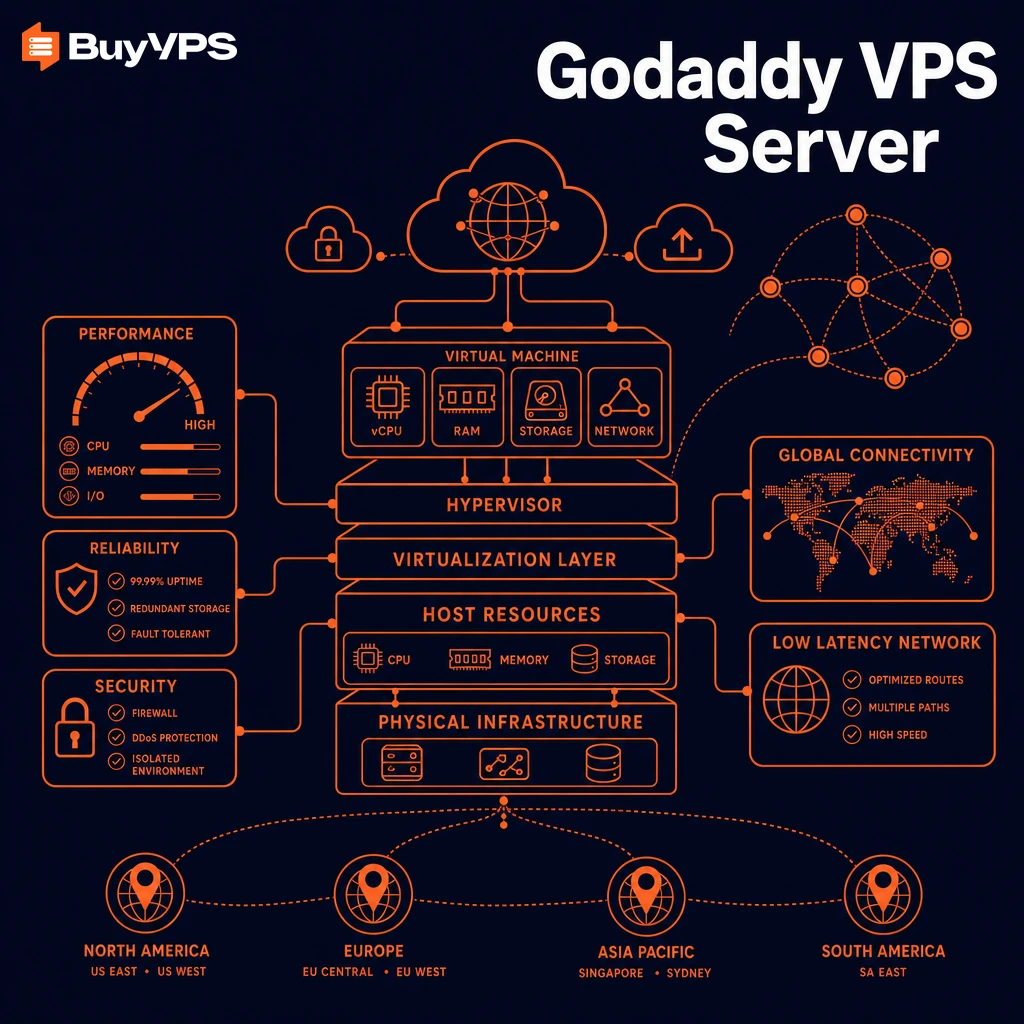
Searching for GoDaddy VPS server services is a natural starting point for many people.
While VPS hosting resides in a specific performance area (ie: dedicated resources, root access, fully isolated virtual environments).
This guide takes a hard look at what a GoDaddy VPS, including its Windows VPS offering, will deliver to the user, where the product sits in the market, and provides a comparison to other worthy alternatives. Below, we will break down the key features of the VPS server, and then examine the GoDaddy VPS server in more detail covering the technical specs of CPU, storage I/O, network and support. See GoDaddy on Wikipedia for background.
Whether you're hosting a new production site or moving an existing one to a VPS, our services can help. Related: NVMe storage.
What is a GoDaddy Windows VPS server and how does it work?
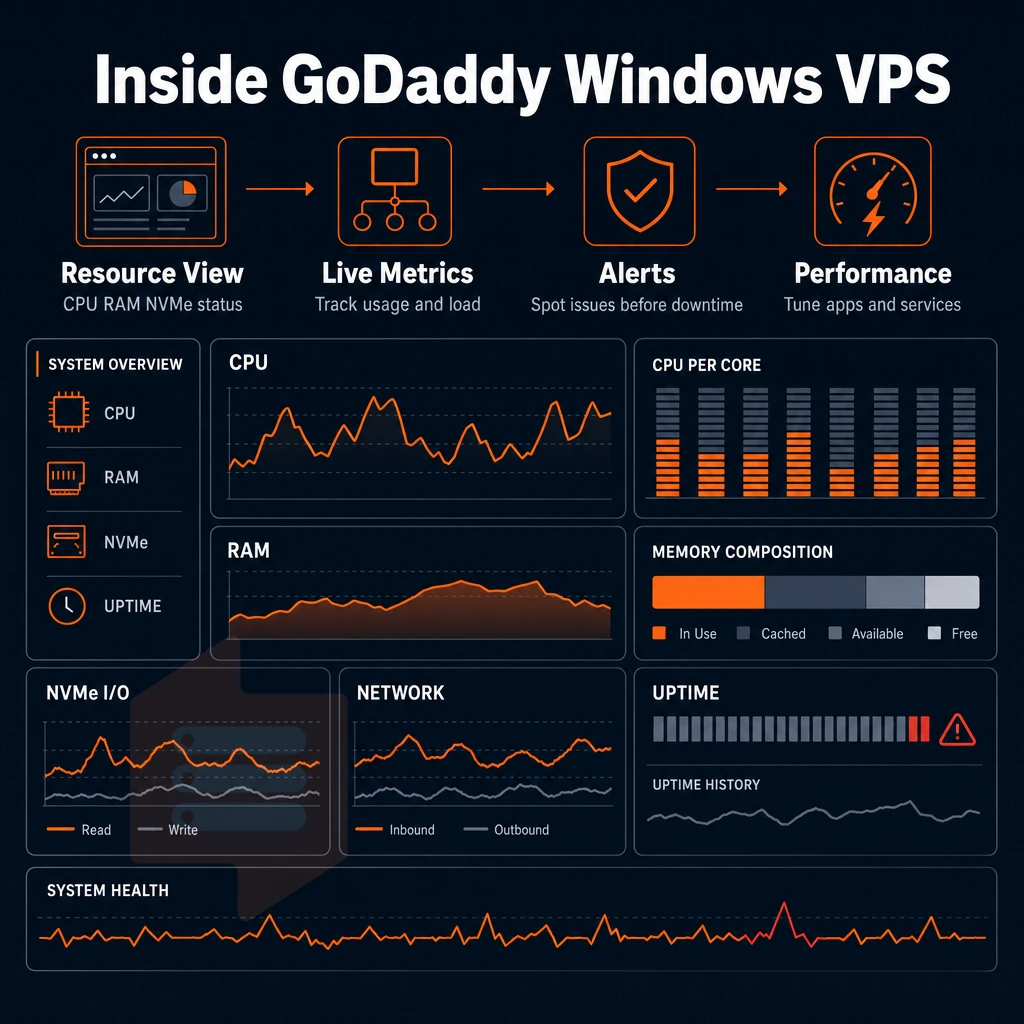
A VPS sits between shared server hosting and dedicated hardware.
Virtual private server: what isolation means for server management
KVM based hypervisors carve up physical servers to create multiple Virtual Private Servers (VPS) on one physical host.
With VPS hosting you get full superuser access.
VPS plans: managed vs. Self-managed options
Self-managed VPS servers are provided with a clean OS image and nothing else. You get to decide how you set up your server, including setting firewall rules, choosing a software stack, applying security patches, etc. Managed VPS servers on the other hand have provider administration for an additional charge. Users who opt for self-managed plans gain complete autonomy over their environment but assume full responsibility for maintenance and troubleshooting.
Developers evaluating self managed options should carefully assess their technical expertise and available time before committing to a plan that requires hands-on system administration. If you run into trouble during configuration, most hosts provide documentation or community forums, though response times vary significantly between providers. Regardless of which path you choose, implementing regular back ups protects your data from accidental deletion, failed updates, or hardware issues that could otherwise result in permanent loss.
One of the most common managed add-ons is for web hosting in general.
Where BuyVPS fits for e mail hosting
Our KVM VPS servers are powered by the high-performance AMD EPYC processor, backed by fast NVMe RAID10 storage, and available from two locations in Amsterdam and New York. Unlike many other providers that load up and oversell their nodes for maximum profit.
With the mechanics of VPS out of the way, let’s put it up against the two tiers of hosting that VPS sits between: shared web hosting and the ultimate in server solutions: bare-metal dedicated servers.
VPS hosting and how it differs from shared and dedicated servers
When looking at hosting options, there are many options in between the fully communal hosting environment and the bare-metal servers.
First month $1
Then the normal monthly price. One per customer. No setup fee, and a 30-day performance guarantee on your first order.
See the plans“Excellent experience from start to finish! The server was delivered promptly, and the service was reliable and efficient. I m very happy with the results and would definitely recommend them.”
Shared hosting vs. VPS hosting plans
Entry-level hosting shares RAM and CPU, so one noisy neighbor spikes load for everyone.
VPS plans and dedicated servers
VPS hosting plans have closed the gap to bare-metal hosting.
Virtual private server OS and management choices
Most hosts offer Linux and Windows VPS servers.
For such servers the (provider is not responsible for patching and monitoring. BuyVPS for example offers un managed KVM VPS servers with full admin access.
| Tier | Resource isolation | Root access |
|---|---|---|
| Shared | None | No |
| VPS | Full (RAM, CPU, NVMe) | Yes |
| Bare-metal | Full (physical) | Yes |
VPS is best for isolation and scalability without the overhead of bare metal, and often includes ddos protection, while bare metal is best when single-tenant hardware is a requirement. Now that we have defined the tiers, you can see what to expect from GoDaddy's VPS server: whether it lives up to the promises of its tier, and where it falls short.
Why choose BuyVPS for your VPS server needs
BuyVPS runs KVM VPS hosting on AMD EPYC hardware across two data centers, Amsterdam and New York, with identical specs and pricing at both sites. Every VPS plan ships with full system access, IPv4+IPv6 dual-stack, and NVMe RAID10 storage with published benchmark results (Geekbench 6, fio, pgbench) so performance is provable, not promised.
- No-oversell guarantee: Hard memory caps and low node density mean your VPS servers get the RAM and CPU they're allocated, always.
- Three tiers, one platform: Standard CPU (S-tier), Dedicated CPU (D-tier) with pinned cores for predictable latency, and High Memory (H-tier) for RAM-heavy workloads.
- In-place upgrades: Scale your VPS hosting plans without migration or IP rotation, your network identity stays intact.
- Transparent pricing: The advertised price is the full price. Reliable budgeting for any business owner.
- Engineer-led support: Real engineers reply, not chatbots, backed by a founder-run operation running since 2002.
Developers and teams evaluating self-managed options can compare BuyVPS plans in detail or reach our team at info@buyvps.com to discuss which tier fits your workload. Still have questions about GoDaddy VPS specifically? The FAQ below covers the most common ones. You can also reach the team by phone during business hours for immediate assistance with technical questions or account setup.
Frequently asked questions
Is GoDaddy the best VPS with full root access, backups and a free SSL certificate?
Yes, GoDaddy offers VPS hosting plans alongside its domain and standard web hosting products. However, VPS hosting specialists, providers focused exclusively on virtual private servers, typically deliver more consistent performance, better hardware, and more transparent infrastructure than generalist registrars, giving the user a noticeably more reliable experience. If raw VPS performance and reliability are your priority, a dedicated VPS provider is the stronger choice. While most providers advertise uptime guarantees, the underlying infrastructure quality and network peering arrangements ultimately determine whether those promises hold under real-world traffic conditions. When performance metrics are compared side-by-side across multiple hosting tiers, specialists consistently outperform generalist platforms in benchmarks for disk throughput, network latency, and CPU steal time.
What is the best Windows VPS server with reliable backups
The best VPS depends on your workload, but the key criteria are CPU architecture, storage type, network quality, and the provider's oversell policy. For compute-heavy or latency-sensitive workloads, look for dedicated (pinned) vCPUs, NVMe RAID storage, and hard memory caps per node, features often absent from other plans. BuyVPS offers exactly that: AMD EPYC-powered Standard and Dedicated CPU tiers, NVMe RAID10 storage with measured 122,959 4K read IOPS, and a strict no-oversell policy, available from Amsterdam and New York.
How to complete a VPS server setup on GoDaddy
After purchasing a GoDaddy VPS plan, the user can access it through van je control panel, select an operating system image, and connect via SSH once the instance provisions. From there, you update packages, configure a firewall, and deploy your application stack as you would on any Linux VPS. Many administrators choose ubuntu as their distribution because of its extensive package repositories and long-term support releases that simplify maintenance.
If you prefer a more developer-friendly workflow, providers like BuyVPS offer a self-service panel with API access, in-browser VNC console, and support for custom ISO uploads, giving you full unrestricted server access and tighter control from the first boot. Many developers also appreciate the ability to snapshot environments before major deployments, ensuring rollback options remain available without manual backup overhead.
How much do VPS plans cost per month?
VPS pricing varies widely based on vCPU count, RAM, storage, and whether cores are shared or dedicated. BuyVPS publishes transparent pricing for its Standard CPU, Dedicated CPU, and High Memory tiers, with no setup fee, no surprise fees and no hidden charges for backups. Customers pay a predictable monthly rate without worrying about sudden price increases after promotional periods expire. Before committing to any plan, use online tools to calculate your expected monthly traffic and resource consumption, ensuring the tier you select aligns with your application's actual demands. When plans are compared side by side, transparent pricing models reveal the true long-term value beyond introductory discounts. Evaluating the total cost of ownership means looking beyond the advertised monthly price to include bandwidth overages, control panel licenses, and backup storage fees that some hosts add separately.
A VPS server provides you with dedicated resources such as RAM, processor and disk space. full shell access and is isolated from other 'neighbors' on the linux server that may cause the user problems i.e. they are on a shared infrastructure hosting account.
The key factor with a VPS is the underlying hardware and the price at initial sign up and then at renewal. I.e. is it a commodity VPS that you can build on or is it just some servers churning out VPS’s in a datacenter. Before committing to any plan, calculate your monthly resource requirements against the provider's pricing tiers to ensure the cost remains sustainable as your workload scales.
BuyVPS runs KVM-isolated VPS instances op de AMD EPYC hardware across Amsterdam and New York, with clearly defined vCPU RAM allocations and hard memory caps per node, NVMe RAID10 storage, and no hidden fees. Engineer-led support handles issues directly, without first-tier scripted responses. If predictable performance and transparent terms matter to your deployment, explore the BuyVPS plans and pick the tier that matches your workload.