
For years CentOS VPS hosting has been the go-to choice for production Linux environments. Recently, with the transition from CentOS 8 to successors like AlmaLinux, Rocky Linux and CentOS Stream, many teams hosting websites and other long-running workloads have had to reevaluate their choices around robust security features. Importantly, choosing the right VPS hosting platform now is more important than choosing the distro.
Rather than providing a list of abstract questions about server resources that drive the evaluation of various Hypervisors as a hosting solution, here are the actual questions one might ask to determine whether a given Hypervisor provides adequate isolation.
In addition to these questions, one would also inquire as to whether a given provider of VPS hosting to run CentOS on might be overselling RAM and CPU in particular. Questions? Email support@buyvps.com.
Ultimately, the only way to really answer these questions is to read on to find out what to look for in a VPS hosting for CentOS. Specifically, this guide covers distributions that are supported by VPS hosting services , hardware architecture, network and more.
For examples of how various CentOS compatible distributions behave when used for high performance VPS hosting, the services supported by BuyVPS (Amsterdam and New York based) are examined in particular. Specifically, AlmaLinux, Rocky Linux and CentOS Stream are all supported distributions here. And so, by way of introduction, here is what CentOS VPS hosting actually is. These distributions emerged as community-driven alternatives that are actively supported through regular security updates and long-term maintenance commitments. Organizations that choose CentOS benefit from binary compatibility with RHEL while avoiding licensing fees, making these distributions ideal for cost-sensitive production environments.
The binary compatibility that makes CentOS distributions attractive for enterprise workloads means migration from RHEL works without application refactoring or dependency conflicts. The open source nature of these distributions allows organizations to audit code, contribute patches, and maintain full transparency over their infrastructure stack. This combination of stability, compatibility, and zero licensing costs has made CentOS-based distributions the preferred choice for developers and enterprises deploying scalable web applications and microservices architectures.
What is CentOS VPS hosting?
Our CentOS VPS hosting combines a popular Linux distribution for enterprise computing, with the power of Virtual Private Servers, giving you a fully isolated server with root access, all based on Red Hat Enterprise Linux.
First month $1
Then the normal monthly price. One per customer. No setup fee, and a 30-day performance guarantee on your first order.
See the plans“BuyVPS offers simple and reliable VPS hosting solutions for different online needs.”
What the CentOS stream operating system is
The CentOS Operating System (Community Enterprise Operating System) is a free, open-source Linux distribution, rebuilt from the RHEL source code. Like RHEL, it is a stable operating system that has long support cycles and is binary compatible, which makes it very suitable for production workloads, that require predictability.
Why sysadmins chose CentOS hosting for their servers
We had a number of Enterprise customers host on CentOS. However, because the ecosystem of packages stored on NVMe SSD storage, etc for RHEL corresponded exactly to their existing RHEL tooling: RPMs, SELinux policies. Etc, to run the same software stack on a CentOS server (zero OS cost) as on a paid RHEL server.
CentOS VPS server use cases
A CentOS VPS server suits workloads like web application stacks, database backends, and CI/CD pipelines. VPS hosting on CentOS gives developers full root access, clean package management via dnf/yum, and a community of millions for troubleshooting. At BuyVPS, our KVM-based VPS hosting supports CentOS Stream alongside other enterprise Linux options, same hardware, same network, in Amsterdam and New York. Understanding why that matters requires a look at how the CentOS project itself changed.
What is replacing CentOS? Rocky Linux and hat enterprise Linux rhel alternatives
CentOS Linux, now a rolling release distribution, has left many a user searching for a stable enough RHEL alternative. Currently, three distributions lead the pack: Rocky Linux, AlmaLinux and CentOS Stream.
Primary successors to hat enterprise Linux rhel
- Rocky Linux is a community developed Linux distribution designed to be a 1:1 binary compatible rebuild of Red Hat Enterprise Linux (RHEL). This distribution includes all of the enterprise focused features that CentOS users have come to rely on. This includes SELinux, long term support, and scheduled releases.
- AlmaLinux is another open source platform that offers full RHEL compatibility, with strong community support behind it, targeting the same community enterprise operating system use case and includes additional security tooling in every release.
- CentOS Stream is distributed just upstream of RHEL. Thus it is intended for the use of developers and for test or “staging” environments. It is not intended for production use where the highest level of security and stability is required.
High performance server deployment on BuyVPS
All plans are offered from Amsterdam, New York, and you can choose any of the three distributions for your KVM VPS.
Note: CentOS Stream receives upstream patches before RHEL.
I have described how to install the main distributions through the three main paths.
How to install CentOS (or a compatible OS) on a VPS
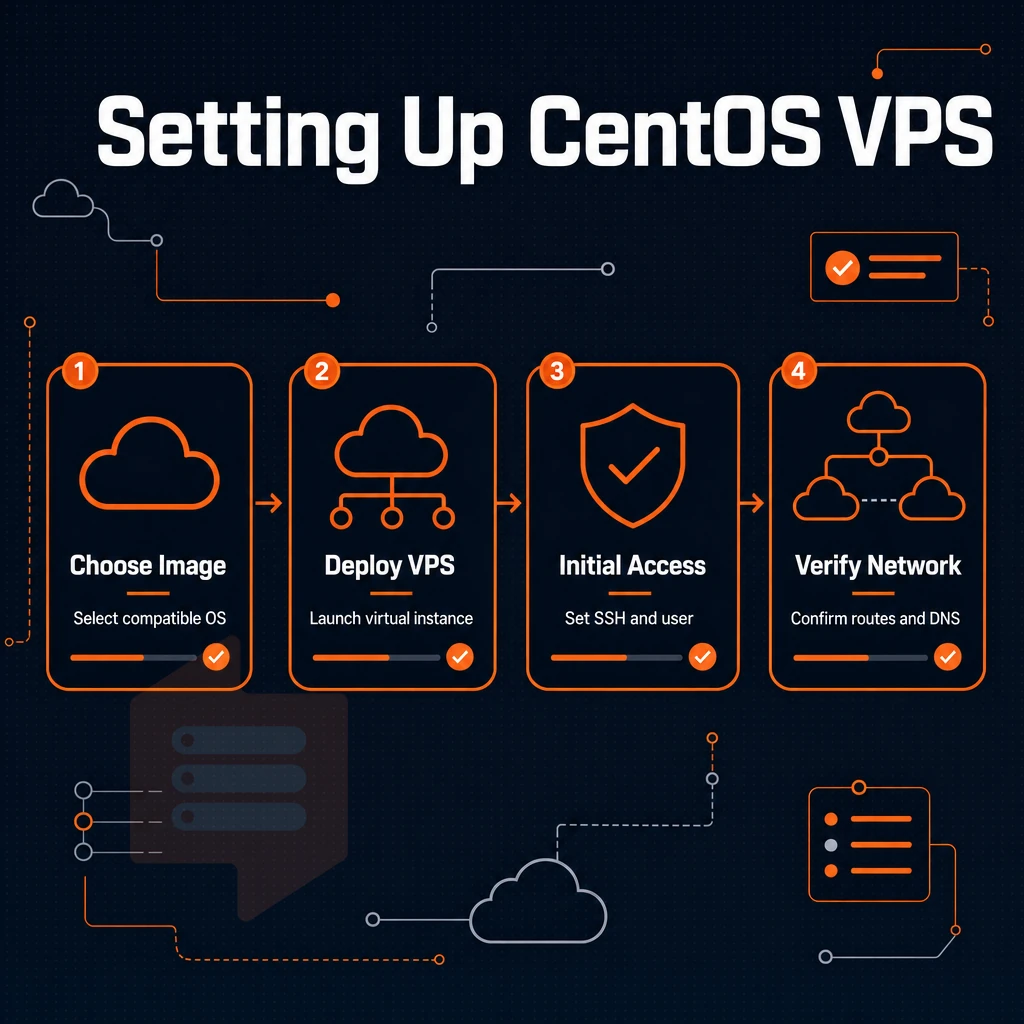
How to get a RHEL-compatible distribution up and running on a virtual private server VPS. Most platforms for self-service on VPS enable you to set up a RHEL-compatible distribution easily. Here are three ways to reinstall your favorite distribution on VPS.
Install CentOS or a compatible OS at provisioning
When you order a VPS, you can select from a list of distributions. We support AlmaLinux, Rocky Linux and CentOS Stream. All of these distributions are based on RHEL and your new VPS will boot from the selected distribution with root access granted within a few minutes.
Virtual private server control panel reinstall and configuration
A user friendly control panel allows you to reinstall the OS of your server with a single click in the control panel, without having to open a support ticket. The control panel of BuyVPS handles server configuration changes (including OS swaps) in-place, so your IP address does not rotate. This streamlined approach reduces downtime and simplifies server management by allowing users to switch between distributions without manual intervention or complex workflows.
The user friendly interface ensures that even administrators new to VPS environments can perform critical operations confidently without requiring extensive training or documentation. The platform supports various control panels that integrate directly with the underlying infrastructure, giving administrators flexibility in how they interact with their server environment. Many administrators prefer cpanel for its intuitive dashboard that consolidates DNS management, email configuration, and file operations into a single interface.

Custom ISO for advanced server management
To support customers who need a flexible hosting solution and want to upload custom ISOs (for example specific kernel builds, minimal operating system images), the custom ISO can be uploaded directly through the customer panel. Once the custom ISO has been uploaded, the customer can use the in-browser VNC console to step through the installer. For users who prefer graphical interfaces over command-line workflows, many providers also support cpanel integration, which simplifies domain management, email configuration, and database administration through a web-based dashboard.
Once the customer has completed the installation of the Operating System, the focus will return to day-to-day management of the server.
Managing your CentOS server: control panel and root access
Managing a CentOS server on a day to day basis can require quite a bit of fine-grained control over your server environment. On a community driven linux distribution powering a virtual private server VPS, installing packages, configuring services and deploying web applications are but a few examples of things that can require change on a regular basis.
Every BuyVPS plan includes full superuser access and a self-service control panel with API access, so you never wait on tickets to change your server.
What root access unlocks
With administrative superuser access, you control everything: package installation via dnf, firewall rules, kernel parameters, and service configuration.
Control panel and API for a well regarded Linux distribution
Via API you can automate provisioning and integrate the server management of Scalecube into your own tooling.
IP addresses and dedicated IP support team
Dedicated IPs for SSL certificates and mail server reputation can be ordered at a dedicated server level.
Why choose BuyVPS for centos-compatible VPS hosting
BuyVPS runs CentOS Stream, Rocky Linux, and AlmaLinux on KVM virtual private servers with a separate kernel per VPS, clean RHEL-compatible isolation out of the box. Every plan includes full root-level access and custom ISO upload, so your CentOS VPS hosting environment stays exactly as you configure it.
- NVMe RAID10 storage, 122,959 4K read IOPS measured; no shared spindles slowing your centos server down.
- No-oversell policy, hard memory caps and low node density mean dedicated resources stay dedicated.
- Pinned cores (Dedicated CPU tier), predictable latency for enterprise workloads on RHEL-based stacks.
- In-place upgrades, scale resources without IP rotation or migration downtime.
- Amsterdam and New York, identical hardware, same pricing in both regions.
No hidden fees.
Frequently asked questions
Why is a hosting provider discontinuing CentOS on their virtual server plans?
Red Hat shifted CentOS from a stable, downstream rebuild of Red Hat Enterprise Linux to CentOS Stream, a rolling-release distribution that sits upstream of RHEL. This change means CentOS Stream tracks ahead of RHEL rather than mirroring it, making it unsuitable as a drop-in RHEL replacement for production servers.
CentOS Linux 7 reached end-of-life in June 2024, ending security updates entirely. The decision was driven by Red Hat's interest in using CentOS Stream as a development and testing ground for future RHEL releases.
What CentOS versions are being replaced and by what
The two most widely adopted replacements are AlmaLinux and Rocky Linux, both are free, community-driven, binary-compatible rebuilds of RHEL. Rocky Linux was founded by one of the original CentOS co-founders and follows a similar governance model. Both distributions receive regular security updates and are designed as direct migration targets for CentOS 7 and CentOS 8 workloads.
Which OS is best for VPS?
For most workloads, Ubuntu LTS or Debian are the best choices, they have the largest community support base, frequent security patches, and broad software compatibility. For teams migrating from CentOS or running RHEL-compatible software stacks, AlmaLinux or Rocky Linux are the strongest alternatives.
The right choice depends on your stack: PHP and Python projects tend to favor Ubuntu or Debian, while enterprise applications tied to RPM ecosystems fit AlmaLinux or Rocky Linux best.
Which VPS web hosting provider is the best for Linux?
BuyVPS is a strong choice for Linux VPS hosting, supporting Ubuntu, Debian, AlmaLinux, Rocky Linux, CentOS Stream, Fedora, and custom ISO uploads on every plan. All plans include full administrative access, KVM virtualization with a separate kernel per VPS, and NVMe RAID10 storage, giving you a clean, unshared environment for any Linux workload.
The no-oversell policy with dedicated resources and hard memory caps per node means your Linux server performs consistently under real load, not just at idle.
The end of life of CentOS caused a change in the landscape, but the ecosystem has moved on. The RHEL-compatible distributions, such as Rocky Linux, offer the same stability and package compatibility as CentOS and thus are good alternatives for production servers. Also, the transition to these well regarded CentOS hosting alternatives is manageable because the tooling, commands and even the administrative patterns are similar.
Without them, you’re working around your infrastructure rather than with it.
BuyVPS runs KVM with a separate kernel per VPS and full superuser privileges on every plan. Both Amsterdam and New York nodes support AlmaLinux, Rocky Linux, and CentOS Stream out of the box, with custom ISO upload available if you have specific requirements. Browse the plans at BuyVPS.com and deploy a compatible OS in minutes.