
VPS cost catches most teams off guard not because the base rate is surprising, but because the total cost rarely matches the headline number.
When evaluating the cost of a provider for your applications there are six basic variables that set your baseline cost.
We will go into detail on what each variable means, how providers stack up on each variable including technical support and operating system compatibility, and what are the workloads that you should be paying closest attention to with each variable. Compare our VPS plans.
What drives VPS cost: the key pricing factors
There are six core variables that go into pricing for virtual private server (VPS) hosting. By understanding each of these variables, from RAM and CPU to gb SSD storage, you and your hosting providers can configure your virtual server with the right amount of resources to fit the needs of your workloads and avoid paying for unnecessary capacity that you will never use. See Virtual private server on Wikipedia for background.
First month $1
Then the normal monthly price. One per customer. No setup fee, and a 30-day performance guarantee on your first order.
See the plans“Great experience with BuyVPN! The service is easy to use, the connection has been smooth and reliable, and the overall experience has been really good. The pricing is also reasonable…”
What shapes your VPS hosting plan cost and operating system
Virtual Servers are not Shared Hosting.
- vCPU count and type: Shared vCPUs are cheaper; pinned dedicated cores cost more but eliminate noisy-neighbor latency.
- GB RAM: Memory is often the steepest per-unit cost. High-memory server configurations, such as 64 GB RAM or above, carry a significant premium.
- GB SSD / NVMe storage: NVMe on PCIe direct outperforms SATA SSD and is priced accordingly. Add-ons like offsite backup storage push the total higher.
- Bandwidth and traffic policy: Metered transfer caps or overage fees can dwarf the base plan cost on traffic-heavy workloads.
How contract length and data centers location shift the number
The longer the commitment, the lower your monthly rate will be. Questions? Email support@buyvps.com.
We have two data centers, one in Amsterdam and one in New York.
Choosing between a virtual private server and dedicated server tier
For web apps and general development environments, most hosting providers offer shared-vCPU environments across their supported operating systems that are generally fine, but for databases and very latency sensitive APIs pinned to dedicated cores is usually better.
Also for ram hungry cloud servers, good physical server management means hosting providers should ensure you have allocated GB of ram equal to your servers peak working set (not average) to avoid unwanted swap in's which dramatically increase servers execution time. Properly allocating server resources based on workload profiles prevents bottlenecks and ensures your application scales efficiently as traffic grows.
Once you have established the basic resource requirements for your application(s), the next question from a server administration standpoint is whether a VPS is required at all, or if shared hosting will suffice. Shared hosting typically restricts your choice of operating system and server-level configurations, whereas a VPS grants full control over the environment.
Shared hosting plans bundle multiple websites onto a single server with minimal customization, making them suitable for low-traffic sites but limiting scalability for growing applications. VPS environments provide isolated resources and root access, which, unlike shared hosting, allow administrators to install custom software and configure security policies tailored to specific application requirements.
Cheap VPS hosting provider options: what you get at each price tier
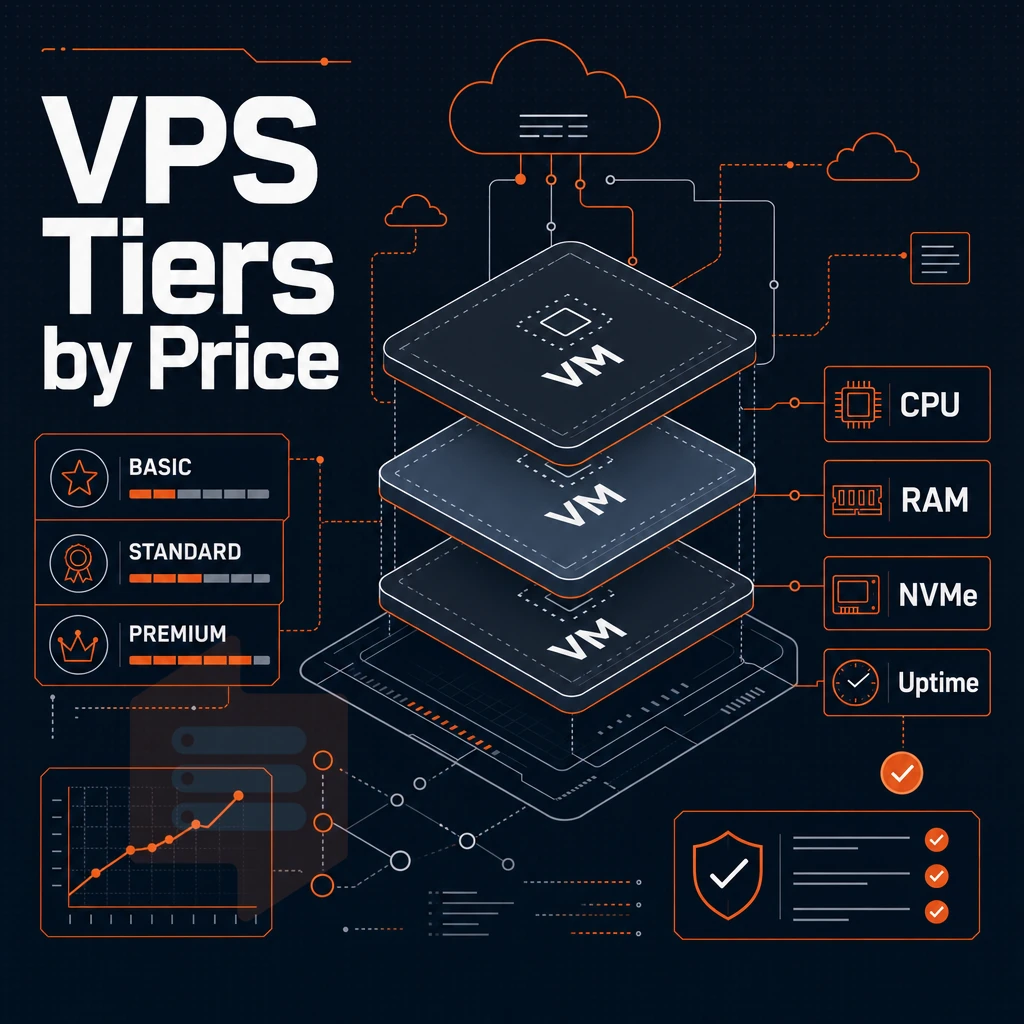
VPS prices vary by provider.
Hosting providers and entry-tier VPS hosting plans
A typical entry-level VPS hosting setup for a VPS server would include 1-2 vCPUs, 1-2GB of RAM and 20-40GB of SSD storage space. Typically these VPS servers will support the installation of Ubuntu and/or Debian and are generally unmanaged VPS hosting (you update, manage security, etc. as required).
Note: Cheap VPS providers at this tier often offset low pricing with high node density, slower support, or steep renewal hikes after year one.
Mid-tier: where the cheap VPS hosting provider trade-offs become visible
Mid-range plans are powered by 2-4 vCPUs, 4-8 GB of RAM and an 80-160 GB SSD. This tier includes a number of additional operating system choices including AlmaLinux, Rocky Linux and CentOS Stream. Also available in this tier is managed VPS hosting, however expect to pay a premium for this service.
BuyVPS Standard CPU VPS plans fall into this category.
Performance tier: dedicated resources and predictable specs
The Performance-tier plans have pinned/vCPUs, 16GB of RAM or greater, and NVMe storage with IOPS that you can depend on. The quality of support goes up dramatically as it is engineer-led vs the first-tier script-based support found in the other two plans.
BuyVPS Dedicated CPU VPS features AMD EPYC Genoa processors with pinned cores and DDR5 ECC RAM, the other half is deciding how much server management you want to own.
Traffic, load balancer, and network costs: what to watch for
Understanding how traffic, load balancing, and DDoS protection are charged helps you avoid surprise overages, especially if you moved from shared web hosting and are now building a multi-server infrastructure.
Unlimited traffic vs. Metered billing by GB RAM
Some providers market unlimited traffic, only to apply fair-use limits or slow down sites as they hit thresholds.
BuyVPS cheap VPS hosting servers have a large data transfer allowance on all of the plans, and you get to use it as you wish without any restriction to normal usage and without any sneaky throttling.
Load balancers, private network options, and additional ips
A load balancer spreads the load of incoming requests over several servers. There are many providers for hosting websites and web applications, but many of them charge extra for a load balancer. With full root access, creating a private network between your VPS nodes prevents your traffic from having to travel over the public Internet, thus saving you money and reducing latency. This architecture gives you complete control over traffic routing policies, failover behavior, and the ability to implement custom health checks without relying on third-party services.
This setup is particularly valuable for e commerce websites that require high availability and the ability to scale horizontally during traffic spikes. Many ecommerce sites benefit from this approach by maintaining uptime during peak sales periods while keeping infrastructure costs predictable. This load balancing strategy proves especially effective when managing multiple websites on separate VPS instances, as it enables failover and resource distribution across your entire hosting infrastructure.
We provision dedicated IP addresses for all of our plans. There may be a fee for additional IP addresses on some providers, and this would be a fee per IP address. You'd want to keep this in mind when planning out server resources to host multi-server applications or even some Windows servers where individual servers require to bind to separate IP addresses.
DDoS protection and GB RAM as cost factors
DDoS protection outside of regular edge filtering is often charged extra by some providers. We include edge filtering from both Amsterdam and New York data centers in our basic edge filtering service. Note that full control of mitigation rules typically is an extra service that you should carefully check what is included.
Good technical support matters too.
Knowing the full cost of a VPS, including the operating system , and having compared it with the cost of a multi-tenant hosting account, it is now a matter of whether a VPS would be cost effective for your needs as opposed to your current shared server hosting account.
Why choose BuyVPS for predictable, no-surprise VPS hosting cost
Hidden fees and renewal hikes are the most common virtual server cost complaints. BuyVPS publishes every rate up front and charges no setup fee. Our virtual private server hosting runs on AMD EPYC hardware with NVMe RAID10 SSD storage, KVM isolation, and a separate kernel per VPS, no entry-level hosting compromises, no oversold nodes.
Each virtual private server includes a modern control panel interface that simplifies server management tasks, from resource monitoring to application deployment, without requiring command-line expertise. The control panel provides access to essential features like snapshot management, firewall configuration, and one-click application installs that streamline daily operations.
- Transparent pricing. No hidden fees. The rate you sign up with stays flat.
- In-place upgrades. Move to a larger VPS plan without migration or IP rotation. Your server environment stays intact.
- Hard memory caps, low node density. Unlike shared-resource hosting, your GB RAM allocation is never borrowed by other users.
- Full root access on every plan. Choose your operating system, upload a custom ISO, and take complete control of your virtual server.
- Dual-stack networking. Every VPS ships with IPv4 and IPv6. Data centers in Amsterdam and New York provide consistent performance across regions.
Our dedicated CPU tier adds pinned cores for resource-intensive applications where predictable CPU performance is non-negotiable. The self-service control panel includes API access and an in-browser VNC console, no managed hosting dependency required.
Compare our VPS plans or contact our engineering team at info@buyvps.com to discuss which configuration fits your workload.
Frequently asked questions about GB RAM
How do cheap VPS plans compare in cost to a dedicated server hosting option?
VPS hosting prices vary widely based on resources, virtualization quality, and provider tier.
How does a 1 GB RAM VPS cost compare to a dedicated server at a cheap hosting provider?
Dedicated-core plans from hosting providers like BuyVPS, built on AMD EPYC Genoa with pinned cores and DDR5 ECC RAM, cost more but deliver predictable, consistent performance.
Is getting a VPS or dedicated server with enough GB RAM worth it?
Yes, for any workload that has outgrown standard web hosting or needs root access, a VPS is the logical next step. You get an isolated environment, a dedicated IP, and total control over the software stack, none of which traditional hosting provides.
The performance gap is especially clear with NVMe-backed VPS plans: BuyVPS records over 120,000 4K read IOPS in fio benchmarks, which shared server environment cannot approach.
Why are VPS plans with GB RAM so cheap?
Most low-cost unmanaged VPS plans achieve their price by overselling, packing more virtual machines onto a host node than the hardware can comfortably serve under real load.
Providers that enforce hard memory caps and low node density, as BuyVPS does with every VPS hosting plan, cost more than the cheapest options because the resources you pay for are actually available.
What is the difference between managed and unmanaged VPS hosting cost?
Unmanaged VPS gives you root access and nothing else, OS updates, security hardening, and software configuration are your responsibility. fully managed virtual private server adds a layer of provider-side administration, which is reflected in a higher monthly cost. For developers and sysadmins who are comfortable on the command line, unmanaged is the better value. Teams without dedicated infrastructure staff may find the premium for managed hosting justified by the time it saves.
Does unlimited traffic on a VPS really mean no overage charges?
Not always.
What hidden costs should i watch for when comparing VPS hosting plans?
The most common surprises hosting providers throw at customers are renewal price hikes, charges for additional IPv4 addresses, fees for OS reinstalls or snapshots, and paid support tiers that gate basic technical help behind an upsell. Some providers also charge for control panel licenses or backups that competitors include by default.
Before committing to cloud servers, confirm what is included: IP allocation, VNC console access, API access, and in-place upgrade capability should all be standard, not add-ons.
The cost of VPS hosting is determined by three key factors: the resources you provision (e.g.
managed services trades you control for the convenience of having it managed for you and typically incurs a premium. Self-administered VPS hosting, which gives you full root access to manage your own server and associated services, can help keep costs down as long as you have the technical wherewithal to do so.
The headline rate is rarely the whole story.
BuyVPS enforces hard memory caps per node and keeps node density low by design, so whether you're using full root access in Amsterdam or New York, the resources on your plan are the resources you actually get. Browse the VPS plans at BuyVPS.com and find the tier that fits your workload.