
The price for a VPS hosting server varies more than you would expect at first glance. While providers might offer similar specs for their VPS, the actual costs for the customer (i.e. the billing.
The way resources are allocated across operating systems and, often hidden, the costs for renewals on a game server can differ greatly between the different tiers. Understanding these price differences across VPS hosting options is the biggest difference between a server that fits your needs and a server that either is overequipped or underpowered without you even noticing.
This guide will detail out the VPS pricing model, the difference between shared vCPU plans and dedicated-core plans, and how GB RAM, GB SSD storage, and network quality really affect the cost to run your workloads. See also: Amsterdam and New York.
We will outline which type of VPS is best suited for various applications, including high-traffic web applications and memory-intensive databases. Additionally, provide a detailed comparison of each operating systems offering to help you determine what is best for your workloads and to scrutinize the fine print before signing up for a year or more. Understanding resource allocation becomes especially critical when deploying high traffic apps that demand both horizontal scalability and low-latency response times under sustained load.
Modern VPS architectures with optimized network stacks can achieve low latency connections that rival dedicated hardware, making them suitable for real-time applications and API endpoints. Workloads involving machine learning inference or training benefit significantly from VPS plans with dedicated CPU cores and high memory allocation, as model serving requires consistent compute resources to maintain prediction latency. For most web applications, a VPS with 4, 8 GB RAM and shared vCPU cores provides sufficient headroom to handle typical request volumes without over-provisioning resources.
With providers like BuyVPS offering transparent, lock-in-free virtual server pricing with no renewal rate increases, it is easy to compare different plans to find the best for your specific needs.
This guide aims to arm you with the knowledge of what to look for in a VPS plan, from RAM and CPU to gb SSD storage, and to evaluate plans against dedicated server alternatives on their true value, not just their marketing label. Choosing the best VPS means evaluating not only upfront costs but also long-term value, ensuring your provider delivers consistent resources without hidden fees or performance degradation over time.
What drives VPS price? The real cost factors explained
The price of a VPS is determined by a number of fixed variables. By knowing these variables, you can work with your hosting provider to choose the correct server tier for your workload and avoid paying for excess capacity that you don't need. For community perspectives, see Cheapest quality VPS? : r/selfhosted.
First month $1
Then the normal monthly price. One per customer. No setup fee, and a 30-day performance guarantee on your first order.
See the plans“BuyVPS offers simple and reliable VPS hosting solutions for different online needs.”
The core cost levers of a virtual private server with more power
Unlike with Shared Hosting, a VPS will give you isolated. Dedicated resources on a physical server and no other account on the server can impact your performance by spiking your CPU or eating up your RAM.
The factor that determines how much you pay for a VPS is: Each VPS operates as an isolated environment, ensuring that resource spikes or security issues on neighboring accounts cannot affect your workloads. This isolation prevents resource contention, meaning that CPU-intensive tasks or memory leaks triggered by other users on the same physical hardware will never degrade your application's responsiveness or uptime.
- CPU type: shared vCPU plans cost less; pinned-core plans cost more but deliver consistent performance.
- RAM: GB RAM is the most direct price driver, doubling RAM roughly doubles the tier cost.
- Storage: NVMe SSD capacity and RAID configuration affect both speed and price.
- Bandwidth: monthly traffic allowance scales with plan tier.
- Billing term: annual or two-year commitments lower the effective monthly rate versus paying month-to-month.
Managed vs. Unmanaged isolated environment virtual private server
In managed VPS hosting the OS patching, security updates and support is added to the cost of the server resources. In self-managed VPS hosting you are given root access and that is it, you have complete control of the server stack. Managed hosting is best for people who don’t have a sysadmin on staff, unmanaged is best for developers that want full control of their server.
Where BuyVPS fits in the VPS market with DDoS protection
Our Standard, Dedicated and High Memory offerings are based on 3 main variables.
The last variable is location and we offer Amsterdam and New York, both virtual server locations have identical hardware, including the same gb SSD configuration, ddos protection, and control panels, and pricing, so location is not an additional cost variable.
The next question would be have you outgrown shared hosting to the point where a VPS is actually required in the first place. Some providers charge separately for additional ip addresses, but BuyVPS includes one IPv4 and IPv6 address with every plan at no extra cost.
Cloud servers vs best VPS options: difference in price and control
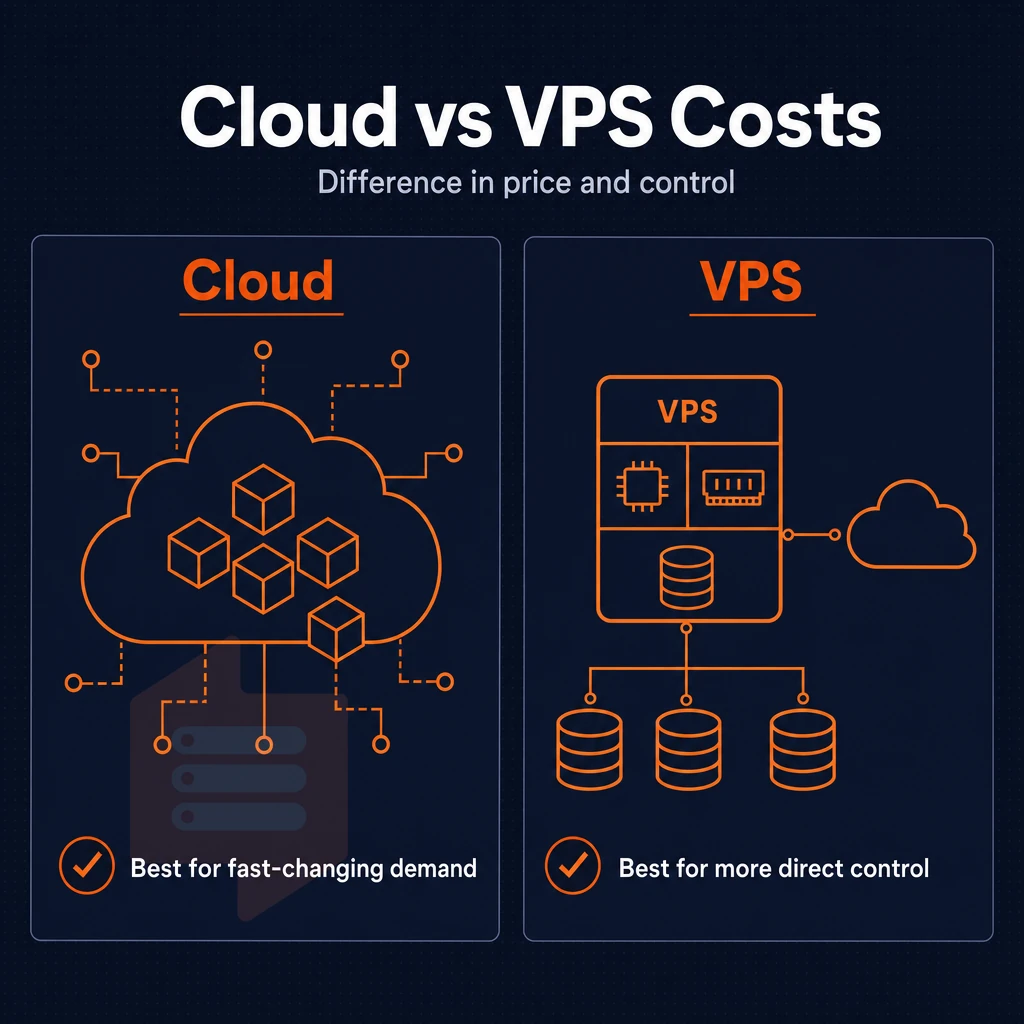
Many people are confused between the terms ‘cloud server’ and ‘VPS’ and believe them to be equal. Unlike shared hosting, the main differences with this option come down to how billing works, the degree of control the customer has over the server, and the risks involved for the customer.
Cloud servers vs dedicated CPU and VPS billing differences
Hourly and per minute billing of cloud server s makes them expensive to use for sudden peaks of traffic. It’s bad enough that paying for unused instances of servers adds up quickly. Then there are the egress fees, the cost of storing your snapshots, and the load-balancer charges that can quietly inflate your VPS hosting plan bill without you even realizing it. It all adds up before you get the bill.
Flat priced for a KVM VPS, meaning a flat monthly rate. You know the price from day 1. No additional charges for bandwidth spikes etc. No extra charges for API calls etc against your own servers.
Full root access on CPU optimized servers and what it means
When you have full root access on a VPS you control the entire server environment, including kernel parameters, the firewall, package versions and system daemons. It’s a fully transparent environment and there is no abstraction by an orchestration layer. This level of access also enables better security through custom firewall rules, intrusion detection systems, and the ability to harden your stack according to your specific threat model.
An self-managed VPS is basically handed to you completely 'as is'. Control panels are optional in this web hosting setup, so you can have a completely 'raw' terminal and install any management interface you need for your applications and services, not tied to a particular VPS package. Additionally, as a hosting provider, BuyVPS provisions all plans with KVM, and each VPS gets its own kernel (so no risk of shared-kernel problems for you).
- We’re loading up NVMe SSD storage on every tier and measuring out 122,959 4K read IOPS.
- Hard memory caps per node to preserve memory’s performance under load.
- In-place upgrades with no IP rotation or migration.
Control panels are available if you prefer to run from a GUI, but that is in addition to root access not being removed in either case.
Why choose BuyVPS for predictable VPS pricing
Price-conscious buyers don't just want a low starting rate, they want a VPS hosting provider where the cost stays predictable as their business grows. BuyVPS is founder-run since 2002, publishes every rate up front and charges no setup fee. No surprise fees.
- No-oversell policy: Hard memory caps per node and low node density mean your virtual server gets the guaranteed resources you paid for, unlike communal hosting, where other users compete for the same physical server.
- In-place upgrades: Scale your VPS plan without migration or IP rotation. Your server environment stays intact.
- Pinned cores on Dedicated CPU VPS: Dedicated CPU tiers use AMD EPYC Genoa with pinned CPU cores, consistent performance for high-traffic apps, ecommerce sites, and machine learning workloads.
- NVMe RAID10 storage: PCIe-direct NVMe SSD storage with published fio benchmarks, performance is provable, not promised.
- Full administrative access, both regions: Every plan includes full privileged access, KVM isolation, and identical hardware in Amsterdam and New York.
Engineers, not chatbots, handle support. Explore our VPS hosting plans or reach out to compare configurations for your workload.
Virtual private server FAQ about operating systems and more
What is the typical cost of VPS hosting with 1 GB RAM for server administration needs?
VPS hosting spans a wide range depending on resources, virtualization type, and provider tier.
How much does a VPS with 1 GB RAM cost per month?
Monthly VPS costs vary by CPU type, RAM, storage, and whether cores are shared or pinned. Beyond these core specifications, other factors such as bandwidth limits, backup options, and support tier can also influence the total monthly cost.
Is getting a virtual private server with 2 GB RAM worth it?
Yes, for any workload that needs predictable performance, full server control, or isolation from noisy neighbors, a VPS is the right tool. Unlike a multi-tenant hosting environment that pools resources unpredictably, VPS hosting options give you guaranteed RAM, dedicated storage, and a separate kernel. VPS plans deliver dedicated resources that remain consistent under load, ensuring your application receives the CPU cycles and memory it was provisioned for without contention from other tenants. For workloads requiring even greater isolation and hardware control, some teams eventually migrate from VPS to a dedicated server once resource demands exceed what virtualized environments can efficiently provide. As your application scales and traffic increases, upgrading to a plan with more power ensures your infrastructure can handle peak loads without throttling or downtime.
What do data centers charge for a 16gb RAM VPS hosting plan?
A 16GB RAM VPS falls in the mid-range of most provider catalogs. Entry-level plans typically start with 2 GB RAM, which suffices for small websites, development environments, or lightweight applications that don't require extensive memory allocation. Applications with high concurrency or large datasets benefit from plans with 8 GB or more, as memory performance directly impacts query response times and caching efficiency. Developers running multiple websites on a single VPS often allocate 4, 8 GB RAM per site, making 16 GB plans ideal for hosting three to four production applications with room for background services.
Managed vs unmanaged VPS hosting: choosing a hosting provider
An self-managed VPS instance gives you full administrator access and hands you a clean OS, all configuration, patching, and maintenance is your responsibility. A managed VPS includes provider-side administration: OS updates, security hardening, and sometimes application support. Unmanaged plans for hosting websites cost less and suit developers and sysadmins who want total administrative control. The trade-off is that unmanaged plans require technical expertise to handle security patches and system administration, whereas managed services absorb that operational burden at a high cost.
How does VPS hosting price compare to shared hosting?
shared server plan is cheaper upfront because dozens of sites share the same server resources with no isolation. A VPS costs more because you get guaranteed RAM, dedicated storage I/O, unlimited traffic potential, and a separate kernel that no other tenant can affect. The performance gap is significant: VPS plans on NVMe RAID10 with hard memory caps deliver consistent benchmarks that communal server hosting simply cannot match. For any production workload, the VPS premium is a sound investment.
What factors affect virtual private server hosting price the most?
DDR5 ECC) add to the cost tier.
When comparing the prices of VPS hosting, there are three main things to look at: 1) the way you can allocate resources on the node (e.g. share a CPU or have your own.
Do they hide huge price increases for future years?).
NVMe storage and a no-oversell policy are not marketing terms at Packet.
BuyVPS offers Standard, Dedicated CPU, and High Memory VPS plans built for high traffic sites, available from data centers in Amsterdam and New York, all with hard memory caps, in-place upgrades, and transparent pricing. If you know your workload requirements, browse the plans at BuyVPS.com and find the tier that fits.