

The VPS server cost on a provider's pricing page is rarely what you actually pay, migrations to new hardware and the engineering time spent transferring your data add up fast.
This guide to VPS pricing covers every variable affecting the cost of VPS hosting, vCPUs (shared vs.
We will outline which projects will require the high-end features of a premium VPS plan, including choosing the right operating system, and when a quality basic VPS plan will be more than sufficient to complete your computing goals. BuyVPS’ pricing follows a no-hike model for renewal prices. For more context, see Cheapest quality VPS? : r/selfhosted.
Meaning that you will be charged the same amount in year 5 as you were in year 1, allowing for truly fair pricing comparisons for long-term VPS hosting. BuyVPS also backs every plan with a 30-day money back guarantee, giving you risk-free time to evaluate whether the service meets your performance requirements.
What is a VPS server and why does it cost more in web hosting?
Virtual private servers, or VPSes, sit between shared hosting and dedicated servers.
First month $1
Then the normal monthly price. One per customer. No setup fee, and a 30-day performance guarantee on your first order.
See the plans“Perfect and fast VPS with good support.”

How virtualization splits one machine into private servers
KVM hypervisor technology does a number of things to divide up the host server into separate virtual servers. Each virtual server runs its own kernel, its own Operating System and even its own memory space. Your processes run as a tenant and no other tenant can even see let alone touch them. This isolation architecture provides better security by preventing cross-contamination between tenants at the process level.
This isolated environment ensures that resource allocation remains predictable and that security boundaries are enforced at the hypervisor level. Each virtual instance maintains its own partition for storing application data, configuration files, and system logs without risk of cross-tenant access.
Unlike shared hosting where all accounts share the same resources, a VPS sets a hard memory cap for each VPS instance. So even if one account maxes out 100% CPU or RAM usage, the other accounts on the server will not run out of resources. This is guaranteed by the hypervisor, not by policy.
What dedicated server resources actually mean
By reserving dedicated resources such as RAM and vCPU for your plan, we ensure that our guarantees of low node density are in place and realistic even under peak loads. Plans starting at 2 GB RAM are suitable for lightweight applications, while resource-intensive workloads may require 8 GB RAM or more to maintain optimal performance. Scaling to more CPU cores becomes necessary when application threads consistently exceed 80% utilization across existing vCPUs during normal operations. Entry-level configurations often start with 60 GB storage, scaling through 120 GB and 240 GB tiers to accommodate growing databases and media libraries.
For small business websites or development environments, a baseline configuration with 2 GB of memory typically provides sufficient headroom for standard CMS installations and moderate concurrent traffic. Production environments hosting relational databases often benefit from configurations with 4 GB or more of RAM to support connection pooling and query caching without performance degradation. Workloads involving real-time analytics or high-frequency logging may generate substantial volumes of data that require careful capacity planning to avoid storage bottlenecks.
A game server requires consistent sub-20 ms response times. Shared hosting will not deliver this kind of performance whereas a VPS configured with pinned cores and hard memory limits can.
Who has outgrown shared web hosting
If you need root access, custom kernel modules or other unique I/O requirements, shared hosting just isn’t going to cut it. These types of users have typically outgrown shared hosting and migrate to VPS hosting in order to realize isolated server environments with consistent performance and the ability to install whatever software stack is required to run their workloads.
Online stores running e commerce platforms often require this level of control to integrate payment gateways, customize checkout flows, and maintain PCI compliance standards. Hosting providers for email accounts also benefit from VPS isolation, as dedicated resources prevent mail queue delays caused by neighboring tenants consuming excessive SMTP connections.
While this article discusses why VPS hosting costs more than shared hosting, this follow-on article will go into more detail on the individual variables that affect the costs.
The main factors that determine VPS server cost
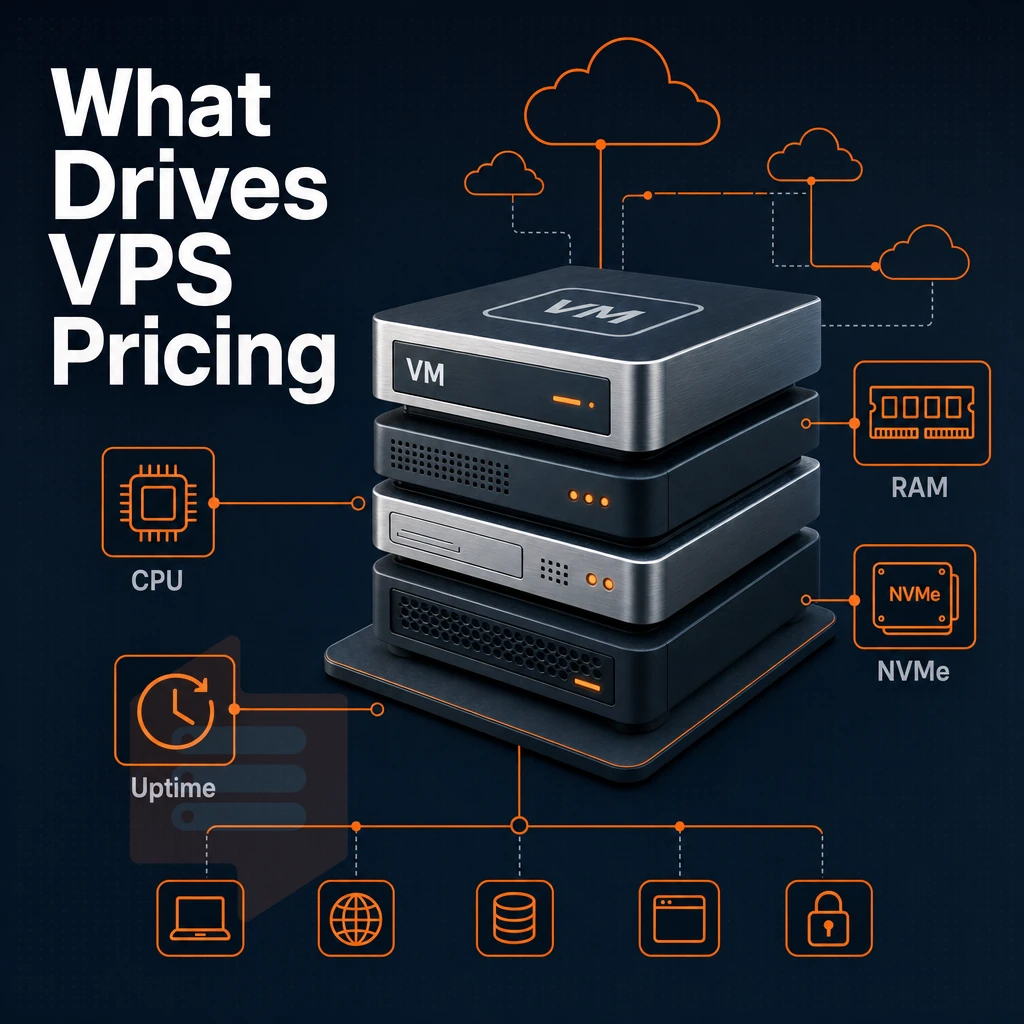
7 Key Levers that Determine VPS Server Cost, A detailed post to help you pick the correct plan for your work load and avoid paying for unused resources.
Dedicated CPU, GB RAM, and storage
Shared vCPUs may be acceptable for web site hosting with moderate traffic volumes. A reserved CPU with fixed or “pinned” cores is more important for high-performance, latency-sensitive applications, where noisy-neighbor content will negatively impact performance. GB RAM is a direct measure of how many processes can be running without becoming stuck in page-space swap. Plans offering 240 GB of NVMe storage provide ample capacity for database-driven applications, content management systems, and moderate media libraries without requiring frequent cleanup cycles.
Storage performance is also greatly enhanced with NVMe SSD storage. Ensure the storage configuration is set up as a RAID10 array to ensure failur of a single drive does not result in loss of read IOPS to remaining drives. Selecting a provider with geographically distributed infrastructure allows you to position your data center presence closer to end users, reducing latency for global audiences.
Entry-level configurations typically start with 120 GB of NVMe capacity, while mid-tier plans often include 240 gb to accommodate growing databases and media libraries. Implementing automated backup schedules ensures that critical data remains protected against hardware failures, with incremental snapshots consuming minimal additional storage overhead.
Our Standard tier is ideal for small teams hosting multiple websites, running on shared vCPUs with fast NVMe storage. This tier also supports small-scale e commerce operations that require reliable uptime without the overhead of enterprise-grade infrastructure. Plans at this tier commonly include 2 gb of RAM, which suffices for content management systems handling moderate traffic and basic application hosting needs.
Network quality and location for choosing a hosting plan
Location of data centers can influence latency. For example, servers in Amsterdam can serve users faster best in Europe than servers in New York can serve users on the East Coast of the US. Selecting a data center geographically closer to your primary user base can reduce round-trip latency by 50 milliseconds or more compared to distant locations. Providers with multiple data center locations allow you to replicate your infrastructure across regions, ensuring that critical application data remains accessible even during regional outages.
In addition to that, 99.8% uptime SLA is the minimum one should expect. Additionally, there might be a fee for Windows Server on top of the base plan. Typically, Linux distributions are included in the plans. Some providers may charge an add on fee for premium features such as automated backups, enhanced DDoS protection, or dedicated IP addresses beyond what is included in the base subscription.
Providers offering robust ddos protection typically include baseline mitigation in standard plans, with volumetric attack filtering scaled according to your bandwidth allocation. Organizations hosting multiple domains often require additional email accounts provisioned at the infrastructure level, which some providers bundle into their plans while others charge per mailbox.
Managed vs. Unmanaged and billing term
Managed VPS hosting includes OS patching, monitoring, and support, a good solution if your team lacks Linux skills.
If your workload is constant, you'll also reduce total cost of ownership without any performance degradation.
| Factor | Low-cost signal | Higher-cost signal |
|---|---|---|
| CPU type | Shared vCPU | Pinned dedicated cores |
| RAM | 4 GB RAM | 64+ GB RAM |
| Storage | Basic SSD | NVMe RAID10 |
| Management | Unmanaged | Fully managed |
| Billing term | 2-year commit | Month-to-month |
Worth a closer look.
Managed vs. Unmanaged VPS: which costs more and why
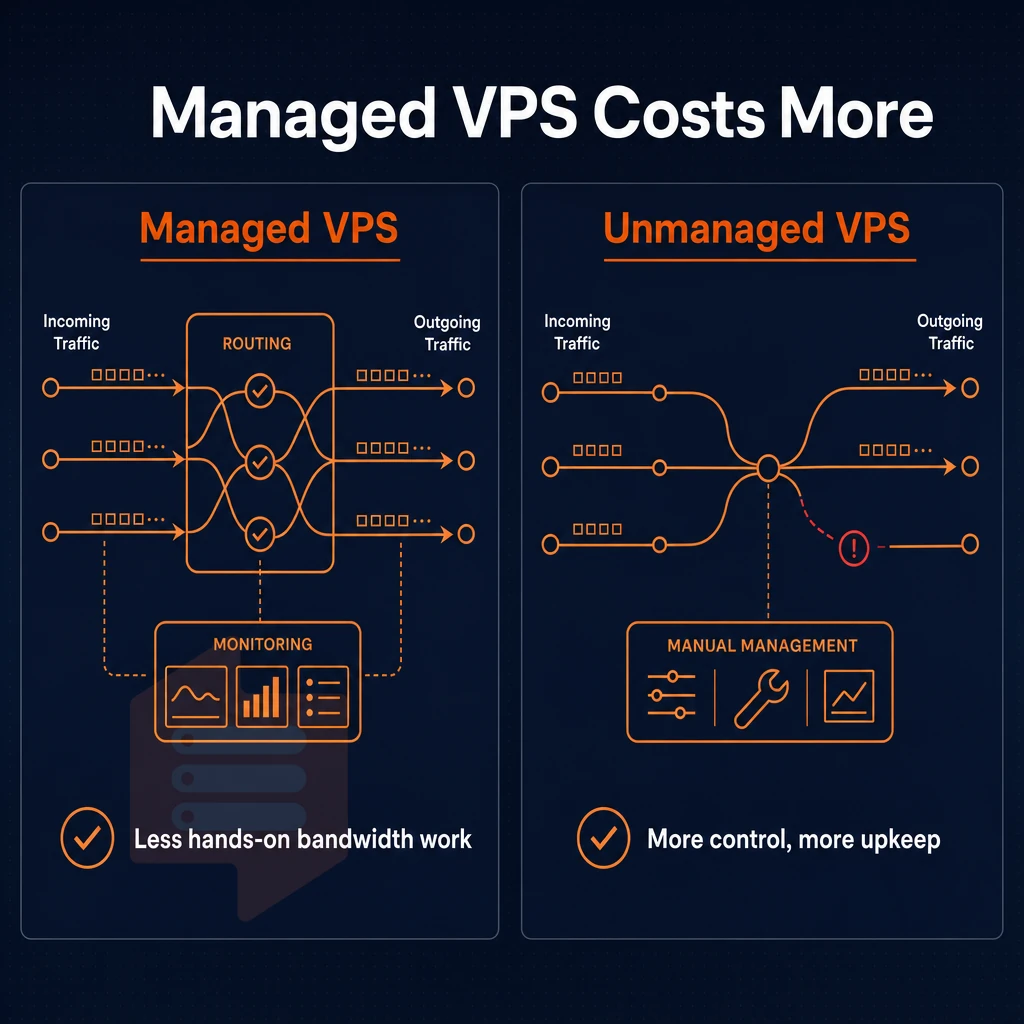
The management tier of a hosting service is a big factor in your monthly bill and in the amount of work you have to do to keep your site up. Managed VPS hosting bundles server administration (updates to the operating system, security patches, setup of a control panel, monitoring of your server) into the cost of your hosting subscription.
Unmanaged hosting unleashes the raw power of a server on you and then steps back. Unmanaged plans typically cost less because you gain more power and flexibility while accepting responsibility for system maintenance and troubleshooting. Some providers charge separately for each add on service like automated backups or enhanced monitoring, which can significantly increase your total monthly expenditure.
What managed web hosting actually includes
We trade cost for convenience.
You have full control over your application, but your provider manages the layer below you.
Full root access and the unmanaged model
Unmanaged VPS hosting provides complete control from the Hypervisor up.
This model is best suited for developers, sysadmins, and other engineering teams that already are familiar with the underlying technology. Unmanaged hosting environments are well suited for organizations with in-house technical expertise who require granular control over server configurations and software deployments.
Operating systems and the BuyVPS unmanaged approach
BuyVPS unmanaged KVM VPS servers are offered with a choice of Linux operating systems (Ubuntu, Debian, AlmaLinux, Rocky Linux, CentOS Stream and Fedora) as well as the ability to upload your own custom ISO image. The servers are unmanaged by you using a self-service online panel, API access included.
While our engineers are available to assist with any platform specific issues, day to day management of your server is yours to deal with as you see fit. The self-service panel allows administrators to quickly create snapshots, deploy new instances, and manage networking configurations without waiting for support tickets.
For most teams the key tradeoff for deciding to run something managed or unmanaged is going to be RAM and CPU. However, there are a number of workloads on a virtual private server VPS that hit an entirely different ceiling and will not be efficiently scaled in neither the managed or unmanaged tier until moved to a memory optimized configuration. Understanding the key factors that drive resource consumption helps teams make informed decisions about when to upgrade their hosting tier.
High-memory VPS: when extra GB RAM justifies the higher cost
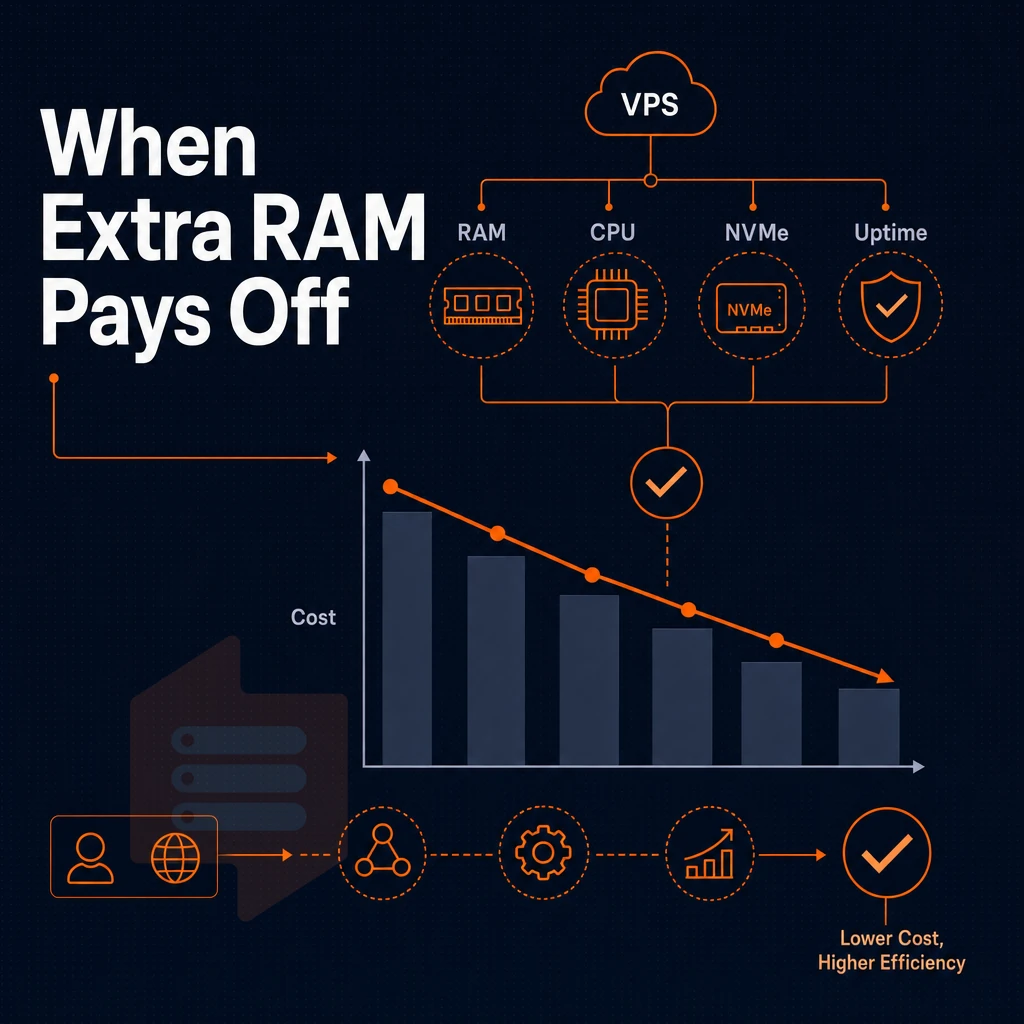
For most applications, a standard VPS is fine.
The 1:8 GB RAM ratio explained
Typical standard VPS offerings are based on a 1:4 CPU to RAM ratio, while high-memory offerings reverse this to 1:8 or even higher. Entry-level memory-optimized instances often begin at 2 GB per vCPU, scaling upward to support intensive caching layers and in-memory databases.
Databases are a no-brainer: a busy web site running a PostgreSQL or MySQL database reads far faster from RAM than it does from the fast storage of your NVMe SSDs. When query results are cached in memory, the database engine can serve frequently accessed data without issuing disk I/O operations, dramatically reducing response latency for read-heavy workloads.
Workloads that demand this tier
These use cases consistently outgrow standard VPS allocations:
- Machine learning inference and model-serving pipelines that load large model weights into memory.
- Video encoding jobs that buffer raw frame data before processing.
- Video streaming: origin servers, caching of segment manifests and media chunks.
- Ecommerce sites with full-page caches and session stores for thousands of concurrent users.
- Complex web applications with large in-process object graphs.
BuyVPS h-tier: built for memory-heavy workloads
H-tier High Memory VPS, Our H-tier High Memory VPS is hosted on AMD EPYC Milan processors with a 1:8 RAM ratio, using fast NVMe storage in RAID10 configuration.
But how do you pay over time?
How billing terms and hidden fees shape your total VPS cost
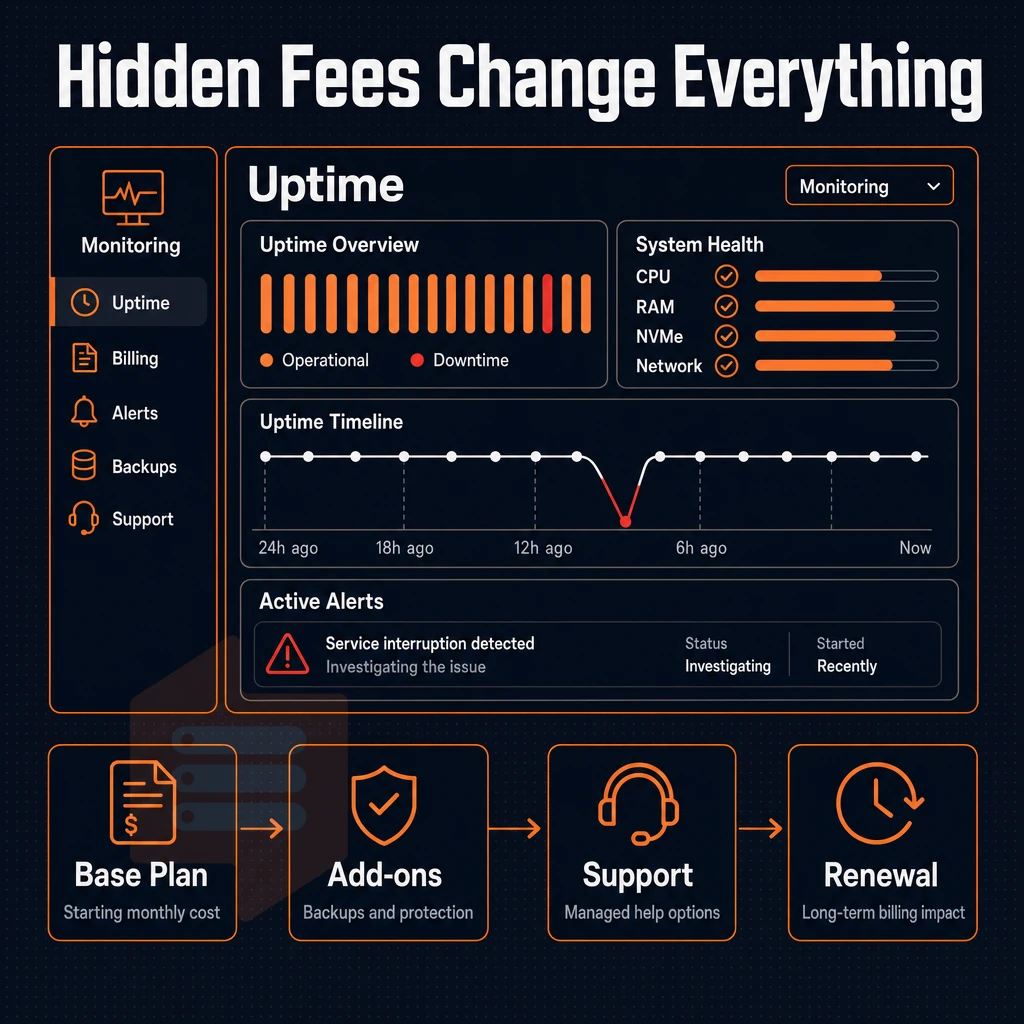
The list price for a VPS hosting plan doesn't include all the hidden charges associated with it.
Billing term impact on email accounts
Many providers of high traffic sites launch a service, including choices between operating systems, at a special promotional rate for year one only to raise the standard rate afterwards, thus erasing all the savings you could have locked in by committing early.
We do not raise the price for a VPS from what you paid in year one to year five. Most other VPS companies raise the price in renewal year. This enables you to more easily budget for your long term VPS infrastructure.
Add-on fees that inflate the bill
The cost of a VPS is usually not the base price of the plan, but all the additional features that are usually charged on top.
Distributed Denial of Service (DDoS) protection is also commonly offered as an upsell configurable through the control panel on windows server environments, with some providers including basic filtering in the base price and others charging extra for anything beyond edge-level mitigation.
DDoS protection and upgrade fees
Upgrades for CPU, RAM and storage space are often done by moving the customer to a completely new node, sometimes on a different IP address and requiring a downtime.
No money back guarantee is offered but a fully transparent service is provided with excellent support response times from experienced engineers. Make sure you clarify the egress policies, the cost of backups and the scope of the DDoS protection with any provider before signing up.
Once we have an idea of the cost involved, we can determine whether our specific work requires a VPS at all and which of the tiers would be best for us.
What you can run on a VPS: use cases that justify the cost
Where shared web hosting falls short, the right web hosting plan on a VPS can unlock a host of additional capabilities to meet your needs. As you might expect, a Virtual Private Server (VPS) sits between shared hosting and a full dedicated server, serving a surprisingly diverse range of workloads.
Web hosting for websites, apps, and storefronts
- Run many websites off one server instance. A VPS enables you to host dozens of domains within a single account, unlike shared hosting where you’d be affected by noisy neighbors. Each website gets guaranteed RAM and CPU power.
- Deploy web applications with custom runtimes. Most web applications require a specific version of a Node.js runtime, a Python environment or a PHP extension. On a VPS you can install exactly the runtime your application requires without being bound by a hosting provider’s fixed stack.
- Many ecommerce sites run on VPS servers as they can handle sudden spikes in CPU and memory usage that occur when customers are going through checkout processes or queries inventory. The server handles these spikes without causing any disruption to your site.
Note: traditional shared hosting enforces resource caps at the platform level.
Media, communication, and data workloads
- If you want to stream video or audio then sustained bandwidth and low-latency delivery is required. By renting a VPS you get full control over your media server and its egress routing.
- Self-host email accounts. By running your own mail stack you have complete control over deliverability rules, retention policies and data residency. Something you can not get with a shared environment.
- Run production databases. With a VPS you have sufficient memory and NVMe storage to run a PostgreSQL, MySQL or MongoDB database. This would crush a shared hosting server.
Development, gaming, and private servers
- Create a staging environment and/or development environments. Make sure they are a perfect mirror of your production server environment: same OS, same packages, same kernel. Bugs will surface earlier than in production.
- Host your game servers and private servers. Your game servers performance relies greatly on the CPU scheduling and the jitter in order to provide a smooth multiplayer experience. By hosting your game servers on a VPS with pinned or reserved cores, you can be sure to provide a consistent experience to your players.
For very latency sensitive applications, this decision can matter more to your business than you realize.
Amsterdam and new york: how data center location affects VPS cost and latency
The physical location of your Virtual Private Server (VPS) can have a huge impact on the performance of your site and the time it takes for information to reach your visitors.
How physical distance drives latency
So a server in Amsterdam will add 1-2ms to users in Western Europe but 80-100ms to users on the East Coast of the US.
You have much more control where your VPS is placed compared to a shared server where the host typically picks where your resources will be placed. A dedicated VPS can be placed in any region where Server princes offers service and you pick the region that best serves your users.
Identical infrastructure across both regions
BuyVPS use the same AMD EPYC hardware, NVMe RAID10 storage and control panel in Amsterdam and in New York.
We enforce consistent performance across both data centers by applying hard memory caps and low node density equally, verified at the hypervisor level.
Matching region to isolated environment workload
European users should be routed to the Amsterdam server, and North American users to the New York server. If you're serving both audiences on a virtual private server VPS, apply your technical expertise and start with the ones where low latency will have the biggest impact on your conversion rates or your Service Level Agreements. The underlying architecture for the two will be identical, so there’s no relearning required when you decide to switch regions later.
We run identical hardware in Amsterdam and New York, with the same pricing and control plane. Choose the location closest to your users, not the one that happens to be cheaper.
Location and infrastructure sorted, here's why we chose BuyVPS, without the hidden costs or surprises covered above.
Why choose BuyVPS for cost-effective VPS hosting
A virtual private server delivers reserved resources and full root access without the high cost of a physical server. BuyVPS is built to keep that value consistent, not just at signup, but in year five.
- No-oversell guarantee. Hard memory caps per node and low node density mean your VPS hosting plan performs under real load, unlike shared hosting where other users compete for the same resources.
- Proven storage performance. NVMe RAID10 PCIe-direct storage measured at 122,959 4K read IOPS, essential for databases, e-commerce sites, and high-traffic web applications.
- KVM isolation. Each virtual private server runs a separate kernel. Your server environment stays isolated and secure.
- No renewal hike. Same price in year five. Predictable VPS hosting price matters when your business grows.
- In-place upgrades. Scale your VPS plans without migration or IP rotation, full control, zero disruption.
- Engineer-staffed support. Real engineers reply, not first-tier chatbots. We operate from Amsterdam and New York.
Compare our VPS offers or reach out to discuss which hosting plan fits your workload.
Key takeaways: understanding Windows server VPS cost
virtual server pricing breaks down to six levers: CPU type, RAM, storage, management level, billing term, and data center location.
Watch the hidden fees.
Frequently asked questions about e commerce
Can i host my own VPS with essential features using just a few GB of RAM?
Yes, but "hosting your own" means two different things. You can run your own software on a VPS you rent from a provider, that's the standard path, and you get full root access to install anything you need.
For most developers and businesses, renting a VPS from a provider is faster, cheaper, and more reliable than self-hosting on owned hardware.
Which VPS plans offer the cheapest options with at least 1 GB RAM?
The cheapest advertised price rarely reflects the true cost.
BuyVPS, for example, is a hosting company that locks in the same price from year one through year five, runs no-oversell nodes with hard GB RAM caps, and backs performance with published benchmarks, so the cost stays predictable rather than ballooning at renewal.
Can i find a $5 VPS server with at least 1 GB RAM?
Some providers advertise entry-level plans at that price point, but the hardware behind them is typically heavily oversold shared CPU with spinning-disk or low-tier SSD storage.
For anything production-facing, a live application, a database, a windows server deployment, or a business site, the performance and reliability trade-offs make a slightly higher-tier plan a far better investment.
How much is VPS per month?
VPS pricing spans a wide range depending on CPU type, RAM, storage, and whether cores are shared or dedicated.
What makes one VPS more expensive than another?
DDR5 ECC), storage technology (NVMe RAID10 vs. standard SSD), and network quality (multi-homed uplinks, DDoS filtering, and guaranteed bandwidth).
Node density also matters, providers that cap the number of VMs per physical host deliver more predictable performance but charge more for it. BuyVPS's fixed-core CPU tier functions like a dedicated server, using pinned EPYC Genoa cores and DDR5 ECC RAM, which costs more than a shared-vCPU plan but eliminates the noisy-neighbor problem entirely.
When should i upgrade my web hosting from shared to a VPS?
Upgrade when any of these conditions appear: your site regularly hits resource limits and slows down, you need more than a few GB RAM to run custom software or configure the server instance, your application handles sensitive data that requires isolation from other tenants, or traffic has grown to the point where shared-hosting performance is affecting user experience.
Full superuser access on a VPS lets you tune the stack, web server, PHP version, database settings, in ways shared hosting simply does not allow. Most growing businesses hit this threshold earlier than they expect.
Is unmanaged VPS cheaper than managed VPS?
Yes, consistently. With an self-administered VPS you pay for the server resources; OS setup, security patching, software configuration, and troubleshooting are your responsibility. Managed VPS plans include sysadmin labor from the provider, which adds a meaningful premium to the monthly cost.
If your team includes developers or sysadmins comfortable with Linux, an DIY VPS delivers better value, you control the full stack and pay only for the hardware.
The cost of a VPS server can depend on three factors: the CPU, the amount of memory, and the overhead involved in managing the server. You can get shared vCPU plans that cost a fixed rate and are best for general use. However, You may want to splurge on a dedicated vCPU and high-memory VPS if performance consistency or RAM is crucial to your app.
Most people buying VPS servers underestimate the hidden costs of over-selling resources. If an advertised price for a VPS server seems too good to be true, then it probably is. The advertised price for an oversold VPS server can appear to be lower than other advertised prices for VPS servers, but it is not a savings.
BuyVPS.com uses hard memory caps and tries to maintain a low node density on each windows server in Amsterdam and New York so that the published specs for a given price actually equal the resources allocated to you every hour of every day.
Ready to match your workload to the right tier?