


Latency to users in the UK also matters. A VPS server based in the UK or otherwise close to it can remove tens of milliseconds from each request. This in turn can translate to significant improvements in page load times and API response times delivered through windows hosting services and consequently improved user experience and retention.
However, there are dozens of providers that claim low latency European coverage.
This in-depth guide explains the real performance determinants for workloads located in the UK. You will learn to properly assess VPS hosting providers by looking at the proper server specs (beyond just vCPU counts). Additionally, see how BuyVPS fits the bill for reliable UK VPS and European hosting with verified benchmark results and 100% no-oversell servers.
We look at Amsterdam as the closest high-performance European data center to the UK. Additionally, Explain how a properly setup VPS hosting server there can deliver latency numbers comparable to those of local UK hosting services. First, we cover the basics of what a VPS is and how it functions.
What is a VPS server and how does it work?
A Virtual Private Server (VPS) is in between shared hosting and a full dedicated server. It offers the customer a fully isolated environment (with full root access) for a price that is in between a shared account and a full dedicated server. This type of hosting is suitable for people that already have some knowledge of web hosting and would like to move up to the next level. For more context, see VPS.
First month $1
Then the normal monthly price. One per customer. No setup fee, and a 30-day performance guarantee on your first order.
See the plans“Great experience with BuyVPN! The service is easy to use, the connection has been smooth and reliable, and the overall experience has been really good. The pricing is also reasonable…”
How virtualization splits one machine into virtual servers
KVM virtualization enables you to run multiple virtual servers on a single physical server. Each virtual server (or guest) is allocated a portion of the host server’s memory (RAM), as well as a dedicated set of CPU threads. Additionally, It runs on its own dedicated storage (e.g. an NVMe drive). The allocated disk space is isolated per guest, preventing storage contention that commonly affects shared environments.
Each instance is set up as a fully independent server, with its own operating system and kernel. VPS hosting is therefore very different from normal shared hosting, where all accounts share the same resources.
VPS web hosting services vs shared web hosting
Unlike shared hosting where hundreds of other sites are hosted on the same server (where one noisy neighbor can slow down all others). VPS web hosting guarantees that you have complete use of your allocated resources that are hard-capped to ensure you get exactly what you pay for.
- Full root access, you can install any package and edit any config file.
- Predictable performance under real load.
- Your own kernel, not a shared one.
Which VPS hosting is best for the UK?
For VPS web hosting services to be considered suitable for UK-based workloads, they should offer low-latency connections across European networks and be non-oversold. Our UK VPS network is hosted from a datacenter in Amsterdam, which is close enough to connect with users across the UK at sufficient speed. Our KVM-powered virtual private servers, available with Windows Server, feature hard memory caps per node, are powered by AMD EPYC processors and utilize NVMe RAID10 storage.
Our infrastructure is optimized for low-latency connectivity throughout the asia pacific region as well, ensuring global reach for businesses expanding beyond European markets. This combination of enterprise-grade hardware and strategic geographic positioning delivers reliable performance for mission-critical applications requiring consistent uptime and predictable response times. Clients requiring Microsoft environments can deploy Windows Server instances with full administrative control, enabling Active Directory integration and .NET application hosting across our European infrastructure.
Why UK users choose VPS hosting over shared hosting
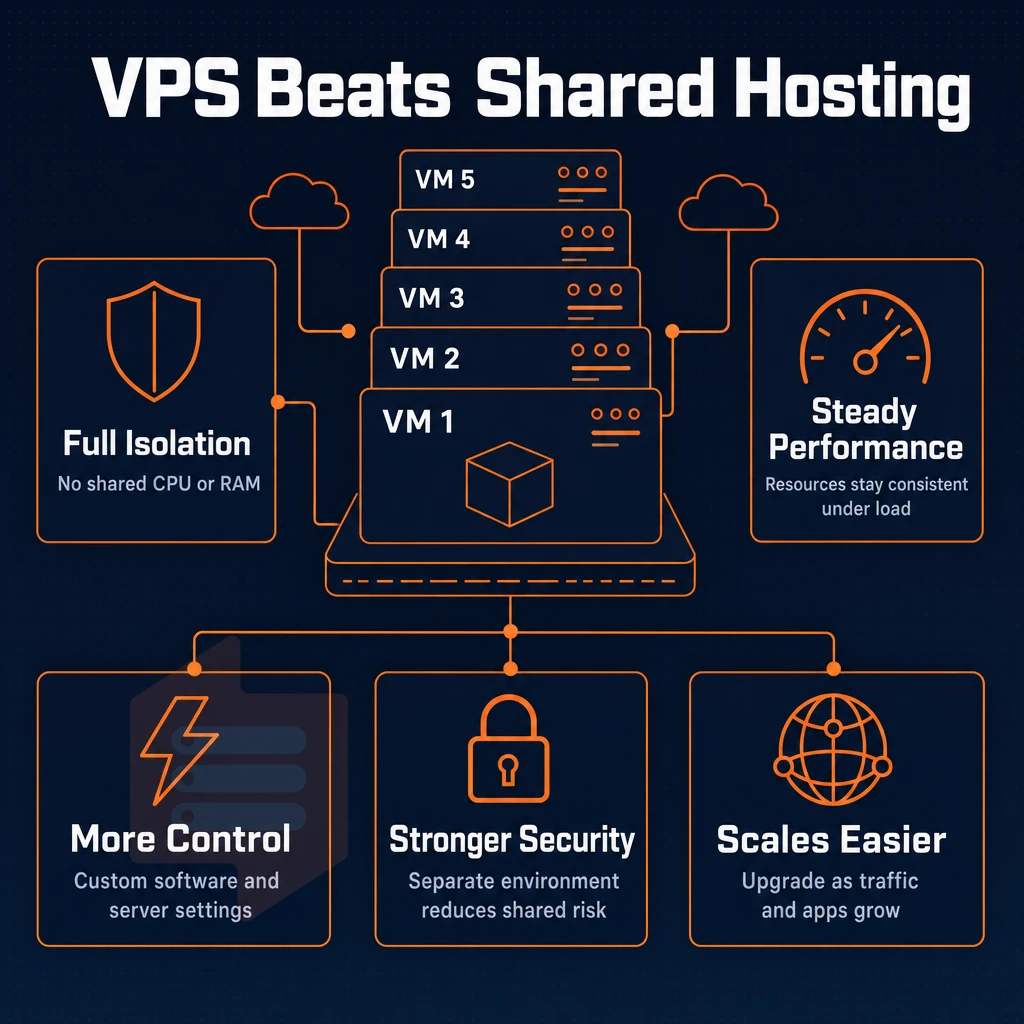
While this primer has established what a VPS is, understanding VPS hosting plans in practical terms explains why they're becoming increasingly popular with UK-based developers and businesses. It’s because of the multitude of problems that are inherent to shared hosting and which are continually exacerbated as usage of sites increases.
Principal among these are the problems of web hosting server resource contention and the restrictive server configurations in place to prevent such problems occurring in the first place. And then there's the problem of lack of scalability.
What is a virtual private server in the UK?
A Virtual Private Server (VPS) is a (virtual slice of a physical server created by a hypervisor. Unlike with shared hosting, your VPS comes with a guaranteed amount of RAM and CPU power that is all your own. Also, your VPS runs its own kernel and will not be affected by a traffic spike from another tenant. This dedicated resource allocation means your applications can handle traffic spikes without performance degradation, maintaining consistent response times even during unexpected load increases.
Proper resource allocation and low node density are essential for achieving maximum performance in production environments where reliability cannot be compromised. Scaling vertically by upgrading to plans with more resources becomes straightforward when your application demands exceed initial allocations, without requiring complex migrations or architectural changes.
Why choose VPS hosting over shared
What operating systems and daemons can you run on a shared hosting account? A VPS account on the other hand gives you root access to the server. Giving you full control to install any number of databases, runtimes and custom proxies as well as server monitoring agents and custom firewall rules. You own the stack. This level of administrative freedom grants you complete control over every aspect of your server environment, from kernel parameters to network configurations.
Whether you’re looking at cloud hosting or Windows-based VPS hosting, VPS offers an attractive middle ground between shared hosting and a full dedicated server. For teams looking at web hosting, a VPS provides greater control over the server, more reliable and predictable performance, and the ability to handle sudden spikes in traffic without being throttled back.
Shared vs. VPS servers at a glance
| Factor | Shared hosting | VPS |
|---|---|---|
| Resource isolation | None, shared pool | Hard caps per VM |
| Root access | No | Yes |
| OS choice | Fixed by host | Linux or Windows |
| Uptime SLA | Typically lower | 99.8%+ common |
Isolation on a cheap VPS would actually beat shared hosting . As we enforce strict memory caps per node and keep the node density low. You get to guarantee consistent and adequate resources for your workload(s), as opposed to shared hosting where you get whatever is left over.
This isolation model provides enhanced security by preventing cross-contamination between virtual environments, ensuring that vulnerabilities in one tenant's configuration cannot compromise others on the same physical host. Keeping your server safe becomes simpler with isolated environments that limit attack surfaces and allow granular control over security policies at the hypervisor level.
For now, this is what is decisive for UK-based teams looking to move off of shared hosting plans. Next up, what you should be looking at when evaluating providers for these types of hosts.
Key factors to consider when choosing a VPS server in the UK
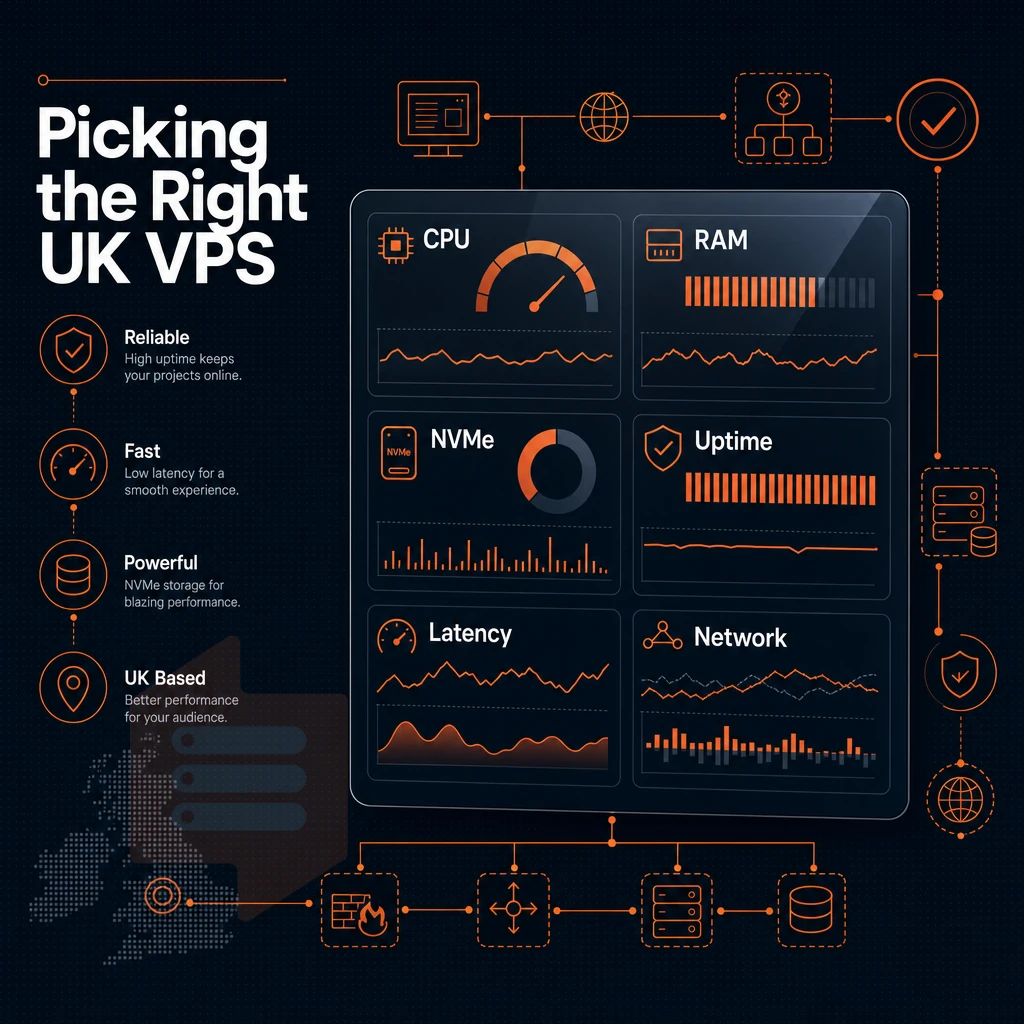
Choosing the right VPS server in the UK depends on six key technical factors. By choosing the right options, you can avoid the most common causes of poor performance and unexpected extra costs. Understanding these key benefits helps teams make informed decisions about infrastructure investments that align with their performance requirements and budget constraints.
Optimized server configurations and strategic data center placement directly impact your site's search engine rankings by improving page load speeds and overall user experience metrics. Proper evaluation of these factors helps teams avoid unnecessary costs that arise from inadequate resource allocation or poorly configured infrastructure.
Hardware and resource allocation
- Check for CPU Type and Core Model. Shared vCPUs can have processing power taken away at high loads, whereas Dedicated / Pinned CPUs give consistent performance. For Latency Critical applications, Pinned Cores are a MUST HAVE.
- Check how the provider is allocating RAM and verify that they are not overselling memory across nodes. A hard memory cap is used to ensure dedicated resources on a per node basis. Ensure that the provider is enforcing this prior to committing to them.
- Evaluate NVMe SSD storage. NVMe SSD storage delivers far higher IOPS than SATA SSD or spinning disk. Check whether the provider publishes benchmark figures, measured IOPS numbers are a reliable signal of real-world storage space performance. Note: "SSD" alone does not mean NVMe. Ask specifically.
Network and virtualisation quality
- Check the uplinks of the network and the DDoS protection at the edge. There should be multiple uplinks to avoid any single points of failure. Most reputable VPS hosting companies include DDoS protection by default. Also check for IPv4+IPv6 dual-stack and whether there’s any bandwidth limit (unlimited traffic by default is also ok).
- Confirm the hypervisor. KVM gives each VPS a separate kernel, which limits noisy-neighbour risk. Avoid providers that cannot name their virtualisation layer. Note: Some budget VPS plans use container-based virtualisation, that is not true isolation.
Which virtual private server is the cheapest in the UK?
While the cheapest VPS offer at first sight may appear to be the cheapest in the long run, it’s not. Most low-cost VPS hosting packages are sold on an annual subscription basis and are renewed at higher rates after the first year. When a VPS offer includes unlimited domains on one plan, be wary of the base price being pumped up by included services.
True cost effectiveness emerges when evaluating the total expenditure over multiple years, factoring in renewal pricing and the actual resource allocation you receive. Transparent pricing structures across different hosting plans enable businesses to accurately forecast infrastructure costs and avoid budget surprises during scaling phases.
Assess a host's offer on the basis of their flexible monthly billing, their 'cancel at any time' policy, the quality of their control panel, and the signup rate vs. their renewal rate. Modern VPS providers typically offer intuitive control panel interfaces that simplify server management tasks, from domain configuration to resource monitoring, without requiring command-line expertise.
These control panels allow administrators to easily manage multiple domains, configure DNS settings, and monitor resource usage through a unified dashboard. Administrators can quickly create snapshots and backups through these interfaces, ensuring data protection without manual intervention or complex scripting requirements. Many control panels also include built-in file managers that let you transfer files directly through the browser, eliminating the need for separate FTP clients in routine maintenance tasks.
- Look at the billing cycles of potential service providers. Typically, monthly billing provides more flexibility than annual billing for higher costs but lower average costs for annual billing. Be sure to find out if they can cancel at any time and if there are any early termination fees.
- Find out the renewal rates for cheap VPS hosting. Low introductory rates that massively increase on renewal are often not as cheap as they seem. Make sure to get the renewed rate in writing before signing up for a VPS hosting service.
After settling on the main technical criteria, one has to think about what will actually run on this server.
Common VPS server UK use cases for Windows server
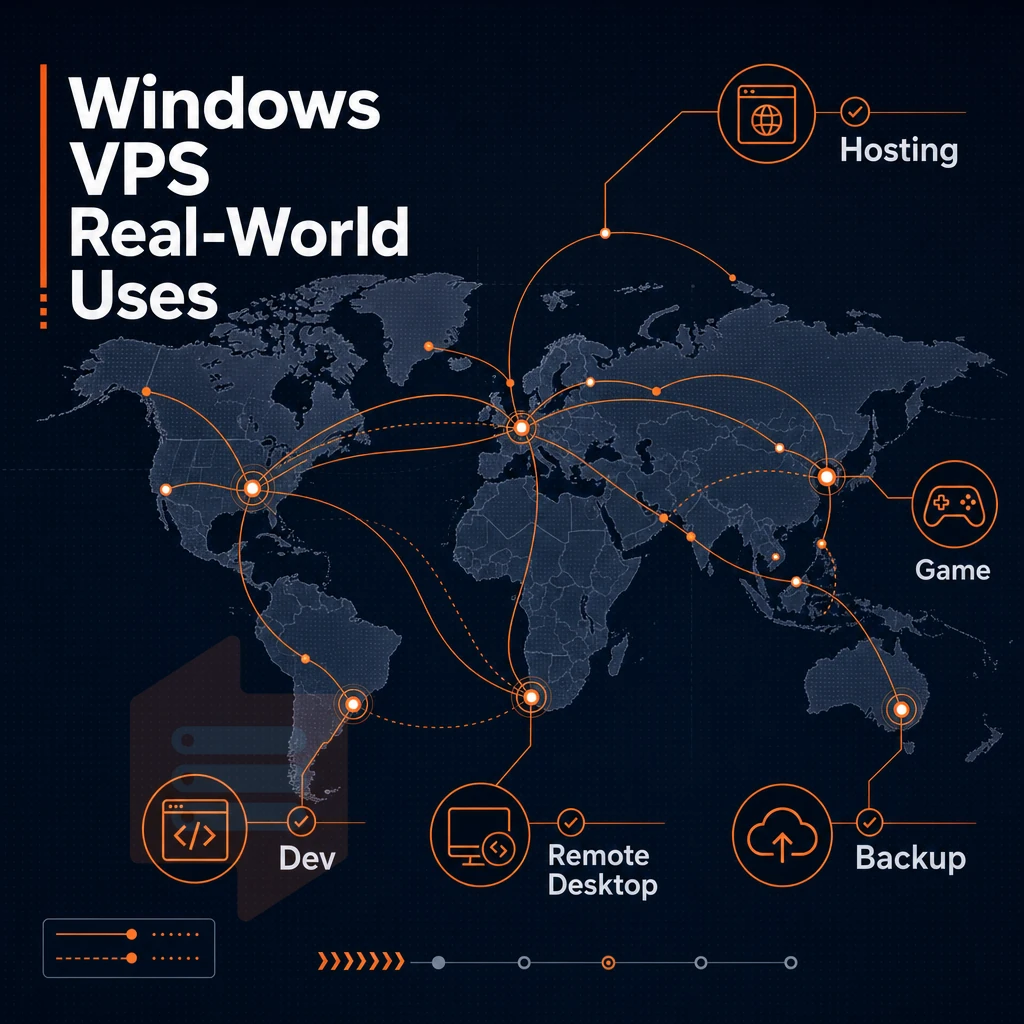
A UK-based VPS is capable of handling a wide variety of workloads. Whether you need to run isolated environments for coding, persistent game worlds or private self-hosted tools and services, a virtual server provides root access and dedicated resources, without the limitations of shared hosting.
VPS hosting services for running multiple sites
A VPS (Virtual Private Server) is often the next step up from shared hosting. You get a complete web hosting service (Nginx or Apache, PHP-FPM, MariaDB etc) fully configured for your web applications.
With a VPS you can run many websites from a single plan, fully controlling SSL, caching and the server side bits of your websites. Unlike shared hosting you won’t have any noisy neighbors and you won’t have any restrictions placed on the version of PHP that you can run. This level of complete control over your hosting environment allows you to optimize performance for specific application requirements without waiting for provider approval or support tickets.
Application, API, and development environments
VPS servers are typically used by people who are deploying custom software, running staging environments and APIs. In KVM each virtual machine runs as a completely separate kernel instance. This means a staging environment can be a near perfect mirror of your production environment. You can install whatever software you need, pin versions of dependencies to specific versions, and fine-tune server settings to only expose the ports you need to.
Game servers, self-hosted tools, and web hosting vpns
Games like Minecraft or Palworld require low-latency, persistent compute resources. Use the same server to run your Jellyfin media server, FTP server or WireGuard VPN endpoint. NVMe storage and a fixed IP address are just a couple of the features that make virtual server hosting ideal for these types of services.
Is VPS safer than a VPN?
They solve different problems. A VPN encrypts your traffic and masks your IP. A VPS is a remote server you administer, it can run a VPN, but it also exposes open ports and requires hardening. Properly configured, a VPS with firewall rules and SSH key authentication is a controlled, auditable environment. A consumer VPN is simpler but gives you no control over the underlying infrastructure.
With the use cases out of the way, a look at how VPS compares with the other two tiers in terms of server management and hosting services when evaluating a potential host can be useful.
VPS hosting vs shared hosting vs dedicated server: which is right for you?
There are essentially three tiers of hosting that dominate the market: shared, VPS and dedicated. The best hosting for your company at any given time in its growth will typically be one of these three options. Additionally, choosing the wrong VPS web hosting plan means you will either be paying too much for excess capacity to run your current workload or be capped and having to throttle a very demanding workload.
How the tiers compare
| Factor | Shared hosting | VPS | Dedicated server |
|---|---|---|---|
| Resource isolation | None, shared pool | Hard-capped per VM | Full, entire server |
| Root access | No | Full root access | Yes |
| Cost-effectiveness | Lowest outlay | Strong mid-tier value | High, hardware overhead |
| Scalability | Limited by plan | In-place upgrades | Hardware-bound |
| Server management | Provider-managed | Self-managed or assisted | Fully self-managed |
When each tier makes sense
Domain hosting for simple brochure sites typically falls under the umbrella of a shared hosting service. But when you need isolated resources, custom software stacks or consistent performance under load, then virtual server hosting is typically the way to go.
A UK VPS is a mid-ground solution between fully-dedicated servers and under-powered shared server s. Our VPS offer dedicated resources in a virtual machine without the high upfront costs or complex management of a full server. On our VPS nodes, we enforce strict memory caps per VPS to ensure that even in very high load situations. Your allocated memory will remain available to you and not get consumed by other VPS on the same node.
Can i run Windows server on a VPS?
The majority of KVM-based providers will support Windows, but you will be charged for the licensing. As a web hosting service, BuyVPS deploy a range of Linux distributions (including Ubuntu, Debian, AlmaLinux, Rocky Linux, CentOS Stream and Fedora) as well as allow upload of custom ISOs. A UK VPS with KVM isolation is a clean and auditable environment, ideal for Linux-native stacks.
The choice of web hosting service tier is only half the decision, where the server resides physically is also key to ensuring that data can reach users in the UK as quickly as possible.
Server location and latency: what UK users need to know
Where your VPS servers are located has a big impact on the page load time, search engine ranking and user experience for your site. For UK users looking to host a UK VPS, the closest BuyVPS location would be Amsterdam, approximately 350km of fiber cable across the North Sea from London. With round-trip latency below 10ms, Amsterdam is a practical location to host UK & Western European-based workloads.
Amsterdam vs. New york: choosing your region
We run 2 regions with identical server settings: Amsterdam (EU) and New York (US East), both running identical hardware and offering the same 99.8% uptime SLA. If you're based in the UK or Europe, Amsterdam is the best region for your web hosting service, but for US-facing applications that need East Coast proximity, New York is the way to go.
| Region | Best for | Approx. latency to London | Uptime SLA |
|---|---|---|---|
| Amsterdam | UK, EU, Western Europe | <10 ms | 99.8% |
| New York | US East Coast, Americas | ~75-85 ms | 99.8% |
VPS web hosting vs cloud hosting: what is the difference?
With a VPS you get a slice of a physical server allocated to you, which could be CPU power, RAM or disk space. You’ll typically get to control the entire server environment within the limits of your plan.
This is different from cloud hosting where resources are pooled and can be allocated dynamically between servers. If you need consistent, high levels of performance and are able to predict demand, then VPS hosting plans would be a suitable solution. However, if you have unpredictable traffic spikes then cloud hosting would be more suitable.
Practical guidance for UK deployments
You can use the Amsterdam location for your VPS servers if your users are based in the UK or in Europe, because of the reliable infrastructure.
Next up is choosing the correct plan type and specifications for your use case.
VPS hosting plans: understanding tiers and specifications

BuyVPS offers three VPS offerings for three different workloads.
Choosing your tier
- Standard CPU VPS, shared vCPU on AMD EPYC Milan processor with DDR4 ECC RAM and NVMe storage. The cheapest option for web applications, development environments and small databases. Good starting point for teams who need full root access but do not want to over-specify hardware for their VPS.
- Dedicated CPU VPS, Pinned Cores on AMD EPYC Genoa processors with DDR5 ECC memory. Provides consistent processing power for high latency sensitive or very CPU intensive applications. No noisy-neighbor contention on the core.
- High Memory VPS, 1:8 vCPU-to-RAM ratio on EPYC Milan processors. Ideal for high-Memory hosting of large databases, in-memory data caches, business intelligence / analytics and other memory-intensive applications where more resources than cores are required.
Our VPS Servers come with full root access, IPv4 + IPv6 dual-stack, KVM virtualization and a choice of Linux distributions including Ubuntu, Debian, Rocky Linux, AlmaLinux and many more.
Billing and upgrades
- You can choose to pay monthly or commit for a year or two to get even lower prices than the advertised rates. We guarantee that you won’t get hit with a renewal price hike in year five, the rate you signed up at will still apply.
- You can cancel anytime. No lock-in penalty.
- Upgrade in place as your needs increase. Your IP addresses remain unchanged.
Note: Avoid over-provisioning at sign-up. Start on the Standard tier and upgrade in place once real load data justifies it.
Do i need technical knowledge to manage a VPS server?
Basic Linux command line skills are required to use a VPS. As root on windows based VPS hosting you have full control over the server, so you are also responsible for installing software, patching servers to fix security holes, etc. Our support team consists of real engineers, not chatbots. New to managing a VPS? Start with a distribution you already know well, like Ubuntu or Debian, and work through a server-hardening HOWTO.
We’d recommend considering BuyVPS in particular for UK & European-based deployments.
Why choose BuyVPS for your VPS server
BuyVPS delivers reliable infrastructure built for workloads that demand consistent performance. Our VPS hosting runs on KVM with a separate kernel per VPS, true isolation, not shared-stack virtualization. Every plan includes full root access, custom ISO upload, and your choice of operating systems including Rocky Linux.
- No-oversell guarantee: Hard memory caps and low node density mean dedicated resources stay yours under real load.
- NVMe RAID10 PCIe-direct storage: Measured at 122,959 4K read IOPS, NVMe SSD storage that's fast by benchmark, not just by spec sheet.
- Pinned cores on Dedicated-tier VPS: Predictable CPU power with no noisy-neighbour interference.
- Amsterdam and New York regions: Identical hardware and pricing in both locations, a strong fit for UK VPS and US East Coast deployments alike.
- No renewal hike, cancel anytime: Same price in year five. Monthly billing with no lock-in.
- In-place upgrades: Easily upgrade your VPS solutions without migration or IP rotation.
Founder-run since 2002, with engineer-level support on every ticket. Reach our team at support@buyvps.com to compare VPS plans for your workload. Once you've chosen a plan, getting your server live is straightforward.
Getting started: how to set up your VPS server
Provision your VPS in minutes, not hours. Our easy to use self-service control panel guides you through the virtual private server hosting setup process, select your preferred Operating System, and be logged in within minutes, all without requiring you to raise a support ticket.
Choosing your operating systems
We offer Ubuntu, Debian, AlmaLinux, Rocky Linux, CentOS Stream and Fedora ready-to-deploy images.
Rocky Linux is a good option for teams migrating from older RHEL environments. Ubuntu LTS is still the most common choice for web and application workloads.
Accessing your virtual private server hosting account
Root SSH access is enabled right away for your server. With root access you can install any packages, kernel modules, and configure anything you need without restrictions. If you are unable to connect to your virtual server via SSH, you can always fall back on the in-browser VNC console to access it directly via keyboard.
How to install custom software and management tools
The control panel takes care of tasks like provisioning, rebooting and OS reinstallation. The API allows for easy management of your fleets by program. Useful for your staging pipelines or automated deployments.
Basic hardening steps after first login:
- Run
apt update && apt upgradeor the equivalent for your distro. - Create non-root sudo user and disable password logon via ssh.
- Configure
ufworfirewalldto restrict inbound ports.
CPU power available from first boot, no throttling and no shared CPU queues even during peak hours.
Virtual Private Servers (VPS) provide users with dedicated resources, full admin access and consistent performance, all for the cost of shared hosting. For UK-based users seeking an affordable price, the most important things to consider when selecting a Virtual Private Server are guaranteed RAM, NVMe storage and a sufficient and non-oversold network.
A VPS (Virtual Private Server) is the next step up from shared hosting when your website traffic has reached the ceiling or you require a consistent amount of CPU power to run the application. The types of users are numerous: online stores, web development environments, game servers and business applications. In short anything that requires a server to behave in exactly the same way at 2 AM as it does at 2 PM.
BuyVPS runs KVM VPS on AMD EPYC hardware with NVMe RAID10 storage, a clean control panel, and hard memory caps per node, no overselling, no surprises. Browse the plans at BuyVPS.com and find the tier that fits your workload.