
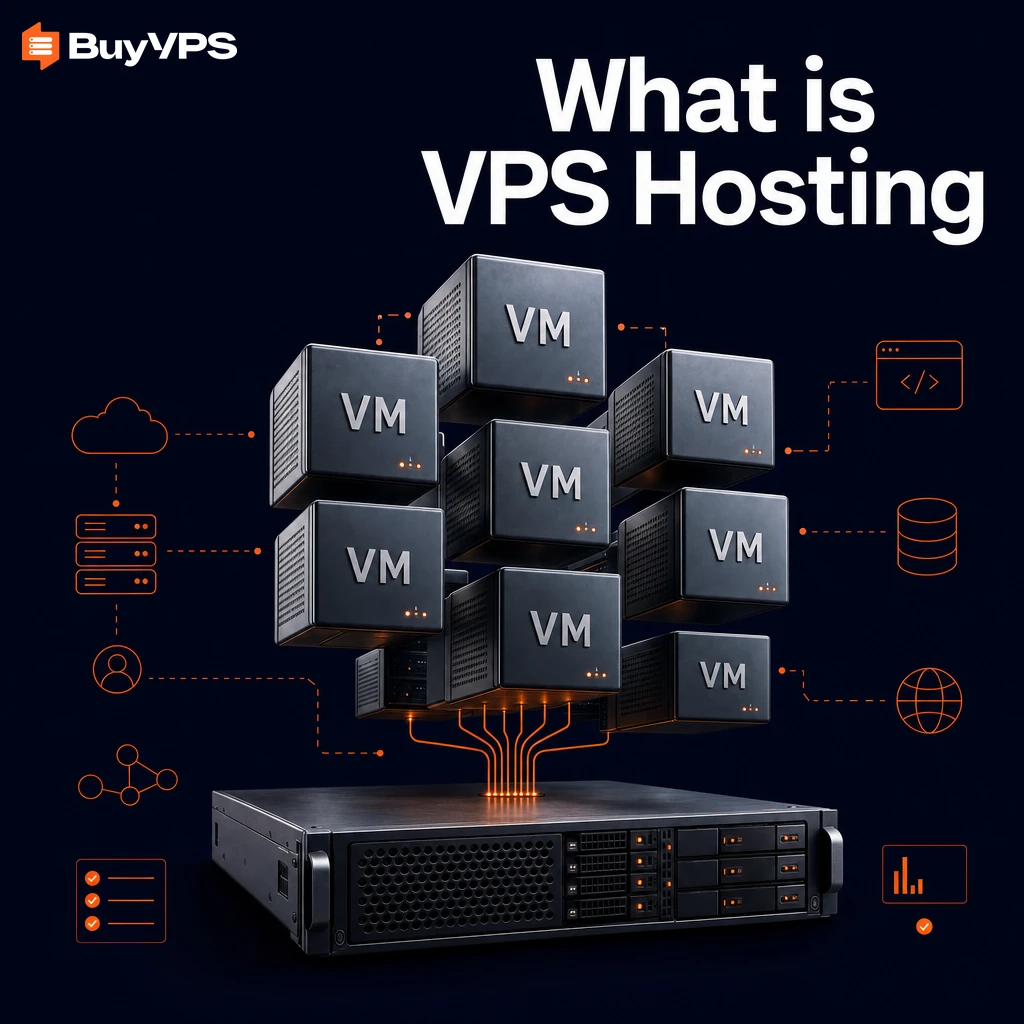
Most web applications will grow out of shared hosting in the end.
At this point, you and your fellow developers and IT staff start wondering what VPS hosting is, how it differs from dedicated hosting, and whether it might solve your problems. A VPS (Virtual Private Server) is a dedicated portion of a server, i.e. a guaranteed amount of RAM, a guaranteed amount of CPU, full root control. This isolation ensures you receive all the resources allocated to your VPS without competition from other users on the same physical machine.
On the other hand, it's typically much faster to provision a VPS than to go the dedicated hosting route of waiting for a server shipment to arrive, get unpacked, and be racked. See Virtual private server on Wikipedia for background.
The following sections go into the details of how VPS hosting works. Additionally, What to look for when selecting a hosting provider. See also: BuyVPS.com/VPS.
For a complete overview, explore our what is VPS hosting guide.
What is VPS hosting? A plain-english definition
A Virtual Private Server (VPS) is a virtualized slice of a real server. It acts as a completely independent server and you have your own resources, such as CPU power, RAM and disk space. On top of these web hosting resources you can also install your own full-fledged operating system and manage it completely as you wish.
First month $1
Then the normal monthly price. One per customer. No setup fee, and a 30-day performance guarantee on your first order.
See the plans“Great experience with BuyVPN! The service is easy to use, the connection has been smooth and reliable, and the overall experience has been really good. The pricing is also reasonable…”
How virtualization splits one machine into many
Hypervisors such as the one used by BuyVPS split a single physical server into separate, isolated environments to run their own kernel images and operating system environments in separate areas of the physical server where each tenant has his own memory and processes that cannot be accessed by another tenant. We use KVM here. For more context, see Virtual private server. Each isolated environment functions as an independent server instance, allowing administrators to configure guest operating systems with custom kernel parameters and security policies specific to their application requirements.
This architecture enables a single physical machine to host multiple virtual servers, each operating independently with dedicated resource allocations and isolated execution environments. The hypervisor layer ensures that resource allocation boundaries remain strictly enforced, preventing any virtual environment from consuming resources beyond its designated limits on the same physical server.
The key difference from a shared hosting provider
As opposed to a Shared Hosting plan where many users compete for CPU and RAM without any isolation, a VPS server configuration guarantees a certain amount of resources exclusively to your account. A traffic spike on a neighbor’s site will not negatively affect your site. In shared hosting environments where multiple users share the same pool of resources, performance degradation becomes inevitable during peak usage periods across neighboring accounts.
When a VPS with your own operating system is the right fit
Understanding why VPS isolation holds when hosting websites under larger traffic loads requires an understanding of the server environment at the level of the hypervisor.
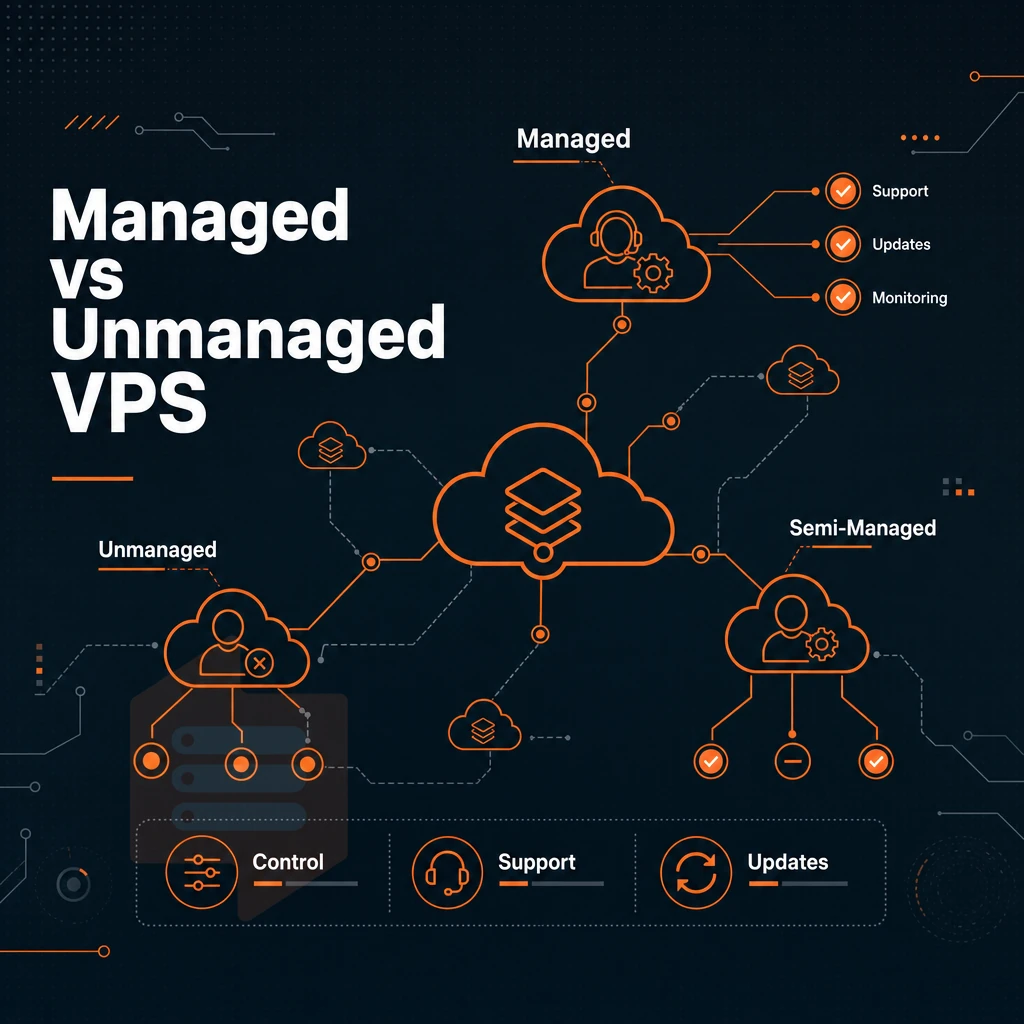
Types of VPS hosting: managed, unmanaged, and semi-managed
Server management responsibilities greatly affect the cost, flexibility and required technical expertise of server hosting.
Managed VPS server hosting plan
The hosting provider manages OS updates, security patches, etc. on your behalf.
Unmanaged VPS hosting on a physical server
Unmanaged VPS hosting is where you have full system access to the server, but you are also 100% responsible for the server. This means you will have to configure the kernel, harden the OS, manage updates, etc. Many developers and sysadmins prefer dedicated hosting as it gives flexible access to the physical server's resources and can end up having a lower total cost of ownership than fully managed hosting.
Semi managed VPS hosting
Semi managed VPS hosting is in the middle of the spectrum. The VPS hosting provider will maintain the hypervisor, the network and the hardware of the servers. Everything above the OS is your responsibility. This means you are responsible for your application stacks, your runtimes and your deployments. Organizations with experienced system administrators often prefer self managed hosting to maintain complete control over their infrastructure and software stack configurations.
Managed hosting versus unmanaged hosting has one main trade-off: control versus convenience. Unmanaged hosting offers more flexibility than managed hosting, but managed hosting has an edge when it comes to operational overhead.
Cloud hosting vs. Self-managed VPS
Cloud hosting platforms abstract the infrastructure even further than a single physical server setup, such that you don't even get to control the OS of the servers. Unlike traditional VPS environments that virtualize resources on a single physical server, cloud platforms distribute workloads across multiple machines for enhanced redundancy and scalability. Cloud platforms enable you to scale resources dynamically based on demand, automatically adjusting compute capacity without manual intervention or downtime.
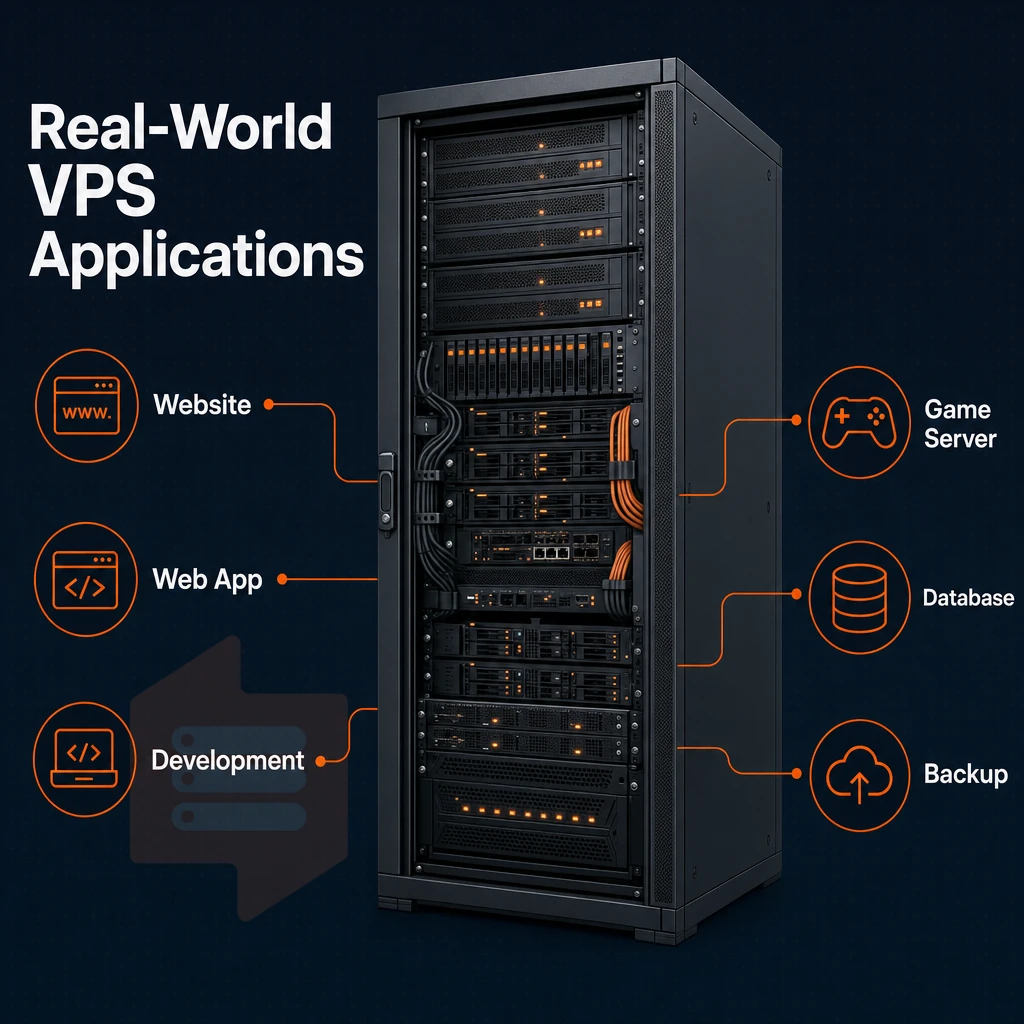
The workloads that can be run on an entire physical server with managed hosting as opposed to self-managed hosting on a VPS are diverse, and it is best to have a good idea of the different types before you go about sizing a plan. Selecting the right hosting plan requires evaluating your workload's resource demands, expected traffic patterns, and whether you need the isolation and control that VPS provides over shared alternatives.
What is VPS hosting used for? Common use cases
VPS hosting can be used to host a wide variety of workloads including websites, web applications, game servers and more. VPS hosting is ideal for websites that require a lot of power and would typically be charged for on a shared server.
With a VPS server, you can host multiple domains from a single server, making it a cost effective solution compared to shared hosting. Hosting providers often allow you to manage multiple websites from a single VPS control panel, streamlining administration and reducing operational overhead for agencies and developers.
High-traffic and production workloads
Virtual private server hosting allows each user to have dedicated RAM and CPU power. This means that high traffic websites will still perform well under load. So if you are running an online shop, a SaaS platform or other media heavy website. Then Virtual private server hosting is the way to go as it provides guaranteed resources as opposed to shared hosting environments.
In a VPS environment, you have the ability to install whatever software you require alongside full control over server resources: custom runtimes, databases or even different versions of the Operating System that are not supported by a shared server environment. Root-level privileges enable granular access management, allowing you to define user permissions and security policies tailored to your application's specific requirements. Root access provides comprehensive administrative control, enabling system-level modifications and the deployment of custom security frameworks that align with enterprise compliance standards.
This level of control makes VPS hosting particularly valuable for businesses requiring custom configurations that align with specific compliance frameworks or proprietary application architectures. Administrators can install software packages from any repository, compile custom binaries, or deploy containerized applications without the restrictions typically imposed by shared hosting environments. This flexibility proves essential when deploying specialized server applications that demand specific library versions, kernel modules, or network configurations unavailable in standardized hosting environments.
Development, staging, and game servers
A Virtual Private Server (VPS) is mirrored 1:1 to production.
Game servers also work very well with low-latency and very predictable performance. Often one can host many game instances on a single physical server, each instance running from its own virtual server, each virtual server running its own kernel. At BuyVPS we use the KVM model for our virtual servers.
Consolidating multiple sites with dedicated resources
One VPS virtual machine can replace multiple servers for the smaller websites and portfolios, hosting agencies and freelancers can host dozens of client sites from a single VPS, managed from one control panel with full privileged access.
Key benefits of VPS hosting
VPS hosting is between shared hosting and a full dedicated server. You get your own dedicated resources that won’t be affected by other users on the server, plus full control of your server, something that most shared hosting packages cannot offer.
Organizations that outgrow VPS resource limits often migrate to dedicated hosting for complete hardware control and maximum performance isolation. While a VPS provides isolated resources on shared hardware, a dedicated server offers exclusive use of an entire physical machine, making it the preferred choice for enterprises with stringent performance or compliance requirements.
Virtual private server isolation and control
Virtualization software such as OpenVZ or Xen enables a host computer to be virtually divided into many Virtual Private Servers (VPS). Each VPS can run its own operating system, is root-enabled and is completely isolated from other tenants. Your data and your resources (CPU, RAM and disk I/O) are in your own private space and are not affected by other tenants.
Physical server performance and scalability
Allocation of hardware resources is done on a per plan basis and can be set with hard caps. To scale additional capacity within the hosting environment, the amount of resources can be increased for a plan without a migration or change of the IP. Game servers, e-commerce applications like online checkouts as well as CI/CD pipelines all profit from low and stable I/O latencies and are stored on NVMe RAID10 storage.
Semi managed VPS options
BuyVPS however combines this flexibility with the best support around, from real engineers, not chatbots. Clients can also request additional services such as custom firewall configurations, backup solutions, and performance monitoring tailored to their specific infrastructure needs. Many providers also offer automated backups as part of their managed service tier, ensuring data protection without manual intervention.
Bottom line: choose VPS when you've outgrown shared hosting but don't need a full bare-metal server. BuyVPS deploys from Amsterdam and New York with NVMe RAID10 storage and in-place upgrades. If you're ready to pick a provider, here's what sets BuyVPS apart.
Dedicated server frequently asked questions
How does a VPS differ from shared and dedicated hosting in using physical servers?
VPS hosting is used to run applications that need dedicated resources and full root access, web servers, databases, APIs, game server s, development environments, and private VPNs are the most common workloads. Unlike shared hosting, a VPS gives you an isolated environment with guaranteed RAM and CPU, so performance doesn't degrade when other users spike their usage. Businesses also rely on a VPS hosting provider to host e-commerce storefronts, run scheduled jobs, and stage code before pushing to production.
Are virtual servers a better hosting option than shared web hosting?
For most serious workloads, yes. Shared hosting packs dozens or hundreds of sites onto one server or virtual machine with no resource guarantees, so one noisy neighbor can slow your site to a crawl. A VPS gives you isolated CPU, RAM, and storage away from multiple users sharing the same server, full admin access, and the ability to install any software stack you need. If your site handles real traffic, runs a database, or requires custom server configuration, shared hosting will hold you back and a VPS is the right move.
Who actually needs a virtual private server VPS over a physical server?
Developers, growing businesses, and anyone who has outgrown shared hosting needs a VPS. Specifically: teams running Node.js, Python, or PHP applications with real traffic who need dedicated server resources; businesses storing customer data who need an isolated environment; and engineers who require SSH access, custom firewall rules, or specific kernel settings. BuyVPS serves these users with both managed and unmanaged hosting options via KVM-isolated VPS plans on AMD EPYC hardware in Amsterdam and New York, with full root privileges and no-oversell guarantees on every plan.
How much does a VPS cost per month?
Entry-level shared-vCPU plans are cost-effective for multiple users running common web applications, while dedicated-core and high-memory configurations carry a higher but predictable monthly cost.
VPS hosting is often positioned between shared hosting and a dedicated server.
The use of KVM virtualization also means that your workload is running on its own kernel with dedicated server settings, which is great for avoiding issues with noisy neighbors and resource contention that can plague shared server.
Managed vs unmanaged is almost as important as the specs for a VPS.
If you're ready to move beyond a shared web hosting environment, or you need more predictable performance from your current VPS, explore BuyVPS's Standard, Dedicated CPU, and High Memory plans. Both Amsterdam and New York are available. See the plans at BuyVPS.com.