


Picking the top VPS cloud hosting is crucial. There are plenty of cloud hosting services out there, and they all promise the same things: good uptime, fast storage, a variety of plans.
And choosing the wrong VPS hosting service could cost you more than just money: hours of migrating your servers, changing your IP addresses, and spending engineering hours you don't have. Many reputable providers now offer free site migrations to ease the transition and reduce the technical burden on your team.
We cut through the hype to give you a real evaluation of the top VPS hosting platforms. For more context, see How do you evaluate "Top Managed VPS Hosting" options ....
We outline the key features you should look for when comparing the best VPS hosting services, the warning signs of oversold servers, and the specific workloads that each tier of service is best suited for. In the end, you’ll have a clear framework for choosing the right hosting provider for your specific needs and avoiding lock-in with any particular vendor.
What is VPS hosting and how do cloud providers make it work?
Virtual Private Servers (VPS) are created from one physical server, but each VPS has its own isolated environment.
First month $1
Then the normal monthly price. One per customer. No setup fee, and a 30-day performance guarantee on your first order.
See the plans“Good support, fast VPS. Thanks!”

How virtualization technology works
In KVM-based VPS offerings, a physical server is partitioned into virtual servers, each booting into a complete operating system environment with its own separate kernel. This is how all of our VPS servers at BuyVPS hosting services run, under KVM with a dedicated kernel for each server, as opposed to sharing a kernel with other servers.
Full root access on every virtual server, install packages, edit system files and even set up the network stack on your virtual server as you would on a bare metal server.
VPS hosting or cloud infrastructure: which is better?
VPS offers fixed resources on known hardware. Cloud hosting scales out over commodity hardware, but comes with variable latency. For workloads that require consistent levels of performance (databases, APIs, game servers, etc.), a VPS server is typically the more reliable offering. Many cloud providers prioritize horizontal scaling and elasticity over the predictable, single-tenant performance guarantees that make VPS hosting ideal for latency-sensitive applications.
In contrast, cloud services prioritize elasticity and multi-region redundancy, which can introduce unpredictable network hops that degrade performance for real-time applications. Cloud platforms also distribute workloads across multiple locations by default, adding geographic redundancy but introducing latency variability that VPS deployments avoid by keeping resources on a single physical host.
Linux and Windows based VPS hosting service
Most workloads run on Linux distributions such as Ubuntu, Debian, or AlmaLinux.
Dedicated, shared, and VPS hosting: choosing the right tier
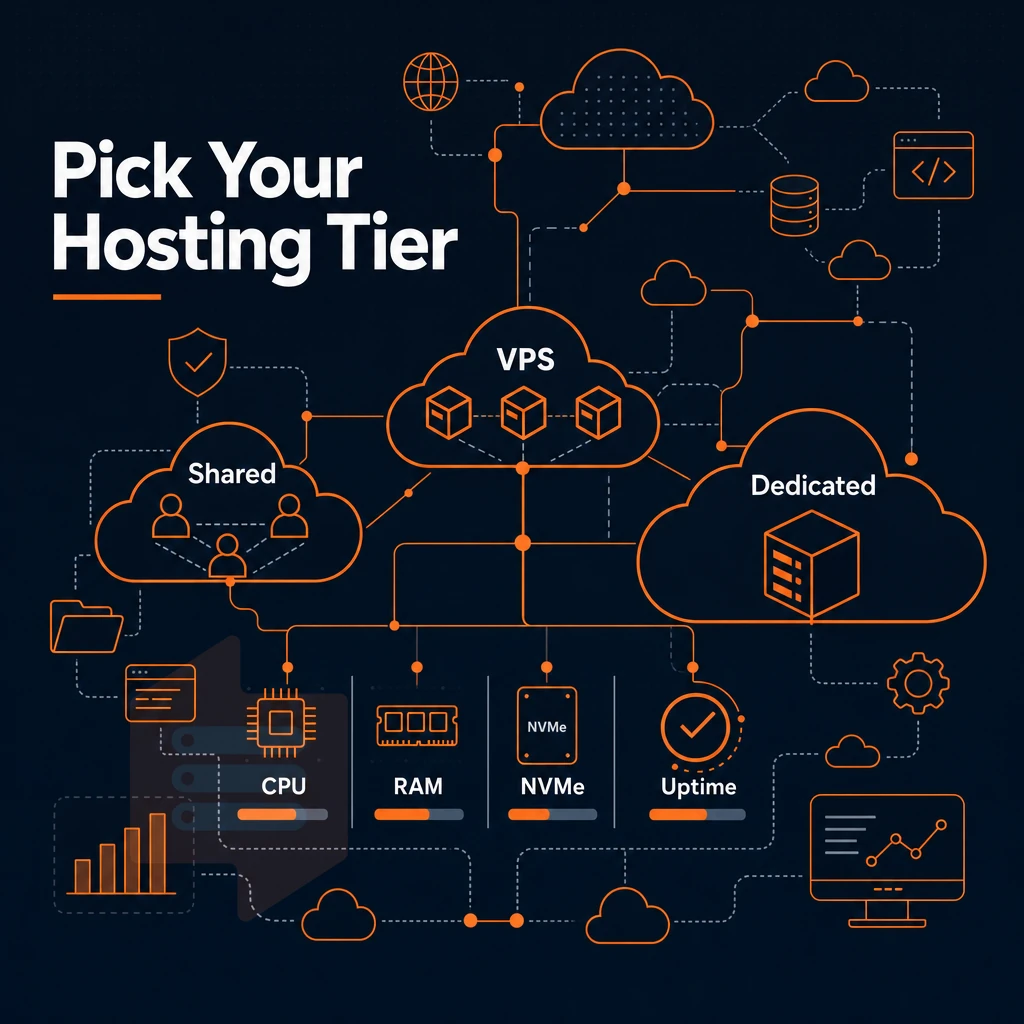
Just because you need web hosting doesn’t mean you need the same web hosting plan. Web hosting services exist on a spectrum, with shared hosting on one end and dedicated servers on the other.
VPS hosting is the middle ground, and understanding where your workload falls, along with your server management needs, can help you choose the right hosting provider, save money, and prevent under-provisioning. Dedicated hosting sits at the high end, offering an entire physical server for a single tenant, while VPS carves isolated environments from shared hardware at a fraction of the cost.
When you've outgrown shared hosting
- Here are the warning signs. Slow loading, Resource Limit is reached errors, and surges in traffic that cause your site to crash are all symptoms that you have outgrown shared hosting. The shared hosting environment by nature limits CPU and RAM to ensure 100+ accounts are running on the same machine.
- Track your actual resource usage. If your host’s control panel graphs consistently hit your CPU and memory caps, you want a hosting solution that provides you with guaranteed, isolated resources as opposed to unguaranteed shared ones.
Choosing the right VPS hosting service and tier
- First rule out dedicated web hosting, a full dedicated machine is best suited for large sustained single-tenant workloads. While it may be a growing site’s best option for now, most growing sites are overpaying for the services of dedicated web hosting.
- Choose a VPS hosting service that suits your growth needs. VPS hosting offers root access, dedicated resources and upgrade in place. We have a VPS hosting service called BuyVPS that allows you to scale up without having to go through IP rotation or migrate your servers.
Note: Avoid any VPS provider that oversells node capacity. Hard memory caps per node, not soft limits, are what guarantee consistent performance.
What is the cheapest VPS hosting provider?
The cheapest VPS hosting option isn't always the best value. Entry-level plans from budget hosts often share overloaded nodes, negating the isolation VPS hosting promises. BuyVPS web hosting services offer Standard CPU plans starting at a competitive monthly rate with NVMe RAID10 storage and hard memory caps, real isolation, not a marketing label.
Check BuyVPS.com for current pricing. Beyond tier selection, the specific features a hosting provider offers, operating system choices, storage type, CPU allocation, unmetered bandwidth, and network reliability, determine whether that plan holds up under real load.
How to choose the best VPS hosting providers for your needs
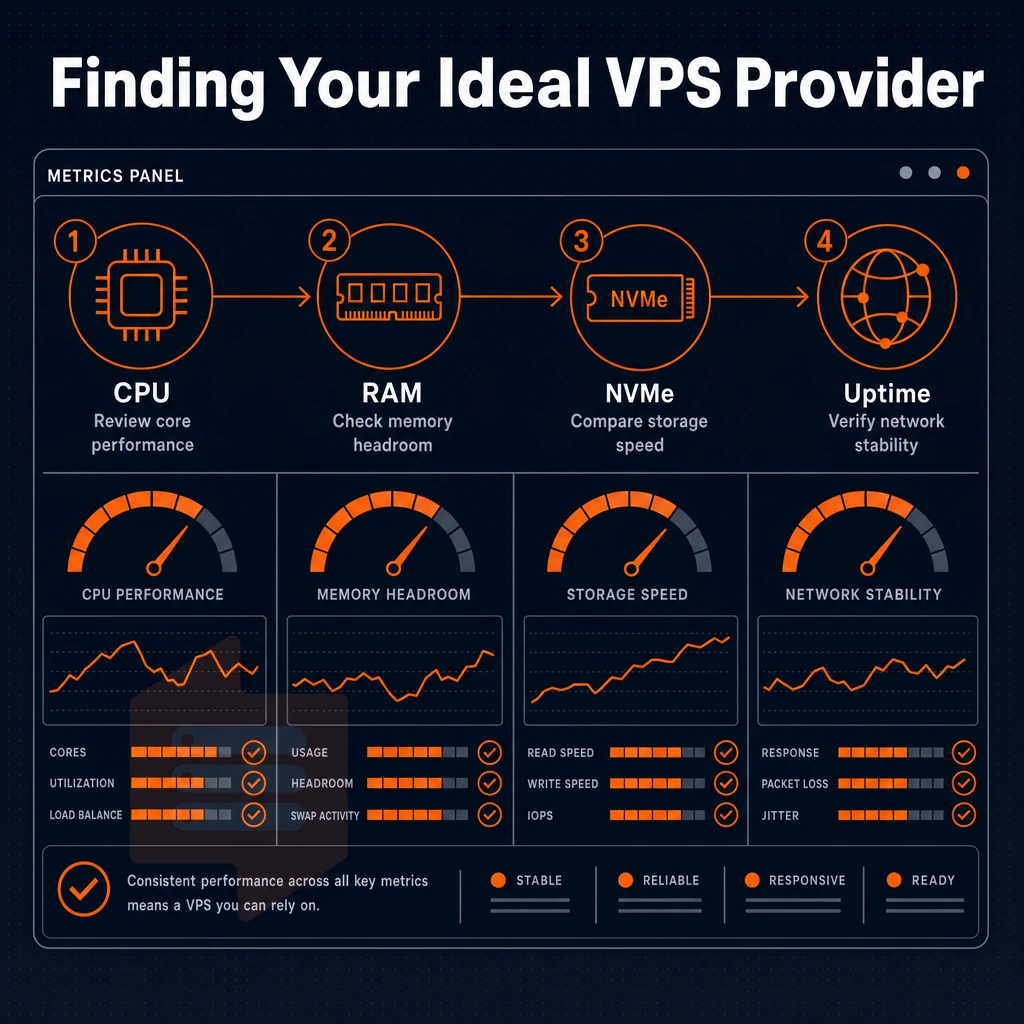
VPS plans are not equal. Good VPS hosting services should offer sufficient hardware, a stable network, and flexible possibilities for the administration of your server. When evaluating providers, prioritize those that clearly document their essential features in service-level agreements rather than burying critical specifications in marketing copy. Evaluating a VPS platform requires comparing not only advertised specifications but also the underlying virtualization technology and network architecture that determine real-world reliability.
Storage, CPU, and RAM
Fast NVMe SSD storage with RAID10 for consistent performance under load, not possible with shared hosting or even with VPS with spinning disks. Dedicated CPU cores (not vCPUs shared between guests) to avoid noisy-neighbor latency spikes. Scalable RAM with hard memory caps to avoid one guest starving all others. Look for providers that include advanced ddos protection at the infrastructure level to prevent volumetric attacks from saturating your allocated bandwidth or overwhelming your VPS instance. Some providers also offer built in caching layers at the hypervisor or network edge to reduce database load and improve response times for frequently accessed content.
Verify that cpu power is allocated as dedicated cores rather than burstable shares, ensuring your workload receives consistent processing capacity even during peak usage periods. Providers should guarantee a minimum allocation of disk space with clear upgrade paths, ensuring your VPS can accommodate database growth and log retention without throttling. Selecting a provider that combines these hardware specifications with proactive monitoring ensures optimized performance across all resource tiers without manual intervention.
BuyVPS assigns dedicated CPU cores on the Dedicated CPU tier and strict memory limits per node, real dedicated resources, not just labeled so.
Does Aws offer a VPS hosting service?
Note that AWS does not sell VPS, and EC2 instances (even those described as ‘Virtual Private Servers’ online) are really fully isolated virtual machines that you have root access to. While EC2 instances can be used as VPSes, the pricing, complexity, and egress charges make them unsuitable for most use cases where one of the best VPS hosting providers offering a simple VPS will suffice.
This is especially true for WordPress sites and development environments, where purpose-built VPS hosting service providers offer simple, predictable VPS hosting plans.
Managed vs. Unmanaged best VPS hosting services
Whether to opt for unmanaged VPS that gives you full control of your server. Alternatively, For managed VPS where your provider handles the patching, configuring and securing of your server for you, depends on your team’s level of Linux expertise and their current operational capacity.
Teams with strong technical expertise can leverage unmanaged options to fine-tune kernel parameters and optimize resource allocation, while those lacking in-house skills benefit from the proactive support that managed plans provide. Managed plans are ideal for organizations that lack the technical know how to maintain server security and performance but still require VPS-level resource isolation.
VPS vs dedicated hosting services and bandwidth claims
Virtual private servers (VPS) are usually sold as a middle ground between shared hosting and a completely isolated physical server. When evaluating the best VPS hosting services, be very cautious of offers for unmetered bandwidth or "unlimited" bandwidth, and read the acceptable-use policy carefully to discover whether there are in fact fair-use caps in place.
For any VPS hosting service, a published SLA with a 99.8% or higher uptime guarantee and clear terms for compensation for downtime below that threshold is far more meaningful than virtually any other marketing claim. Providers that consistently deliver high uptime demonstrate robust infrastructure redundancy and proactive monitoring, reducing the risk of revenue loss from service interruptions. Selecting a hosting provider with transparent SLA documentation also ensures you understand exactly what performance metrics are guaranteed and what remediation you can expect during outages.
Managed services vs unmanaged VPS: which suits your needs?
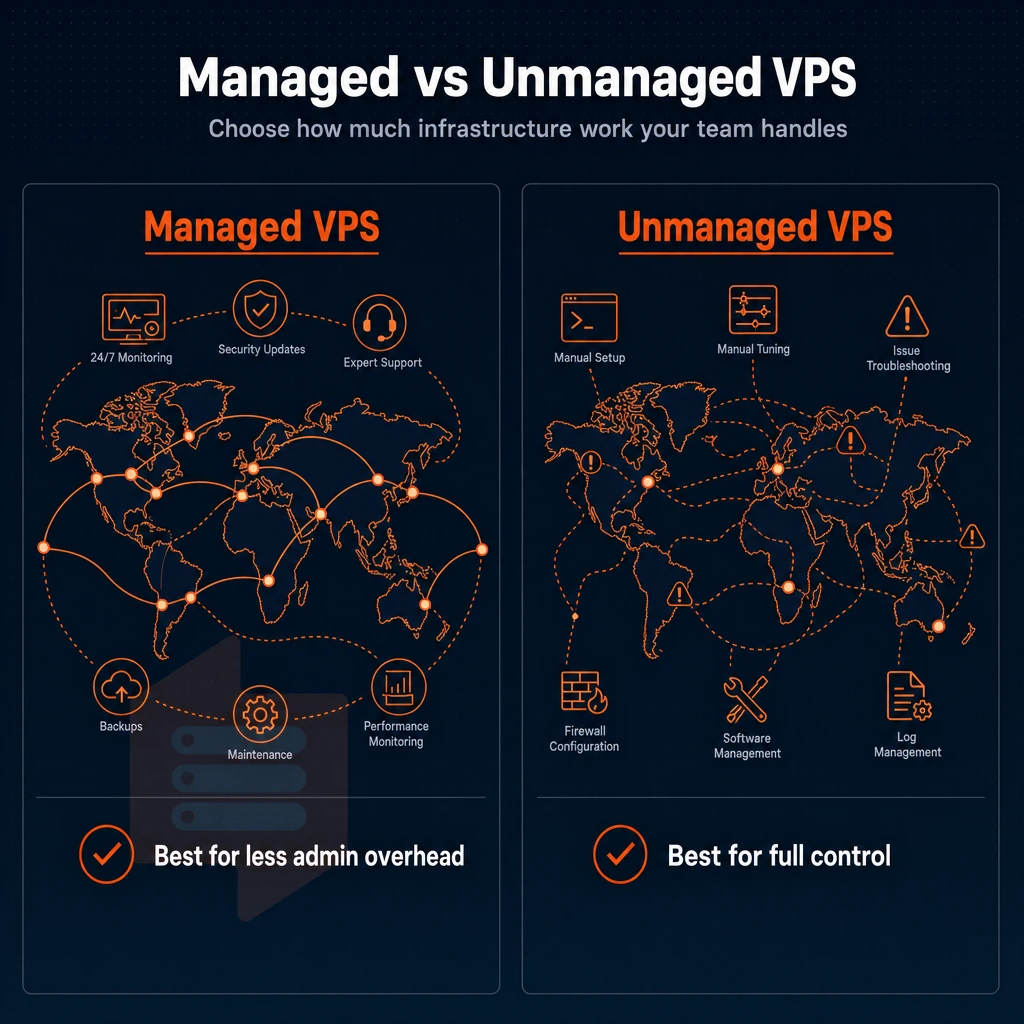
Deciding between managed and self-managed VPS hosting providers essentially decides how much time your staff will spend running infrastructure versus building product.
Managed services: hands-off operations
For managed VPS hosting, you can leave the server administration to your provider, such as updating the OS, applying security patches, monitoring the server and resolving incidents. Your staff will be limited to the application layer.
Dedicated sysadmins are expensive, which is why these web hosting services are intended for teams without a sysadmin.
- OS and software updates applied automatically.
- Security patches deployed on a defined schedule.
- Server management handled end-to-end by the provider.
Unmanaged VPS hosting providers: full control, full responsibility
An unmanaged VPS server gives you root access but that is it.
For the most part, VPS offerings in this category target developers and DevOps engineers. They allow for custom kernels, detailed networking configuration, and containerized applications that most managed hosting services lock down and wouldn't permit on a standard VPS. Providers in this tier often supply multiple control panel options such as cPanel, Plesk, or custom dashboards to simplify server administration without sacrificing configurability.
Which fits your team?
A managed VPS provider is typically the right choice for teams without sufficient Linux expertise that have high SLA requirements and cannot afford downtime caused by their own mistakes. self-managed VPS servers, each running its own operating system, are a good idea for people who need full control over their environment and are willing to handle the operational overhead of maintaining it.
An unmanaged KVM VPS platform, shipped with root access, run on AMD EPYC hardware, and supported by experienced engineers, is a solid base for technical teams who manage their own servers.
Why choose BuyVPS for best VPS cloud hosting
BuyVPS delivers best VPS cloud hosting built on provable specs, not marketing claims. Our VPS hosting service runs KVM with a separate kernel per VPS, NVMe RAID10 storage (122,959 4K read IOPS measured), and hard memory caps that eliminate overselling. Every plan includes full root access and custom ISO support.
- Dedicated CPU tier: pinned cores on AMD EPYC Genoa for consistent performance under real load.
- NVMe storage: PCIe-direct RAID10, benchmarks published, not estimated.
- No-oversell policy: hard memory caps and low node density per host.
- Dual locations: identical hardware in Amsterdam and New York for low latency to Europe and the US East Coast.
- In-place upgrades: scale up without IP rotation or migration downtime.
No renewal price hike. No first-tier chatbots, engineers reply. Founder-run since 2002. Reach out to compare plans or discuss which VPS hosting tier fits your workload.
Choosing the leading cloud VPS hosting comes down to three decisions: the right resource tier (shared vCPU, dedicated cores.
Network quality and hardware honesty matter just as much as headline specs.
If you need full root access, KVM isolation, AMD EPYC compute, and NVMe RAID10 storage across Amsterdam or New York, with no renewal hikes and in-place upgrades, explore BuyVPS's Standard and Dedicated Servers plans. Additionally, High Memory VPS plans and find the tier that fits your stack.