
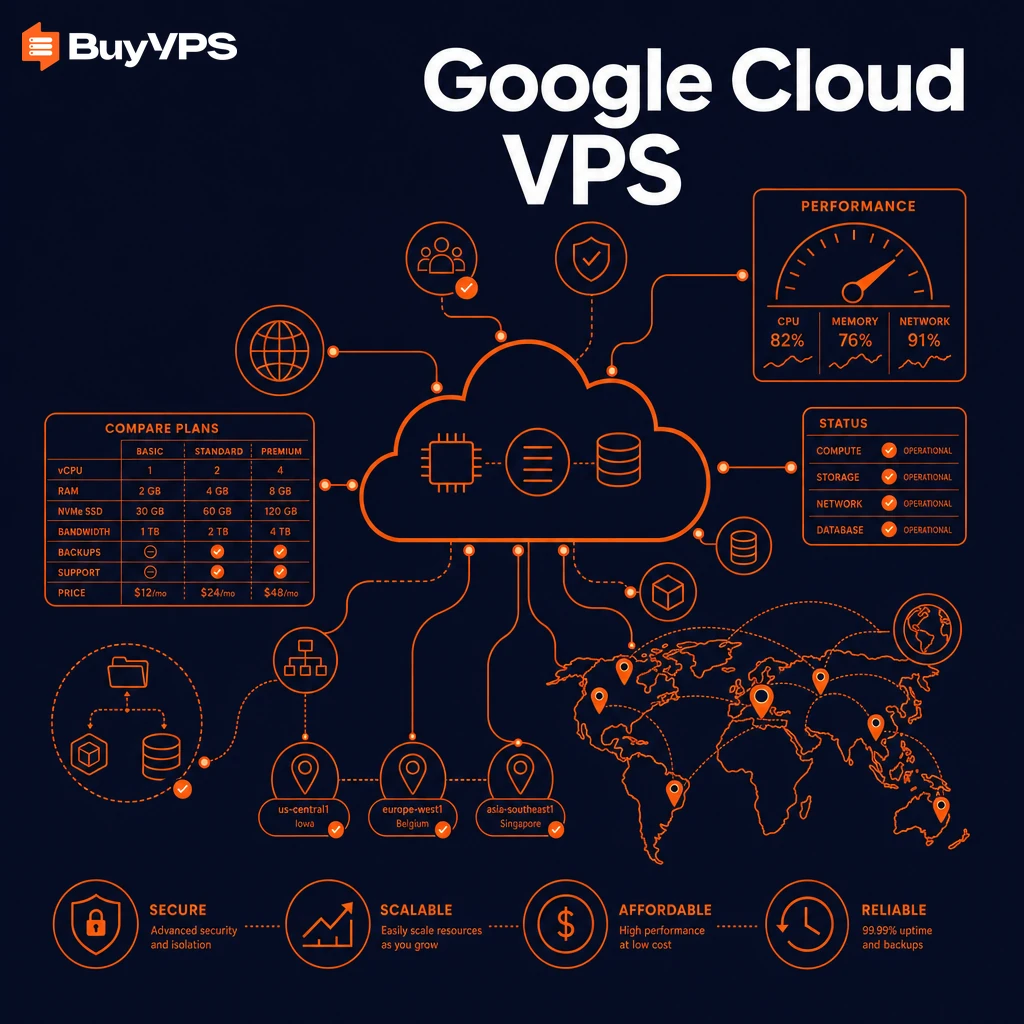
Google cloud virtual machine options have gained serious interest from engineering teams.
Engineering teams need to be aware that choosing the right VPS within your cloud infrastructure is not simply a case of choosing the right amount of compute power, there are also issues of operating system compatibility, control, predictability, and how resources are shared with other users.
Developers often prioritize complete control over their virtual environment to ensure they can configure system-level settings and security policies without platform restrictions. Achieving full control means being able to install custom kernels, modify network stack parameters, and deploy containerized workloads without requiring approval from platform administrators. See Google Cloud Platform on Wikipedia for background.
This guide explores how Google Cloud's virtual machine offerings are structured and where they excel. See also: Amsterdam and New York.
A second part compares purpose-built VPS providers to the hyperscalers on the parameters that matter most for developers managing VM instances: performance, full superuser access, cost transparency, and network quality, helping you decide whether hyperscaler infrastructure or VPS-style virtual servers is the right fit for your stack.
What is Google compute engine and how does it work?
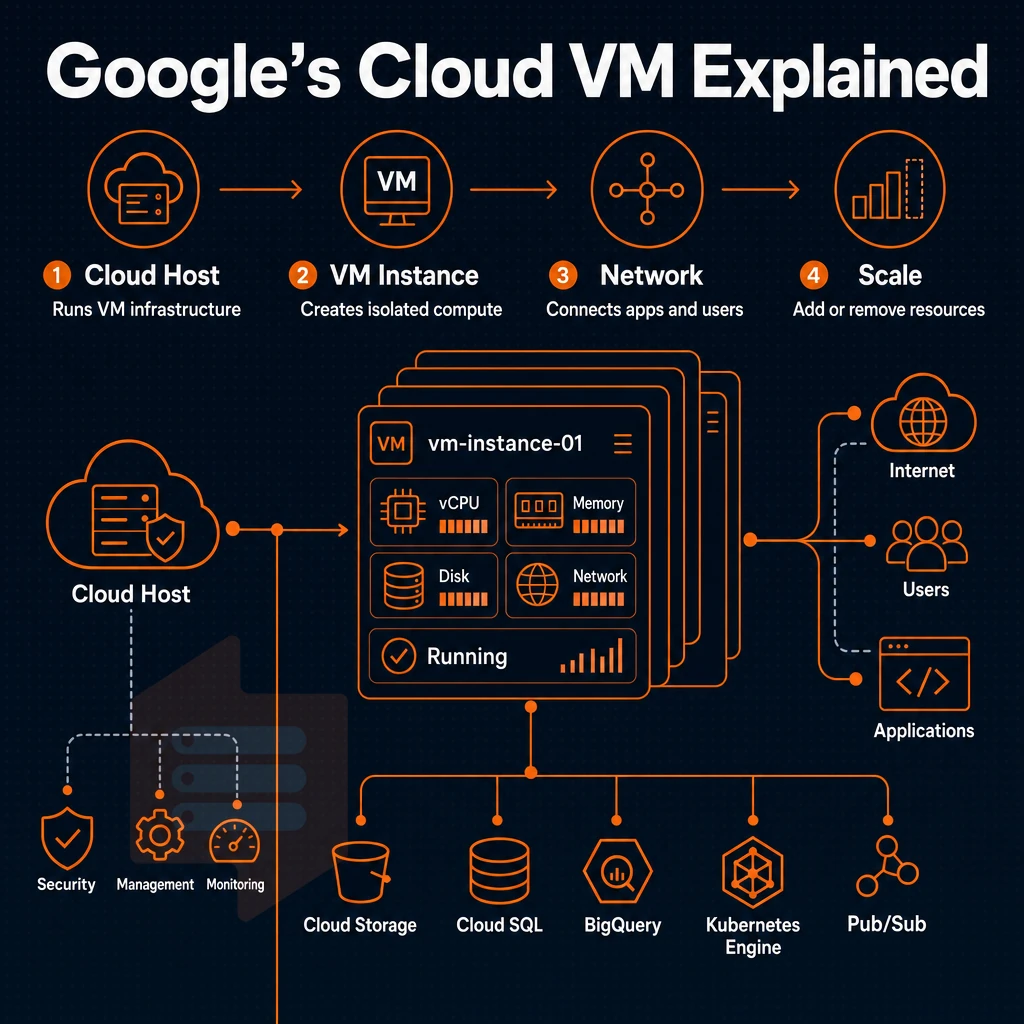
When searching for a Google Cloud VPS on Google Search, you will actually find Google Compute Engine, an infrastructure-as-a-service product by Google that provides virtual machine instances, not a virtual private server in the hosting sense. compare page.
How virtualization creates multiple private server environments
Virtualization software, such as VMware, allows a single physical server to be split into multiple fully private servers.
VPS vs. Renting an entire physical server or full cloud platform
A Virtual Private Server (VPS) is a fixed resource VM that you pick a plan for to get a consistent amount of compute to run your applications on.
The breadth of server platforms in cloud offerings can bring complexity and varying price points. In cases where a single stable VM is needed, a dedicated cloud platform can end up being more than what is required. Organizations running resource-intensive applications may find that a dedicated server offers the isolation and performance guarantees they need without the complexity of multi-tenant cloud architectures.
What this means for your compute engine workload
If your application needs a few VMs at fairly fixed resource levels, a VPS, fully integrated into a simple control panel, is probably a better option than buying a whole physical server worth of cloud services.
Knowing the underlying architecture of Google's Compute Engine, and how it can help or hinder your use of the service, is also important. Teams evaluating whether to adopt a full cloud platform should weigh the architectural trade-offs between managed orchestration layers and direct control over individual compute resources. Organizations deploying containerized workloads at scale often use google kubernetes engine to orchestrate microservices across multiple compute instances with automated scaling and management.
Why BuyVPS excels in cloud CDN and cloud computing services
Google’s cloud platform is very powerful.
First month $1
Then the normal monthly price. One per customer. No setup fee, and a 30-day performance guarantee on your first order.
See the plans“Perfect and fast VPS with good support.”
- KVM virtualization, a separate kernel per VPS, true isolation, not shared compute resources as found with other users.
- NVMe RAID10 storage: 122,959 4K read IOPS measured, not estimated.
- No-oversell policy, hard memory caps per node to ensure your VM is given the resources it was allocated.
- Our D-tier VPS is a dedicated-core server, it runs on pinned physical server cores for lowest possible latency.
- Full root access, custom ISO for your server environment and OS.
- In-place upgrades, no IP rotation and no hidden fees.
We operate data centers in Amsterdam and New York with identical hardware and no-oversell guarantees at both sites.
Shared and dedicated hosting data analytics frequently asked questions
Does google's infrastructure offer VPS control beyond shared hosting?
Google Cloud does not sell a product explicitly called a VPS. Its closest equivalent is VM hosting service, which provides virtual machine instances running on Google's network.
These VMs offer full administrative access and configurable CPU, RAM, and storage, functionally similar to a VPS, but they are marketed as cloud compute instances rather than virtual private servers. If you want a product explicitly designed and sold as a VPS, dedicated providers offer a more straightforward experience with predictable specs and no cloud-platform complexity.
Does Google cloud platform offer free credits for VPS or dedicated servers?
Google Cloud, as a cloud platform, offers a free tier that includes limited cloud server platform usage, specifically one e2-micro instance in select regions, but it comes with tight resource caps and regional restrictions. Beyond that free tier, all usage is billed, and costs can climb quickly once you add storage, egress bandwidth, or a static IP. The free tier is suitable for experimentation only, not high performance production workloads. Purpose-built VPS providers typically offer a transparent, flat-rate pricing model with no surprise egress fees.
How to create a VPS on Google cloud infrastructure
Log in to the Google Cloud Console and navigate to infrastructure compute service, then select "VM Instances" and click "Create Instance." Choose a machine type, select a boot disk image (such as Debian or Ubuntu), configure your firewall rules, and click "Create." SSH access is handled through Google's browser-based SSH tool or by adding your public key to the instance metadata. Once your instance is running, deployment of applications typically involves SSH connection followed by package installation and service configuration through standard Linux commands. Selecting the appropriate machine type determines the CPU and memory allocation for your instance, with options ranging from shared-core e2-micro instances to compute-optimized configurations for demanding workloads.
The process works, but it involves more configuration steps than a purpose-built VPS panel, especially when spinning up a new project on a cloud platform, whereas providers like BuyVPS offer a self-service control panel with in-browser VNC console and API access that gets you running faster.
Cloud platform VPS cost effectiveness compared
cloud VM instance pricing varies significantly depending on the provider and billing model. Large cloud platforms charge variable rates based on compute, storage, and egress separately, making monthly costs hard to predict. Dedicated hosting providers typically offer flat-rate plans with no egress surprises, which lowers total cost of ownership for steady workloads. BuyVPS, for example, offers isolated environments perfect for any new project across Standard, Dedicated CPU, and High Memory tiers in Amsterdam and New York with no setup fees, visit BuyVPS.com for current plan details.
Google Cloud’s cloud computing engine allows users to create flexible, on demand virtual machines that are hosted across Google’s global server facilities. While virtual compute service is a powerful tool, the flexibility in how machines are created and managed can lead to complexity in cost and management of virtual resources, especially at scale.
This global reach enables enterprises to deploy applications closer to end users, reducing latency for geographically distributed workloads. Enterprises with globally distributed users rely on robust internet connectivity and low-latency routing to ensure responsive application performance across continents.
For teams that require raw compute power on a single, purpose built platform and do not require the overhead of a full cloud platform. A VPS (Virtual Private Server) can be a more efficient and effective solution.
If your compute needs are short-lived, elastic and vary greatly from moment to moment then virtual cloud server is your game. For consistent always-on workloads where predictable performance and fixed, reliable costs are more important than auto-scaling then traditional VPS hosting is the way to go. Teams running production workloads benefit from knowing their exact monthly costs upfront, avoiding the budget uncertainty that comes with metered billing models.
If your workload runs continuously, a production database, a busy API, a game server, BuyVPS offers KVM-isolated VMs on AMD EPYC hardware with NVMe RAID10 storage, no-oversell guarantees. This architecture ensures high performance consistency for latency-sensitive applications that cannot tolerate resource contention from neighboring tenants.
The no-oversell policy ensures that your server maintains consistent response times even during periods of increased traffic, preventing performance degradation that can occur in shared hosting environments. Real-time applications such as gaming servers and API endpoints depend on low latency infrastructure to deliver responsive user experiences without perceptible delays.