

Comparing GoDaddy VPS hosting plans can be an exercise in frustration. With features “left out” of the lower plans that sound important until you realize they are not essential.
Is it a physical host or is it a server in a virtual environment? While a lot of web hosting plans list RAM as the main feature of a plan. Experienced web hosts know that for a production server, Linux or Windows VPS alike, the real considerations go beyond other services and come down to the CPU architecture, the virtualization type, storage I/O and network quality. This guide details what GoDaddy VPS plans have to offer against what your production server really needs.
So instead of simply looking for the best provider of a given service, you need to compare the features of plans, from server management to storage limits, to determine which best fits your needs. Compare all VPS hosting plans.
For example, you might look for a plan that offers a dedicated CPU or more NVMe storage than spinning disks, or root access to the server, or support for IPv6 addresses. Evaluating these key features systematically helps you avoid locking into a plan that looks adequate on paper but fails to deliver under production workloads.
In addition to consumer-oriented registrars, there are also many VPS providers, including the specialist provider BuyVPS. For over 15 years, BuyVPS has been operating KVM-based VPS servers on high-performance AMD EPYC hardware in data centers in Amsterdam and New York. By comparing the available options on the market for a given service, you can avoid getting locked into a seemingly affordable plan that ultimately limits your options over the long term. If you have specific requirements for your hosting environment, it's essential to check whether the provider offers full configuration flexibility.
Whether you're evaluating hosting and infrastructure for a single application or a portfolio of projects, understanding the underlying hardware and network topology is crucial for long-term scalability. If you need robust infrastructure with predictable performance, it's wise to choose providers that offer transparent SLAs and clear hardware specifications. Based on your specific workload requirements, you can determine which combination of CPU, memory, and storage best fits your application architecture. The choice of the right infrastructure partner depends heavily on your project's specific technical requirements and the degree of control you need over the server environment.
What are GoDaddy virtual private server VPS plans?
Virtual Private Servers (VPS) are hosted on a physical server, but each customer gets their own virtual slice of that server with their own dedicated RAM, storage and processing power. The alternative to shared hosting is pooled server space where there are hundreds of accounts on the server.
First month $1
Then the normal monthly price. One per customer. No setup fee, and a 30-day performance guarantee on your first order.
See the plans“Good support, fast VPS. Thanks!”
GoDaddy VPS Hosting is a managed hosting solution. It’s designed for customers who want more control over their server than they would get with shared hosting, but don’t want to deal with the full-on management of a server. Choosing the right hosting provider means evaluating not just the management layer, but also the underlying infrastructure quality and support responsiveness. Many businesses transitioning from shared environments prioritize this balance, seeking greater resource isolation without the overhead of hiring dedicated system administrators.
How the managed e mail model works
GoDaddy’s managed virtual private server VPS product offerings are bundled with a control panel (cPanel or Plesk) on top of the VPS hosting infrastructure. In terms of management, the hosting provider will take care of updates for the Operating System as well as other security patches.
Automated back ups are typically scheduled through the control panel interface, ensuring that configuration changes and site data are preserved without manual intervention. Users who prefer cPanel will find it tightly integrated with WHM for account provisioning, while those opting for Plesk gain a unified interface for both Linux and Windows environments.
The control panel will also be configured for the end user. Often the end user interacts with the control panel by way of a GUI (Graphical User Interface) instead of having to interact with the raw commands of a server. This abstraction layer simplifies server configuration tasks such as creating databases, managing domains, and adjusting PHP settings without requiring command-line expertise.
A well-designed server setup ensures that these GUI-based tools are properly integrated with the underlying operating system and security policies from the start. Administrators should verify that automated back ups are configured correctly through the control panel to protect configuration changes and user data.
It limits root access or even gates it.
Virtual private server VPS plans and tier structure
GoDaddy structures its VPS plans across three tiers:
- Entry tier: 1 vCPU, 2 GB RAM, suited to low-traffic sites or staging environments.
- Mid tier: 2 vCPU, 4 GB RAM, the most common starting point for small business workloads.
- Upper tier: 4 vCPU and above, aimed at higher-traffic applications.
All tiers utilize shared vCPU resources. Core allocation is not pinned and therefore variable in terms of performance under load.
Who this targets with a virtual private server
GoDaddy’s hosting plans are designed for the non-technical user, the person who has outgrown the entry-level web hosting and needs a more powerful hosting solution. For the more technical user, the managed hosting solution will provide enough setup for them without having to get into the details of the full server access, custom kernels, etc. Users with limited technical expertise will appreciate the pre-configured environment, while those seeking deeper customization may find the managed approach restrictive.
This balance makes GoDaddy's offering particularly suitable for smaller projects that require more resources than shared hosting but don't justify the complexity of unmanaged infrastructure. Developers often use these managed solutions to quickly spin up test environments for staging applications before moving to production infrastructure. Many small to mid-sized businesses find this tier of hosting strikes the right balance between affordability and performance for their web applications.
Un-touched self managed options for hosting that can guarantee a set amount of CPU power and allow them to customize the kernel, etc. What are the inclusions for each of GoDaddy’s hosting plans?
Key features included in every GoDaddy VPS servers plan
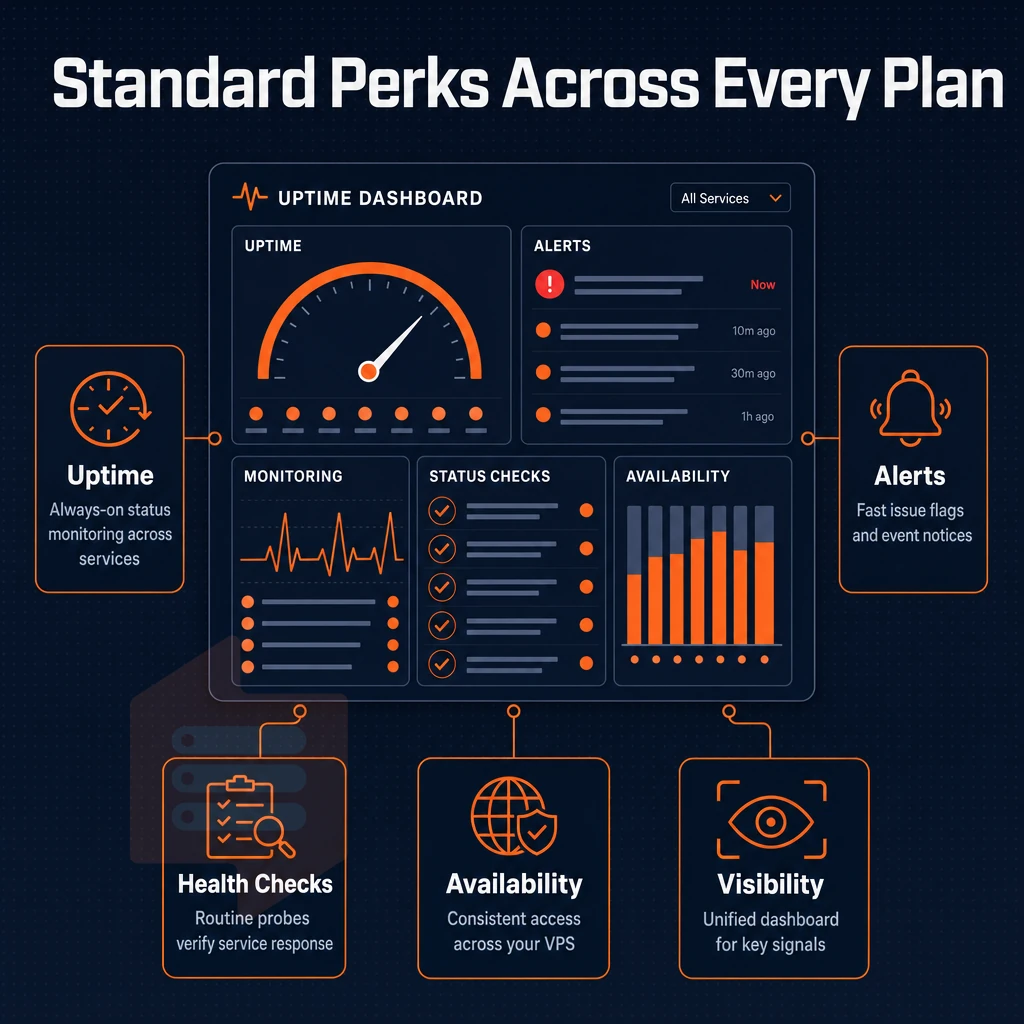
So we know that large managed VPS providers list the same features for the different plans they offer. And so we have to distinguish between the features that a provider lists as standard for the different offers, and the features that come at an extra cost charged by BuyVPS.
Key virtual private server features and storage
Most plans list NVMe SSD storage as the main feature first. Typical entry-level plans come with 40-100 GB of NVMe storage which can vary between the different tiers. The storage is then often marketed as a performance upgrade compared to traditional SATA storage. It especially improves random I/O performance which is important for databases.
superuser access is usually included in all managed and unmanaged hosting tiers. Typically, the free VPS hosting for Linux users will have the option of a variety of Linux distributions (e.g. Ubuntu, Debian, CentOS). On the other hand, the free VPS hosting for Windows users will be set up with a standard.NET/MSSQL VPS configuration, complete with free SSL certificates (either bundled or via the free Let’s Encrypt integration).
Plesk obsidian control panels kun je kiezen
Most managed VPS plans today ship with Plesk Obsidian panel or cPanel, either as standard or as a paid add-on. These control panels make short work of managing a server’s DNS, email and multiple sites. In particular, managed web hosting services aimed at developers are typically offered without a control panel, and with direct CLI (command line interface) access instead.
For users migrating from shared environments, cPanel offers a familiar interface that reduces the learning curve when managing email accounts, FTP users, and database connections.
DDoS protection is usually included in most of the plans.
Where BuyVPS fits for hosting multiple websites
BuyVPS offers KVM VPS with NVMe RAID10 storage, IPv4+IPv6 dual-stack, and engineer-led support from Amsterdam and New York datacenter locations. As BuyVPS does not offer any control panels on their dedicated hosting plans, you can install whatever control panel you prefer and there will be no forced licensing fees on your plan. With that established, I shall go on to describe how GoDaddy's tier structure relates to real workloads.
Why choose BuyVPS for VPS hosting plans
If you've outgrown managed virtual machine or need VPS server provisioning that delivers consistent, no-surprise performance, BuyVPS is built for that transition. We operate KVM-isolated virtual private server VPS instances on AMD EPYC hardware across two data centers, Amsterdam and New York, offering web services with identical hardware, pricing, and control at both locations, along with reliable back ups to keep your data safe.
- Dedicated CPU VPS with pinned EPYC Genoa cores, predictable latency and reserved resources, no noisy-neighbor CPU contention.
- Standard CPU VPS on AMD EPYC Milan with NVMe RAID10 storage, measured at 122,959 4K read IOPS, so storage space performance is provable, not estimated.
- High Memory VPS packages for RAM-intensive workloads that most providers can't serve on standard virtual server plans.
- Full root access and custom ISO on every plan, your operating system, your configuration, no restrictions.
- In-place upgrades with no IP rotation, scale your VPS server management plan without migration headaches.
- Transparent pricing, with engineers (not bots) answering support tickets.
Compare our VPS tiers or reach out to our team at info@buyvps.com to discuss which cloud infrastructure plan fits your workload. You can also reach our team via e mail for technical questions about server configuration, migration assistance, or custom infrastructure requirements.
Frequently asked questions about back ups
Does GoDaddy provide fully managed VPS hosting for Windows with full server setup?
Yes, GoDaddy offers VPS hosting plans aimed at small businesses and developers who need more control than shared managed services provides. Their lineup includes both self-managed and managed tiers for hosting multiple websites, with options to add Plesk's Obsidian release for a control panel interface. If you need a provider with published performance benchmarks, no-oversell guarantees, and dedicated CPU options, independent VPS providers are worth evaluating alongside GoDaddy.
What is the cheapest VPS hosting en option available?
Entry-level virtual private server packages from the majority of hosts start at a low monthly cost for 1-2 vCPUs and 2-4 GB RAM. BuyVPS, for example, offers Standard CPU VPS servers on AMD EPYC Milan with NVMe RAID10 storage and hard memory caps, so you get consistent performance rather than a cheap spec sheet that degrades under real load.
How much is a GoDaddy VPS or dedicated hosting plan?
GoDaddy publishes its VPS pricing on their website, and costs vary by tier, management level, and billing cycle. For a predictable cost, compare GoDaddy's renewal pricing line by line with the transparent flat pricing of alternatives.
How much do VPS hosting services usually cost?
VPS server operations spans a wide range depending on CPU type, RAM, storage, and whether the plan uses shared or pinned cores. A basic shared-vCPU plan with 2-4 GB RAM is at the low end; dedicated-core plans with large RAM allocations sit considerably higher. The smarter question is total cost of ownership for a self managed server infrastructure services, factor in renewal pricing, migration costs if you outgrow the plan, available operating system options, and whether the provider charges for in-place upgrades or forces you to rebuild.
What is the difference between managed and self-managed VPS hosting?
A self- managed server administration plan package gives you full superuser privileges and complete control over the OS, software stack, and security, you are responsible for updates, hardening, and troubleshooting. A managed cloud VPS means the provider handles OS patching, monitoring, and often control panel setup, in exchange for a higher monthly cost and less direct control.
Most developers and sysadmins choose self-managed; managed plans suit teams without dedicated server expertise.
Can i use a custom operating system on a VPS?
Most KVM-based VPS providers support custom ISO uploads, which lets you boot any OS, including niche Linux distributions, BSD variants, or custom builds. For any business owner, GoDaddy's VPS offerings provide a set of pre-approved OS images, and custom ISO support depends on the specific plan tier. BuyVPS supports custom ISO uploads on all plans alongside standard options like Ubuntu, Debian, AlmaLinux, Rocky Linux, CentOS Stream, and Fedora.
What is Plesk obsidian and do i need it for VPS hosting?
Plesk is a commercial control panel that provides a graphical interface for managing websites, databases, email, and DNS, it sits on top of your VPS OS. GoDaddy bundles it with some managed server plan instance tiers as a convenience layer.
You do not need it: experienced sysadmins typically manage VPS environments directly via SSH and command-line tools, avoiding the overhead and licensing cost that a control panel adds. If you are comfortable with the command line, a self-managed virtual server environment with dedicated resources and full root privileges is the leaner, more flexible choice.
GoDaddy's VPS infrastructure management packages, which include regular backups, trade away raw power and complete control for convenience. The managed snapshots, email and interface are all designed to make it easy to get started with a VPS. However, the trade off for the convenience is a very limited choice of OS, a black box for the underlying infrastructure.
If you have needs that require a server to hit predictable levels of performance, require full administrative control, and continue to function in the same manner (even in year 3) as it did when first launched, then a self-managed VPS service platform forms the better platform.
BuyVPS runs KVM VPS on AMD EPYC hardware with NVMe RAID10 storage, hard memory caps per node, and engineer-led support, with server location options in Amsterdam and New York. Compare plans at BuyVPS.com and see whether the specs match your stack.