


While it is relatively simple to order a VPS server and have it up and running within minutes, there are many differences between mediocre VPS web hosting providers and excellent ones.
In this guide we will go through the features that actually matter when choosing a VPS.
We will also go through KVM isolation and how the location of a data center affects latency.
All of our VPS servers are powered by AMD EPYC CPUs and are monitored to ensure that we enforce the Memory Limits per node as advertised, whether you're on an 8 gb plan or higher. Our infrastructure also includes generous bandwidth allocations to handle high-volume data transfer without throttling or unexpected overage charges. Customers requiring substantial memory for containerized workloads or in-memory databases often select our 24 GB tier, which provides ample headroom for resource-intensive applications.
For a complete overview, explore our buy a VPS server guide.
What is virtual private server hosting and how does it work
A Virtual Private Server (VPS) is a partition of a physical server. By using virtualization on the physical servers, each VPS acts as a fully independent server. When hosting websites on a VPS, you get guaranteed CPU, disk space, and RAM through the control panel, all independent from other customers on the same servers.
First month $1
Then the normal monthly price. One per customer. No setup fee, and a 30-day performance guarantee on your first order.
See the plans“Great service! Everything was delivered quickly and worked exactly as expected. the process was smooth, reliable, and professional. Highly recommended!”
Dedicated resources: how the split works
We partition a single physical server up into virtual servers, each running its own Operating System as well as having hard limits on resources such as memory, CPU and storage. Multiple websites share the server, but their workloads never compete for resources as all resources are allocated on a per tenant basis.

KVM is used as the hypervisor at BuyVPS.
VPS vs. Shared hosting and dedicated server by hosting provider
Shared hosting includes dozens of sites running on top of a single operating system without any separation. The only way to get maximum power and control is with a dedicated physical server, and maximum cost. VPS hosting eliminates the need to provision and maintain physical hardware while still delivering isolated resources and administrative control.
A VPS is somewhere in between a shared hosting account and a dedicated server. You have root access to your virtual private server and get to enjoy consistent performance, but you don’t have to pay for a whole server. This middle-ground approach delivers enterprise-grade isolation and flexibility at an affordable price point for growing businesses. VPS hosting bridges the gap between shared and dedicated hosting by offering isolated resources and administrative privileges without the overhead costs of maintaining physical hardware.
How much does a virtual private server cost?
Different VPS plans have different CPU tiers, amounts of RAM and storage space. Check out the current VPS plans on BuyVPS.com. Most providers structure their offerings so customers can easily upgrade between tiers as resource demands grow without migrating to a new server. Scaling your infrastructure to match traffic spikes or seasonal demand can be accomplished in just a few clicks through the provider's dashboard. Understanding how resources allocated across CPU cores, memory, and disk I/O scale with each tier helps you right-size your plan from the start. Providers that offer true elastic infrastructure allow you to tap into scalable resources on demand, ensuring your application can handle unexpected growth without manual intervention.
Businesses experiencing rapid growth often need the ability to scale resources vertically by upgrading CPU and RAM allocations or horizontally by deploying additional VPS instances behind a load balancer. When evaluating different VPS offers, compare not only the headline specs but also the underlying hardware generation, network uptime guarantees, and whether backups are included or cost extra. For instance, a mid-tier plan offering 24 GB of RAM typically supports multiple containerized applications or several high-traffic WordPress sites running simultaneously.
Can i run multiple e commerce websites on a single VPS hosting plan?
Yes. You have full root access and your own virtual environment. You can install a web server, configure virtual hosts and run as many websites as you have resources allocated to you. This flexibility makes VPS hosting ideal for developers deploying custom web applications that require specific runtime environments or non-standard software stacks.
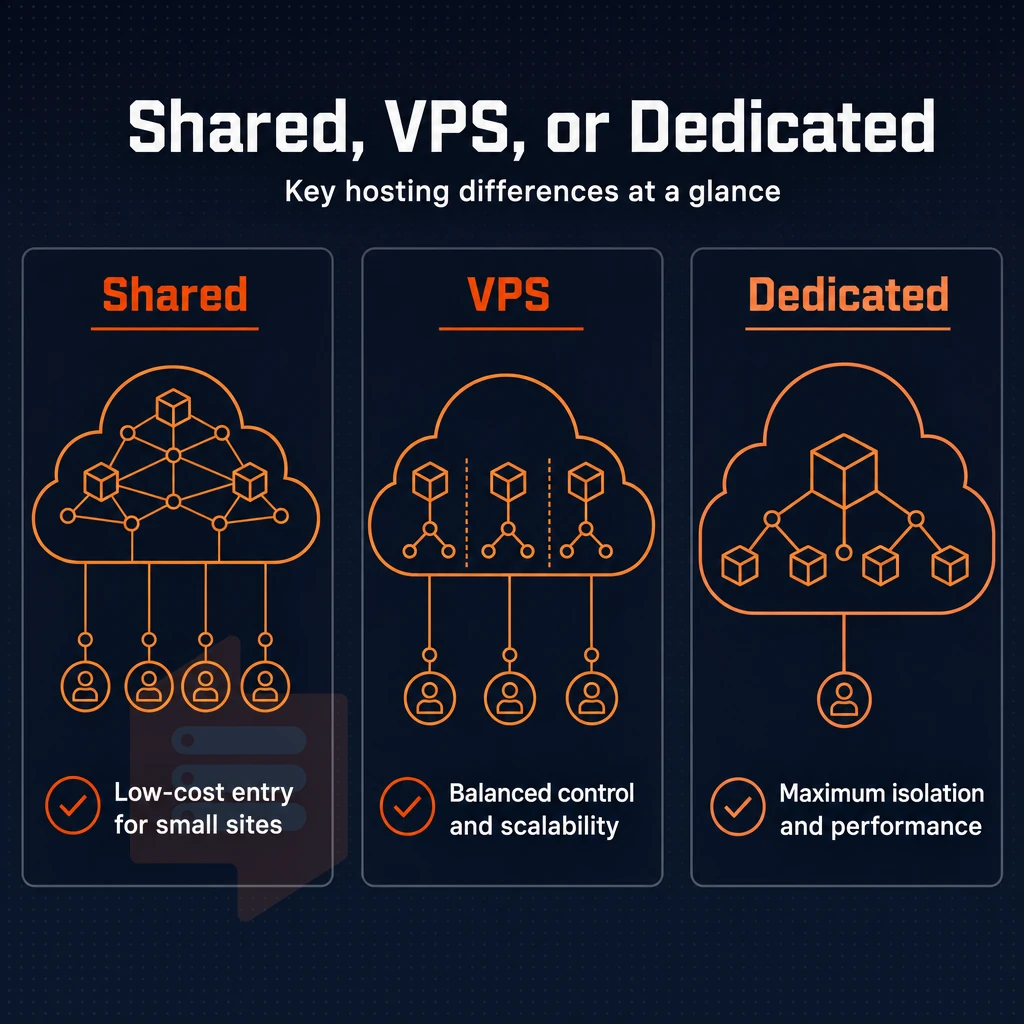
After explaining the basics of a VPS, the question remains: how does an VPS compare to other offerings?
Shared hosting vs VPS vs dedicated hosting: key differences
There are primarily three tiers of hosting on the market today: shared, VPS, and dedicated.
Resource isolation and control
Unlike shared hosting where dozens of websites are hosted on a single OS instance and a noisy neighbor can spike the CPU and affect everyone. VPS hosting carves up the physical machine into isolated virtual servers, each with guaranteed RAM and CPU. With VPS hosting you get to control your own slice of the server and can install packages, configure the kernel and set up firewall rules as you see fit. This isolation becomes especially critical for e commerce websites that handle sensitive customer data and payment transactions requiring stable, predictable server resources.
Many ecommerce sites choose VPS hosting precisely because it offers the security and resource guarantees needed to maintain PCI compliance and protect customer checkout flows. For high-traffic applications, pairing VPS hosting with a load balancer distributes incoming requests across multiple instances to prevent any single server from becoming overwhelmed. Retailers running online stores benefit from VPS isolation because it prevents resource contention during flash sales or promotional campaigns when traffic surges unexpectedly.
One major difference is root access. On a VPS, you control the entire server stack. On a shared hosting account, your host limits you to below the application (e.g. no modifying the OS, etc.).
Performance, consistency, and how to easily upgrade
| Dimension | Shared hosting | VPS hosting | Dedicated server |
|---|---|---|---|
| CPU isolation | None, shared pool | Soft or hard cap per VM | All cores reserved |
| Uptime SLA | Typically 99.5 % | 99.8 %+ | 99.9 %+ |
| Root access | No | Yes | Yes |
| Typical use case | Brochure sites | Apps, APIs, staging | High-traffic, compliance |
Where can i buy a virtual private server?
Most providers offer VPS hosting but the server specs and quality of service can vary greatly. We offer KVM VPS hosting in Amsterdam and New York on AMD EPYC hardware with NVMe RAID10 storage and a 99.8 % uptime SLA. We have hard memory caps and low node density to ensure great performance and not just when you first sign up.
Use shared hosting for a static site or low traffic site. Move up to VPS hosting when you need isolation, custom applications or demand better, more consistent performance. If you need every cycle on a server for your workloads, use a dedicated server.
Organizations with mission-critical workloads that cannot tolerate resource contention often transition directly from VPS to dedicated hosting for complete hardware control. VPS hosting strikes an optimal balance for teams running resource intensive applications that require dedicated CPU and memory but don't justify the expense of bare-metal hardware.
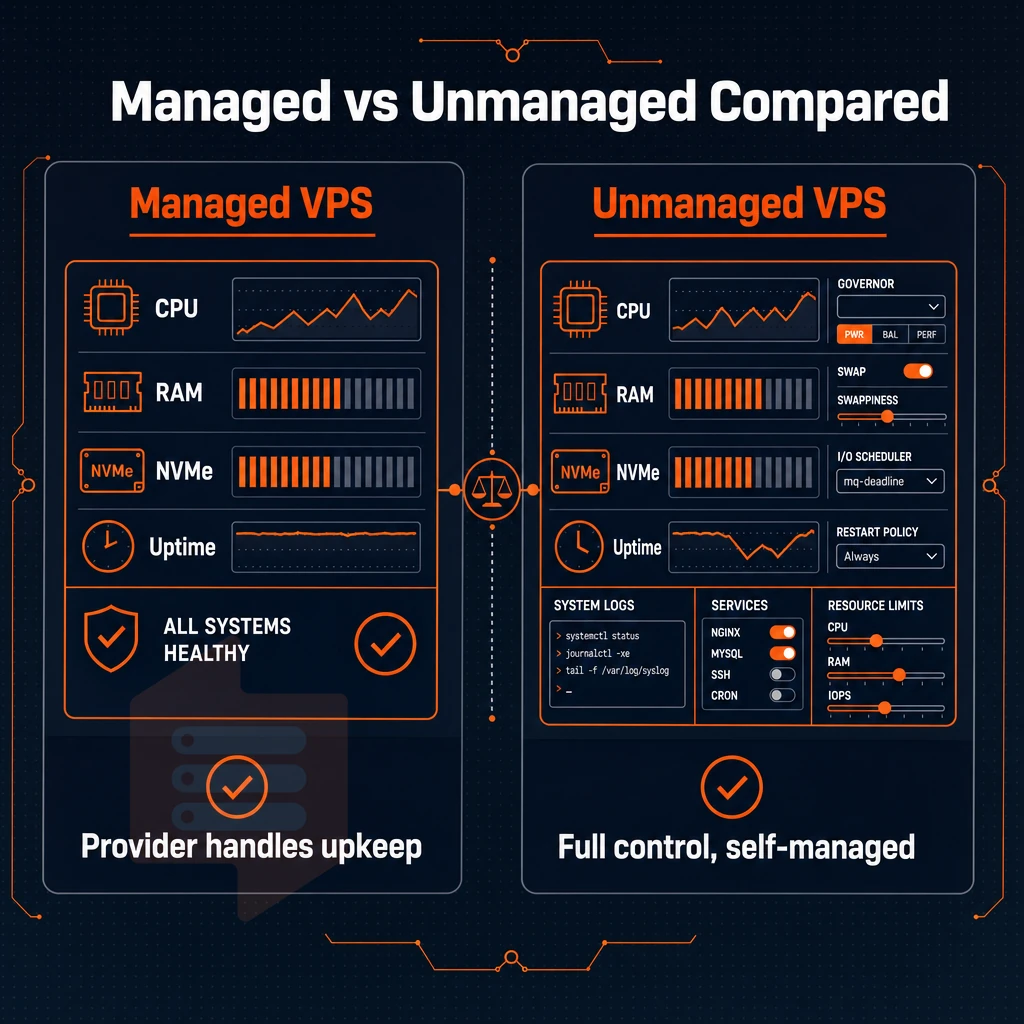
Managed vs unmanaged VPS hosting providers: which is right for you
Deciding whether to have your hosting provider manage the VPS for you (i.e. manage the OS) or if you want to manage it yourself is a major decision when you purchase a VPS server. How you manage your VPS will largely determine the variety of tools you need to maintain your server environment, as well as the types of applications you will be able to run and their associated price.
What managed VPS web hosting actually covers
With managed VPS hosting you get to use a running environment, whereas the provider looks after the OS updates, security patches and core server administration. Managed VPS hosting is ideal for small teams without their own sysadmin. Providers typically include technical support for server-level issues, allowing your team to focus on application development rather than infrastructure troubleshooting.
The trade-off is reduced flexibility. Managed tiers often restrict kernel parameters, custom modules, or direct access to system daemons. If your stack requires fine-grained tuning, custom sysctl values, non-standard kernel builds, or a specific Windows Server configuration, management abstractions can get in the way. Providers offering managed tiers typically reserve advanced features like custom kernel compilation or direct hypervisor interaction for their unmanaged or enterprise plans.
Unmanaged VPS hosting: full root access and full responsibility
Unmanaged VPS hosting is a type of hosting where you are fully responsible for all layers of your server. This means you can select the OS, whether Linux or Windows Server, and apply software updates as well as configure firewall rules and perform service hardening to name a few examples. This type of hosting is typically offered to developers and other IT infrastructure teams who handle their own server management and treat a VPS as nothing more than raw compute resources.
The technical expertise bar for contributing to this project exists. To contribute you will need some level of understanding of Linux administration including package management, SSH hardening, log monitoring and basic server management under load.
Can i find a $5 virtual private server?
Ultra-low-cost tiers do exist, with hard limits (e.g., shared vCPU s, min RAM) and no useful SLA. These will generally hit a ceiling of usefulness pretty quickly, i.e. within a project larger than very personal.
Where BuyVPS fits
All of our plans are sold as unmanaged solutions. That means we set up a fully unmanaged root account for you, a KVM isolated server and a self-service control panel with API access. With our VPS servers, you can pick the OS you like, set up the services and apps you need, and upgrade within a minute without us having to move anything or change your IP address.
Engineers directly reply to support tickets with proper technical answers and not with a copy/paste reply. This is especially important at 2 AM when you’re in the middle of debugging.
Unmanaged VPS Hosting is best suited for teams without specific IT skills and BuyVPS is the most capable and cost effective option to manage your servers. We give you the tooling to work fast, but still full control of your servers. A short introduction on what to look for when comparing the specs of different plans.
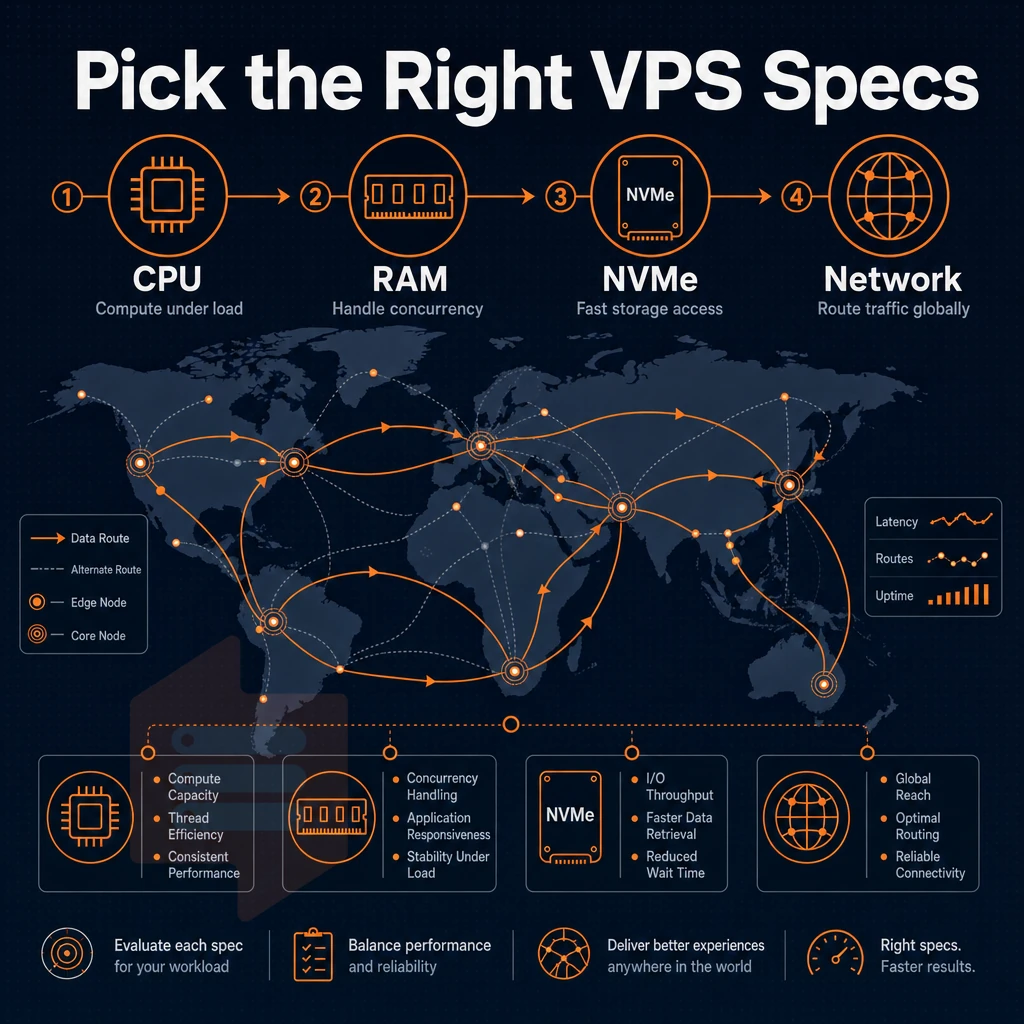
How to choose a VPS hosting plan: specs, storage, and network to evaluate
The specs for a VPS plan tell you exactly how a server will perform under load.
You can tell exactly how a server with a given set of specs will perform under load.
How to choose VPS hosting: RAM, CPU, and storage
First match the amount of RAM on your node to your workload: a 4 GB node runs one app or a small database. A 8 GB node runs concurrent processes or a busy CMS. 24 GB is required when multiple websites run from the same environment or you use in-memory caching.
CPU type and number of CPU cores matter almost as much as CPU cores are shared. With bursty traffic shared vCPU is completely fine. However with databases and real-time APIs constant low latency is crucial and that’s why we’re using pinned dedicated CPU cores on Dedicated CPU tier, EPYC Genoa CPU cores to be specific.
For heavy database workloads, NVMe SSD storage is a must.
Network: bandwidth, dual-stack, and DDoS protection
Avoid plans that advertise "unlimited bandwidth" and don't publish a fair-use cap in the small print.
As standard edge-level DDoS protection should be enabled for all nodes. For more advanced web hosting setups, please check if the respective provider supports integration with load balancers as well as private networks (VLANs) between the individual nodes. We grant VLANs upon request.
What is the difference between managed and unmanaged VPS hosting?
An self-managed VPS is fully unmanaged by you. It has root access, you can install any OS you want, and it can be fully secured as you see fit.
Managed hosting includes OS patches, monitoring, and support for your stack, but costs more and is less flexible.
Control panel and OS options
You can control your server using a self-service control panel, using the provider’s API, or even using a VNC console within your browser. Many providers allow you to upload your own custom ISO images, important for users with non-standard builds. The vast majority of virtual private servers are offered as Linux VPS plans, but there are also Windows VPS plans available for people who need.NET or Active Directory-based servers.
After you matched the specifications of a VPS to your needs, you can easily purchase and set up a VPS.
How to buy a VPS server: from physical server to first login
Buying a VPS server online typically takes only a few clicks.
Step 1: choose a region and hosting plan tier
Choose Amsterdam for EU-based workloads and New York for US East Coast-based workloads.
| Tier | Hardware | Best for |
|---|---|---|
| Standard CPU (S-tier) | AMD EPYC Milan, NVMe, DDR4 ECC | Web apps, dev environments, small databases |
| Dedicated CPU (D-tier) | EPYC Genoa, pinned cores, DDR5 ECC | Latency-sensitive APIs, CI/CD, game servers |
| High Memory (H-tier) | EPYC Milan, 1:8 RAM ratio, NVMe RAID10 | Large in-memory caches, analytics, big DBs |
Linux VPS servers operating system options
After selecting a web hosting plan, choose your preferred Operating System from our list of supported OS's including Ubuntu, Debian, AlmaLinux, Rocky Linux, CentOS Stream and Fedora. You can also upload your own ISO file if we don’t list your preferred OS. All virtual machines are configured with full root access and IPv4 + IPv6 dual-stack by default.
Do i need technical expertise to run a VPS physical server?
While some knowledge of Linux is expected, in-depth knowledge of the operating system will not be required. The self-service panel gives you full control over the majority of server actions such as provisioning, rebooting and re-installing the OS.
Any issues with a server that has been mis-configured can be fixed from the in-browser VNC console. Should any further issues arise with shared web hosting or other services, users will be able to receive reliable support from real engineers instead of from chatbots at support@buyvps.com.
DDoS protection and network security
By default all of our VPS hosting plans come with edge filtering and an abuse-policy-based firewall. Optionally we can set up VLANs for you to isolate a private network within your VPS instances. Most other VPS hosting providers don't include these by default, and you'll find out real quick where they fall short under load, BuyVPS includes them all.
Decision guide
Instead of just comparing the top advertised features like 8 gb RAM for VPS providers, compare them on pinned cores, storage IOPS, and real support quality.
The differentiators that set us apart from other dedicated hosting companies serving multiple users are designed and built into the operation and architecture of BuyVPS.
Why choose BuyVPS when you buy a VPS server
When you get a VPS, the hosting provider you choose determines whether your virtual private server delivers consistent performance or quietly drains productivity. Built around a no-oversell policy: hard memory caps per node and low node density mean the dedicated resources your VPS hosting plan promises are the resources you actually get.
- KVM isolation with a separate kernel per VPS, true virtual machine boundaries, not a shared server environment where other users affect your workload.
- Full root access on every plan, complete control over your operating system, software updates, and server administration from day one.
- NVMe RAID10 PCIe-direct storage, published benchmarks confirm 122,959 4K read IOPS, so good VPS storage performance is measurable, not marketing copy.
- Pinned cores on the Dedicated CPU tier, unlike shared hosting or standard virtual servers, your vCPUs are never contested.
- In-place upgrades, no IP rotation, scale resources without migration downtime or reconfiguring your DNS and load balancer.
- Data centers in Amsterdam and New York, low latency for EU and US East Coast workloads, with identical hardware and network specs at both sites.
Engineer-staffed support, not chatbots, backs every self-managed VPS hosting deployment. If you want reliable support and a hosting provider with no renewal price hikes, reach out to our team to compare VPS plans for your workload. Those qualities add up to a clear advantage over the alternatives, which brings the case for VPS hosting full circle.
The core advantages of buying a VPS server over other hosting options
Virtual private server (VPS) hosting is often considered to be between shared hosting and dedicated servers. The hosting provides a customer with dedicated resources within a virtual environment that is fully isolated from other customers’ environments.
In addition, customers have complete control over their server as if it were a physical server. Full root access is provided to the server allowing customers to configure, install, and manage everything as needed to support their workloads.
There are many advantages to using a VPS hosting server. VPS hosting servers run on a virtual machine that can scale as needed with growing traffic and can often be upgraded within a few clicks of a mouse.
So if you are looking to purchase a VPS server that provides great performance and is scalable, then the advantages listed above are great to have in a VPS hosting server. The main advantages are a VPS hosting server provides you with dedicated resources, great isolation and no ceiling on your ambitions.
When choosing virtual private server hosting there are three major choices to make: amount of isolation, managed or unmanaged, and the correct specs for your intended workload, not the cheapest option to start with. A VPS provides you with dedicated resources, full root access, and consistent performance, which is not possible with shared hosting.
The main distinction between managed and unmanaged dedicated hosting that most buyers get wrong is whether their team manages the server or not.
BuyVPS runs KVM VPS on AMD EPYC hardware across Amsterdam and New York, with hard memory caps per node starting at 8 gb, NVMe RAID10 storage, and no renewal price hikes. If you're ready to spec out a plan, browse the BuyVPS plans and find the tier that fits your workload.