

I am searching for a cheap VPS Europe hosting service. Most providers advertise cheap entry-level plans but at the end of the day they trade off performance for low price. In reality I am searching for a European VPS hosting service with fixed performance, root access and fixed costs.
Learn what really matters for hardware and network configuration in European data centers, which workloads need dedicated CPU cores versus shared vCPU, how to measure storage I/O, and where to find affordable, reliable VPS providers.
For example, BuyVPS provides AMD EPYC powered VPSes running on top of NVMe RAID10 storage, located in Amsterdam. Affordable VPSes with hard memory limits per node make for a reliable hosting plan, as long as you select them based on the right criteria, as presented in this guide. Their managed services include automated backups and monitoring, ensuring your infrastructure remains operational with minimal administrative overhead.
What is a cheap VPS in europe, and what should it actually include?
A Virtual Private Server (VPS) is often between Shared Hosting and a Dedicated Server (full physical server). On a VPS you get to use isolated server resources (your own RAM, vCPU and storage etc) but you are not renting a whole physical server. Here “cheap” refers to strong value per resource (i.e. very powerful for the money) rather than just low price tag. For community perspectives, see What's the Cheapest EU based VPS provider..
First month $1
Then the normal monthly price. One per customer. No setup fee, and a 30-day performance guarantee on your first order.
See the plans“Very satisfied with the service. The server was provided quickly, and everything worked perfectly. Fast response, reliable service, and great overal experience!”
One workload where an EU location matters more than price is bookkeeping and ERP; our Odoo and ERPNext VPS guide keeps the data in Amsterdam.
What VPS hosting actually gives you
Your virtual server will be running on its own kernel at affordable prices, away from the noisy neighbors that might be using up all your allocated resources. With full root access you can install, configure and run whatever you need.
The control panel interface provides straightforward management of your virtual server resources, allowing you to monitor usage, reboot instances, and adjust configurations without requiring command-line expertise. Modern virtual machines provide this isolation through hypervisor-level resource allocation, ensuring predictable performance even during peak usage periods across the host infrastructure.
The main practical difference from shared hosting is the level of control that you have. With a VPS account, the hard resource caps on the server ensure that no account can cause problems for others.
Which VPS server provider in europe is the cheapest?
Instead, ask yourself which cloud provider running data centers in Europe will give you the most RAM and storage for your money without overselling the hardware at their marketed price. Comparing the specifications and monthly costs across providers helps you identify which option delivers the best price for your specific resource requirements. Evaluating european cloud infrastructure requires examining not just advertised specifications but also the underlying hardware allocation policies that determine whether you receive guaranteed resources or share oversubscribed capacity.
If nodes are oversold, a lower number in web hosting means the hardware gets saturated by users, operating system processes, and the workloads that price actually covers.
Amsterdam and New York both run AMD EPYC with NVMe RAID10 storage and hard memory caps per node.
Is a cheap VPS europe server gdpr-compliant?
Europe VPS hosting based in the EU (e.g.
When running virtual servers, it is the user's responsibility to maintain full control over encryption, access rights, and data removal policies in order to remain compliant.
Why data centers in europe matter for performance
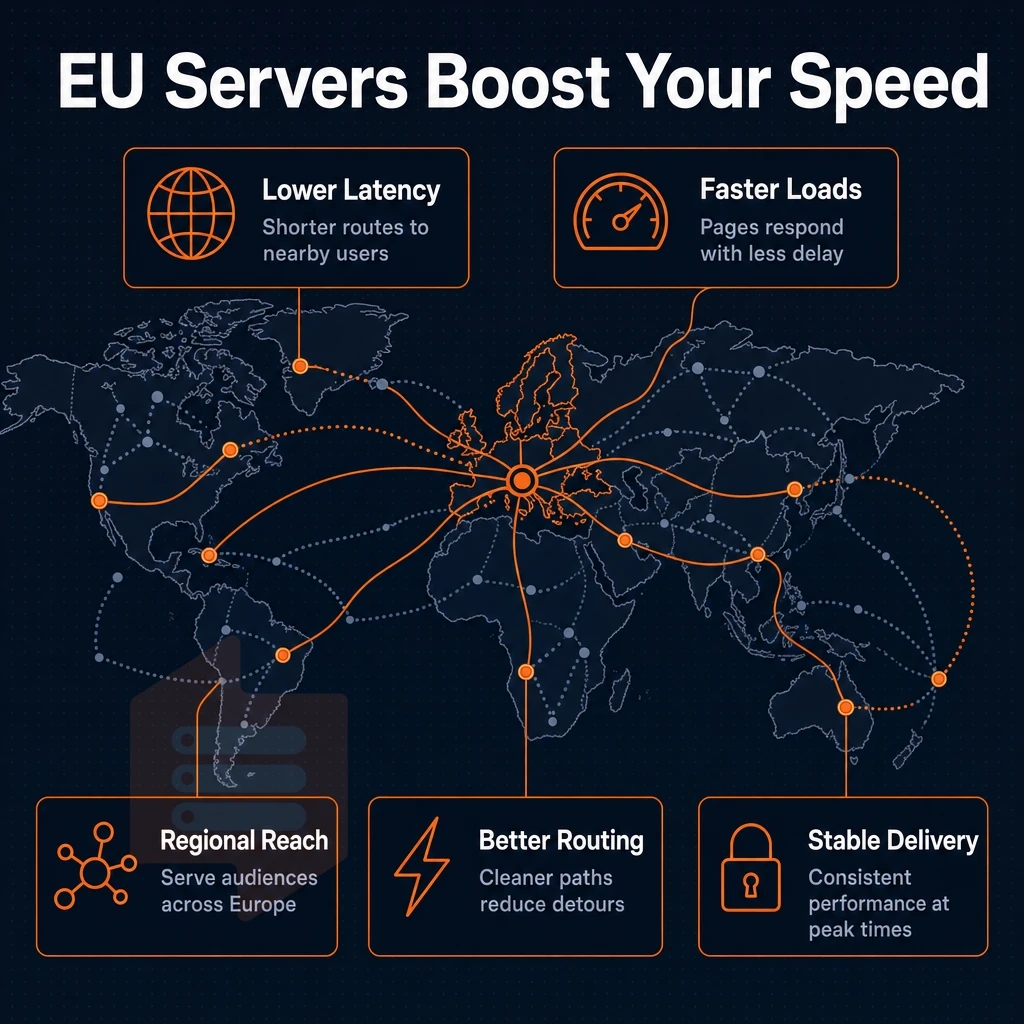
The location of your physical server can greatly affect the loading time of web pages for real end users. For businesses targeting audiences in Europe, choosing servers in Europe rather than a server in Virginia can eliminate the 80-120 ms of additional round-trip time that comes from the difference in server location. Potentially negatively affecting your business’s online conversion rates and search engine rankings.
Why server location shapes EU performance
Latency is physics. So a server in Europe can serve a visitor from the EU, because they are on the same continent. So for nearby users the round-trip time will be under 10 ms. A server hosted across the Atlantic Ocean, regardless of the operating system it runs, will add 80 ms or more to the round-trip time for a single byte to reach the browser of a visitor in Berlin or Paris.
European data centers and gdpr compliance
Just storing user data within the EU is not enough. Even under the GDPR, the transfer of personal data to a third country (i.e. outside the European Economic Area) requires additional legal mechanisms. By choosing to host on European data centers, all of this is automatically taken care of. Your data is hosted within the EU under the jurisdiction of the EU and none of the cross-border transfer agreements will apply.
The US CLOUD Act is also relevant here. While a cloud provider based outside of the EU may be forced to release data held anywhere in the world (including within the EU). Such a provider based in the EU would clearly be exposed to less such compulsion.
Organizations evaluating european cloud solutions must weigh these jurisdictional considerations carefully when selecting infrastructure partners for sensitive workloads. Evaluating hosting providers requires understanding how their legal structure and operational policies affect your ability to maintain compliant services across jurisdictions.
Where is the cheapest europe VPS hosting?
European VPS that’s cost effective is supplied by web hosts who run their own data center or buy VPS hosting in bulk instead of reselling. We operate the EU region from our data center in Amsterdam, one of the best network hubs in all of Europe. Providers who control their infrastructure can negotiate volume discounts on hardware and bandwidth, allowing them to offer the best price without compromising on quality or support.
Selecting a european cloud provider with physical infrastructure in the region ensures both regulatory alignment and optimal network performance for your applications. Responsive customer support teams based in the same region can resolve technical issues faster, minimizing downtime for mission-critical applications. Evaluating hosting services based on infrastructure ownership rather than brand recognition helps identify providers capable of delivering consistent value as your resource needs evolve.
We run our VPS hosting on the latest AMD EPYC CPUs, paired with the fastest NVMe storage available, all in a RAID10 configuration for maximum protection. This hardware configuration is deployed across our data centers to ensure uniform performance characteristics regardless of which facility hosts your instance. Organizations requiring multi-region redundancy can deploy identical configurations across multiple data centers in Europe to maintain service availability during localized outages. Each node includes enterprise-grade ddos protection to safeguard your infrastructure from volumetric attacks and ensure uninterrupted service delivery.
The infrastructure also incorporates high security measures including isolated network segments and hardware-level encryption to protect sensitive workloads from unauthorized access. For applications requiring horizontal scaling and traffic distribution, load balancers can be deployed in front of multiple VPS instances to ensure optimal resource utilization across your infrastructure. Each instance can be secured with an ssl certificate to encrypt data in transit between your server and end users.
| Factor | EU-based VPS (Amsterdam) | Non-EU VPS |
|---|---|---|
| Latency to EU users | <10 ms typical | 80-150 ms typical |
| GDPR data residency | Satisfied by default | Requires transfer agreements |
| Uptime SLA | 99.8% (BuyVPS) | Varies by provider |
Here’s why: low latency, clean GDPR compliance and a proper network in the right region.
Shared vCPU vs. Dedicated CPU VPS: which is right for you?
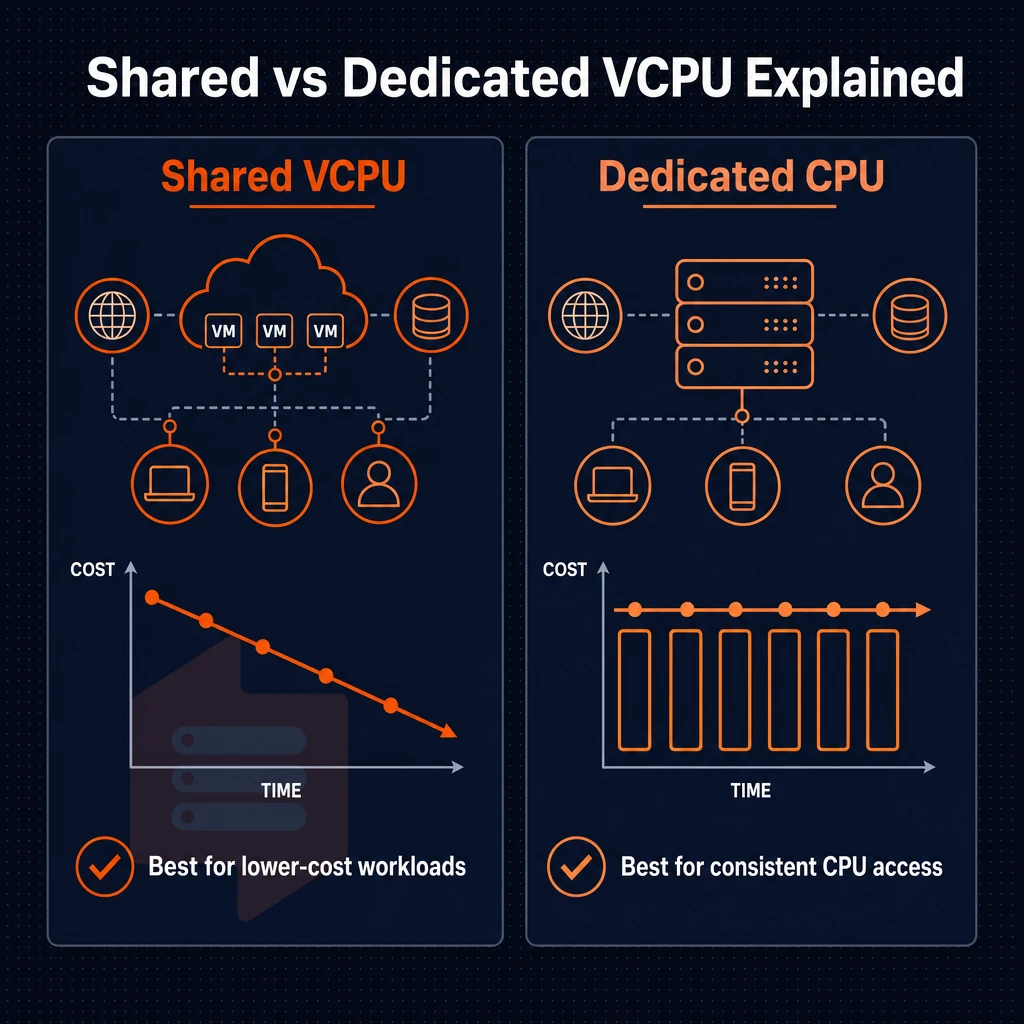
Workloads have different computing needs.
Which VPS or dedicated server is the cheapest?
Our Standard CPU (S-tier) plan is the most cost effective entry point for our services. The shared AMD EPYC Milan vCPUs are combined with DDR4 ECC RAM and run on top of NVMe RAID10 storage. The base plan starts at 2 GB RAM and 50 GB NVMe storage, scaling up to 16 GB RAM and 400 GB storage for workloads that demand more resources.
For technical users who run test environments, staging builds of web sites or even low-traffic web sites, the shared vCPU will deliver plenty of value. Note that our shared plans are not subject to hourly billing, but instead bill on a monthly, annual or 2-year basis. Startups and small projects operating on limited resources can use this tier to establish their infrastructure without committing to premium pricing models.
Each plan includes access to our technical support team, available to assist with configuration questions and troubleshooting issues that may arise during deployment. Organizations can upgrade between services tiers as their requirements evolve, ensuring infrastructure scales alongside business growth without requiring migration to a new provider.
When dedicated cores matter for your control panel
Our Dedicated CPU (D-tier) pin physical CPU Cores from the AMD EPYC Genoa processor to your VPS. This isolation between tenants is what allows for consistent performance for databases, CI/CD pipelines and other workloads that can't afford any latency variance during traffic spikes. Applications demanding more power can scale vertically within this tier by adding additional dedicated cores to handle compute-intensive operations.
D-tier uses the EPYC Genoa CPUs with the respective D-tier DDRIII ECC RAM (the generation newer than S-tier node hardware). It provides a significantly tighter latency under load.
High performance for memory-bound workloads
There are some workloads (in-memory caches, large analytics datasets, high-concurrency application servers) that exhaust RAM long before they exhaust computing power or CPU cycles. That’s why we built the High Memory (H-tier) for the kind of High Performance that keeps a working set in memory, rather than on disk. The 1:8 vCPU-to-RAM ratio and up to 192 GB of RAM per VPS makes it the right call for such workloads.
Memory-intensive applications like Redis clusters and Elasticsearch nodes are well suited to this configuration, where keeping data resident in RAM directly translates to query response times measured in microseconds rather than milliseconds. Allocating sufficient memory resources upfront prevents costly performance degradation as your dataset grows beyond available RAM capacity.
- S-tier: shared vCPU, ideal for dev, staging, and low-traffic sites.
- D-tier: pinned cores, ideal for databases, APIs, and production apps.
- H-tier: high RAM density, ideal for caches and memory-intensive services.
I have attempted to map the four tiers to the options available within the wider European VPS market.
European cloud VPS comparison: what the market offers
The European VPS market can be organized into three tiers of service. Knowing what each service tier offers business websites, from full control over your panel settings to resource limits, helps you find the right hosting for your needs rather than just the cheapest option. Evaluating providers across these tiers requires comparing not only advertised specifications but also the quality of support services, uptime guarantees, and backup solutions included at each price point.
Market tiers at a glance: finding the best price
Unlike shared hosting, virtual servers can offer you a virtual server with dedicated resources and full server access. Below is an overview of typical tiers and features.
| Tier | vCPU type | Typical RAM | Storage type | Key use case |
|---|---|---|---|---|
| Entry shared vCPU | Shared | 2-8 GB | SSD or NVMe | Dev, staging, low-traffic sites |
| Mid-range dedicated core | Pinned | 4-16 GB | NVMe | Production apps, databases |
| High-memory | Shared or pinned | 64 GB+ | NVMe RAID | In-memory caches, analytics |
How BuyVPS maps to each tier
Our S-tier offering is for entry-level europe VPS hosting. Our H-tier plans are designed for memory-heavy workloads with up to 192 GB RAM and ample storage space.
All plans are run on KVM with separate kernels, are powered with IPv4+IPv6 dual-stack and allow for custom ISO uploads. NVMe storage for all tiers of service is set up as RAID10 and uses PCIe-direct, i.e. no shared SAN.
Does a cheap european VPS include DDoS protection from your hosting provider?
Most Europe VPS hosting providers include edge-level filtering as a basic layer of security features. Abuse-policy-based firewall rules are for example applied on the network edge in Amsterdam as well as in New York. This is just one of the reasons why BuyVPS is a very straightforward choice for European VPS hosting.
Why choose BuyVPS for cheap VPS hosting in europe
BuyVPS delivers high performance budget VPS Europe hosting from our Amsterdam data center, purpose-built for low EU latency and GDPR-friendly European data handling. Our VPS hosting runs on KVM with a separate kernel per VPS server, so your workload is genuinely isolated from other users. That is the main difference between a real virtual private server and oversold shared hosting.
- No-oversell policy: hard memory caps and low node density protect your server resources under real load.
- NVMe RAID10 storage: measured at 122,959 4K read IOPS, NVMe SSD storage that delivers consistent performance for databases, e-commerce websites, and online stores.
- Full superuser access: choose your operating system, upload a custom ISO, and take complete control of your server environment.
- In-place upgrades: scale your VPS plans without migration or IP rotation, your DNS management stays intact.
- Engineer-staffed support: real engineers reply, not chatbots, backed by a founder-run operation since 2002.
- Predictable cost: excellent value for growing businesses and small businesses alike.
If you are evaluating European VPS hosting options, compare our VPS plans or reach out to our team at info@buyvps.com to discuss the right fit for your workload. To see how those plans apply in practice, the use cases below map each tier to real deployment scenarios.
Common use cases for a european VPS server
A European VPS can host all sorts of different workloads, from light websites to really memory intensive applications.
Storefronts, content, and web hosting
- E commerce websites and online stores: Deploy on our S-tier for shared-vCPU workloads with moderate traffic. Amsterdam gives EU customers low-latency connections and keeps order data inside European jurisdiction.
- Gaming servers: Pin a D-tier core to eliminate CPU jitter. Players across Europe see consistent frame-tick latency because dedicated cores never compete with neighbours.
- Business sites with unlimited traffic: S-tier plans include generous transfer allowances. No throttling mid-month means your site stays fast during campaign spikes.
Note: Shared vCPU plans suit bursty traffic well, but sustained CPU-heavy workloads belong on the D-tier to avoid throttling.
DNS management, migrations, RAM and storage space
- DNS management: Run your own authoritative resolver from Amsterdam. A VPS gives you full zone control without relying on a registrar's limited dashboard.
- Web hosting migrations: Spin up a staging environment, validate, then cut over. In-place upgrades mean your IP never rotates, so DNS TTL changes are the only step left.
What Windows operating systems can i run on a european VPS?
BuyVPS supports Ubuntu, Debian, AlmaLinux, Rocky Linux, CentOS Stream, and Fedora, all deployable as virtual machines with unlimited traffic via the self-service panel.
Developer environments and growing businesses
- Staging and test servers: Isolate experiments on a separate server VPS instance. KVM gives each environment its own kernel, so a bad kernel module never touches production.
- Scaling without disruption: Growing businesses upgrade in-place, no migration, no new IP. Server administration stays simple because the same credentials and firewall rules carry forward.
Note: H-tier is the right fit when your application's working set exceeds 32 GB RAM, database caches and in-memory analytics are the most common triggers.
European VPS performance is determined by three criteria: server location, hardware, and costs. European VPS servers located in Amsterdam or other low-latency hubs offer reduced round-trip times for European users, along with storage space housed within the region. In terms of hardware, a shared vCPU hosting plan is sufficient for most users, however pinned dedicated vCPUs available across european data centers will deliver reliable performance under load without the problem of noisy neighbors.
BuyVPS runs KVM VPS on AMD EPYC hardware in Amsterdam, with hard memory caps per node, NVMe RAID10 storage, and no-oversell by design. Plans scale from shared vCPU to dedicated CPU and high-memory configurations, all on the same network with affordable prices. If you're ready to pick a plan or want to confirm which tier fits your workload, browse the BuyVPS Amsterdam plans or reach the engineering team directly at info@buyvps.com.