

Deciding between an AWS cloud VPS and a traditional VPS can be a difficult choice. Because AWS offers so many different types of compute services, each with its own pricing model.
Additionally, with often substantially different network topologies, security considerations, and operational complexities, there is considerable engineering expense that can be incurred in selecting the right service. While EC2 instances may appear to be a simple VPS offering, in reality, managing IAM roles, VPC subnets, etc. and avoiding surprise charges can be a complex and time consuming task. Organizations must also factor in the ongoing operational costs of maintaining cloud expertise in-house versus relying on simpler hosting solutions.
The real question is which platform best matches your workflow: steady amounts of traffic, well defined resources, and a development team that wants root access to their servers without needing to become cloud operations specialists.
Purpose built VPS hosting, locked to a set of fixed resources. Additionally, providers sold with a no-oversell guarantee let you install and run workloads against clearly allocated resources, typically beating hyperscalers on performance for real and immediate daily needs. When applications perform consistently under load, this predictability becomes a key advantage for production environments.
This piece sets out to explain what you get from using AWS cloud VPS services, and the various tradeoffs that you make. We also look at the services offered by dedicated VPS providers, such as BuyVPS, and see how they stack up against one another for performance, control and ease of use. We start with a basic explanation of what a VPS is and look at how AWS VPS services fit into that.
What is a cloud VPS and how does it differ from Aws?
A Virtual Private Server (VPS) is a portion of a physical server subdivided into fully managed and isolated servers, each allocated a fixed amount of CPU power, RAM and storage. Unlike shared hosting, a VPS offers root access to fully manage your server, and is guaranteed consistent server performance without disturbance from other users on the same server. For more context, see Amazon Elastic Compute Cloud.
First month $1
Then the normal monthly price. One per customer. No setup fee, and a 30-day performance guarantee on your first order.
See the plans“Good support, fast VPS. Thanks!”
What a virtual private server VPS actually is
Each virtual server runs its own kernel on its own dedicated underlying hardware. There is real isolation between virtual servers, not a shared hypervisor abstracted out from the host. This kernel-level separation ensures that each instance remains protected from vulnerabilities or resource contention affecting neighboring tenants on the same physical host.
How Aws approaches VPS hosting
AWS offers VPS-style compute in EC2 and Lightsail. While these services provision a virtual private server (in a multi-tenant infrastructure) to you, they offer a number of benefits including scaling, and high availability zones. Unfortunately, however, these services do not provide fixed, predictable per-core performance for a fixed price. Lightsail imposes certain restrictions on instance customization and advanced networking features compared to the full EC2 offering.
Key differences at a glance
- Resource model: dedicated vCPU allocation vs. burstable shared cores.
- Virtualization: KVM with per-instance kernel vs. proprietary hypervisor.
- Cost model: flat monthly rate vs. consumption-based billing.
All of these differences affect many decisions about designing and managing VPS-like services, which is central to how AWS structures many of its offerings. Understanding the underlying architecture helps teams evaluate whether AWS's layered approach or a simpler VPS topology aligns with their technical requirements. Teams often underestimate how complex these architectural decisions become when balancing cost, reliability, and operational overhead across multiple AWS services.
How Aws cloud services work as a VPS alternative
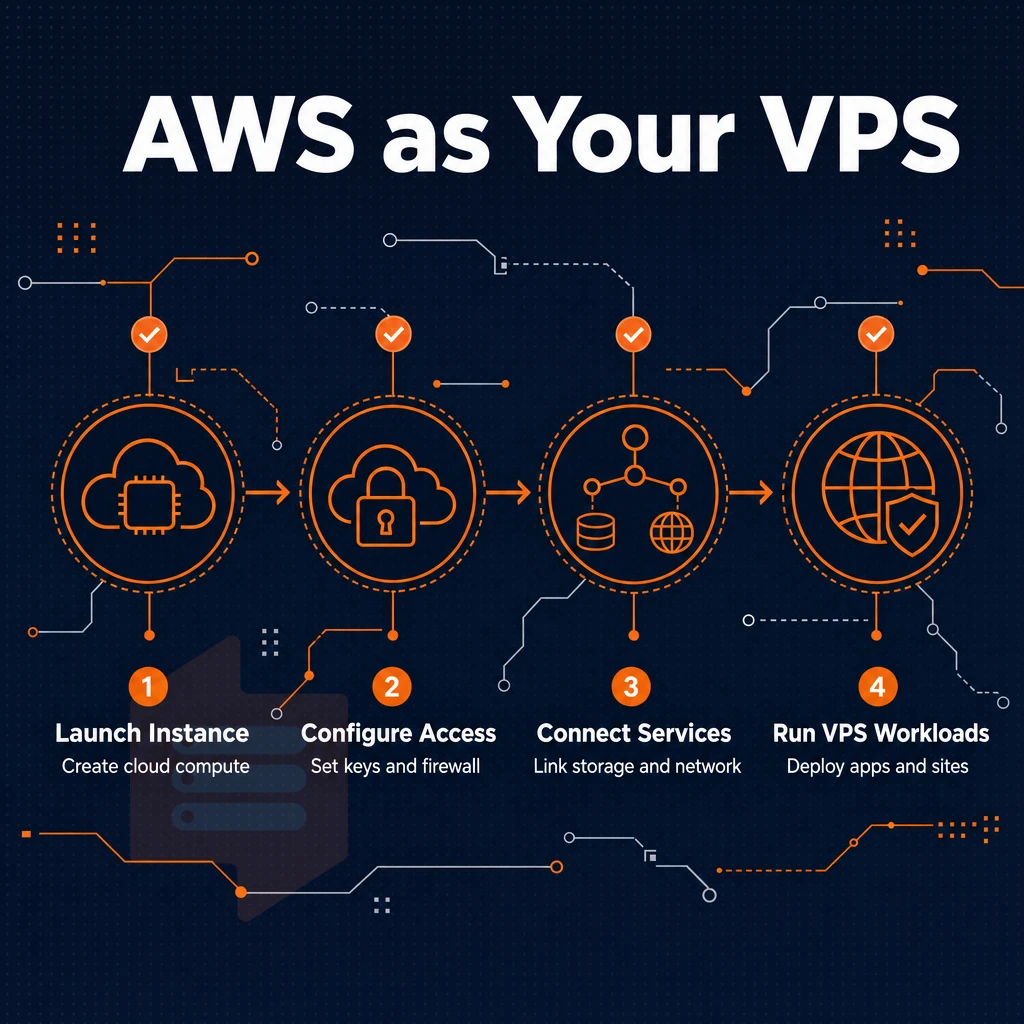
Two ways to get a VPS on AWS are EC2 or Lightsail. EC2 is a full fledged infrastructure service that can host many different flavors of servers (dozens of instance types). Lightsail on the other hand is a more managed service that packages together resources like compute, storage and bandwidth, and charges a fixed monthly sum for each bundle.
Instance types, storage, and server management
There are families of EC2 instance types designed to host general purpose, compute oriented, and memory optimized workloads. In contrast, the VPS instances in Lightsail are bundled together with containers, storage and databases into fixed-price plans for small websites and apps. In addition to EBS-backed volumes, Lightsail automatically creates daily snapshots of your VPS instance.
Server management and cost model complexity
Even basic data transfer, EBS volumes and snapshots will all cost on top of the base price of the instance. Although Lightsail is more cost predictable than EC2, managing growth on a given host becomes a challenge once you hit the resource ceiling of a given plan size. When your application outgrows its current plan, you must migrate to a larger instance or upgrade to a different hosting solution entirely.
Where BuyVPS fits for websites
BuyVPS provides KVM based VPS servers with no oversell ing, and in-place upgrades to all our customers in Amsterdam and New York. We provide the virtual private server simplicity without the AWS billing complexity. No hidden charges, and no per GB egress fee.
In the end, that’s how the choice between them can be made.
Side-by-side comparison: Aws cloud VPS hosting vs dedicated VPS
AWS cloud virtual node hosting and dedicated cloud instance hosting have a number of differences that can affect how you host workloads in terms of performance, predictability, and management.
| Dimension | AWS cloud VPS | Dedicated VPS (e.g., BuyVPS) |
|---|---|---|
| Virtualization | Hypervisor-based virtual machine, shared host | KVM, separate kernel per VPS |
| Resource allocation | Shared, burstable | Pinned cores, hard memory caps |
| Pricing model | Hourly/variable, egress fees | Fixed monthly, no surprise fees |
| Storage | Network-attached block volumes | NVMe RAID10, PCIe direct |
| Root access | Yes (most instance types) | Full root on every plan |
| Custom software | Supported; marketplace dependencies common | Any stack, custom ISO upload |
| Backups | Snapshots available, billed separately | Self-managed or scripted via API |
| Security | Shared-responsibility model, security groups | Edge filtering, KVM isolation, abuse-policy firewall |
| Support model | Tiered plans, paid premium tiers | Engineers reply directly, no chatbot tier |
VPS hosting: shared vs. Dedicated resources
Cloud hosting platforms generally try to distribute resources across all users. A noisy neighbor can quickly cause high latency for you. virtual host hosting, on the other hand, dedicates specific cores and sets strict memory limits.
Security isolation depth for websites
Both models follow a shared-responsibility security model. The main difference is the isolation layer. KVM with a separate kernel for each hosted VM provides a strong security boundary, and guests or tenants cannot escape to the hypervisor or affect other tenants. This is in contrast to software security groups which do not provide a strong boundary on their own. For community perspectives, see Is AWS a good alternative to a $20/month VPS for hosting ....
Dedicated resources and operational predictability
Dedicated resources for VPS hosting mean no contention for resources which typically breaks capacity planning. We run low node density by design, and combine that with in-place upgrades of the host servers and structures. Additionally, with no IP address rotation, you get to run on a very stable and highly predictable host environment from day one.
You also need to know which workloads a platform was designed for.
Common use cases: when Aws and when a VPS is the better choice
For unpredictable, large-scale workloads, AWS wins.
When Aws makes sense
Managed platforms like load balancers, message queues, and ML inference capabilities can also save your team significant time and overhead compared to having to create and maintain your own infrastructure from scratch.
- Global multi-region architectures.
- Event-driven workloads that scale unpredictably.
- Teams heavily invested in managed cloud options.
When VPS hosting is the better choice
For web applications, business apps, and storage backends with consistent loads, a VDS is the way to go.
BuyVPS now also offers the possibility to host on AMD EPYC servers in Amsterdam and New York. Our network has constant throughput and is not affected by other users on the same server. We also have hard memory limits per node.
- Developers who need full OS control.
- Long-running, predictable workloads.
- Projects where billing surprises are unacceptable.
If your workload falls in the virtual compute instance column, you need to know what separates a well-engineered virtualized server offering with strong security from commodity hosting.
Why choose BuyVPS for cloud VPS hosting
BuyVPS delivers dedicated resources and consistent performance across KVM-isolated virtual private server instances in Amsterdam and New York. Every cloud server runs on a separate kernel, no noisy neighbors, no shared memory bleed. BuyVPS also operates locations in Canada, providing low-latency options for businesses serving North American markets. The provider also maintains a presence in singapore, offering low-latency connectivity for businesses targeting Southeast Asian markets.
- No-oversell policy: hard memory caps and low node density protect your server resources under real load.
- NVMe RAID10 storage: PCIe-direct with 122,959 measured 4K read IOPS, fast for data repositories, web applications, and backups.
- Dedicated-core D-tier: EPYC Genoa with pinned vCPUs for workloads that demand reliable performance without contention.
- Full root control + custom ISO: install any custom software, manage your own security model, and deploy any stack.
- In-place upgrades, no IP rotation: scale your virtual infrastructure node hosting plan without migrating data or updating DNS.
- Same price in year 5: a straightforward billing structure with no renewal hike and no hidden additional costs.
Compare plans or reach out to our engineering team at BuyVPS.com to find the right compute instance for your infrastructure.
Frequently asked questions about security
Does Aws offer secure VPS instances containers storage and databases with security for websites?
Its closest equivalent is EC2, a virtual machine service that gives you root-level privileges to an isolated instance running on shared or dedicated hardware. If your business wants a straightforward private cloud instance with predictable specs and no-oversell guarantees, purpose-built providers like BuyVPS are a more direct fit than navigating AWS's sprawling service catalog.
Does a VPS server offer the same security and features as ec2?
Both give you a virtualized server with root permissions running on shared physical hardware. A traditional virtualized compute resource typically comes with a host of fixed, transparent specs, set RAM, vCPU, and storage, and a flat monthly cost. EC2 uses a different model: dozens of instance types, variable billing, and a layered pricing structure for networking, storage, and compute that makes cost predictability harder to achieve. On-demand instances bill by the second with a one-minute minimum, while reserved commitments can lock in rates by the month or year, though calculating total cost per hour remains complex due to layered fees.
How cost effective is an Aws VPS for security and performance?
AWS EC2 pricing depends on instance type, region, OS, reserved vs. on-demand billing, and whether you attach separate EBS storage or pay for data transfer, so there is no single figure. Costs can escalate quickly once egress fees and ancillary tools are added. For straightforward workloads, a dedicated cloud compute instance host offers a flat, predictable monthly cost with no surprise line items. Organizations seeking budget certainty often find that a cost effective monthly price with transparent resource allocation simplifies financial planning compared to variable cloud billing. Businesses that need to forecast expenses accurately often prefer knowing exactly how much money they will spend each month without tracking usage metrics.
How many VPS does Aws have?
AWS does not categorize EC2 instances as isolated server instance plans, but it offers well over 500 distinct EC2 instance types across families optimized for compute, memory, storage, and accelerated workloads. That breadth is useful for highly specialized deployments but adds significant complexity for teams that simply need a reliable virtual server.
Most businesses running websites, DB instances, or dev environments need only a handful of well-defined tiers, which is exactly how providers like BuyVPS structure their Standard, Dedicated CPU, and High Memory plans.
AWS is a good example of a platform suited to companies that require extensive scaling options, managed infrastructure, and a global site distribution network, but are willing to deal with the associated complexities and price uncertainties. Dedicated private server instance hosting is better suited for companies that require predictable costs and sufficient performance.
For most types of applications (e.g. web servers, relational stores, APIs, dev environments) a virtualized node provides sufficient infrastructure at a fraction of the cost of a dedicated server. The performance of our VPSes is based upon real world numbers: NVMe RAID10 storage, AMD EPYC CPUs and strict memory limits per server to prevent other customers from using up all of your memory.
If a no-oversell cloud hosting instance in Amsterdam or New York fits your stack, explore BuyVPS's Standard, Dedicated, and High Memory plans, or reach out to the engineering team at support@buyvps.com with your specific requirements.