

Most reviews for Contabo VPS go over and over the same points: super cheap prices against somewhat unreliable servers and bad support. So if you're looking at VPS hosting for serious work, then reading through the hype of very cheap VPS servers and figuring out the real performance for CPU, network, storage and support is important. For those who can't wait, I compare the results to what you can get from other providers for similar money and performance.
For serious work like very latency sensitive apps, databases and high traffic websites and blogs, the choice of VPS hosting and the price really does matter. A good benchmark for cheap VPS hosting are reviews of BuyVPS where they supply fio and Geekbench 6 benchmarks for real performance and also set a hard memory limit per server to ensure inconsistent performance. Choosing the right infrastructure ensures your website remains responsive during traffic surges and delivers consistent page load times across geographic regions.
What is contabo and how does its VPS hosting work?
Contabo is a German web hosting company offering a large amount of resources for a low price to developers and small companies and businesses. They are based in Munich, Germany. Here we take a closer look at Contabo’s VPS service in order to clarify the cost/benefit ratio for your use case. Whether you need a simple website or a complex web application, understanding the infrastructure behind your hosting choice helps determine if Contabo's resource allocation matches your project requirements.
First month $1
Then the normal monthly price. One per customer. No setup fee, and a 30-day performance guarantee on your first order.
See the plans“Great experience with BuyVPN! The service is easy to use, the connection has been smooth and reliable, and the overall experience has been really good. The pricing is also reasonable…”
How contabo structures its VPS tiers
Contabo offers KVM virtualization on shared vCPU tiers. Although the allocation of cores, RAM and storage is generous on paper, the number of vCPUs shared with other clients may affect performance under load. However, storage is always provided with NVMe or SSD.
OS choices cover standard Linux distributions including Ubuntu, Debian, CentOS Stream, and others, with Windows available on certain plans. Deployment is largely self-service, targeting users with some level of technical expertise.
Cloud VPS versus traditional VPS prices
Contabo’s newer products are marketed as cloud VPS. While the term VPS alone already indicates that it’s not a conventional dedicated server, cloud VPS adds on-demand setup, snapshots and API-based management on top of a KVM-based system. The difference to a pure VPS is mainly a matter of operational flexibility rather than different hardware.
Control panel and data centers locations
We recently launched a new interface for our control panel .
In contrast to BuyVPS's Amsterdam and New York nodes, both being offered at the same price-point with identical hardware. Additionally, the Dedicated plans have no oversell and hard memory caps with pinned cores, so the performance you see in benchmarks is the performance you get under load, and Contabo's offerings come at affordable prices as follows.
Contabo cloud VPS plans and pricing breakdown
This hosting provider has set up their VPS hosting plans into 4 tiers (S, M, L, XL) with 4vCPUs/6GB RAM for the S tier and up to 10vCPUs/60GB RAM for the XL tier. All plans are KVM virtualization enabled and come with a 99.9% uptime SLA. The storage offered is all SSD based with 100GB, 150GB, 200GB, 300GB or 400GB options available.
Affordable VPS plans at a glance
| Tier | vCPU cores | RAM | SSD storage | Bandwidth |
|---|---|---|---|---|
| S | 4 shared | 6 GB | 100 GB | 32 TB outbound |
| M | 6 shared | 16 GB | 200 GB | 32 TB outbound |
| L | 8 shared | 30 GB | 300 GB | 32 TB outbound |
| XL | 10 shared | 60 GB | 400 GB | 32 TB outbound |
All cores are shared, not pinned. So no single core entry option, lowest is 4 shared vCPUs. Object storage is also available as an add-on service charged on a per GB basis. Shorter billing cycles incur setup fees which are waived with annual prepayment. The setup fees apply to monthly and quarterly billing, making annual contracts more economical for users who can commit to longer terms.
How VPS prices compare to other VPS providers
Initial numbers look affordable for a VPS, but Shared Cores always carry a risk of a noisy neighbor when fully loaded. While others promise pinned or dedicated Cores for similar money (e.g. BuyVPS D on AMD EPYC Genoa processor) for CPU-bound work loads they deliver consistent latency.
Outbound traffic and extra fees
The 32 TB egress traffic allowance is generous for most workloads. Overages and optional add-ons (snapshots, additional IPs, object storage) can push the effective monthly cost above the advertised baseline. For businesses streaming media or serving global audiences over the internet, this bandwidth allocation provides headroom for traffic spikes without immediate overage concerns.
Customers running content delivery or SaaS platforms benefit from predictable egress costs when planning infrastructure budgets across multiple billing cycles. A high-traffic website serving dynamic content will consume egress bandwidth proportionally to visitor volume and asset size, making the 32 TB cap suitable for most small to mid-sized deployments.
Contabo VPS performance: what the benchmarks show
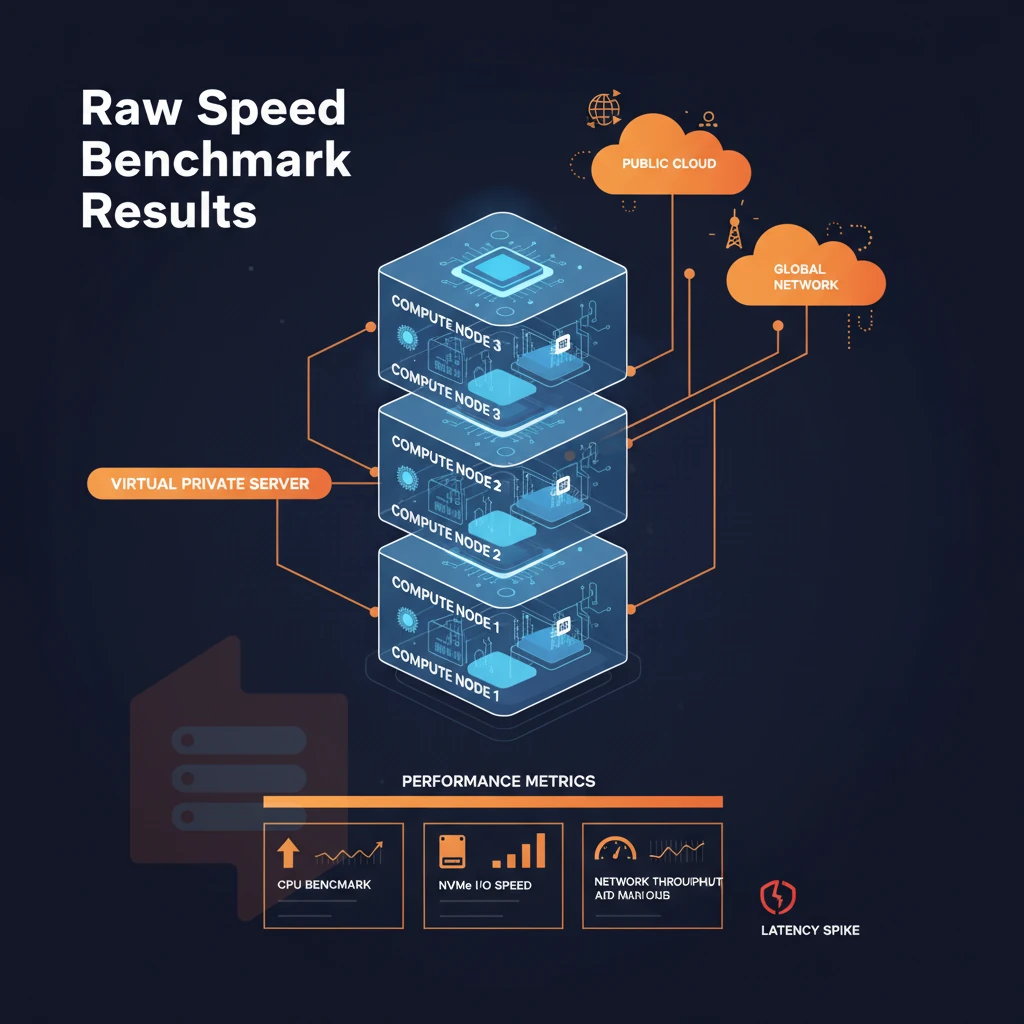
Benchmarks are always published raw, but one raw benchmark score never tells the complete story about a VPS. It’s what that VPS can really do under sustained load, in a realistic work load that will actually run for more than a minute or two.
Whether you're hosting a high-traffic website or running backend services, understanding how your VPS behaves over hours of continuous operation reveals far more than isolated snapshots. Production environments demand that the host consistently allocates CPU cycles and I/O bandwidth without throttling, especially when multiple processes compete for resources during peak usage windows.
VPS hosting provider benchmark results
- Run Geekbench 6 CPU Benchmark for shared-vCPU servers running on an oversold server and compare to the number of CPU cores a provider has advertised. While many providers do not publish their own Geekbench results, those that do can make comparison very easy.
- Test disk IO with fio using a 4K random-read job on the server's local storage. As shared hosting environments share the same IO queue for all tenants, typically high latency variance will be exposed.
- Measure web response time under load. Run a sustained HTTP benchmark at your local test environment against a simple server application. The effects of a noisy-neighbour can only be seen as latency spikes and NOT in averages. Look at the 95th-percentile line rather than the mean.
Note: A single test run can look clean. Run each benchmark three times, wide variance signals resource contention on the host server.
Performance consistency over time
- Run a 30-minute CPU endurance test. A long running load will expose any server to throttling. A server that performs well for the first 5 minutes of a test and then slowly degrades the rest of the time is over commiting resources.
- Compare to published benchmarks. The best VPS deals come from providers who openly publish fio and Geekbench results, no extra charge for access to results. For example, BuyVPS openly publish measured NVMe RAID10 results (122,959 4K read IOPS, fio median).
A server with CPU cores pinned and fully oversell-free will show identical benchmark numbers under sustained load, the real standard by which to measure a host. These numbers also dictate whether a VPS or dedicated server delivers better performance for your specific use case.
Contabo dedicated servers vs VPS: which should you choose?
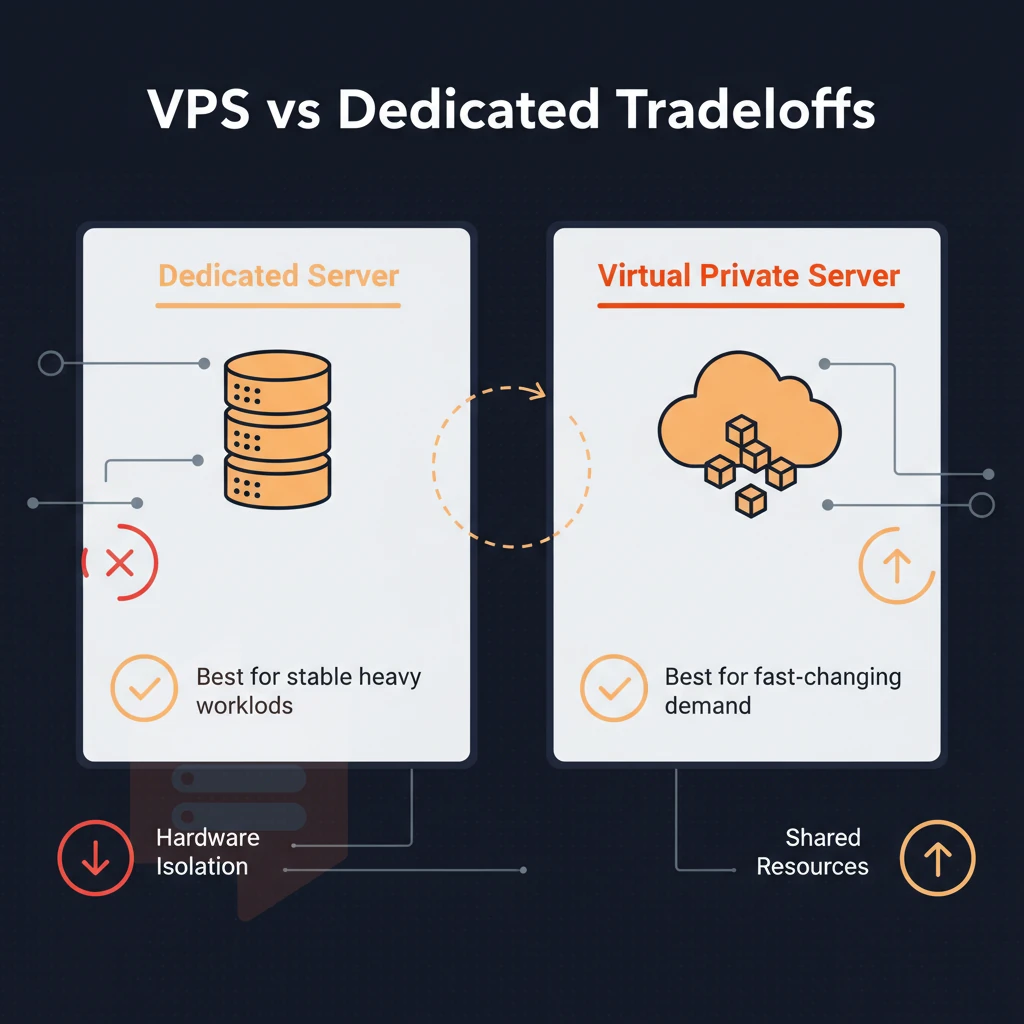
The choice between a VPS and a dedicated server is essentially a matter of how much of the underlying hardware you need to pay for to use. There are different workloads best suited for dedicated servers and for VPSes, and a new panel of options in between these two categories also includes the choice of dedicated-core VPSes.
Dedicated servers: full hardware ownership
Dedicated servers are sold with a completely dedicated server, all CPU cores, all RAM, all hard drive controllers, etc.
Tradeoff: operational weight. Having full root access to your bare metal means all the firmware updates, hardware failures, and capacity planning for that server now rests on your operators. Requires more technical expertise than a VPS and longer provision time. Teams that lack the in-house skills to manage firmware patches and hardware diagnostics may find the operational burden of bare metal unsustainable over time.
Cloud VPS servers: efficient and flexible
VPS servers host multiple virtual machines on the same physical servers. Each VPS can have its own OS installation and has superuser access, but it is running on physical cores that are also used by other users (tenants). For most web applications, API’s and development environments this trade-off is acceptable.
Developers hosting a small business website or personal blog typically find shared-vCPU plans sufficient for their traffic patterns and resource requirements. When selecting a provider to host your application, evaluate whether the shared-core model aligns with your performance expectations and budget constraints.
Shared-vCPU plans have contention as a risk: a single core burst from a neighboring workload can squeeze your utilization.
Single core pinning: the gap-bridging tier
Most dedicated-core VPS plans lock down physical CPU cores to a customer’s virtual server. VPS plans offer the flexibility of being able to scale and provision services quickly while offering similar computer resources to a dedicated server.
Contabo pros and cons: honest assessment
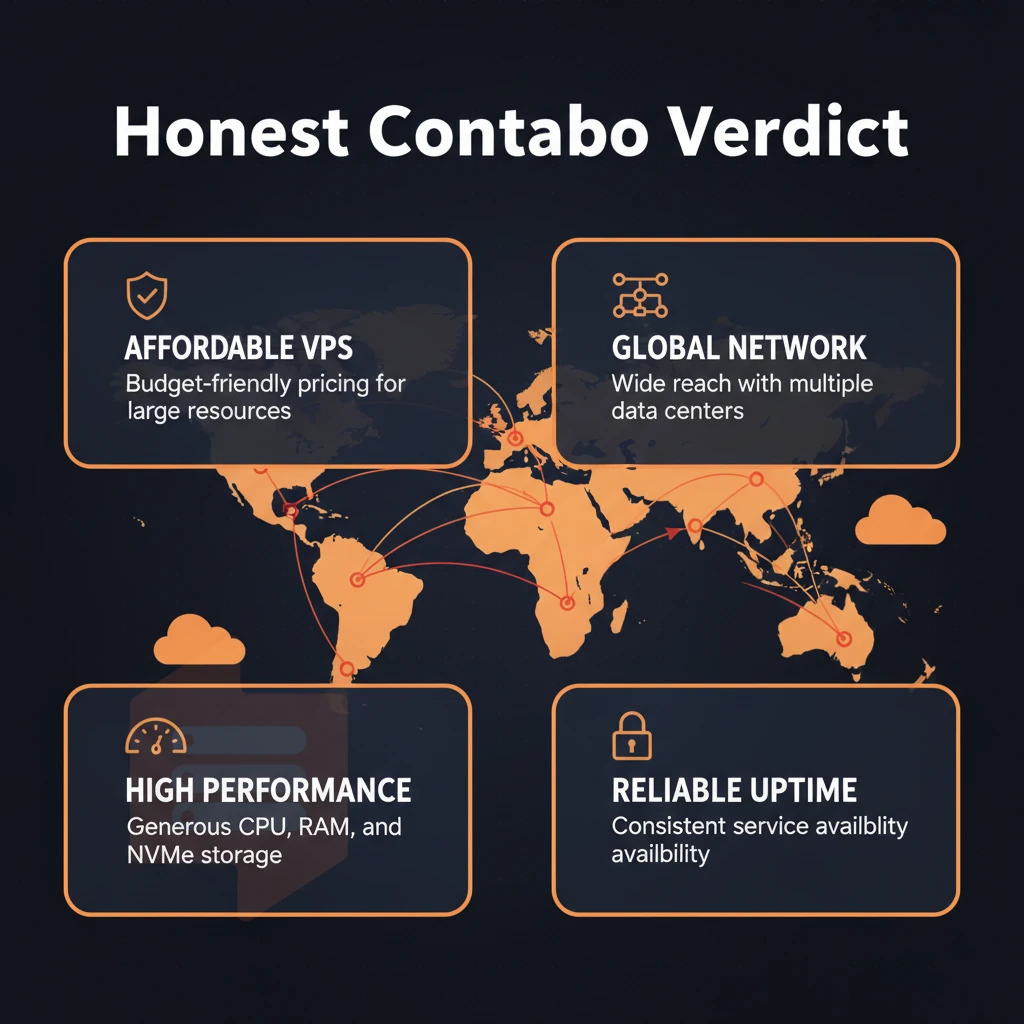
Affordable pricing for large amounts of resources is what typically attracts customers to Contabo. Businesses operating on tight budgets can allocate less money to infrastructure while still obtaining substantial compute capacity for development and testing environments. Providers like digital ocean have built reputations on transparent pricing and developer-friendly interfaces, setting a competitive standard that budget hosts must now address.
What contabo gets right
Cost is the main advantage with users able to get more RAM and storage for their dollar compared to other budget providers.
- Generous RAM and storage allocated to entry level models.
- Full complete root control on all plans.
- Custom ISO support for specialized deployments.
- Multiple host locations across Europe and North America.
Where users report problems
Most notable is the lack of performance consistency, which is described in detail in various online forums, such as this Reddit post. Additionally, Furthermore, that slow response times from support are the norm, with some reports stating that they have to wait days for a response to a ticket.
Users seeking excellent service with rapid ticket resolution may find Contabo's response times frustrating compared to competitors who prioritize faster communication channels. Many customers report that the combination of inconsistent performance and delayed support creates operational challenges for production workloads requiring immediate attention.
This provider's data center coverage is limited compared to providers servicing Asia-Pacific or South American markets.
DDoS protection and network reliability
DDoS protection is included, but quality of mitigation reportedly can vary. There are several reports on internet hosting forums about delays of scrubbing in volumetric attacks. In contrast, providers like BuyVPS clearly state network SLAs on their websites. For example, BuyVPS commits 99.8% uptime and is backed by engineer-led support staff. We should take a closer look at their support model as well. When evaluating hosting providers, customers should verify whether uptime commitments are backed by service-level agreements with financial remedies for downtime incidents.
Contabo support team: response quality and help options
Assessing the support of a web host is almost as important as assessing their performance. Whether you're migrating an existing website or launching a new application, understanding how quickly technical issues get resolved can prevent extended downtime. A reliable host should provide multiple communication channels and clearly documented escalation paths for critical incidents affecting production environments.
Support team structure and response quality
Typically the first point of contact with the customer for a ticket are agents not engineers. For more complex problems like kernel panics, issues with lower levels of the network stack, cPanel misconfigurations etc. it is often required to escalate to engineers which only adds to time.
Phone support and other contact channels available
To contact our technical team, tickets can be created within your customer account portal. While phone support is available, it is only within business hours and within the German time zone. Unfortunately, live chat support is not part of our standard offering.
How BuyVPS compares on control panel options
BuyVPS take a different approach. Engineers respond directly to questions (no first tier filtering). The helpdesk team handling technical questions are able to answer without the normal scripted hand off. As a result you get to answer your questions about your workloads running on AMD EPYC hardware in our Amsterdam and New York datacenters quickly and accurately.
While the number of channels a provider offers to receive questions (e.g. tickets, live chat, email, phone) can be a factor for companies looking for good service on non-infrastructural issues (e.g. billing). For companies that run infrastructure on their VPS and require good service on such issues a good reply is more important than the number of channels.
In that case, an engineer-led team like BuyVPS is a better choice for production workloads, and it's worth mapping these considerations to common VPS hosting use cases.
Common use cases: game servers, web hosting, and developer workloads
VPS hosting can handle a wide variety of different workloads that typical shared hosting environments are unable to handle with sufficient reliability. Experienced web hosts tend to select VPS hosting as it enables full administrative access to servers, customized software stacks and numerous other features associated with a dedicated slice of hardware. Below are several common scenarios which can benefit from a VPS and how they relate to typical hosting options.
Game servers and developer environments
- Run a game server with fixed resources. A game server requires low latency networking and a fixed amount of CPU power to run smoothly. Isolating a VPS to ensure it has the required resources to run is far better than a multi-tenant hosting environment where a misbehaving neighbor could cause massive spikes in ping that you are unable to control. While manual setup of the server software is required, this is typically exactly what a game server operator wants.
- Run developer workloads. Many developers use a VPS to set up copies of their production environments, to run their Continuous Integration and testing code, or to host their staging versions of their sites. They can install whatever runtime, database and tools they require to develop, rather than being limited by whatever the managed hosting service has installed by default.
Choosing a hosting provider for small business applications
- Host a website or web application. Unlike shared server environment, VPS servers handle sudden traffic spikes well. With a VPS, you get to configure the web server and more, such as the SSL termination and caching layer. One VPS service can host many websites as long as you set up proper virtual host configurations for them.
- Run small business software like CRMs, invoicing tools and internal dashboards. While limits on resources like RAM and CPU become a bottleneck very fast when underloaded. They only pose a problem when the actual load of software and users exceeds the set limits for the plan in question.
Note: Undersizing RAM is the most common mistake. Check your application's minimum requirements, then add headroom for the OS and background processes before choosing a plan.
Their Amsterdam and New York KVM offerings have hard memory caps and no overselling, making them directly comparable to Contabo with knowable trade-offs.
Contabo vs other VPS providers: side-by-side comparison
Contabo scores well on raw resources for a cloud vds setup, plenty of RAM and low-priced storage, but significant gaps appear when evaluating production workloads, particularly in performance, support, and storage performance.
Feature comparison at a glance
| Dimension | Contabo | Other hosts |
|---|---|---|
| vCPU type | Shared (noisy-neighbor risk) | Shared or pinned dedicated cores |
| Storage | HDD or SSD storage (plan-dependent) | NVMe RAID10 on performance tiers |
| Data centers | Multiple regions | Varies by provider |
| Uptime SLA | 99.9% | 99.8%-99.99% |
| Support model | Ticket-based, variable response | Engineer-led or tiered |
| Renewal pricing | Setup fees on some plans | Fixed or locked-in rates |
| Root access | Yes | Yes (standard on KVM VPS) |
Where performance consistency matters
Shared vCPU accounts are prone to ‘noisy-neighbor’ problems as other accounts on the same vCPU(s) can cause performance problems when under high load. These are the types of accounts that host latency-critical services like databases and real-time APIs. Use pinned CPU cores (like the EPYC Genoa CPUs used in BuyVPS Dedicated CPU accounts) to ensure that there is no variability introduced by other accounts on the server.
Another significant performance gap is storage speed. Cloud VDS that are hosted on high-performance NVMe RAID10 storage over PCIe-direct connection deliver many orders of magnitude higher IOPS than storage with rotating disks or very cheap SSDs. For read-intensive web applications, this performance gap is real.
Choosing the right server location
Most VPS hosts spread dedicated servers across multiple data centers on several continents. If your users are concentrated in Europe and the US East Coast, choosing a host with identical hardware in both regions makes a meaningful difference.
As an example, BuyVPS offers services from two locations: Amsterdam and New York. With identical hardware in both locations, you get to manage one single data center, instead of two separate ones with different setups.
Why choose BuyVPS as a contabo alternative
When other VPS providers leave you guessing about performance, BuyVPS gives you published numbers. KVM virtualization runs a separate kernel per VPS, no noisy-neighbour effects on your server resources.
- Dedicated CPU VPS: EPYC Genoa with pinned CPU cores, predictable latency that shared-core cloud VPS plans can't match.
- No-oversell policy: hard memory caps and low node density on every host node.
- Same price in year 5: no renewal hike, no extra fees hiding in your customer account.
- In-place upgrades: scale your VPS hosting plan without IP rotation or manual setup.
- Full root access + custom ISO: every plan ships with full system access and your choice of operating system.
- Data centers in Amsterdam and New York: pick your server location at signup; both run identical hardware and control panel.
DDoS protection, IPv4 + IPv6 dual-stack, and engineer-staffed support (not bots) round out the hosting service. When you contact support, you reach people with real technical knowledge.
See how our VPS packages stack up against other VPS providers at BuyVPS.com/compare.
Frequently asked questions about cloud vds
Can contabo's service handle production workloads reliably from a security standpoint?
Contabo targets budget-conscious buyers, and that trade-off shows in production environments. High node density and shared resources mean neighbors can affect your workload's performance at peak times.
How do i log in to my contabo VPS for the first time?
After provisioning, you receive an email with your VPS IP address and root credentials. Connect via SSH using ssh root@[your VPS IP] from any terminal. On Windows, use PuTTY or Windows Terminal. Once logged in, immediately change the root password and add an SSH key pair to secure the server.
Does contabo offer DDoS protection on its VPS plans?
Contabo includes basic network-level DDoS mitigation on its virtual server plans, but the scope and thresholds are not extensively documented. Providers that publish explicit edge filtering policies and abuse-policy-based firewall rules give you a clearer picture of what protection you actually have.
What is the difference between contabo VPS servers and dedicated servers?
A VPS runs on a shared physical host using KVM or similar hypervisor technology, so CPU, RAM, and storage are partitioned among multiple tenants. A dedicated server gives you the entire physical machine with no neighbors.
Contabo sells both products, but the VPS tier uses shared vCPUs, meaning core access is not pinned or guaranteed. If you need predictable, isolated compute, a dedicated CPU VPS, where cores are pinned to your instance, closes much of that gap without the cost of a full bare-metal server.
Is VPS hosting better than shared hosting for performance?
Yes, in almost every measurable way. shared web hosting places hundreds of sites on one server with no resource isolation, so a traffic spike from one account degrades everyone. A VPS gives you dedicated RAM, isolated CPU slices, and your own kernel, meaning one noisy neighbor cannot consume your allocated memory. The performance gap widens further when the VPS uses NVMe storage and hard memory caps, as BuyVPS does, versus the spinning-disk arrays common in shared server environments.
What are the best VPS alternatives to contabo in 2026?
The strongest alternatives prioritize resource isolation, modern hardware, and transparent SLAs over rock-bottom pricing. BuyVPS runs AMD EPYC VPS instances on NVMe RAID10 storage across data centers in Amsterdam and New York, with hard memory caps per node, no-oversell architecture, and pinned cores on its Dedicated CPU tier, making it a direct upgrade for workloads that outgrow shared-resource environments.
Other leading hosting providers offer comparable regions but often at higher cost or with less predictable renewal pricing.
Does contabo charge extra fees on renewal?
Contabo's standard practice, as experienced users who've dealt with live migration or renewals know, is to renew at the rate you signed up for, but promotional pricing on initial terms can create a gap between your first invoice and subsequent ones. Always check the renewal rate explicitly before committing to a term. This is a common friction point across budget VPS providers. BuyVPS addresses it directly with a stated no-renewal-hike policy, the same price applies in year five as in year one.
While Contabo delivers a lot of resources for little money, the benchmark results show shared infrastructure, poor I/O performance and a lot of ticket-based support. But for production databases, APIs, or any service with low latency requirements where performance matters and needs to be consistent, this won't work most of the time.
Density. Engineering hard memory caps and low density into a budget offering costs money to run and such practices are generally not found in providers that charge very low prices for their cloud services.
If consistent, provable performance matters to your workload, explore BuyVPS's Standard and Dedicated CPU VPS tiers, backed by published benchmarks, AMD EPYC hardware, and NVMe RAID10 storage in Amsterdam and New York. See the full plan lineup at BuyVPS.com.