


When reading reviews about DreamHost VPS hosting it is critical to look past marketing hype when evaluating a real infrastructure decision and how the provider’s landing page will translate to real-time performance.
VPS hosting typically falls into a specific performance category that provides users with more control and isolation than shared hosting and less overhead than a fully managed dedicated server. The key factors to determining performance within this category are the hypervisor, CPU, storage, network and whether or not the provider is overselling resources on a given node under load.
Users seeking more power should evaluate whether the provider allocates dedicated or burstable CPU allocation, as this distinction directly impacts application responsiveness during traffic spikes. Prospective buyers should test performance under realistic workloads before committing, as synthetic benchmarks often fail to capture real-world behavior under sustained load.
Read this article to learn what you need to check when choosing a VPS hosting platform.
We built alternatives to the usual suspects, including BuyVPS, which runs KVM on AMD EPYC hardware with NVMe RAID10 storage for a dream network experience across its Amsterdam and New York data centers.
What is dreamhost VPS hosting and how does it work?
Our VPS Hosting product falls between our entry-level Web Hosting services and our Full Dedicated Servers. VPS Hosting provides isolated resources for each account on a shared physical machine, more ‘breathing room’ than you’d get on a packed shared hosting account. However, Without the expense of buying and maintaining a full dedicated server.
First month $1
Then the normal monthly price. One per customer. No setup fee, and a 30-day performance guarantee on your first order.
See the plans“Great experience with BuyVPN! The service is easy to use, the connection has been smooth and reliable, and the overall experience has been really good. The pricing is also reasonable…”
Shared hosting vs. Dedicated server hosting and virtual private web servers
We can describe how shared servers work in some detail on our standard shared plans and even on our shared unlimited plans. As opposed to Virtual Private Servers (VPS), on a shared server every site on the server competes for all of the available RAM and CPU on the server. This means that a single spike in traffic on one site can impact all other sites on the server.
How dreamhost's VPS works in practice
Resources such as managed control panels and Linux distributions are provisioned to each VPS, allowing users to scale as needed from within the control panel without ever having to transfer them to a new server. DreamHost acts as an intermediary for users that cannot find an appropriate plan between shared hosting and fully managed solutions like WP Engine, and that have just moved up from shared hosting.
Users having trouble finding the right balance often benefit from DreamHost's flexible scaling options that bridge the gap between entry-level and enterprise-grade solutions. This tier is particularly well-suited for users running multiple WordPress installations who need isolated environments without the complexity of managing separate hosting accounts.
Key differences from shared plans:
- Dedicated RAM allocation, not shared with other accounts.
- Isolated server space for files, processes, and logs.
- Root-level access to configure software independently.
Where BuyVPS fits for teams needing more control
For those who find DreamHost’s managed layer too restrictive, our KVM-based VPS hosting in Amsterdam and New York comes with full root access to a AMD EPYC powered server, NVMe RAID10 storage, and more. We don’t oversell our VPS hosting and upgrades are done in-place, meaning your IP addresses will not change. So, how do the plans at DreamHost get laid out, and what do you really get with each step up the ladder?
Dreamhost VPS plans, disk space, and included free domain
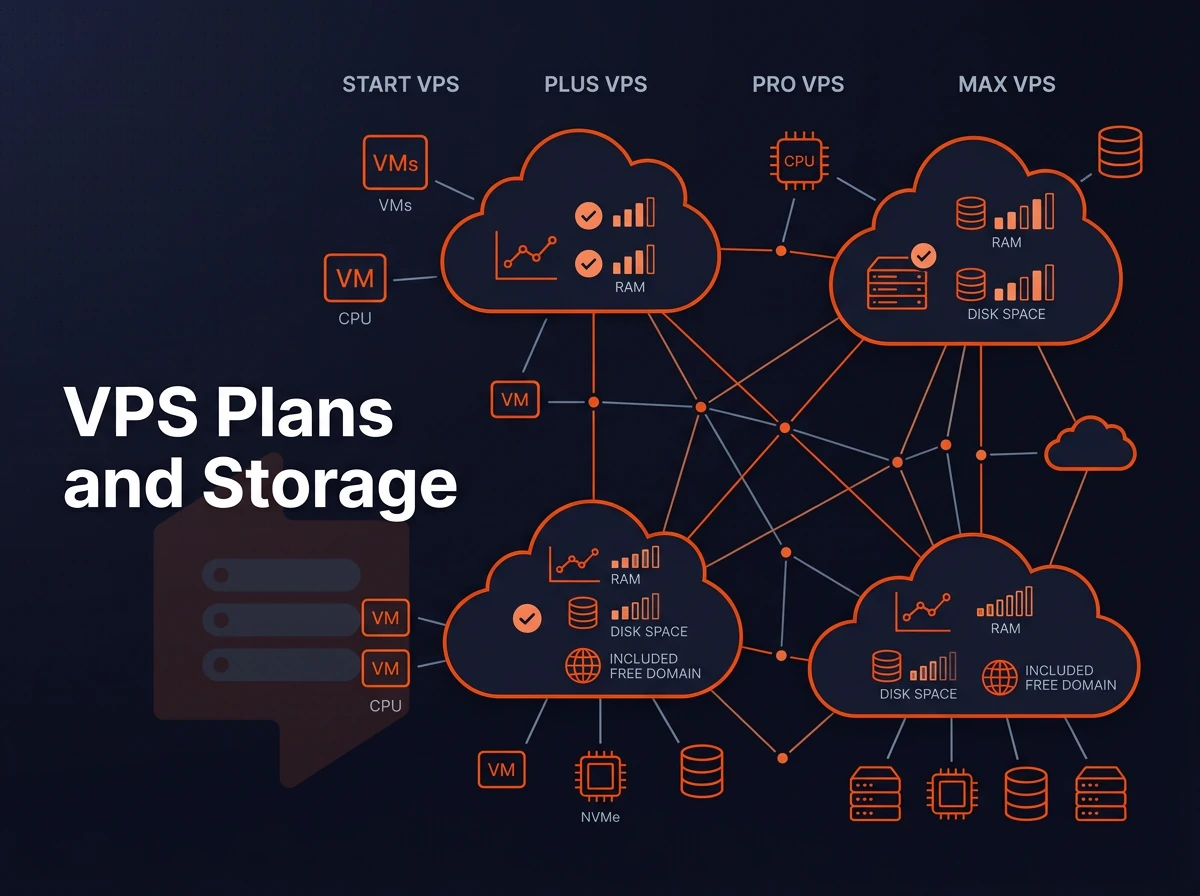
The VPS plans at DreamHost are organized into a small number of tiers, with each tier featuring increases in RAM and storage as you move up. Selecting the appropriate tier depends on workload requirements, and users can upgrade their plan as application demands increase without migrating to a new provider.
VPS plans with unlimited email and disk space
Even the most basic VPS starts with 1 GB of RAM and 30 GB of SSD storage space. Meanwhile, The higher-end models offer up to 8 GB of RAM and 240 GB of SSD storage space. All VPSes come with unlimited bandwidth, and as they are covered by the 100% uptime guarantee in the SLA, they have high uptime (in reality about 99.9% as reported by independent monitoring services).
Each tier supports an unlimited number of hosted domains, enabling users to consolidate multiple projects under a single plan without incurring additional per-site fees. Plans include generous data transfer allowances that accommodate traffic growth without imposing overage fees, making capacity planning more predictable for scaling applications. Users managing multiple domains benefit from the ability to assign separate SSL certificates and configure distinct PHP versions per site, streamlining multi-project workflows.
Free domain registration with data center support
We include a free domain with our annual hosting plans. The complimentary domain is valid for the first year of domain registration. We also throw in a website builder and email hosting with the same bundle. This is geared towards the small business owner, not the infrastructure developer. Many undergraduate students launching their first portfolio or blog find this combination ideal for learning web development without managing complex infrastructure.
The website builder supports both static HTML projects and one-click installations for popular content management systems, including WordPress. Users registering multiple domains can manage all their properties from a unified control panel, streamlining DNS configuration and SSL certificate deployment across their entire portfolio.
Web hosting plans compared at a glance
| Tier | RAM | Storage | Bandwidth | Root access |
|---|---|---|---|---|
| Entry VPS | 1 GB | 30 GB SSD | Unlimited | No |
| Mid VPS | 4 GB | 120 GB SSD | Unlimited | No |
| Top VPS | 8 GB | 240 GB SSD | Unlimited | No |
| BuyVPS (D-tier) | 4-32 GB DDR5 | 45-360 GB NVMe RAID10 | 2 TB+ | Full root |
DreamHost is suitable for users who want to step up from a shared unlimited plan but still want more resources available to them. In contrast, developers will find that DreamHost's managed hosting does not offer enough for them as they require full root access and pinned CPU cores for example, offered on BuyVPS's Dedicated tier.
For WordPress users specifically, DreamHost offers DreamPress Pro, a managed WordPress solution that bridges the gap between standard plans and enterprise-grade performance. Many site owners migrate from shared plans to DreamHost when their WordPress installations outgrow entry-level resource limits and require dedicated memory allocation.
Knowing a web hosting company's plan structure is only half the picture, how they perform under stress is where real differences emerge.
Dreamhost VPS performance: CPU, storage, and response time
Reviews of independent tests of VPS hosting services usually cover three areas: CPU performance, disk performance, and the server’s response time under load.
Preparation: understand what reviewers measure
-
Identify the benchmark types used.
-
Check whether SSD storage is local NVMe or network-attached block storage, block storage is flexible but adds a network hop that hurts I/O-heavy applications.
Note: A single response time figure means little without knowing the test location relative to the data center. Always check where the probe was run.
Execution: read the benchmark results critically
-
Compare CPU core allocation across tiers.
-
Cross-reference disk scores with the storage type.
-
Evaluate uptime data alongside performance. A fast server that drops connections is not best value for production workloads. Synthetic benchmarks can mislead unless you test real-world workloads that mirror your application's database queries, file I/O patterns, and concurrent user sessions.
Verification: match unlimited email results to your workload
-
Run your own fio test after provisioning. Running a baseline fio test immediately after deployment helps you verify advertised IOPS and establish a performance reference for future troubleshooting.
-
For teams needing consistent throughput, BuyVPS Dedicated CPU VPS uses pinned EPYC Genoa cores and NVMe RAID10 storage in Amsterdam and New York, eliminating the noisy-neighbor variance that skews review-site scores. Independent testers like josh jones have validated these configurations in multi-tenant scenarios, confirming that pinned cores maintain stable performance even during peak load periods. Infrastructure analyst michael rodriguez has similarly documented how dedicated core allocation prevents the performance degradation commonly observed in oversubscribed environments. High data transfer allowances on these plans ensure that media-heavy applications and content delivery workflows remain cost-effective without incurring overage fees during traffic surges.
We present raw benchmark numbers for your perusal.
Pros and cons of dreamhost VPS web hosting
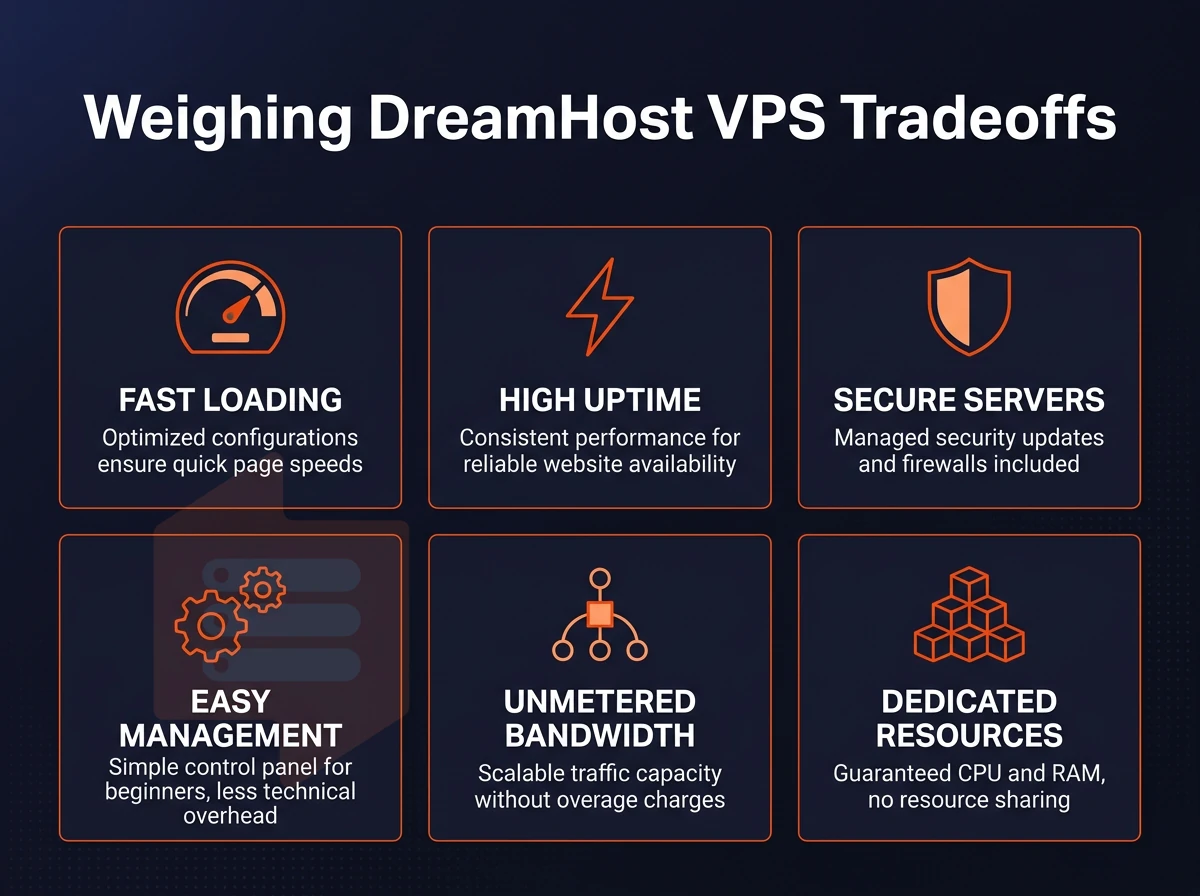
DreamHost fills a specific niche in the VPS space: managed hosting for beginners, with trade-offs in terms of control vs. ease of use that need to be understood in some detail. This positioning makes the service particularly appealing to users transitioning from shared environments who prioritize simplicity over granular server configuration.
Users should assess whether the managed approach aligns with their growth trajectory before committing to a long-term plan. The platform's one-click installer and automatic updates make it especially suitable for users running WordPress sites who prefer to focus on content rather than server administration.
What the managed layer gives you
By bundling a domain name, web site builder, and WordPress hosting with its VPS plans, DreamHost makes it easy for groups without dedicated system administrators to host web sites.
The control panel is designed with the non-technical user in mind. It’s easy to create and manage websites, email accounts and DNS records without ever having to open a terminal. For small agencies and solo developers, time is of the essence. The panel includes one-click installers for WordPress and other popular content management systems, streamlining deployment for users who prefer graphical interfaces over command-line provisioning.
Web hosting and bundled email accounts
We offer unlimited mailboxes under a domain name. For small businesses with lots of users having their own email address at the business’s domain name, this means no per user/seat charges for email. It’s one of the features that differentiates us from many hosts who cap the number of mailboxes at the particular plan level. Teams running WordPress installations with multiple contributor accounts benefit from unlimited mailboxes, as each editor can maintain a professional address tied to the site's domain.
Where the architecture creates risk
The underlying vCPU model is shared with other tenants on the same host.
Root-level functionality is managed, including kernel parameters, custom kernel modules, and low-level networking configuration.
The options for data center locations are limited. Users located in Europe or Asia-Pacific have limited options to reduce latency.
Monthly price for introductory plan vs renewal rate for ongoing use is a well known planning risk. Budget at renewal rate not the promotional rate.
This approach is counter to that of BuyVPS who offer a range of dedicated CPU tiers, all with pinned cores.
If you value predictable performance and need kernel-level server control, unlike other websites that rarely offer such flexibility, evaluate BuyVPS's architecture to see how well it fits your workloads.
Common web hosting use cases for dreamhost VPS
The VPS offering from DreamHost is targeted at a specific group of users: those who have outgrown shared hosting but don’t need to deal with the complexities of unmanaged servers.
Where it fits well
The best fit is the small business owner with a content-heavy site.
Many WordPress-focused teams will also gain access to a suite of WordPress management tools provided by the platform, including updates, staging, and caching all pre-configured for you. In particular, agencies with many WordPress sites will find significant overhead reduction by running these on a VPS tier of wordpress hosting.
Abstraction level works well for developers migrating from shared hosting who want a managed hosting platform without dealing with kernel updates or firewall rules.
Where it falls short
High-traffic sites, intense database workloads, and real-time services are often constrained by managed hosting's abstracted OS and limited tuning options.
A better fit for demanding workloads
Our Dedicated CPU VPS on AMD EPYC processors is perfect for those kinds of workloads and delivers constant performance even under load.
Dreamhost VPS vs. Dedicated hosting and cloud: side-by-side comparison
Deciding between a virtual private server, dedicated hosting and cloud hosting ultimately depends on three criteria: isolation, control and scalability.
| Dimension | VPS hosting | Dedicated server hosting | Cloud hosting |
|---|---|---|---|
| Resource isolation | Hypervisor-enforced; shared physical node | Full hardware isolation, no neighbors | Logical isolation across multiple servers |
| Control level | Full root, custom operating system | Full root, BIOS-level access | API-driven; varies by provider |
| Scalability | In-place upgrades, no IP rotation | Limited; hardware swap required | Elastic; scales in minutes |
| Typical use case | SaaS apps, dev environments, databases | High-compliance workloads, bare-metal performance | Burst traffic, cloud computing pipelines |
| Cost model | Predictable monthly cost | Higher fixed cost; dedicated server plans carry a premium | Variable; consumption-based billing |
Dedicated servers: full isolation, fixed cost
Dedicated servers offer one tenant per server, no shared CPU power and no noisy neighbors. However, scaling on dedicated servers typically involves ordering new hardware, which can be slow and expensive. This makes dedicated servers suitable for compliance-heavy workloads.
Cloud servers: elastic but unpredictable
Cloud servers are spread across lots of infrastructure and run lots of other servers.
VPS plans: the practical middle ground
A VPS can deliver root level access and suitable performance for the majority of web hosting workloads while avoiding the overheads of server hosting and being far more flexible than a dedicated server. All of BuyVPS's KVM based VPS servers are hosted on AMD EPYC processors with high performing NVMe RAID10 storage.
Why choose BuyVPS for VPS hosting over managed alternatives
When managed VPS infrastructure starts limiting your control, locked operating systems, opaque resource caps, renewal price hikes, it's time to move to infrastructure you actually own. BuyVPS delivers performance-focused virtual server hosting built for developers and teams who need real server access, not a dashboard with guardrails.
- KVM virtualization, separate kernel per VPS, true isolation, not a shared container environment.
- Dedicated-core D-tier plans on AMD EPYC Genoa, pinned cores mean consistent, predictable performance under real load.
- NVMe RAID10 storage, 122,959 4K read IOPS measured via fio. Published benchmarks, not marketing estimates.
- No-oversell policy, hard memory caps per node keep your VPS plans performing at spec.
- In-place upgrades, no IP rotation, scale your virtual private server without reconfiguring DNS or firewall rules.
- Data centers in Amsterdam and New York, identical hardware, same uptime SLA, both regions.
Full root access and custom ISO upload are standard on every plan. Price stays the same in year five. If you're ready to compare VPS hosting options, reach out to our team at support@buyvps.com.
Key takeaways: choosing the right VPS hosting plan
Bundled web hosting plans with a no-cost domain, email, and a website builder suit small sites that need simplicity over raw power. When traffic grows and response time matters, a performance-first VPS environment plan with dedicated cores, NVMe storage, and full root access is the stronger choice. Managed convenience and unmanaged control are not the same product, pick the one that matches your actual workload.
If you are still weighing VPS providers and hosting plans, use the provider comparison page to compare specs side by side before committing.
Frequently asked questions to gain access to key answers
Does a shared starter full suite VPS plan support unlimited cloud computing features?
No, they share some surface similarities but are architecturally different. A VPS runs on a single physical host and gives you a fixed allocation of CPU, RAM, and storage. Cloud hosting distributes workloads across a pool of nodes, so resources can scale horizontally on demand. VPS is the better fit when you want predictable, consistent performance at a fixed cost; cloud suits workloads with highly variable traffic spikes.
Is new dream network's dreamhost still in business?
Yes, DreamHost is still operating as of 2025. They continue to offer shared, VPS, and managed WordPress hosting plans. That said, the VPS hosting market has grown significantly more competitive, and many buyers now evaluate newer providers alongside established names when comparing performance and support quality.
How much RAM do i need for a VPS?
For a basic web application or low-traffic site, 2 GB is a workable starting point.
Shared hosting vs VPS hosting: what about email hosting?
On shared web hosting, dozens or hundreds of accounts share the same server resources, CPU, RAM, and disk, with no hard isolation between them. On a VPS, your resources are virtualized and isolated: a noisy neighbor cannot consume your RAM or CPU. You also get full root access on a VPS, which shared server environment does not provide. The result is more consistent performance, greater control, and the ability to install any software your workload requires.
Does dreamhost VPS include a free domain?
DreamHost has historically bundled a complimentary domain with certain annual multi-tenant hosting plans, but VPS plans typically do not include one automatically. You should verify the current offer directly on their site before purchasing, as promotional inclusions change frequently. Domain registration is separate from hosting in most cases, regardless of provider.
What happens to my IP address when i upgrade my VPS plan?
This depends entirely on the provider. Some platforms migrate your VPS to a new node during an upgrade, which can result in a new IP address and DNS propagation delays. BuyVPS handles upgrades in-place, your IP address stays the same and no migration occurs, so there is no downtime or DNS disruption when you move to a larger plan. Always confirm the upgrade process with your provider before scaling.
What is a dedicated-core VPS and when do i need one?
A dedicated-core VPS pins physical CPU cores exclusively to your instance rather than sharing them across multiple tenants.
You need dedicated cores when running latency-sensitive applications: real-time APIs, financial processing, game servers, or high-throughput databases. BuyVPS offers a Dedicated CPU tier built on AMD EPYC Genoa with pinned cores, designed specifically for workloads where consistent, predictable CPU performance is non-negotiable.
For teams needing predictable CPU power, full root access, and large storage to handle real loads, the constraints imposed by DreamHost VPS’ managed simplicity for WordPress-focused workloads will add up quickly. With limited OS options, restricted performance, and a manage-for-you control model that keeps root access on a tight leash, this DreamHost offering isn’t the right choice.
A KVM VPS offers more control than a managed hosting service, yet is far more suitable for a growing workload than shared web hosting. BuyVPS operates a number of AMD EPYC powered nodes in Amsterdam and New York, each offering NVMe RAID10 storage.
Furthermore, every node has a set of hard memory limits, and is configured to ensure that resources are truly no-oversell. Root access, IPv4 and IPv6 dual-stack support on all servers, and instant in-place upgrades (without risking IP address rotation) are all provided as standard.
Ready to compare on raw specs? Browse BuyVPS plans and see how the hardware stacks up against what you're running today.