

When comparing prices for VPS from OVH to those of its competitors, the initial purchase price looks to be very competitive.
In many cases the initial price and the real monthly cost of running VPS servers on OVH is very different once you factor in things such as bandwidth overages. Additional features for the control panel and the terms and conditions of contract renewal.
In this guide, we’ll outline the primary cost drivers for VPS hosting, review key specs to focus on at various price points. Additionally, Then provide a framework for evaluating total cost of ownership at each tier level. We'll also review web hosting providers at each tier level, including BuyVPS (published rates, no setup fee, and powered by AMD EPYC processors in Amsterdam and New York data centers).
As with anything, price is just the starting point, and the provider’s tier structure is a good place to start.
What is ovh VPS pricing and how does it work?
VPS plans from large hosting providers are typically offered as a variety of tiers of resource bundles, including number of vCPUs, amount of RAM, amount of NVMe SSD storage, and amount of bandwidth. Most entry-level virtual servers are offered for less than $10/month on shared vCPU. Knowing how to upscale from there to full virtual servers can help you avoid overpaying for hosting that doesn’t meet your needs.
First month $1
Then the normal monthly price. One per customer. No setup fee, and a 30-day performance guarantee on your first order.
See the plans“Great experience with BuyVPN! The service is easy to use, the connection has been smooth and reliable, and the overall experience has been really good. The pricing is also reasonable…”
For the practical side of leaving a provider, see our migration guide on switching VPS provider, including how long to keep the old server.
Providers typically allocate a generous monthly transfer allowance, though exceeding the maximum bandwidth can result in throttling or additional charges depending on the plan. Network performance is equally critical, as providers often advertise maximum speed capabilities that may not reflect real-world throughput under load.
How the virtual private server tier structure works
Each subsequent configuration doubles the resources of the preceding one.
The cost increases sharply with the number of vCores and amount of RAM added. For example, increasing from 2 vCores to 8 vCores can cause the monthly cost to increase by 4-5 times. Making it important to distinguish between a production virtual private server and a staging box when sizing.
What the plan includes (and what it doesn't)
Daily snapshots, 1 IPv4 address, and server locations are bundled by most tiers. Windows Server is an optional paid OS for some tiers. Deploying is fast and can be done within a few clicks from the control panel. Some providers also offer optional add-ons like automated backups to object storage for long-term data retention and disaster recovery. Most providers support multiple operating systems including Ubuntu, Debian, CentOS, and Oracle Linux, giving administrators flexibility in choosing their preferred distribution.
Typically excluded from shared hosting are dedicated CPU cores, guaranteed RAM, and real SLA assurances. Shared hosting is usually delivered as burstable shared resources, not dedicated reserved resources.
Is ovh virtual private server good for production workloads?
Shared vCPU accounts are generally best for very low traffic websites and development environments. For production websites running on VPS servers, you want consistent performance and thus pinned cores and hard memory limits are more important than a high vCore count. In this case, a far better option would be BuyVPS Dedicated CPU VPS servers on AMD EPYC Genoa processors with pinned cores, run on highly dense no-oversell nodes.
Such important structural differences are best seen when comparing different VPS products side by side. Pinned cores and dedicated RAM allocation ensure optimal performance by eliminating resource contention that can degrade application responsiveness during peak traffic periods.
Ovh VPS vs other cloud providers: key differences
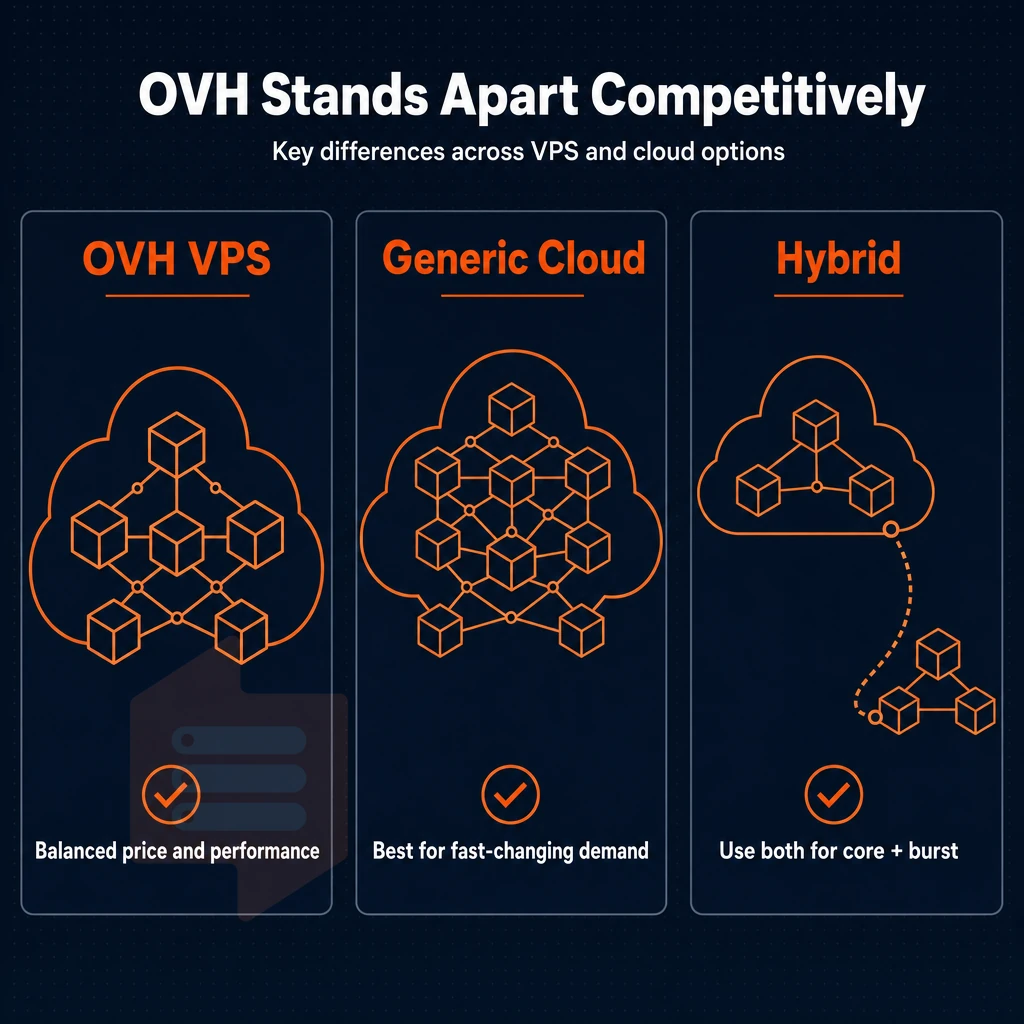
While many VPS products are offered by large cloud providers, not all are created equal. Typically, they compete on price, sacrificing performance for the lowest initial price point. Understanding the fundamental differences between them will help you select the best option for your use case. Aligning the VPS configuration with your business requirements ensures you're not paying for unused capacity or compromising on critical performance metrics.
Many organizations migrate from traditional hosting to cloud services expecting cost savings, only to discover that unpredictable billing models and hidden fees erode their budget advantages. BuyVPS offers VPS plans with transparent pricing and dedicated resources, avoiding the hidden costs common among larger providers.
Virtual private server vs. Public cloud and dedicated hosting
Public cloud services are delivered over shared virtual machines, and it doesn’t matter that noisy neighbors are using CPU and disk resources inadvisedly. Until cloud providers start to pin cores and enforce hard memory limits, the only performance you can measure is that provided by VPS solutions that deliver consistent performance, well suited for databases and latency-sensitive web APIs.
Data center footprint, network reach, and load balancer
At first a wide data center footprint sounds like a good idea but unequal hardware generations and also varying Service Level Agreements (SLAs) might be the result. We keep our data center infrastructure equal in Amsterdam and in New York: identical hardware and network connections, 99.8% uptime SLA and more. Choosing a provider with consistent hardware across locations means your application performs predictably regardless of which data center hosts your workload.
Hardware availability across regions also impacts performance consistency, so providers maintaining uniform specifications eliminate the risk of degraded service during regional failovers. Consistent hardware management across all locations ensures predictable resource allocation and simplifies capacity planning for distributed applications. Providers investing in intel next generation architecture across their fleet deliver better single-threaded performance and energy efficiency for compute-intensive workloads.
| Dimension | Large cloud providers | BuyVPS |
|---|---|---|
| Core allocation | Shared, burstable | Pinned (D-tier) or shared (S-tier) |
| Storage | Varies by tier | NVMe RAID10, 122,959 4K read IOPS |
| Uptime SLA | Varies | 99.8% |
| IP rotation on upgrade | Common | None, in-place upgrades |
How much does a VPS cost per month?
The price for a VPS can vary a great deal from provider to provider, depending on whether or not one can install software of choice, whether one can set up a multi-server setup. Additionally, Whether or not one is charged per API call for cloud services. On top of the cost of the compute resource itself.
Many large web hosting providers also charge egress and add separate layers of support for extra cost on top of the basic monthly fee for the resource itself. BuyVPS charges one published monthly fee per plan, with no setup fee and no separate support tier.
However, unlike shared hosting, if consistent performance and transparent billing matter more to you than a global footprint of datacenters, then BuyVPS is likely the better web hosting option for you. Large public clouds offer dozens of regions to choose from in the control panel, but only if you are willing to pay for the extra services, which can add up quickly. In this post we’ll take a closer look at the good and the bad of budget-tier VPS plans.
Pros and cons of ovh VPS servers
When evaluating a VPS offer, we compare the provider’s promises to the performance that you can actually measure. In the following sections, we explain what budget VPS plans are good for and where they are falling short.
Virtual private server strengths worth noting
- Low entry cost: The VPS platform is aimed at users with minimal budgets for simple use cases like operating systems. Anti-DDoS protection as part of the basic features has a lot of added value for entry-level use cases.
- OS flexibility. Support for many different operating systems (including Oracle Linux distributions) allows you to use the platform of your choice. We make the control panel easy to use to perform reboots and reinstalls of servers as required.
- ‘Headroom’ for the bandwidth that you pay for: Entry level plans are sized for small numbers of users accessing minimal amounts of data and the maximum upstream speed is generally marginally adequate for low-bandwidth applications.
Virtual private server weaknesses to weigh carefully
- Shared vCPU contention. This affects the cheap tiers that are provisioned on shared hardware. In the community forums there are many reports of poor CPU performance under load, particularly on the older Intel Xeon based nodes.
- Support model. Ticket-based support is typically slow to respond, a serious problem for many customers, particularly where uptime is a critical factor.
- Renewal pricing. Introductory rates often rise at renewal. Note: Always check the renewal rate, not just the signup price, before committing.
Which virtual private server provider is the cheapest?
Budget hosts often make up for low prices by using older hardware and inferior support.
The next step is to determine which workloads these are.
Common use cases for VPS hosting: where ovh fits
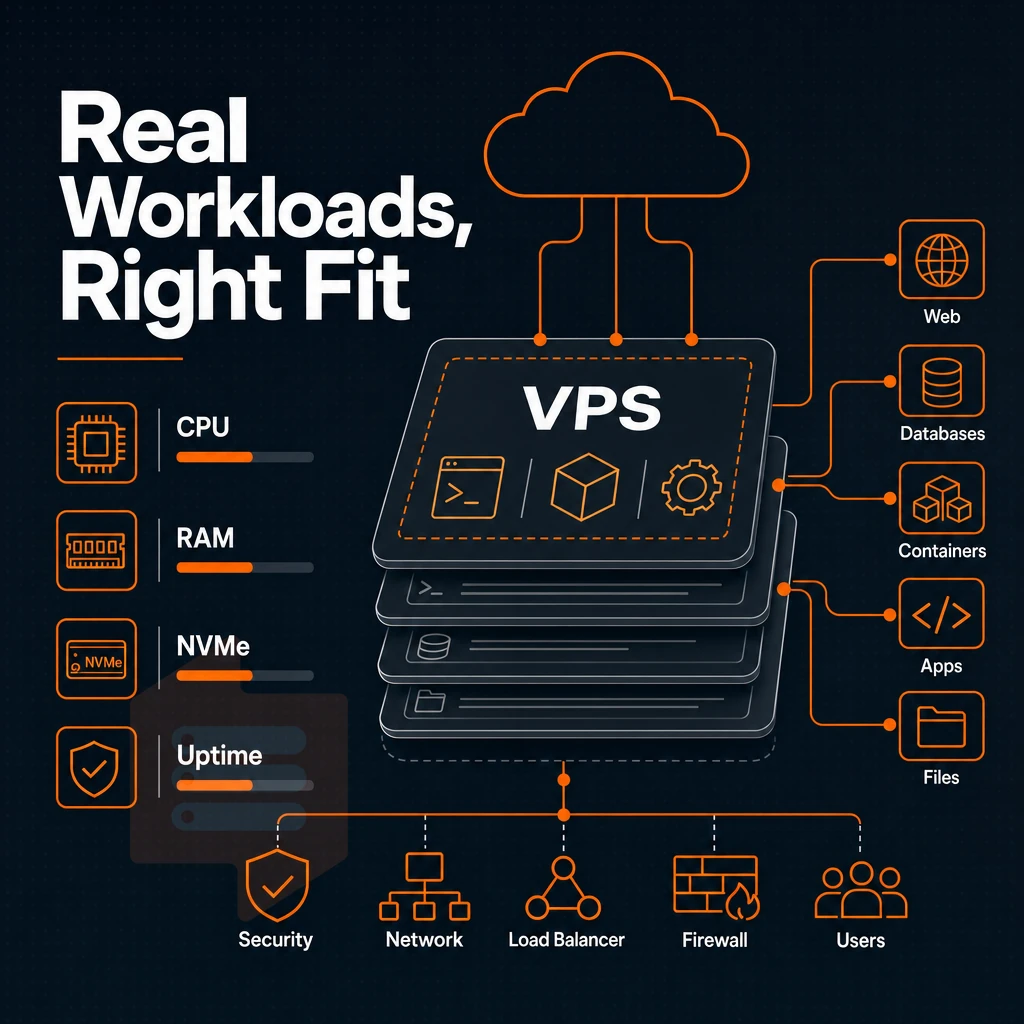
The types of workloads that VPS hosting can support are vast, simple web site projects, multi-server architectures. Knowing when shared vCPU resources are good enough and when you need pinned cores can help you avoid overspending on your hosting. Shared vCPU plans work well for testing business applications before committing to dedicated resources, while production deployments of enterprise software typically require the consistent performance of pinned cores.
Multi-server architectures often rely on interconnected servers to distribute workloads efficiently across different nodes, ensuring redundancy and improved response times for critical applications. When traffic scales beyond a single server's capacity, implementing a load balancer becomes essential to distribute requests across multiple VPS instances for improved reliability. Organizations scaling beyond single-node deployments often adopt a multi server infrastructure to separate database, application, and caching layers for improved fault tolerance.
Matching the right virtual servers and operating system to your workload
Low-traffic web hosting, dev/staging environments and small businesses typically don’t need dedicated CPU power. You can run these on a shared vCPU plan. You install your software, configure your stack and off you go with a clean hosting environment without the overhead of a full dedicated node. This approach delivers the flexibility of virtualized infrastructure without requiring the capital expense or management complexity of bare metal servers.
Organizations requiring maximum isolation and performance beyond VPS capabilities should consider dedicated hosting as the next tier up from virtual servers. Modern VPS platforms also provide enhanced security through isolated environments, ensuring that vulnerabilities in neighboring accounts cannot compromise your server's integrity. Organizations requiring maximum isolation and performance beyond VPS capabilities should consider dedicated hosting as the next tier up from virtual servers, where physical servers provide exclusive hardware access without virtualization overhead.
Unlike shared hosting, every VPS comes with root access, dedicated storage, and a dedicated kernel. Isolation is key, even at entry-levels, another tenant’s traffic spike won’t starve your processes.
What are the cheapest VPS solutions per month?
Entry-level shared vCPU plans from various providers start at a low monthly cost. BuyVPS offers Standard CPU VPS plans on AMD EPYC Milan with NVMe RAID10 storage in both Amsterdam and New York, no setup fee, predictable monthly billing. Check BuyVPS.com for current figures.
When VPS hosting demands a web hosting control panel
Production game servers, production databases and other multi-server infrastructures are typically constrained by shared vCPU. They fail under load with spikes of latency.
For production workloads, web hosting needs control over CPU scheduling. While shared vCPU plans might be suitable for pre-production environments, production environments need pinned cores.
The Dedicated CPU VPS plans from BuyVPS are built with AMD EPYC Genoa processors and DDR5 ECC memory.
Ovh VPS pricing vs BuyVPS: side-by-side comparison table
We have mapped the key specs for each of the decision criteria in a table below.
| Feature | Generic shared VPS (market reference) | BuyVPS |
|---|---|---|
| vCPU type | Shared vCPU (older-gen Intel Xeon on entry tiers) | Shared EPYC Milan (S-tier) or pinned EPYC Genoa cores (D-tier) |
| RAM | DDR4, varies by tier | DDR4 ECC (S/H-tier) or DDR5 ECC (D-tier) |
| Storage type | SSD or NVMe, single-disk typical | NVMe RAID10, PCIe direct, 122,959 4K read IOPS measured |
| Data storage redundancy | Not always stated | RAID10 on every node |
| Network | IPv4 standard; IPv6 varies | IPv4 + IPv6 dual-stack on all plans |
| Root access | Full root access on most plans | Full root access, custom ISO upload |
| Web hosting control panel | Proprietary panel, API available | Self-service panel with API + in-browser VNC |
| Uptime SLA | 99.9% typical | 99.8% stated SLA |
| Renewal pricing policy | Promotional rate, renewal hike common | Published rate card, no setup fee |
| Data center locations | Global multi-region | Amsterdam and New York only |
| Support model | Tiered, ticket-based | Engineers reply directly, no first-tier chatbots |
| Hardware availability | Shared node, density not disclosed | Hard memory caps, low node density by design |
What is the difference between shared vcpu and dedicated-core VPS?
Note that a shared vCPU is scheduled across multiple tenants.
Our Dedicated-Core VPS web hosting instances utilize a dedicated-core VPS which assigns physical cores to a customer's instance and will not have other customers compete with for cycles. The D-tier tier VPS instances use pinned EPYC Genoa cores. This ensures the lowest possible latency under sustained load.
What the table doesn't show about backup options
Also keep in mind that an SSL certificate or a managed database add-on can greatly affect the real cost of a plan. Take a closer look at the full stack and don’t only go by the specs. If storage I/O and CPU consistency are crucial for your workload, you should test our RAID10 NVMe servers and the pinned-core option first. Deciding between shared vCPU and dedicated core is something you should look into in more detail as well.
How to choose between ovh VPS and a dedicated environment VPS

A dedicated-core account carries no such variable.
Shared vcpu vs. Dedicated core: what actually differs
Shared plans have many tenants competing for the same physical cores. Sites that are static and light traffic are usually okay. Databases and latency sensitive APIs and high traffic apps that are anchoring a load balanced site will experience measurable contention on shared plans rather than VPS servers. A dedicated-core VPS will pin cores to a VPS instance just as dedicated servers do, at a fraction of the physical infrastructure footprint.
High performance workloads: when pinned cores matter
Databases, real-time APIs, and multi-server stacks all rely on constant access to CPU power. Shared vCPU powered servers perform great under low load, but can drop in performance unexpectedly under high load. Locked cores guarantee consistent performance. Our Dedicated CPU VPS servers powered by AMD EPYC Genoa processors with DDR5 ECC memory are perfect for apps that cannot afford any performance variability.
Does ovh VPS pricing increase at renewal?
Many cloud providers charge promotional prices when you sign up and then raise the price at renewal time. Always check what OVH charges at renewal, because the promotional rate and the renewal rate can differ. BuyVPS publishes one rate card and charges no setup fee.
| Factor | Shared vCPU | Dedicated-core VPS |
|---|---|---|
| CPU contention | Yes, noisy-neighbor risk | None, cores are pinned |
| Best for | Dev, staging, low-traffic sites | Databases, APIs, high-traffic apps |
| Renewal cost | Varies by provider | BuyVPS: same price, no hike |
| Cost model | Competitive pricing, lower entry point | Higher base, predictable TCO |
For production workloads of any kind, though, go with a dedicated-core plan.
When ovh VPS is not the right choice
The hardware is old, there’s no control over performance, and the surprises at renewal time are many and constantly reproduced by the community.
Workloads where ovh falls short
- If you have CPU-intensive applications, the shared hardware of lower-tier plans will create noise for your neighbors. And if your application needs pinned cores, shared vCPU plans won’t perform well under real load.
- I/O-intensive databases. Storage space is typically very limited on entry-level plans. Disks are shared on physical servers and not direct connected with PCIe to NVMe storage. Measured IOPS values vary significantly from one reboot to the next.
- Production environments need predictable latency, which cannot be guaranteed without dedicated CPU allocation. A web server serving live traffic cannot tolerate spikes in latency when the system is under peak load.
What should i look for when comparing VPS providers?
Assess VPS hosting service providers along four key dimensions: transparent hardware, scalable upgrade path, excellent support, and honest pricing.
- Hardware transparency. Identify the CPU generation, RAM type and storage tier for a VPS before signing up for a account. Published benchmarks help to avoid surprise.
- Upgrade path. Are in-place upgrades supported? Some providers change the IP of your server when you resize it. That means you have to deal with a DNS change and resulting downtime.
- Renewal pricing: Be sure to check the monthly price for the following year(s) and whether there are any price increases planned for future renewals. Most services have increases for renewal years.
- Security posture. Look for actual security features like edge filtering, KVM isolation and hard memory limits. Don’t be fooled by marketing copy.
BuyVPS addresses each of these points directly: published fio benchmarks, no IP address change for in-place upgrades, no price increases for renewals, and external storage space available on request in Amsterdam and New York.
Note: If any provider cannot answer questions about CPU pinning, node density, or IOPS methodology, treat that as a red flag for production use.
And there are a number of considerations involved in this upgrade decision.
Why businesses upgrade from shared-vcpu VPS to dedicated-core infrastructure
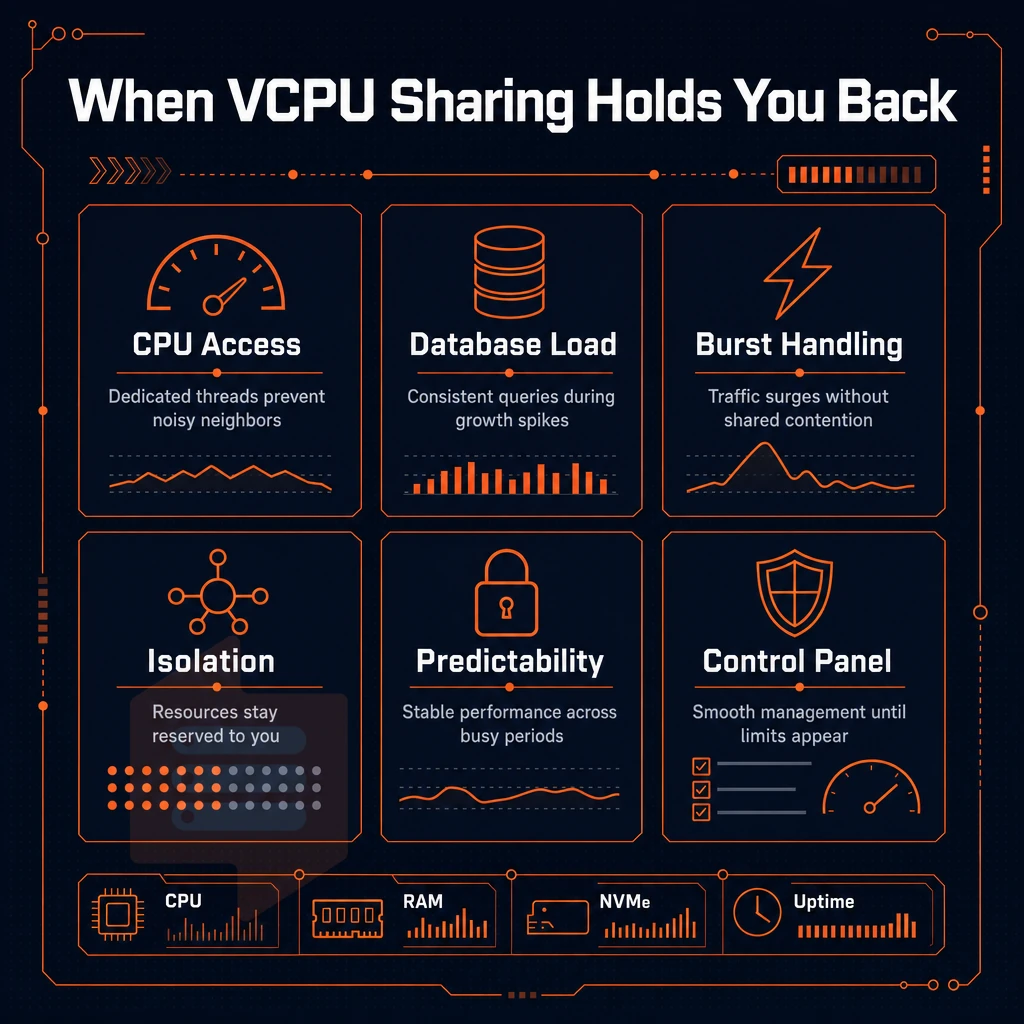
Until something goes wrong with your shared vCPU plans, the control panel generally works well for sudden traffic spikes, growing databases and even compliance.
As soon as you hit one of these triggers, however, you will quickly realize, just a few clicks into your scaling journey through the web hosting control panel, that CPU time is shared with other customers and that one noisy neighbor can instantly bring down your latency. Knowing when these thresholds will be reached allows for a smooth upgrade to more suitable plans.
VPS solutions that hit the shared-cpu ceiling
Business applications with tight SLA's fail first here.
Pinned cores eliminate the scheduler fight. With a Pinned dedicated-core VPS you reserve physical threads for your instance. Performance is consistent under load and not just in benchmarks.
What to look for beyond raw cores
The cutting edge technology in the storage as much as in the CPU isolation. Our NVMe RAID10 storage on PCIe buses with PCIe-direct access outperforms shared servers by a wide margin. Only a solid VPS with predictable throughput for I/O operations allows for a successful integration of object storage. A robust infrastructure is only as strong as the full stack of compute, memory and storage.
The overhead of managing hardware is also significant.
BuyVPS versus other public cloud providers
Our Dedicated CPU VPS runs on the latest AMD EPYC Genoa CPUs and comes with DDR5 ECC memory. In terms of the architecture we applied the latest intel generation principles to KVM isolation.
This means every VPS gets its very own kernel (of which there are several to choose from). Hard memory limits and, thanks to low node density, plenty of scope for in-place upgrades as your business grows. No IP rotation, no migration window, just scale as needed and rebuild nothing.
Running KVM with separate kernels for VPSes means that even if a neighboring VPS gets compromised, your VPS will remain unaffected at the kernel level. This makes KVM a good option for highly compliant workloads.
The same infrastructure choices are made available to customers at all three levels of BuyVPS offerings.
Why choose BuyVPS for high-performance VPS hosting
When evaluating VPS hosting options, the infrastructure behind a VPS provider matters as much as the headline specs. We operate a robust infrastructure across two data centers, Amsterdam and New York, built on high-performance hardware with no-oversell guarantees and hard memory caps per node.
- Three purpose-built VPS tiers: Standard CPU (virtual servers on AMD EPYC Milan with shared vCPU), Dedicated CPU (pinned cores on EPYC Genoa with DDR5 ECC for a true dedicated environment). Additionally, High Memory for RAM-intensive workloads.
- NVMe RAID10 PCIe direct storage: 122,959 4K read IOPS measured under real load, not estimated.
- Full root access on every plan, with custom ISO support and your choice of operating system across all VPS servers.
- In-place upgrades with no migration and no IP rotation, your hosting environment stays stable as your business grows.
- Competitive pricing with every rate published up front and no setup fee.
- Engineers reply to support tickets, no first-tier chatbots, no scripted responses.
Founder-run since 2002, BuyVPS delivers dedicated resources and KVM isolation (a separate kernel per VPS) that shared hosting simply cannot match. See how our VPS solutions compare across tiers at our comparison page, or reach out to discuss which plan fits your workload.
The core differences between ovh VPS pricing and dedicated-core VPS value
VPS hosting price (headline) is not always what it seems. Shared vCPUs, price hikes on renewal, and single-disk storage destroy value in cheap VPS hosting. Pinned cores, fixed-price contracts, and RAID10 NVMe store far greater value in real terms for real workloads.
When buying VPS, it’s helpful to treat your buying criteria as a simple decision tree. If price is more important than performance then look at the shared-core VPS hosting offerings.
But if you need constant throughput on VPS servers, then look at the core count, the quality of the storage and the quality of the support for the hosting provider. At BuyVPS we offer dedicated-core VPS hosting from two datacenters: Amsterdam and New York. There is no renewal price hike and all support is provided by senior engineers 24/7.
The cost of a VPS is not just the monthly rate, also important are performance, renewal prices and the actual infrastructure behind the VPS. Although the starting packages for VPS servers look similar on paper in the public cloud, there can be huge differences in CPU distribution, the storage concept and the quality of the support.
1) Noisy-neighbor behavior on shared vCPU plans, contrasted with the completely isolated performance of dedicated-core plans. 2) The value of a low introductory rate can quickly erode by the time the first renewal hits. BuyVPS addresses both of these issues by dedicating a set number of cores to customers in the Dedicated CPU environment tier rather than relying on public cloud shared resources, and by publishing one monthly price for that tier.
If predictable performance and no surprise fees matter to your deployment, explore BuyVPS plans across Amsterdam and New York, or reach out to the engineering team at info@buyvps.com with your workload requirements.