

The decision for the best VPS hosting in the USA is centered on the location your load runs from and how well it performs under load. Latency to users on the East Coast, storage performance, CPU isolation, and ddos protection are key data center areas that can make for a great host or one that causes problems for you. Choosing the wrong host can make all three of these worse for you.
Most VPS usa buyers get burned by the same pattern: a provider overselling nodes on a server, then throttling back the shared CPUs during peak hours.
This guide cuts through the hype of US VPS providers. A detailed guide to finding the right high performance unmanaged VPS provider for your needs, highlighting the core aspects that matter: hardware, network, virtualization, and support. In this guide we also put BuyVPS to the test, a provider offering virtual servers powered by AMD EPYC hardware in New York, with hard memory limits and no-oversell on high performance nodes for production workloads. Start reading from the beginning.
What is VPS web hosting and how does it work?
VPS hosting, on the other hand, provides you with a private ‘slice’ of a physical server, complete with dedicated resources and full isolation from other users. With VPS solutions, you don't have to worry about other users on shared data center hosting accounts ('noisy neighbors') hogging all the server resources and impacting your site's performance. VPS hosting is positioned between shared hosting and a dedicated server (bare metal server) in terms of control and cost.
First month $1
Then the normal monthly price. One per customer. No setup fee, and a 30-day performance guarantee on your first order.
See the plans“Excellent experience from start to finish! The server was delivered promptly, and the service was reliable and efficient. I m very happy with the results and would definitely recommend them.”
What are virtual servers and how do they work?
A Virtual Private Server (VPS) is a Virtual Server created by a Hypervisor on a physical server. The Hypervisor partitions the bare-metal server into separate Virtual Environments. In a VPS, each of these virtual servers is allocated a fixed amount of CPU, RAM and Storage, unlike Shared Hosting environments where resources are divided into flexible shared pools.
Each of these virtual servers operates independently with its own operating system instance, ensuring complete process isolation and resource guarantees that shared hosting cannot provide. Organizations requiring complete hardware control and maximum resource allocation typically graduate from VPS environments to a dedicated server once workload demands exceed what virtualization can efficiently provide.
This is hardware-grade isolation on the software level.
Dedicated resources and root access
VPS servers are not shared environments and come with strict limits on the available resources. The RAM you are allocated is yours to use. The CPU cycles that are allocated to your server are also yours to use. And with a VPS you have full root access to the server, which means you can install the Operating System of your choice, install any required software. Additionally, Set up the server to best meet the needs of your workloads.
This level of control makes VPS environments particularly well-suited for running custom developer tools, build systems, and staging environments that require specific software stacks. Root access grants full hardware control over virtualized resources, enabling administrators to tune kernel parameters, configure custom network stacks, and deploy containerized workloads without vendor restrictions. When demand spikes, a scalable cpu allocation model ensures your VPS can handle increased load without manual intervention or downtime.
A single Virtual Private Server (hosted on AMD EPYC hardware with NVMe RAID10 storage, as we host it) is all we need to run production databases.
VPS hosting USA: why location matters
For US East Coast latency we host USA VPS in our New York data center, keeping round-trip times for American users down to a minimum. In addition, a USA VPS server will keep your data within US jurisdiction, ideal for compliance-sensitive workloads. Our infrastructure spans multiple us data centers with direct peering agreements to major ISPs, ensuring consistent performance across regions.
- Choose New York for US-facing applications.
- Choose Amsterdam for EU audiences or GDPR-scoped data.
- Both locations run identical hardware and network specs.
Building on that foundation, here’s why choosing to host your VPS in the USA makes a huge difference for workloads based in North America. Selecting a VPS usa deployment ensures that application logic, user sessions, and database queries remain geographically proximate to your primary audience, reducing network hops and improving end-user experience.
Why host your VPS servers in the USA?
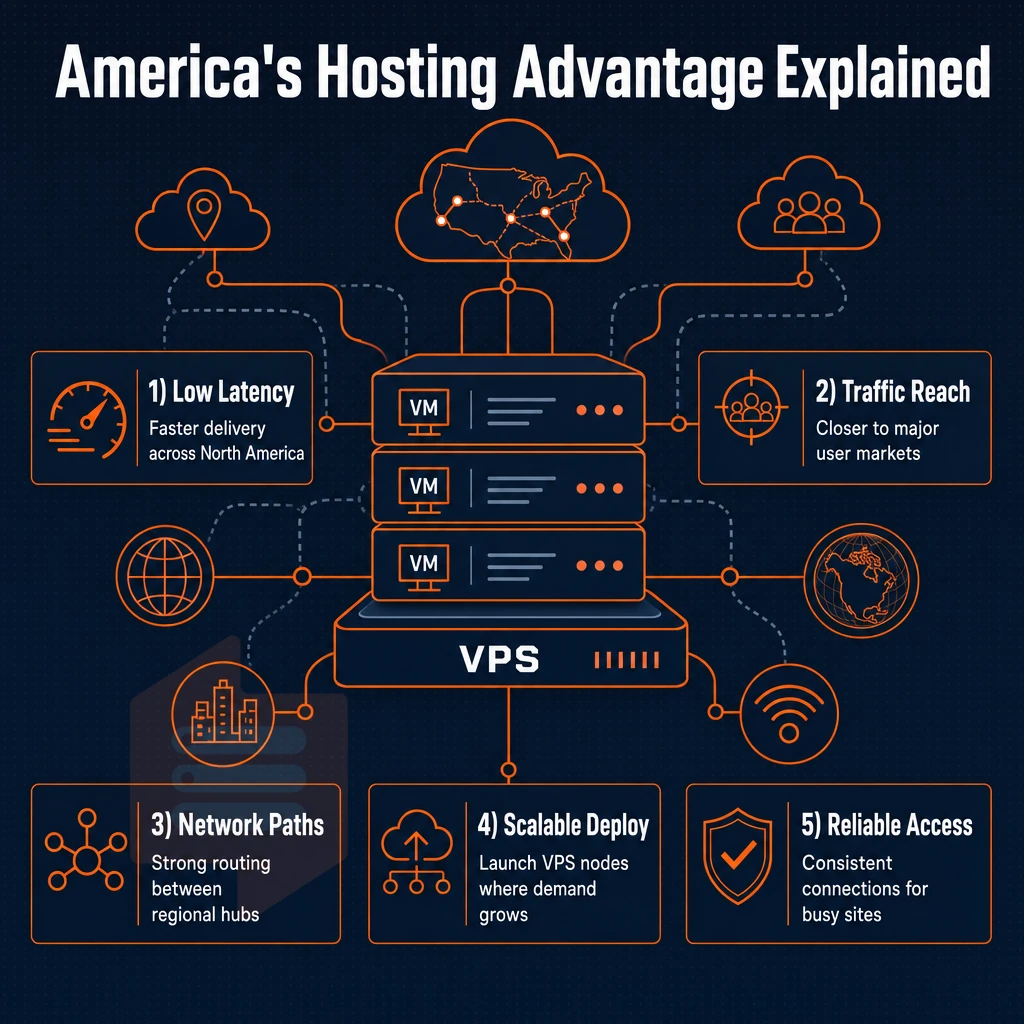
The location of your VPS greatly affects the speed of your server. For a web developer building an online store or high traffic site for North American users, a server in the US can save you from a lot of latency. Our New York data center is at the hub of the largest concentration of US internet users on the East Coast, and is within milliseconds of sending traffic to users across the continent.
Latency and reliability for us-bound traffic
Hosting your website on a USA VPS Server typically will achieve a round trip time of under 20ms to the North Eastern part of the country. However this time increases dramatically the further across the Atlantic you go. For an ecommerce site every extra millisecond can increase cart abandonment.
Our New York based VPS hosting runs on multi-homed uplinks and your data is stored on NVMe RAID10 storage. This performance is made possible by robust infrastructure that includes redundant power, network-level DDoS mitigation, and enterprise-grade hardware provisioned specifically for low-latency workloads.
VPS servers built for north american workloads
US data centers are more than just fast servers. Many US-based companies rely on data local to their own compliance and customer trust requirements. Running your own VPS USA server allows you to have your data local to the US, without the additional costs of a dedicated server. For workloads that require isolation but don't yet justify the capital expense of bare metal infrastructure, a USA VPS bridges the gap between entry-level plans and a dedicated server deployment.
Meaning there are no noisy neighbors that can compete with your VPS for resources.
When new york is the right choice
New York VPS servers are for teams that need high performance under real East Coast load: fintech dashboards, SaaS platforms, API backends serving US customers. Our high performance VPS solutions in the New York region are the best fit for audiences that are primarily North American: they cut latency, keep data local, and scale without IP rotation. This is difficult to achieve from a European node.
These servers also support transactional e mail delivery at scale, ensuring customer notifications and account alerts reach inboxes without delay. These capabilities make New York VPS infrastructure particularly effective for high traffic websites that demand consistent sub-20ms response times and cannot tolerate the performance degradation common in oversold environments. Selecting the best VPS for your workload means evaluating not just advertised specs but actual performance under load, uptime guarantees, and geographic proximity to your user base.
Here is a summary of the BuyVPS plans.
Core VPS servers: standard, dedicated CPU, and high-memory plans
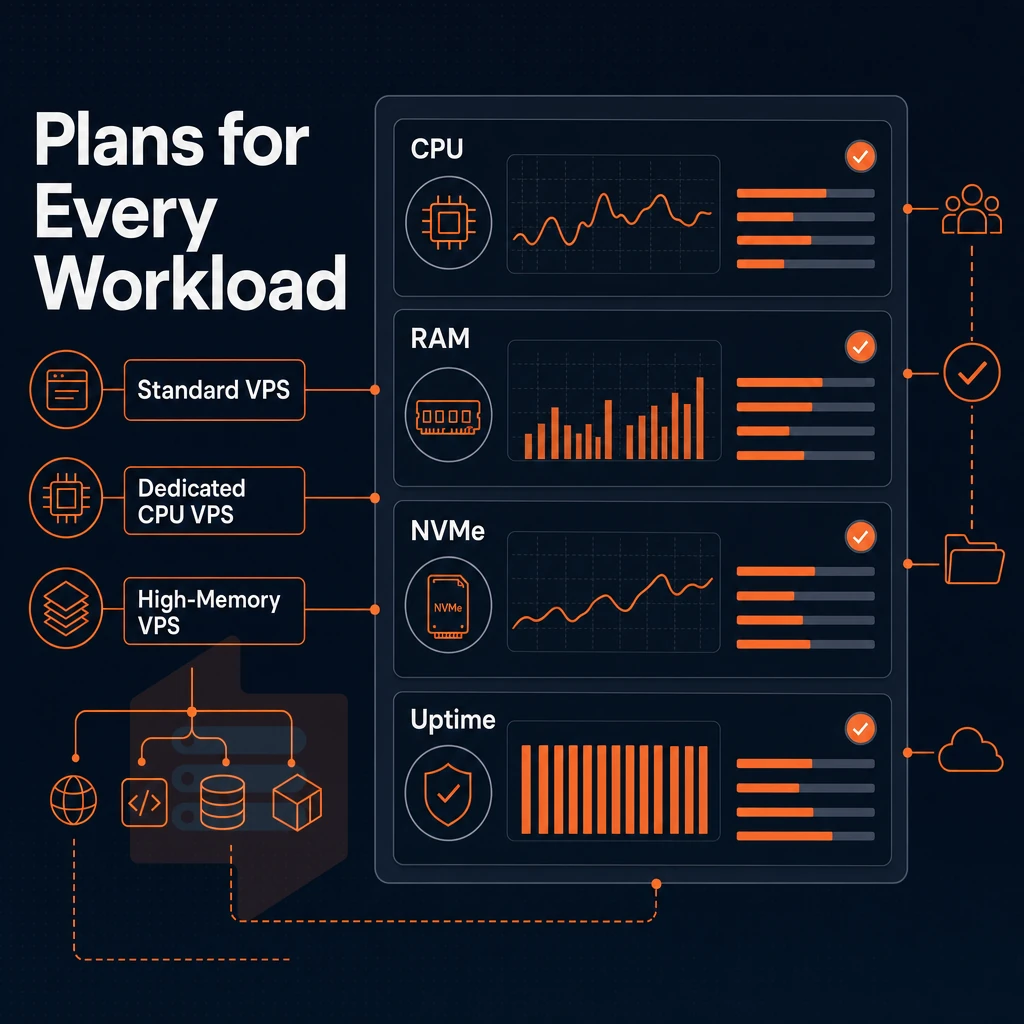
BuyVPS offers three VPS hosting plans, each designed around a specific workload. Unlike shared server plans, each plan includes full root access, KVM isolation, and a dedicated kernel. Start with the plan best suited for your needs and scale up from there. Each tier unlocks progressively more powerful configurations, giving you access to advanced features like custom firewall configurations, snapshot scheduling, and API-driven provisioning as your infrastructure requirements grow. When you choose VPS hosting, understanding your workload requirements upfront ensures you select the right tier without overprovisioning resources or facing unexpected migration complexity later.
Before committing to a plan, review the technical specifications and compare them against your projected traffic patterns, then go to provider documentation to confirm compatibility with your existing toolchain. Comparing VPS plans side-by-side reveals differences in allocated RAM, CPU cores, and storage capacity that directly impact application performance under load. Evaluating VPS services across multiple providers helps you identify which features are essential versus optional for your specific use case. Selecting the best VPS configuration means balancing CPU allocation, memory capacity, and storage throughput against your application's actual resource consumption patterns.
VPS hosting plans at a glance
- Standard CPU VPS (S-tier): Shared vCPU on AMD EPYC Milan with NVMe RAID10 storage. The right fit for general web hosting, staging environments, and moderate-traffic applications. Hard memory caps per node mean neighbors never squeeze your allocation.
- Dedicated CPU VPS (D-tier): Pinned cores on AMD EPYC Genoa with DDR5 ECC RAM. Choose this for latency-sensitive workloads, real-time APIs, game servers, or CI/CD pipelines where CPU steal would cause measurable regressions.
- High Memory VPS (H-tier): A 1:8 vCPU-to-RAM ratio on EPYC Milan. Built for in-memory databases, large caching layers, and analytics jobs that page to disk under lesser VPS solutions.
Selecting and deploying your plan
- Match tier to workload: Identify your bottleneck first, CPU contention, memory pressure, or I/O. Pick the tier that removes that constraint directly.
- Deploy in just a few clicks: Our self-service panel provisions your VPS in minutes. Choose Amsterdam or New York, select your OS (Ubuntu, Debian, AlmaLinux, Rocky Linux, and more), and you're live.
- Scale in place: Every plan supports in-place upgrades. No migration, no IP rotation, a scalable VPS that grows without disrupting running services.
Note: Upgrading requires technical expertise only when reconfiguring application-layer settings after a resize. The control plane handles the infrastructure side automatically. Our control panel includes access to a dedicated support team available to assist with post-upgrade configuration questions or troubleshooting.
VPS services plans summary
| Tier | CPU | Best for |
|---|---|---|
| Standard (S) | Shared EPYC Milan | General workloads, web apps |
| Dedicated (D) | Pinned EPYC Genoa | Low-latency, real-time apps |
| High Memory (H) | Shared EPYC Milan | Databases, large caches |
So it’s worth taking a closer look at the storage layer.
NVMe raid10 and block storage performance
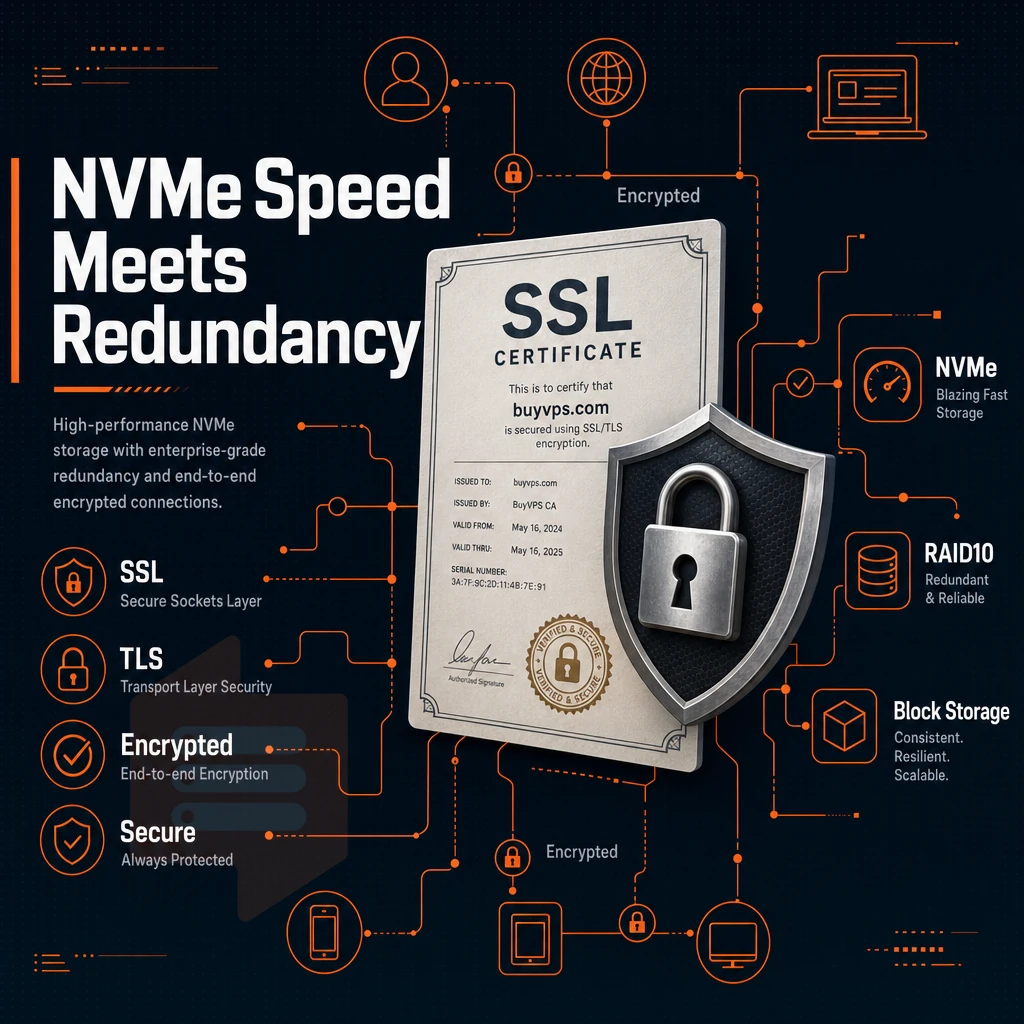
BuyVPS storage is based upon NVMe RAID10 running directly over PCIe.
Block storage architecture
The block storage for the data in gVisor is implemented using NVMe SSDs in RAID10. This configuration stripes and mirrors data to provide redundancy as well as high performance. On a virtual private server hosted environment, storage attached via PCIe directly to the CPU removes the overhead of an HBA and keeps latency in the low microseconds, as opposed to the low to mid milliseconds seen with SATA-connected SSDs.
This architecture delivers stable performance even under sustained write-heavy workloads, ensuring predictable I/O latency for database transactions and application state persistence.
The published fio benchmark result of 122,959 4K random read IOPS is a real new york VPS data center number, reproducible by anyone, because we published it for you to verify for yourself. No numbers made up here, unlike some server administration guides for hosting websites that pull sequential read figures out of context to make StorageOS look better than it does in true random disk access performance.
Why this matters for demanding workloads
For PostgreSQL and MySQL hosted in us data centers, the number of checkpoint flushes, WAL writes, and index scans all get to depend on consistent performance at the block level.
CI/CD pipelines running parallel build jobs for multiple websites or microservices demand both real technical expertise and responsive support, as they hit storage hard during artifact writes and Docker layer pulls. With fast, low-latency NVMe the duration of your pipeline is still predictable.
High-traffic systems such as caches, queues and session stores require a storage system that provides stable and consistent uptime.
Support services and reliability commitments
The hardware is only half the equation, the rest is your team of experts.
An overview of the BuyVPS network architecture and its capabilities under load.
Network infrastructure: low latency, DDoS protection, and uptime
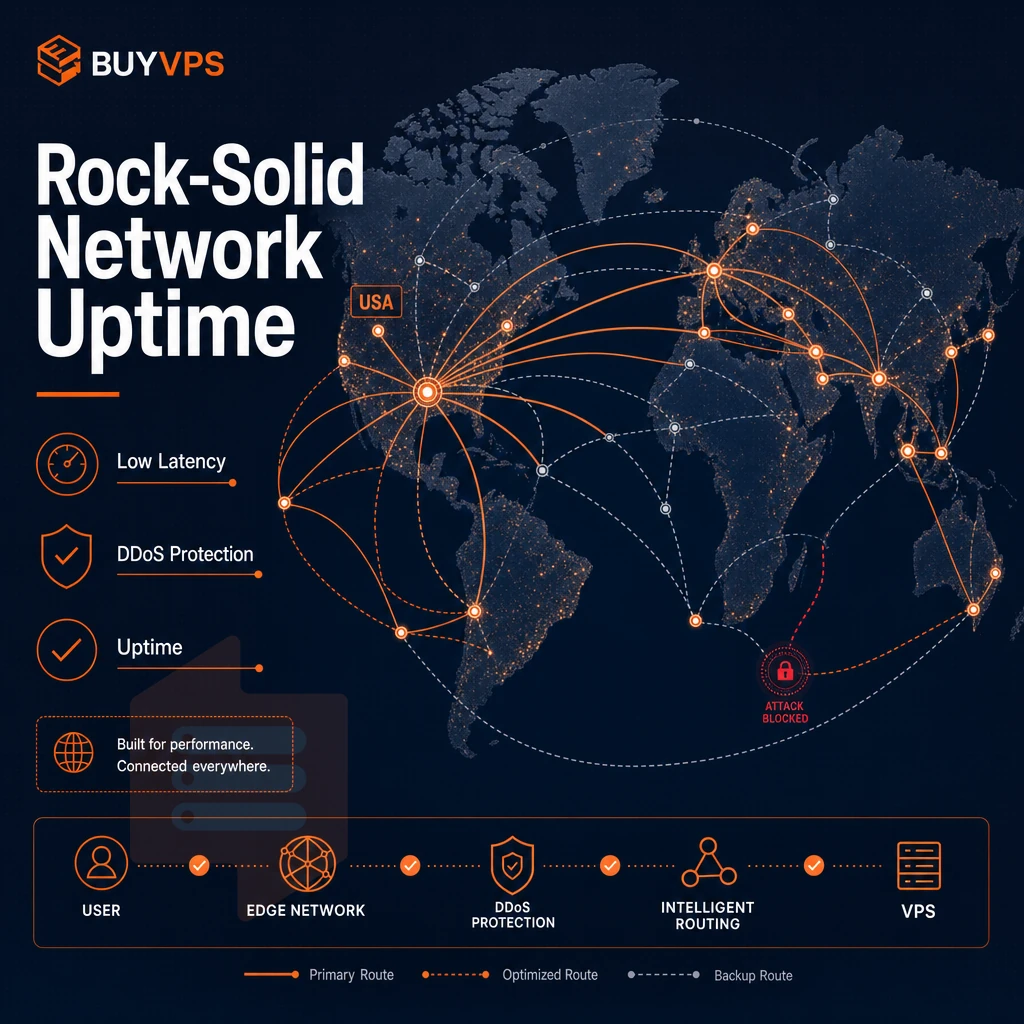
We don't just build our us VPS networks for peak performance, we also build them for consistency and for delivering the stable uptime and throughput that production workloads require. We use multi-homed uplinks, edge filtering, and strict no-oversell policies to achieve these goals.
DDoS protection and edge filtering
Every VPS on our network is configured behind abuse-policy-based firewall rules and edge filtering. DDoS protection is configured at the network perimeter where traffic is scrubbed before it reaches your VPS. You are also able to create your own server-level firewall rules for finer grained control.
All plans come with IPv4 + IPv6 dual-stack support on dedicated IP addresses per VPS.

Reliable VPS hosting through no-oversell architecture
Reliable VPS hosting starts with the hardware, we enforce fixed amounts of RAM per node, and keep the density of nodes on servers low. We don't promote inflated RAM numbers to squeeze in more nodes per data center rack, instead we aim to deliver low latency in real world usage, and not just in contrived test cases.
Dedicated CPU Resources (cores pinned rather than shared) are ideal for workloads that require predictable CPU performance.
Network and traffic policy
The US VPS infrastructure runs on redundant power and multi-homed uplinks.
Unlimited traffic, unlimited bandwidth with no throttling and no overage charges. Same network specs as Amsterdam region for our US VPS customers.
A strong network is nothing without control of the server it runs from. In this section we cover KVM isolation, OS flexibility, and what full root access actually means in practice.
Choosing the right USA VPS hosting service provider
Not all VPS hosting USA services are created equal. Evaluating a few important criteria beforehand will save you from having to transfer your server in the future.
Best VPS USA hardware and virtualization
- CPU generation is also something to look out for. Newer AMD EPYC generations such as Milan and Genoa outperform their counterpart Xeon generations from past years notably in memory bandwidth and core count. Latest silicon generation typically also gives most consistent performance under real load.
- Verify KVM virtualization. Each VPS has its own kernel. OpenVZ virtualization shares one kernel between all tenants. This severely restricts what you can install and leads to noisy-neighbor problems.
- Confirm the NVMe SSD storage is set to NVMe over PCIe and not SATA SSD storage. NVMe over PCIe has significantly higher IOPS than SATA SSD storage and can provide very real performance improvements for database applications and other high traffic web applications.
Service provider policies
- Do they oversell on their VMs? A lot of providers try to cram as many VMs on a node as possible. Look for a provider that has hard memory caps on their VMs and low node density. That way you can rest assured they aren’t going to oversell and you’ll actually get the allocation you paid for.
- Demand to see truly transparent pricing and make sure there are no “Setup Fees” and that there won’t be any renewal price hikes. Also, confirm that there are no hidden charges for things like extra bandwidth or IPv6. Affordable pricing only matters if the price doesn’t suddenly jump at renewal time.
Note: Always read the renewal terms. A low introductory rate that doubles after year one is a common trap.
Scalability and operating system upgrades
- Verify the upgrade path for the solution. In-place upgrades (no migration and no IP change) should be supported. The solution should support scalable resources, including CPU, without having to reprovision.
- Verfiy your organization has dual-stack networking configured. By having IPv4 and IPv6 on every plan you can do minimal latency routing between the two and future-proof your stack without having to worry about extra hardware and the maintenance costs.
BuyVPS does everything right here: KVM, AMD EPYC, NVMe RAID10, fixed RAM, and in location upgrades for Amsterdam and New York.
Of course hardware and policies are important, but the way you are handled by support when things go wrong is equally as important. This section outlines the types of support you can expect to receive with your VPS usa plan and will clearly explain where we take responsibility and where we will expect you to take responsibility.
Support services and server maintenance: what you should expect
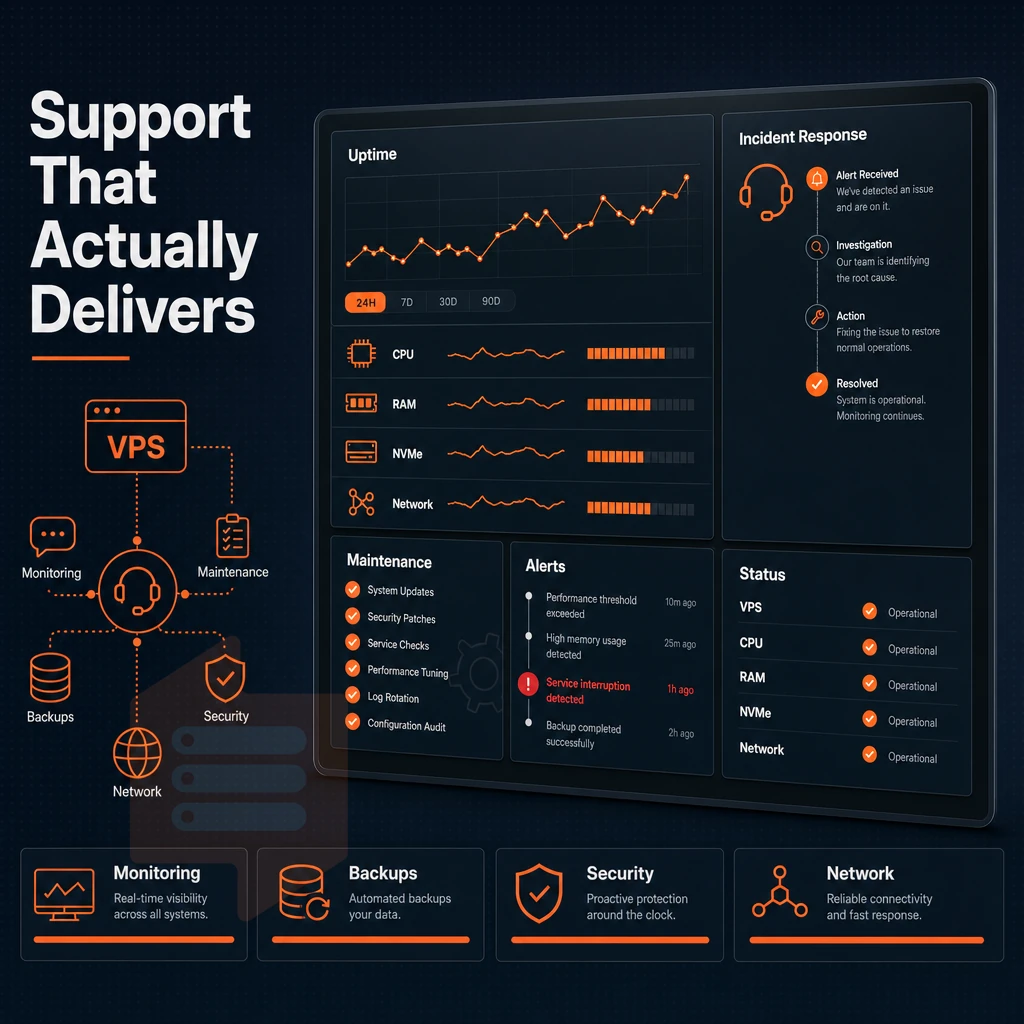
Knowing what your data center hosting provider handles versus what you own, from reliable performance guarantees to incident response, will shape your OS choice and how you manage outages.
Managed vs. Unmanaged: who owns the stack
With managed VPS hosting your provider updates the OS, applies security patches and administers the server for you. With an unmanaged VPS you administer the server, updating the kernel, firewall and package manager as needed. And it’s up to you to sort out any problems that may occur with the server.
Most developers and engineering teams run their production workloads unmanaged, as most provide dedicated resources without the overhead of a managed instance, and root access to tune as you see fit.
VPS servers and hardware responsibility
The boundary of host machine ownership is non-negotiable and always the provider’s. All hardware maintenance (such as failed drives, node replacement, network uplinks) is the responsibility of the provider and never the customer. Today’s VPS hosting clearly delineates between the customer owning the software and the provider owning the infrastructure.
Our isolated server is like a dedicated server, without the upfront cost of the hardware or the ongoing management of the physical servers.
What BuyVPS provides
Our support team is made up of engineers, not first-tier chatbots.
We provide support for problems that are related to the infrastructure. Such problems could be caused by hardware failure, a network incident or a problem in the control-plane. We do not provide support for OS-level configuration or for troubleshooting of applications on our unmanaged plans.
By keeping our technical assistance division focused and fast we can provide you with direct access to the hardware engineers.
We now review all aspects that make up the package that BuyVPS offers as a quality US VPS provider.
Why choose BuyVPS for VPS hosting in the USA
For USA VPS hosting, BuyVPS runs a New York data center with AMD EPYC hardware, NVMe RAID10 storage, and KVM virtualization, the same specs and pricing as our Amsterdam location. No surprises, no hidden fees.
- High-performance storage: NVMe RAID10 with 122,959 4K read IOPS measured (fio median), consistent performance under real load.
- No-oversell guarantee: Hard memory caps per node and low node density mean your dedicated resources stay yours.
- Full root access on every plan: Choose your operating system, upload a custom ISO, and configure firewall rules without restrictions.
- KVM isolation: Each VPS runs a separate kernel, reliable infrastructure with no noisy-neighbor risk.
- In-place upgrades: Scale your US VPS without IP rotation or server migration, just a few clicks in the control panel.
Our New York data center delivers low latency to US East Coast users, backed by redundant hardware and engineer-led support. Transparent pricing, no hidden fees, and identical hardware across both regions make BuyVPS a reliable VPS hosting choice for ecommerce stores, development environments, and high-traffic websites alike. Reach out to compare VPS plans or get a quote.
US-based VPS hosting delivers the low latency, compliance alignment, and raw performance that North American workloads demand. The difference between sluggish virtual servers and responsive ones often comes down to three factors: reserved CPU resources, fast NVMe storage, and a network built for uptime, not oversold on promises.
Standard, pinned CPU, and High Memory plans make VPS hosting today cover everything from lightweight apps to memory-intensive databases, all with complete root access and in-place upgrades that never rotate your IP.
If you're ready to move beyond shared web hosting or an overcrowded cloud instance, browse the BuyVPS plans and pick the tier that fits your workload.