

Choosing the right VPS server in the USA, including how much GB RAM your plan allocates, can greatly affect latency, the level of exposure to non-compliant data, and overall performance.
The USA VPS server market is crowded and the marketing materials typically do not accurately portray what the server hardware can handle.
This guide cuts through the marketing hype to deliver a comprehensive review of the best US VPS hosting . Find out what separates the wheat from the chaff of performant hosting from the masses of poor quality shared hosting with limited resources. We outline the essential specifications you should demand from any prospective virtual private hosting supplier in the United States and clarify which type of virtualized hosting is best suited for different workloads.
Whether you’re moving a latency sensitive API. A database or a CI/CD pipeline that demands a consistent number of physical processor cores to achieve optimal performance then this guide outlines the key criteria to choose the right us based hosting for your needs. We start with the basics of what a VPS is and how the hosting isolation works.
What is a VPS server and how does it work?
A Virtual Private Server (VPS) is between a shared hosting environment and a full dedicated server. It provides isolated resources and full root access to the user, but does not require the user to purchase an entire server. Understanding the type of isolation a VPS USA providers offer, including dedicated cpu ram and resources, can help you decide whether a VPS or shared server hosting environment is best for your specific needs.
First month $1
Then the normal monthly price. One per customer. No setup fee, and a 30-day performance guarantee on your first order.
See the plans“Sjoerd helped me with the setup of my VPS, super helpful team, smooth onboarding, and overall a great experience, thanks again”
A common reason to pick the New York location is a bot that talks to US exchanges; our trading bot VPS guide covers the Linux setup and the time sync.
How virtualization splits one machine into virtual servers
KVM (Kernel-based Virtual Machine) hypervisor technology for servers partitions a single physical server into multiple independent virtual servers (Virtual Machines) that each get to utilize their own partition of CPU power, RAM, NVMe storage etc. This partitioning is hard-capped, meaning that there is no shared usage of server resources.
The NVMe SSD drives used in modern VPS configurations deliver significantly faster read and write speeds compared to traditional SATA-based storage, reducing application load times and database query latency. Modern VPS providers pair these performance advantages with unlimited bandwidth allocations, ensuring that high-traffic applications can scale without incurring overage fees or throttling during peak usage periods.
Each VPS also runs its own operating system kernel.
What is a VPS server in the USA with DDoS protection?
VPS servers from US data centers will give North American users the best possible latency to your applications. Our VPS server in New York gives you a US East Coast presence, with a range of plans featuring ddos protection, powered by the latest AMD EPYC processor technology, with NVMe RAID10 storage, and IPv4+IPv6 dual-stack connectivity.
The NVMe SSD architecture in our infrastructure delivers read speeds exceeding 3,000 MB/s, ensuring database queries and application loads complete in milliseconds rather than seconds. All plans include unlimited bandwidth to ensure your applications can handle traffic spikes without incurring overage charges or throttling.
Root access and what it unlocks in the united states
VPS hosting provides root access, allowing users to install any software, set up firewalls, and even modify the kernel. Once users have a virtual server set up, they can control the entire stack from the bootloader through the applications running on it.
Why host your VPS in the united states?
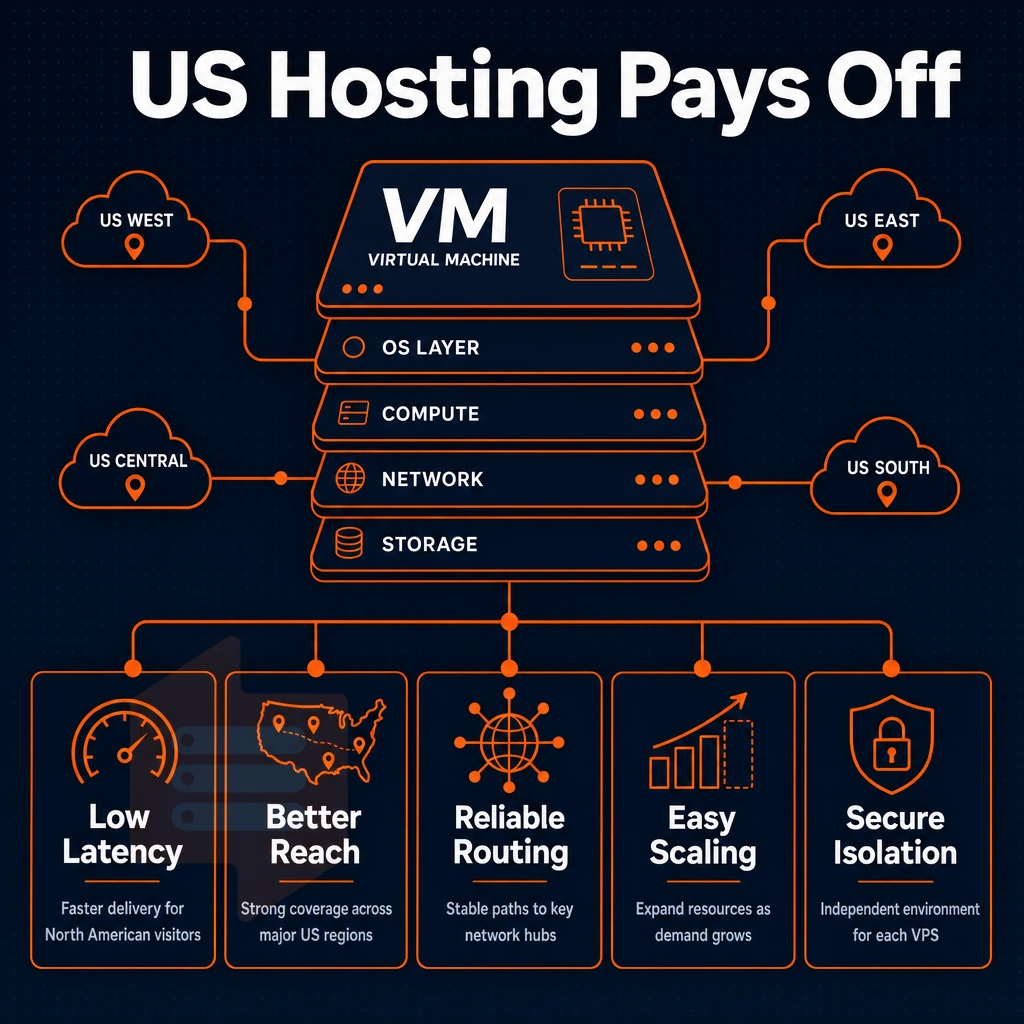
Where is your server located? USA VPS servers help to decrease latency for businesses who are targeting a North American audience. By hosting a VPS server in the USA, your server will be on the same continent as your visitors.
Low latency, network proximity, and DDoS protection
Our US based data center has direct connectivity to several of the East Coast’s largest Internet Exchanges. High traffic sites such as e-commerce sites, real time APIs and video streaming can be impacted greatly by increased latency. BuyVPS’s US servers are hosted in New York, placing us ideally to service East Coast and Transatlantic traffic.
Modern data centers like ours maintain redundant power supplies and network paths to ensure your VPS remains online even during infrastructure failures. Applications requiring low latency benefit from our direct peering arrangements, which minimize the number of network hops between your server and end users. Our infrastructure also includes unlimited bandwidth on all plans, ensuring that high-volume applications never face throttling or overage charges during traffic spikes.
Our VPS USA servers are being deployed with sub-30 ms latency across the continental United States. This low latency performance ensures that real-time applications, gaming servers, and financial trading platforms can operate with minimal delay across major US metropolitan areas.
Data center residency options for us-based businesses
A number of US-based companies require customer data to be stored within the country for compliance reasons. A USA VPS can store your data within the USA without the need for complicated cross-border data transfer agreements. Unlike many other providers running data centers across the United States who advertise unlimited bandwidth yet throttle VPS performance at peak hours, at BuyVPS we enforce strict memory limits and low node densities.
As a result, You can be assured that performance will remain consistent. Our infrastructure guarantees true unlimited bandwidth with no traffic caps or throttling, ensuring your applications can scale during traffic spikes without unexpected overage charges.
Is a US VPS better than shared hosting for high-traffic sites?
By definition a shared web hosting pool of servers (such as what you get from most hosting companies) is a pool of shared CPU and RAM. When usage goes up, such as during high traffic, a single ‘noisy neighbor’ can very quickly drive up your site’s load time.
A USA VPS provides you dedicated resources (whether pinning or not) and root level access to the server to do with it as you will. BuyVPS offers KVM virtual servers, each with its own kernel, thus no single tenant's increased traffic will affect another. Each KVM instance also includes unlimited bandwidth on our network, ensuring your applications can handle traffic spikes without throttling or overage charges.
| Factor | Shared hosting | USA VPS |
|---|---|---|
| Resource isolation | None, shared pool | Dedicated vCPU + RAM per plan |
| Root access | No | Full root on every plan |
| Scalability | Limited by shared plan | In-place upgrades, no IP rotation |
After you have decided a US VPS is the right size for you, it is time to sort the important technical details from the sales hype.
Key features to look for in a USA VPS hosting plan
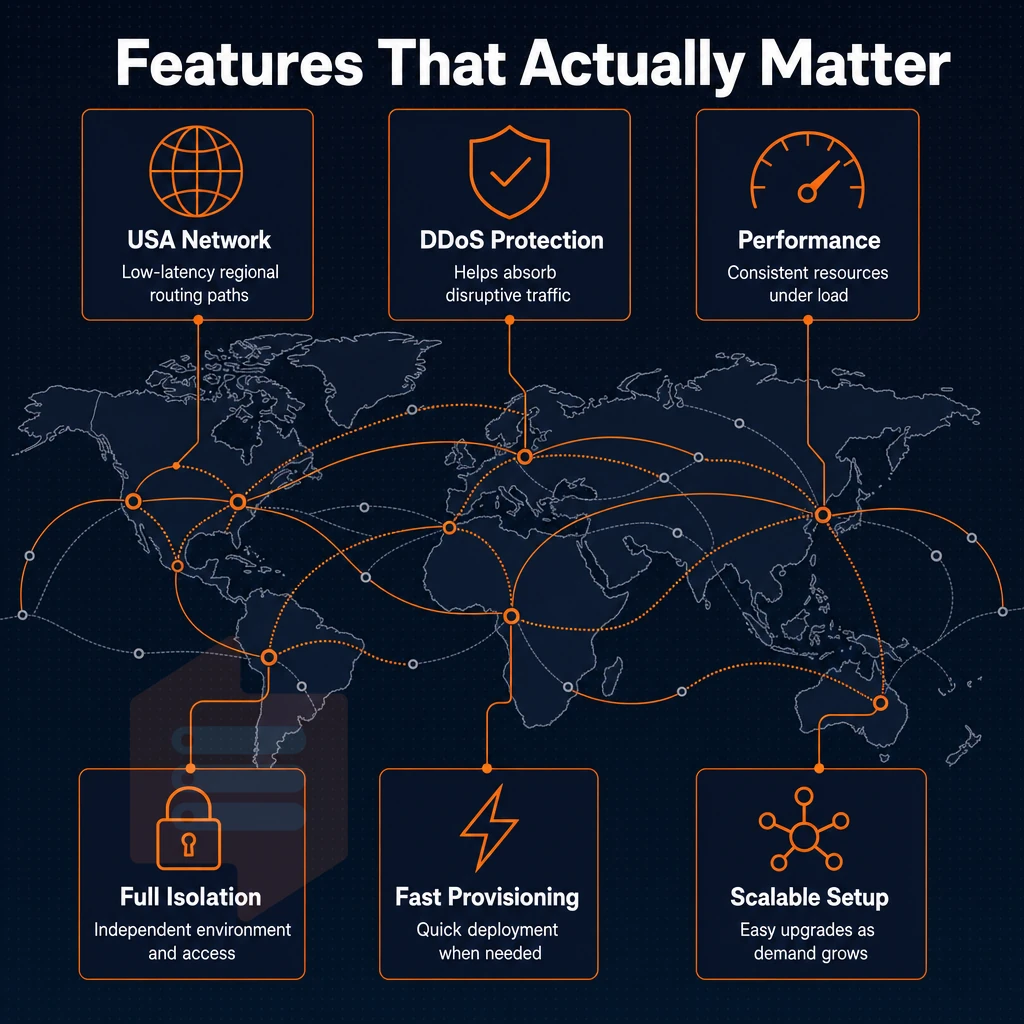
When choosing a VPS server USA plan you will find that there are a number of technical aspects to go through before committing to a server. The wrong default web hosting settings such as shared processor cores, traditional spinning hard disk drives and no redundant components can seriously impact your server's performance under high traffic and real load. Providers that skimp on network infrastructure or oversubscribe their nodes often introduce latency spikes that undermine low latency requirements for time-sensitive applications.
Modern NVMe SSD drives deliver significantly faster read and write speeds compared to traditional spinning disks, reducing database query times and improving overall application responsiveness. Plans advertising unlimited bandwidth should be scrutinized carefully, as true unmetered network allocation requires substantial backbone capacity that budget providers rarely provision adequately.
Compute, memory, and operating system resources
- Check if CPU cores are shared or pinned. Shared vCPUs will compete with neighboring vCPUs during peak times. Pinned (dedicated) cores deliver consistent and predictable latency. For compute intensive workloads, dedicated resources are a must.
- Verify your server is utilizing ECC RAM and the correct amount of RAM that your plan guarantees. ECC RAM is configured to silently fix bit errors. Make sure you know exactly how much GB RAM your plan guarantees and that it’s hard capped and not overcommitted.
Storage, network, and operating system
- We require NVMe SSD storage with RAID redundancy. NVMe SSD storage has a lot higher IOPS than normal SATA SSD storage. RAID10 has redundancy, but it doesn’t hurt read performance. BuyVPS includes NVMe RAID10 storage on all of our virtual server plans.
- Verify IPv4 / IPv6 dual-stack functionality. Many modern applications are written to work with IPv6. Don't limit your deployment options from the start.
- Is DDoS protection included. Edge filtering should be a standard feature, not a paid for additional service.
Note: SSD storage labeled simply "SSD" may be SATA-based. Always confirm NVMe explicitly.
What operating system can i run on a USA VPS?
Having full root access to your VPS means you can do whatever you like with the OS.
- Select the OS at provisioning time. Instead of picking from a list of pre-built images, allow Custom ISO support to remove any ceiling on what images can be provisioned.
- Check for root or sudo access after deploy. Without it you can’t install packages, change the kernel or even properly harden the server as you wish.
So you have made your feature checklist and now it’s time to think whether you actually need a VPS at all or if shared hosting or even a full dedicated server would be better for you.
VPS vs shared hosting vs dedicated server: which do you need?
Web hosting comes in many flavors, from shared plans to dedicated servers, and choosing the right one is mostly about trade-offs between isolation, control, and hard guarantees on resources.
How the three tiers differ mechanically
You have no root access and can’t install software that your hosting account needs.
A VPS (Virtual Private Server) server is powered by a KVM-based hypervisor to create Virtual Servers off one physical server. Unlike dedicated servers, each VPS is limited by the physical RAM, has its own filesystem and its own kernel that you control to ensure proper configuration and security. All Virtual Servers are completely isolated from each other which is why VPS hosting is a solid middle tier hosting option.
A dedicated server gives you a complete physical server and is the only option where you have no neighbors and thus maximum throughput.
| Type | Resources | Control | Best for |
|---|---|---|---|
| Shared hosting | Pooled, unguaranteed | Panel only, no root | Static brochure sites |
| VPS | Isolated, guaranteed | Full root, custom OS | Apps, APIs, dev environments |
| Dedicated server | Entire physical host | Full control, bare metal | High-throughput, compliance workloads |
Do i need root access on a VPS server?
Yes, for almost any real workload. Root lets you install runtimes, tune kernel parameters, configure firewalls, and run a windows server or Linux stack exactly as your application requires. Without it you are locked down to whatever the host pre-installed.
Having a US VPS also means you get to decide how you want to secure the server (and not have to rely on a shared sudoers file for example. Additionally, Not get pummeled by surprise package updates from your provider). BuyVPS gives full root access on all plans in each data center location, Amsterdam and New York, so you can configure the server at the OS level as desired.
When US based VPS hosting is the right call
If your users are based in the US then a us VPS server in New York would halve round-trip latency compared to servers based in Europe. BuyVPS servers are powered by high-specification AMD EPYC processor-based nodes, each configured with high-performance NVMe storage in RAID10, a hard memory cap to guarantee the isolation that you need, and built-in ddos protection. Each plan includes unlimited bandwidth to ensure your applications can handle traffic spikes without incurring overage fees or throttling.
But just because a VPS usa tier of server has the cpu ram potential to handle your workload, doesn't necessarily mean that it will actually be the best choice for you.
Common use cases for a US based VPS server
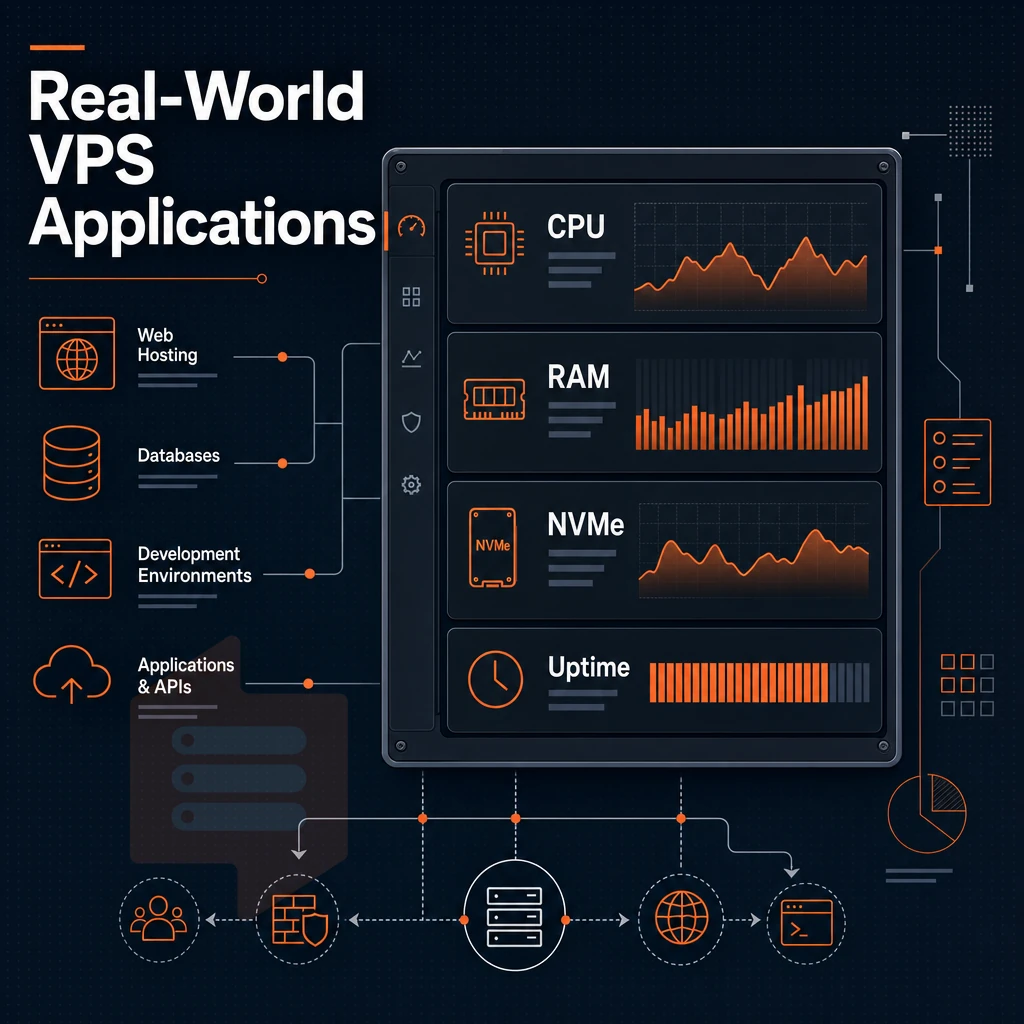
A US VPS can handle a wide variety of production work loads. The decision for a VPS versus a shared server hosting server for production work loads is typically made between having Dedicated resources to your server versus where the server is geographically located versus raw specs of the server versus cost.
Web apps, e-commerce, and high-traffic sites
Our New York node for low-latency within the US East Coast.
What is the difference between shared vCPU and dedicated-core VPS?
In contrast, our D-tier Dedicated-core plans pin a physical EPYC Genoa core along with its cpu ram resources to a single server within our data center infrastructure, with no other tenants able to use it. This ensures that you have the predictable throughput your applications need to perform well under sustained loads, such as for game servers, real-time streaming, web hosting on Windows Server environments, and database-intensive applications.
Media, file servers, and dev environments
We support multi-homed uplinks for your sites.
- Game servers (Minecraft, ARK, DayZ), Dedicated servers with pinned cores prevent tick-rate drops.
- Proxy and VPN services, a US virtual server for clean American egress.
- Dev/staging, mirror production exactly (complete root access + custom ISO support).
BuyVPS VPS solutions handle all of these workloads from 2 locations: New York and Amsterdam. High performance is achieved with AMD EPYC processors, NVMe drives and real memory caps, not just marketing hype.
New york data center: BuyVPS US east coast infrastructure
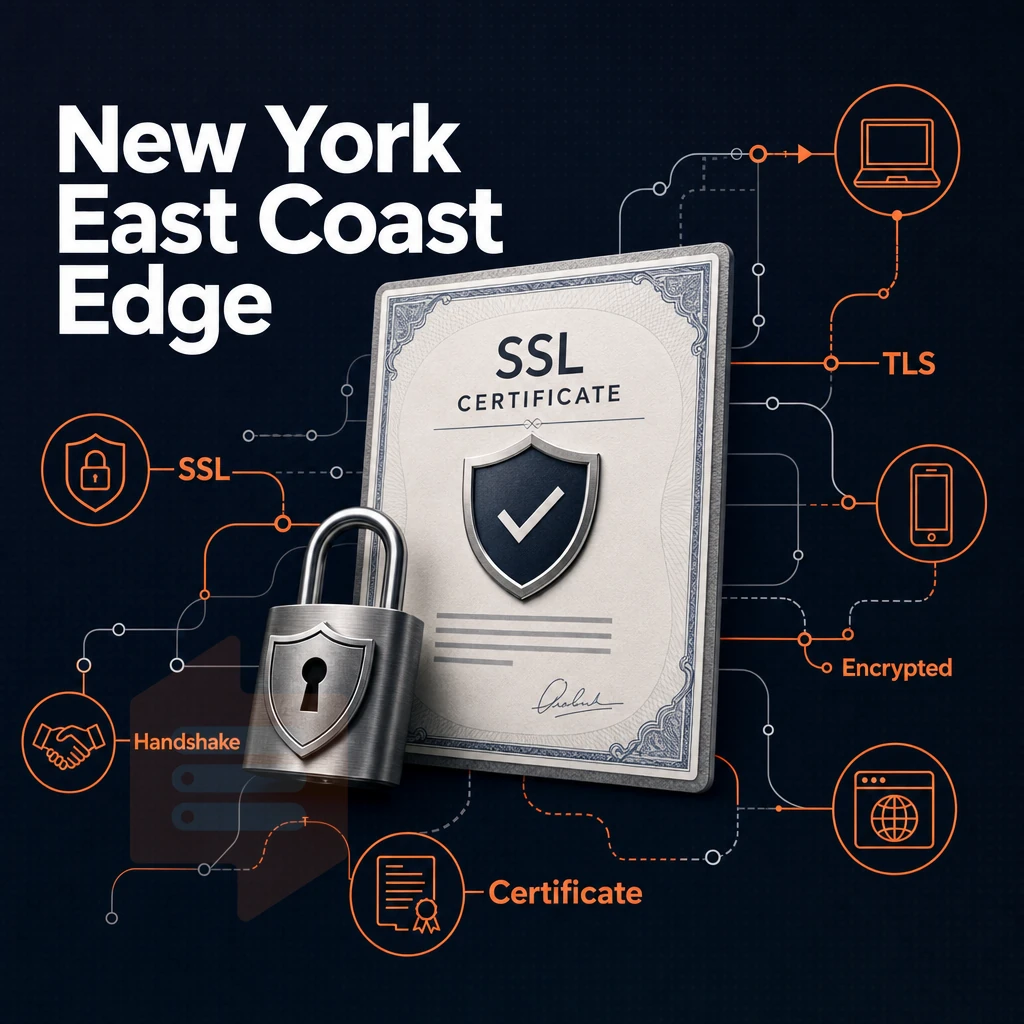
It runs on the same hardware stack as the Amsterdam data centers (identical specs, same SLA and same approach to node density).
Hardware, storage, and operating system
Our Standard and High Memory VPS servers are powered by AMD EPYC 7000 series (Milán) processors with DDR4 ECC memory. Meanwhile, our Dedicated CPU servers, available in the United States, utilize the latest AMD EPYC 9000 series (Genoa) processors with dedicated, pinned cores and DDR5 ECC memory, no sharing and hence no contention.
All our servers, be they VPS or Dedicated, utilize NVMe RAID10 storage on PCIe-direct connected servers.
How does NVMe storage improve VPS performance?
Our numbers reflect real world load.
Reliability and network full control
We run every server in our datacenter as dedicated servers under KVM, with a separate kernel for each VPS to prevent a VPS of one customer crashing that of another. Hard memory limits and a low node density mean we can ensure our no-oversell policy is in effect at all times. Every VPS comes with IPv4 and IPv6 addresses on dual-stack, as well as edge filtering for DDoS protection.
DDoS protection decision guide
So choose New York if your users or your infrastructure is based on the US East Coast and Amsterdam for EU traffic. Note that all the hardware, SLA and no-oversell guarantees are exactly the same. So your choice is purely geographic and then you can pick the plan that best matches that geographic choice.
Why choose BuyVPS for your USA VPS hosting
Our US-based USA VPS hosting runs from a New York data center on AMD EPYC hardware, the same specs and pricing as our Amsterdam node. Every virtual private server is KVM-isolated with a separate kernel, so your workloads never compete for resources. Hard memory caps and low node density mean the high performance you benchmark on day one holds under real load.
- Full superuser access on every plan, deploy any supported operating system or upload a custom ISO.
- NVMe RAID10 storage, 122,959 4K read IOPS measured (fio median); no multi-tenant hosting plan bottlenecks.
- Pinned cores on the Dedicated tier, predictable CPU and RAM, closer to a dedicated server without the cost.
- In-place upgrades, scale your US VPS with no migration and no IP rotation.
- Transparent pricing with no hidden fees.
Engineer-staffed support (not chatbots) backs every VPS server. Reach us at info@buyvps.com to compare VPS solutions or discuss which plan fits your traffic requirements.
A US-based VPS is a hosting solution that gives you the control of a dedicated server at a fraction of the resource commitment, full administrative root-level access, isolated compute, and predictable performance for applications that a shared server environment simply cannot handle. Location matters too: hosting in the United States with sufficient GB RAM puts your workload close to North American users and within reach of major internet exchange points, cutting latency where it counts.
When evaluating any virtual server hosting solution, prioritize the details that compound over time: NVMe-based storage, KVM virtualization, no-oversell policies, and a provider that won't hike your rate at renewal.
BuyVPS runs KVM VPS infrastructure out of New York, AMD EPYC processors, NVMe RAID10 storage, and hard memory caps per node. Browse the plans at BuyVPS.com and find the tier that fits your workload.