

DDoS attacks can bring your app down in a split second. A cheap hosting service without any form of traffic scrubbing can thus turn a small problem into a huge and frustrating perturbation. Finding the best DDoS protected VPS is not just a matter of looking for a badge of honor on a sales page. It involves filtering your network traffic, a real SLA and robust infrastructure that can withstand large volumetric attacks that last for a long time.
This guide cuts through the hype and explains what DDoS protection you can realistically expect from a VPS, covering network and hypervisor layers.
BuyVPS edge filtering and abuse-policy-based firewall rules come enabled by default on every service plan at both their Amsterdam and New York nodes. This guide provides criteria by which potential hosts can be judged by game servers, financial APIs, and high-traffic web sites alike, all of whom hope to survive certain levels of traffic. Each website owner must evaluate their specific exposure to attacks when selecting a provider that matches their operational requirements.
What is a DDoS protected VPS and how does it work?
DDoS (Distributed Denial of Service) attacks are a type of attack where thousands of computers worldwide are used to flood a server with traffic.
First month $1
Then the normal monthly price. One per customer. No setup fee, and a 30-day performance guarantee on your first order.
See the plans“Excellent service! Thank you for providing the server so quickly. The service was fast, reliable, and exactly what I needed. Highly recommended!”
How DDoS attacks overwhelm unprotected dedicated servers
A bunch of compromised hosts are coordinated to send the same kind of unwanted traffic to a service. Today’s DDoS attacks are more than just a high volume of traffic. Additionally, Take advantage of a variety of weaknesses in a particular protocol, consume all of a host’s connections, or even fill up a service’s uplinks.
Attackers often exploit stupid misconfigurations in server software or outdated protocols to amplify the impact of their campaigns. Modern attackers frequently target vulnerable website platforms by exploiting outdated plugins or weak authentication mechanisms to launch sophisticated attacks.
This type of issue is particularly problematic in a shared hosting environment. One targeted account can bring down every other account on the same server, because each account shares the same service traffic stream.
When a DDoS attack targets one site on a shared server, legitimate requests to neighboring sites are also blocked or delayed, creating cascading failures across the entire platform. Each website hosted on the shared server competes for the same pool of resources, making it impossible to isolate and protect individual sites during an attack.
What makes a DDoS protected VPS different
A DDoS protected VPS is protected by the infrastructure in front of it, which inspects all incoming traffic before it reaches your instance. There are two general approaches to this kind of protection.
- Null routing. Null routing can be used to very quickly (in seconds or less) knock a single IP address off the Internet, but it is very bad for legitimate traffic to the site as well.
- Our active DDoS mitigation solution scrubs malicious traffic at the edge of the network and allows clean traffic to reach your VPS.
Edge filtering is what you really need to distinguish real server protection from advertisement statements. Our network edge filtering uses abuse-policy-based filtering by firewall rules on the perimeter to absorb high volumes of attacks before they even reach your VPS.
How do i protect my VPS from DDoS?
When picking a VPS hosting provider with DDoS protection, make sure they actually mitigate and not just null route. On top of your hosting provider’s layer of protection, you should also try to harden your own stack by capping rates on connections, dropping bad packets with firewall rules, etc. To distinguish from dedicated servers, a KVM VPS with hard memory caps means a volumetric attack on one node will not spill over to your server.
Now that we've covered connection handling basics, let's explore why this matters for any internet-facing service provider or workload.
Why your hosting provider must offer DDoS protection for VPS
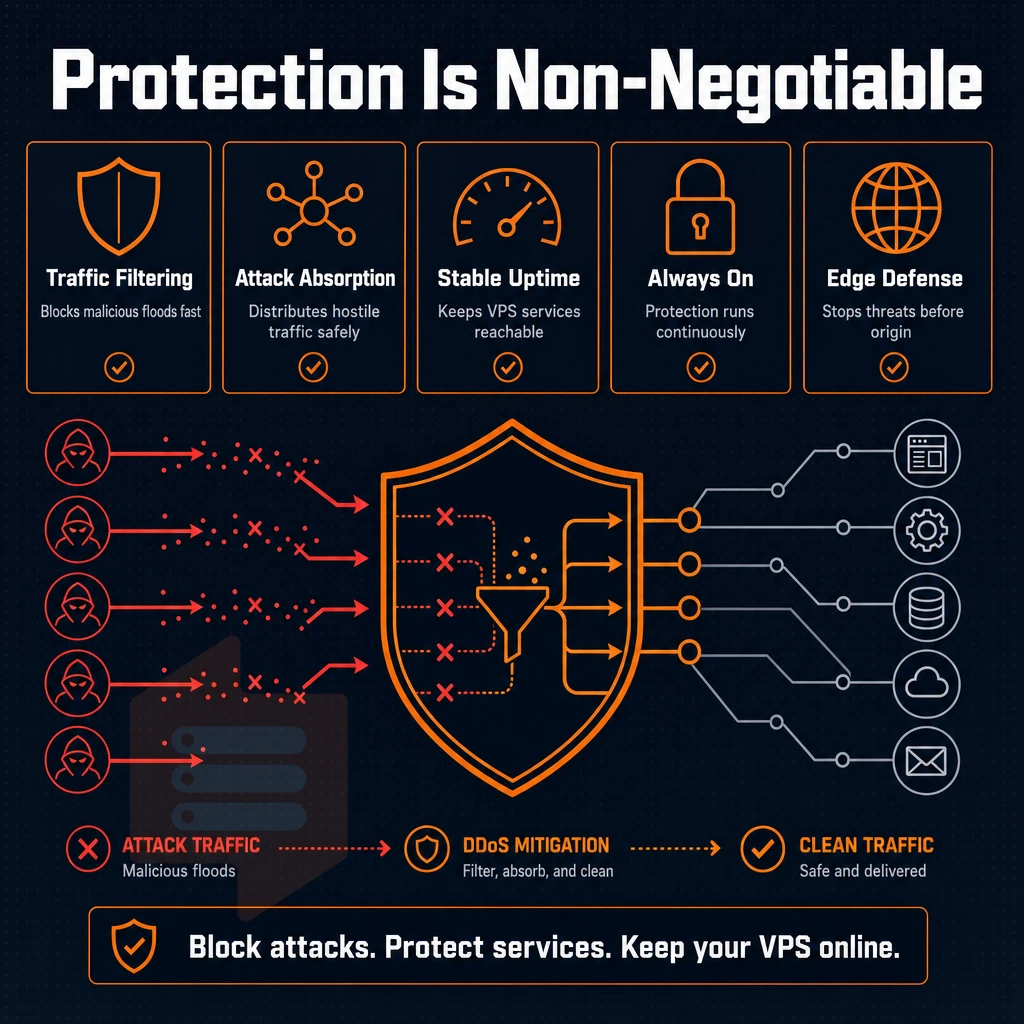
All internet-facing servers are potential targets for DDoS attacks, which are growing more frequent and larger in volume.
Who gets hit, and why it hurts
E-commerce sites, SaaS APIs and multi-player game servers are extremely valuable to attack.
Volumetric floods cannot be absorbed by software-only solutions (such as iptables rules and rate-limiting).
Network-level protection vs. Software-only security
Upstream scrubbing intercepts attacks at the edge of the network.
Is a DDoS attack illegal? (Distributed denial of service explained)
Most countries consider the launch of a distributed denial of service attack to be an illegal activity and subject the perpetrator to prosecution under the country’s computer fraud statutes. Therefore, every host provider must assume that at some point they will be the target of a DoS attack and design their systems to cope.
Proactive planning for safety includes implementing redundant systems, maintaining updated security protocols, and ensuring staff are trained to respond effectively to incidents. Comprehensive incident response plans must include procedures to protect customer assets, maintain service continuity, and document forensic evidence for potential legal proceedings.
While it is good to know the potential risks to your practice's servers and data, you need to know which of the features listed below will actually address each risk. Understanding how each security measure can protect your service from specific attack vectors enables informed decision-making when selecting a hosting provider. Whether you operate an e-commerce platform or a corporate website, matching protection capabilities to your specific threat profile ensures optimal security posture.
Key features to look for in a DDoS protected VPS
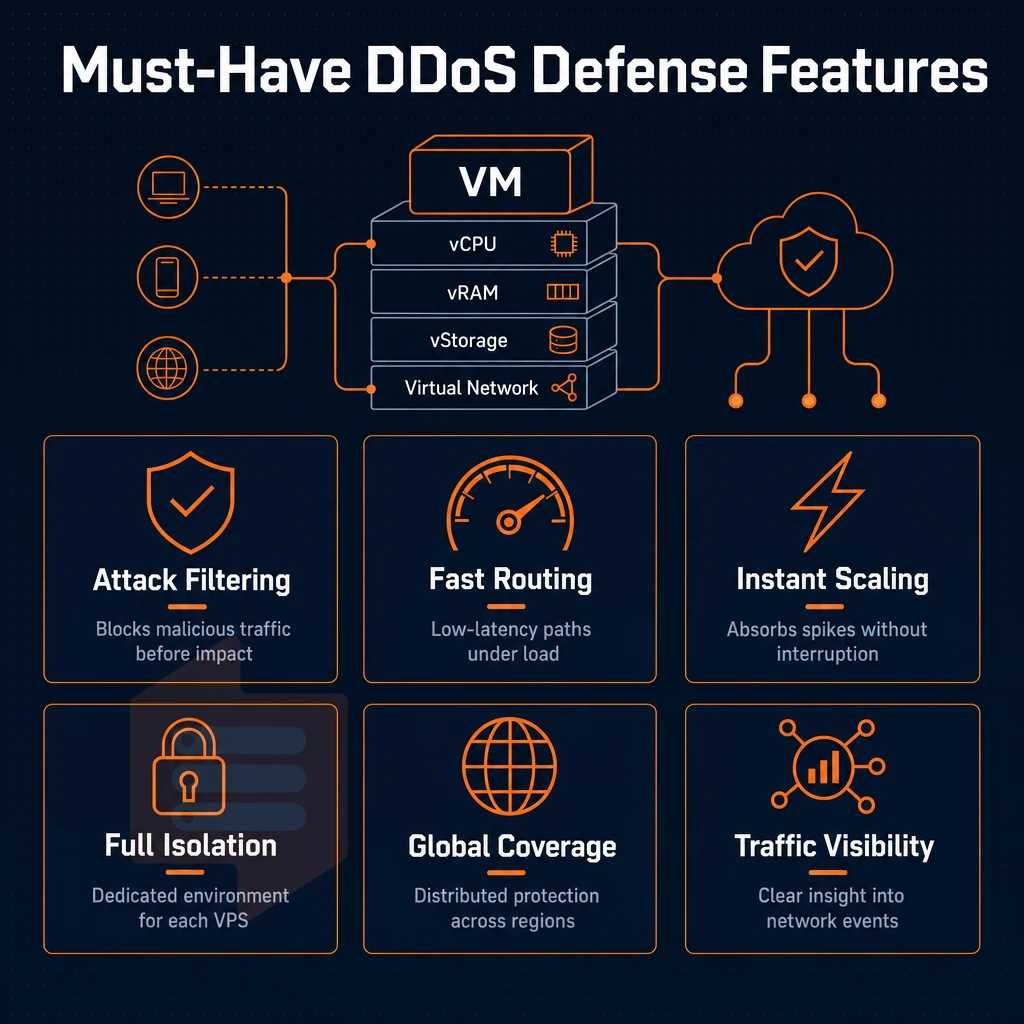
Not all DDoS protected VPS hosting is equal. This simple checklist will help you distinguish between a seriously designed DDoS protected VPS hosting solution and a basic offer with some filtering slapped on after.
Mitigation and dedicated servers network architecture
- Always-on vs. on-demand mitigation. Always-on mitigation modes scrub traffic in real time to block malicious traffic before it reaches your VPS. On-demand mitigation only kicks in after an attack has been detected. Thereby providing no protection for the time between the attack’s detection and mitigation (i.e. lots of bots can blast your bandwidth while legitimate traffic gets dropped).
- This post compare s and contrasts edge filtering with software firewalls. Edge filtering at the network layer can block volumetric attacks before they consume all of your resources. In contrast, a software firewall cannot possibly hope to absorb multi-gigabit floods, and it will intercept packets after they have hit your server.
- KVM isolation. A good hypervisor has one kernel per VPS tenant. If one tenant is attacked then the attack cannot “bleed” into other neighboring VPS tenants. A shared-kernel environment can’t prove that the isolation boundary holds in real-world loads. We run KVM with separate kernel per VPS tenant as this is the proven method to isolate tenants from each other.
Servers, storage, access, and IP stack
- NVMe storage performance. High performance disk I/O during an attack becomes a bottleneck, the storage will keep your application running during the attack even as the mitigation is scrubbing the traffic overhead.
- Full root access. With root access you can setup custom firewall rules, limit bandwidth for certain connections and even install your own net-filtering tools. A cPanel-style control panel just does not offer enough control.
- Offer a IPv4 + IPv6 dual-stack solution to your customers as many attacks are moving to IPv6 and a dual-stack strategy helps to keep both address spaces secure without requiring any additional tools.
SLA and setup fees by hosting provider
- Uptime SLA. Check if the SLA covers also attacks and not only hardware failures. BuyVPS offers a 99.8% uptime SLA for Amsterdam as well as New York.
- There are no hidden setup fees. Unlike other providers which charge per-IP add-on fees for DDoS protection, we ensure that DDoS protection is included in the plan and not charged separately.
Who has the best DDoS protection?
The best solution is always-on edge filtering, KVM isolation, and full root access on a no-oversell infrastructure. We offer this at BuyVPS.com, with hard memory caps per node, great NVMe RAID10 storage, and top-notch engineer-led support in Amsterdam and New York. Clients benefit from guaranteed resource allocation and predictable performance under attack conditions. Pricing tiers are structured to accommodate different workloads, ensuring that even those on a tight budget can access enterprise-grade protection without sacrificing essential security features. For businesses requiring low-latency connections to North American markets, canada represents an increasingly popular jurisdiction for hosting critical services. Even budget-conscious startups can find cheap VPS options that include always-on DDoS mitigation, proving that robust security need not require premium pricing.
Customer testimonials consistently highlight the responsive support team and reliable uptime as key factors contributing to a good experience with the service. The service also provides a direct control panel link for instant access to server management tools and real-time monitoring dashboards. Whether you run a small blog or manage enterprise applications, selecting a plan that aligns with your personal requirements ensures you receive adequate protection without overpaying for unused capacity. Each plan includes dedicated ram allocations to prevent resource contention during peak usage periods. When evaluating providers, it's wise to stick with those offering transparent SLA commitments and verifiable uptime records. Transparent pricing models help businesses allocate their money efficiently while maintaining comprehensive security coverage. The engineering team provides around-the-clock technical support to resolve configuration issues and answer questions about optimizing your server's defenses.
Of course the specific features of a security offering are only of use if the underlying protection of your servers is of sufficient quality to deal with the relevant attacks on your workload.
Types of DDoS attacks your VPS needs to withstand
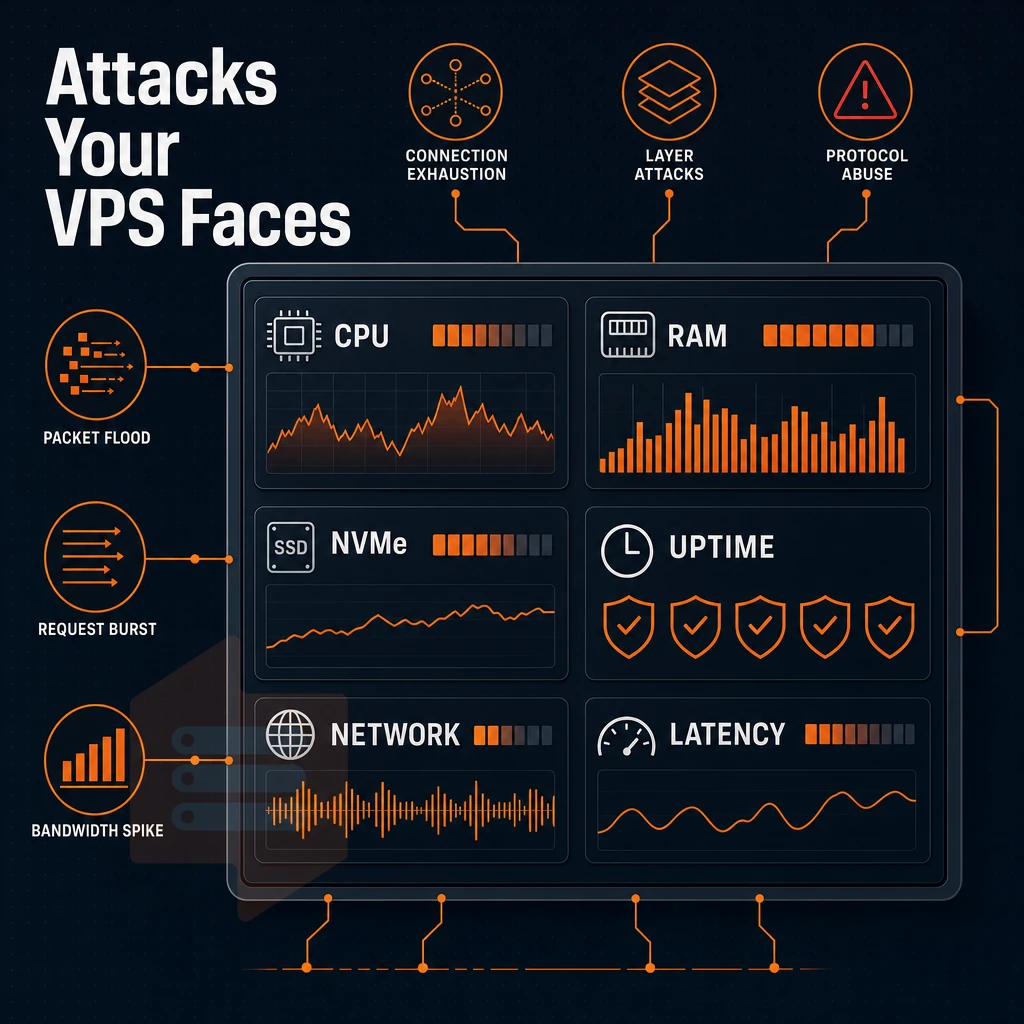
Different types of DDoS attacks affect different layers of your infrastructure. Therefore, it is essential to differentiate between those attack types and choose the top DDoS-mitigated VPS for your needs.
Volumetric and protocol-layer threats to servers
Most volumetric attacks aim to exhaust available bandwidth by sending raw spoofed UDP or ICMP traffic in terabits per second up the uplink before it reaches the VPS.
Application-layer HTTP floods targeting host resources
These types of attacks are more difficult to detect as they are issued by bots which send valid syntactic HTTP GET or POST requests. Sophisticated attackers can mimic legitimate user behavior to bypass simple rate limits, making it difficult for a website to distinguish between real visitors and malicious requests.
Large volumes of such requests do not in themselves look large but can cause excessive CPU and database usage on the host VPS. These types of attacks are typically mitigated in data centers using behavioral methods of attack detection such as request-rate fingerprinting and challenge-response detection.
Implementing rate-limiting policies at the application level can help protect against resource exhaustion while behavioral analysis identifies malicious request patterns. Properly configured application firewalls on the VPS can complement upstream protections by filtering suspicious requests before they reach your website's backend services.
Which VPN offers DDoS protection?
A VPN on your network does not mean your servers will survive a DDoS attack.
This has to be set up by your provider. They will route your whole network through a scrubbing center, and then announce your IP block via BGP. A VPN is for privacy and routing of traffic, and it is not capable of handling multi-gigabit flood events.
Why multi-vector attacks raise the bar
Contemporary attacks are orchestrated to simultaneously deliver volumetric, protocol-based and Layer 7-based attack vectors. Thereby challenging the entire suite of mitigation technologies to classify and block individual attack streams while permitting legitimate users to connect and conduct legitimate activity.
Filtering malicious traffic at the network level at the edge of the data center is the first line of defense.
The edge of your host is only half the story of what you need to do to secure applications. The other half has to do within your host and that has to do with isolation. Proper isolation mechanisms protect individual virtual machines from resource exhaustion caused by neighboring instances under attack.
VPS isolation and performance under attack
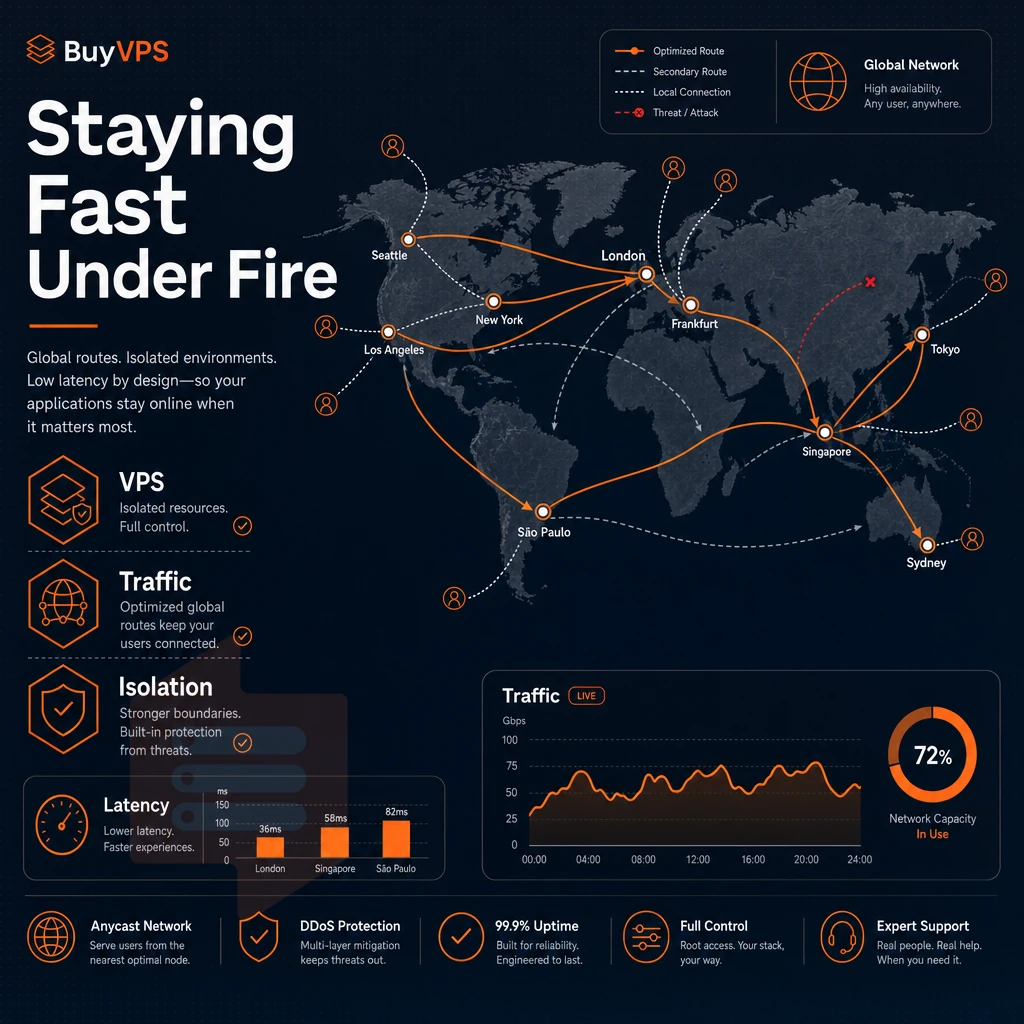
The first line of defense for any DDoS protected VPS is isolating tenants from each other, ensuring that even if one is under attack, other workloads on neighboring servers remain unaffected.
KVM isolation keeps neighbors safe
KVM runs with a separate kernel for each VPS. The attack network traffic on one VPS cannot affect adjacent VPSes because of the kernel boundary. In contrast, shared hosting and oversold nodes have no such barrier, and therefore a single, targeted tenant can bring down an entire node.
Thus RAM is never overcommitted. A flooded VPS cannot steal memory from your site or from other users on the host.
What is the difference between null routing and active DDoS mitigation?
Null routing means that all data traffic to a certain IP address is dropped.
How your host handles storage and scalability under load
We run our NVMe storage on RAID10 over PCIe-direct connected disks.
In-place upgrades do not change the IP address(es) of your servers.
Your VPS performance is only as good as the underlying network infrastructure. Where your VPS is located geographically affects how quickly clean bandwidth reaches your users after scrubbing.
Server locations: amsterdam and new york for low-latency DDoS protection
The location of your VPS host can significantly affect the quality of DDoS protection provided.
Two data centers, one consistent platform
Both locations run identical hardware, control plane, and network configuration. There is no performance difference between the two host locations, only your geographical location differs.
When choosing a region to host your VPS, choose a location that is near your primary user base to minimize latency. EU users are best served by servers that host from the Amsterdam region, while US East Coast users are best served from the New York region. Our infrastructure filters malicious data flow before it ever reaches your VPS, ensuring that even extreme volumes of attack infrastructure flow will have minimal impact on your legitimate users.
| Dimension | Amsterdam | New York |
|---|---|---|
| Primary audience | Europe, Middle East, Africa | US East Coast, Americas |
| Hardware | AMD EPYC, NVMe RAID10 | AMD EPYC, NVMe RAID10 |
| Uptime SLA | 99.8% | 99.8% |
| IPv4 + IPv6 | Dual-stack | Dual-stack |
Why geography matters for DDoS protection
This is a fabric network backbone problem, not a personal software problem. A good scrubbing center can absorb a volumetric attack before any of the bandwidth usage even reaches your servers. A provider with an edge presence near your users can keep clean-backbone load latency very low even under attack.
Choosing the right region for your hosting provider
So for example data load originating from within Europe would typically be served from our Amsterdam operations.
Many teams that outsource decisions related to their servers and hosting platform mistakenly overlook this step and pay the penalty of increased latency instead. Serve your community of end users from the region closest to them. Your mitigation will work perfectly with your topology and not against it.
The choice of location for your provider is out of your control once you have created it and it is running on your host server.
How to protect your VPS from DDoS attacks: best practices
Software defenses on the host alone can only slow down an attacker, they cannot absorb a volumetric attack for a long period of time. Effective DDoS protection is provided by a layer of grid-level filtering at the provider level combined with server-level hardening steps that you can control directly on your server.
Preparation: choose the right host foundation
- Pick a host with edge filtering built in. topology-level scrubbing stops attack connection volume before it reaches your VPS. BuyVPS applies edge filtering across both Amsterdam and New York, protecting all workloads without extra configuration. Note: no OS-level rule can compensate for a provider that lacks upstream mitigation.
- Enable root access and lock down SSH. Switch to key-based authentication immediately, disable password login in
/etc/ssh/sshd_config. This closes the most common brute-force entry point.
Host hardening: firewall and rate limiting
- Set up rules for iptables or nftables. Invalidation packets should be dropped. New connections from one IP address should be limited in speed. Only whitelisted ports for your application should be allowed.
- Apply OS-level rate limiting. Use
iptables -m limitornftables limit rateto throttle connection floods at the kernel before they reach your application stack. - Keep the OS patched. Run
apt upgradeon Ubuntu or Debian,dnf updateon AlmaLinux, Rocky Linux, CentOS Stream, or Fedora. Unpatched kernels are a common amplification vector.
Monitoring and HTTP layer for your hosting provider
- Baseline your packet volume. Use
vnstatornetdatato record normal bandwidth patterns. Anomalies become obvious once you have a baseline. - Add an upstream proxy for HTTP services. This upstream proxy for HTTP services can be a reverse proxy or a CDN and will catch application layer floods for HTTP services before they hit your VPS.
These steps in turn harden the server, but to really protect your server you need to look to the underlying server architecture, including its scalability, provided to you by your provider, and we cover this off below.
Why choose BuyVPS for DDoS protected VPS hosting
When DDoS attacks hit, your hosting provider's architecture determines whether your service stays up or goes dark. BuyVPS is built for exactly that pressure. Our VPS hosting delivers ddos protected VPS hosting through layered, underlying network-level defenses, not bolt-on software.
- Edge filtering + abuse-policy firewall: Malicious throughput is identified and blocked at the interconnect edge before it reaches your VPS. Attack mesh throughput never touches your application layer.
- KVM isolation, separate kernel per VPS: A DDoS attack against one tenant cannot degrade neighboring servers. Your performance stays consistent regardless of what hits the wider pipeline.
- No-oversell, hard memory caps: Low node density means your VPS retains full RAM and CPU headroom under load, shared hosting simply cannot offer this.
- NVMe RAID10 storage, PCIe direct: Our NVMe storage benchmarks at 122,959 4K read IOPS. I/O performance doesn't degrade during an attack event.
- Full root access + custom ISO: Deploy your own firewall rules, mitigation tooling, or hardened OS image. Root access gives you complete control over your security posture.
- In-place upgrades, no IP rotation: Scaling up never changes your IP address, your firewall allowlists and DDoS protection rules stay intact.
We operate data centers in Amsterdam and New York, with IPv4 + IPv6 dual-stack on every plan. Engineer-level support, not automated agents, backs every deployment. Reach out to our team to discuss which DDoS protected VPS plan fits your workload.
Choosing the best DDoS protected VPS for your workload
A DDoS protected VPS is best when it matches your plan to your workload. Thus, a shared vCPU can be sufficient for a budget internet presence or a dev environment. A dedicated core is required for latency-critical online services and for heavily loaded workloads that are under DDoS attack. High-memory VPS servers are required for data-intensive applications where a VPS has plenty of RAM to spare even under constant DDoS attack.
A DDoS protected VPS should absorb attack data throughput at the core systems level and keep your visitors unaffected. Performance headroom is not a luxury item, it is what allows a deployment to be resilient as opposed to null routed under load.
A DDoS protected VPS typically has three characteristics: it applies real routing layer-level filtering at the boundary to your server, it isolates you from other neighbors. As a result, They can’t attack you and vice versa, and it delivers consistent performance under realistic load. A reliable hosting provider scrubs volume-based attacks at scrubbing centers and edge filters, while KVM-based isolation with hard memory limits ensures that even if the node is under assault, your workloads will run stably.
When comparing the protection offered by the host of different providers available, be aware that not all protection is equally valuable. While flashy marketing should not be dismissed out of hand, you are better off checking out the specifications of a service, its SLA for uptime, and its filtering capacity for mitigating attacks.
Additionally, How it deals with abuse at the data plane edge. BuyVPS implements edge filtering, runs KVM virtualization with a separate kernel for each VPS, and even sets strict memory limits on each of its game server and VPS nodes in Amsterdam and New York. This means that, regardless of bandwidth consumption reaching your VPS, your VPS remains isolated and unchanged.
Ready to see the plans? Browse BuyVPS VPS hosting and pick the tier that fits your workload.