


Game VPS hosting addresses the issues that shared hosting servers and consumer cloud packages fail to handle, specifically low-latency, consistent performance with 50 or more players connected simultaneously.
In gaming VPS hosting environments, frame timing spikes and packet loss have real consequences on player experience, ending sessions early and hurting retention.
This guide will highlight the differences between a VPS designed for games and regular servers. Additionally, the key features to look for when choosing a VPS include a good control panel and the right specs (not as many cores as possible, for example, more emphasis on CPU speed, NVMe storage I/O, and the network path). We will also provide guidance on how to properly evaluate gaming VPS hosting providers and their claims, including published benchmarks and what they actually mean in real terms.
Modern game hosting infrastructure relies heavily on nvme ssd technology to minimize load times and reduce stuttering during asset streaming phases. Reputable providers stand behind their infrastructure claims with transparent refund policies, offering money back guarantees that let you test performance risk-free before committing long-term.
We run a variety of AMD EPYC processor-powered VPSes on NVMe RAID10 storage in two datacenters (Amsterdam and New York). They are all KVM-based, which means each VPS has its own kernel, and we expect to handle sudden spikes in player numbers without a problem. By the end of this guide you will have a clear way to match up your game servers with the right size of hosting tier.
Each nvme ssd in our storage array delivers sustained read speeds exceeding 3,000 MB/s, ensuring map loads and asset streaming remain consistently fast even during peak concurrent sessions. Our data centers maintain redundant network paths and power systems, ensuring your game servers remain accessible even during localized infrastructure events.
What is game VPS hosting and how does it work
A gaming VPS is a Virtual Private Server that has been tailored for gaming server software. It grants full root access and sufficient resources to its customers. All this, in contrast to shared hosting, is possible due to the KVM isolation granted to each VPS.
First month $1
Then the normal monthly price. One per customer. No setup fee, and a 30-day performance guarantee on your first order.
See the plans“Perfect and fast VPS with good support.”
Some providers use cookies on their client portals to maintain login sessions and track resource usage preferences across visits. Players who opt for a gaming VPS get full administrative control over their server environment, enabling custom mod installations and fine-tuned performance configurations that shared hosting simply cannot provide.

What a gaming VPS does in a data center
Most game servers are hosted on shared servers, which means all tenants share the same CPU power and RAM. A gaming VPS is a fixed part of the physical machine and cannot be used by other tenants.
KVM enforces this boundary at the hypervisor level.
What is a gaming VPS and how is it different from a dedicated game server?
A dedicated server is a complete physical machine. A gaming VPS is isolated virtual hardware on a shared server. For most private server cases a VPS will deliver similar performance to a dedicated server but with less of a financial commitment.
While dedicated servers offer maximum isolation and raw performance, most multiplayer game hosting scenarios achieve excellent results with properly configured VPS instances at a fraction of the cost. Many providers offer trial periods or guarantees, so you can test performance risk-free and request money back if the VPS doesn't meet your game's latency requirements.
Flexibility is key.
Which data center location should i choose for my game server?
You can select the region which is closest to your player base. We have servers set up in Amsterdam (Europe) and New York (US East Coast). Both locations are running the identical hardware and network setup. Modern data centers in these regions feature redundant power systems and carrier-neutral network fabrics that maintain sub-millisecond jitter even during traffic surges.
While most hosting providers treat location to your server as a secondary consideration, at Lower latency we treat it with the same consideration as any other service parameter.
At LowerLatency.com we focus on a single measurable: latency to your site before you pay us a dime.
Why hosting game servers demands more than standard hosting

Game servers are notoriously difficult to host on standard web hosting.
Data center CPU clock cycles and core contention
For a typical game server, this means processing 20-128 ticks per second.
The clock speeds of AMD Ryzen-class processors are relevant here. The single-thread high performance provided by Ryzen silicon is far more important to a hosting game server program that relies on a high tick-rate in a loop than to one that scales horizontally across many cores.
How much RAM do i need for a game server VPS?
RAM requirements grow with player count and world complexity.
Data center storage and network throughput
Saving worlds and chunk generation put a lot of stress on storage. To avoid stalling the game loop while saving, one can use fast NVMe storage to achieve 4K random read IOPS in the six-figure range. Modern game hosting architectures rely on nvme storage to eliminate bottlenecks during high-frequency world state persistence operations that would otherwise degrade tick consistency. Selecting an nvme ssd configuration with appropriate endurance ratings ensures your game server can sustain years of continuous write operations without degradation.
| Workload factor | Standard web VPS | Dedicated-core game VPS |
|---|---|---|
| CPU access pattern | Burst, shared pool | Pinned cores, sustained |
| RAM type | DDR4, shared node | DDR5 ECC, hard-capped |
| Uptime SLA | Varies | 99.8% guaranteed |
BuyVPS Dedicated CPU plans are optimized to use the EPYC Genoa processor with pinned CPU cores and DDR5 ECC RAM, making them the perfect data center server for game servers that cannot tolerate interference from noisy neighbors.
This has no impact on server-based game play. Low latency of less than 20 ms to player bases is provided from both our Amsterdam and New York locations. In order to select the correct VPS plan for your workload, you first must establish which hardware tier your workload requires. Strategic placement of data centers in these regions ensures that most European and North American player populations experience sub-30ms response times during active gameplay.
Choosing the right VPS tier and data center for your game server
Every game server load is different. By picking the right VPS tier for your game based on player count and game engine, you can avoid waste and performance issues quickly. This is how to choose. Reputable providers typically offer a money back guarantee period during which you can test performance under real player loads and request a refund if the tier proves inadequate.
Assess your data center workload type
- Find out the CPU vs. memory profile of your game engine. CPU-heavy games like Minecraft or FiveM/RedM will see big improvements at low player counts, while CPU and memory-heavy games like Rust will see big improvements as your world simulation scales. Use this to find the best cpu ram balance for your purchase.
- Estimate the number of peak concurrent players you expect. A small Minecraft server up to 20 players runs fine on a shared vCPU setup. For 40+ players or heavily modified servers, even a small number of shared CPU cores can cause occasional latency spikes under load.
Match data center tier to use case
- Standard CPU (shared vCPU), A good offer for casual players and small communities. Budget offer for game server hosting. Our AMD EPYC Milan servers with NVMe SSD storage are perfect for hosting a vanilla Minecraft server or a light FiveM server with up to 30 players.
- Dedicated CPU (pinned cores), for very competitive and highly script-driven servers. Pinned cores prevent your game servers from being interrupted by noisy neighbors. A highly-modded FiveM/RedM server with 50+ scripts or a large. Busy Rust map with 60+ players will require a high-end server dedicated to deliver smooth and consistent tick rates, that's where gaming VPS hosting comes in.
- High Memory, Large Rust Worlds and Mixed Stacks. Multiple game processes are run off a single VPS and with a 1:8 CPU-to-RAM ratio there is still ample resource to allow for smooth game hosting with plenty of headroom.
Can i host multiple game servers on one VPS?
Yes, you can manage this with some planning.
Note: Running dedicated servers for two different games on one node doubles your memory floor. Check combined RAM requirements before sizing down.
| Players | Game | Recommended tier | Min GB RAM |
|---|---|---|---|
| 1-30 | Minecraft / FiveM | Standard CPU | 4 gb ram |
| 30-80 | FiveM / RedM / Rust | Dedicated CPU | 8 GB |
| 80+ | Rust / multi-server | High Memory | 64 GB+ |
Choosing the right tier for your account handles the compute side of things for you.
Network quality and DDoS protection for hosting game servers
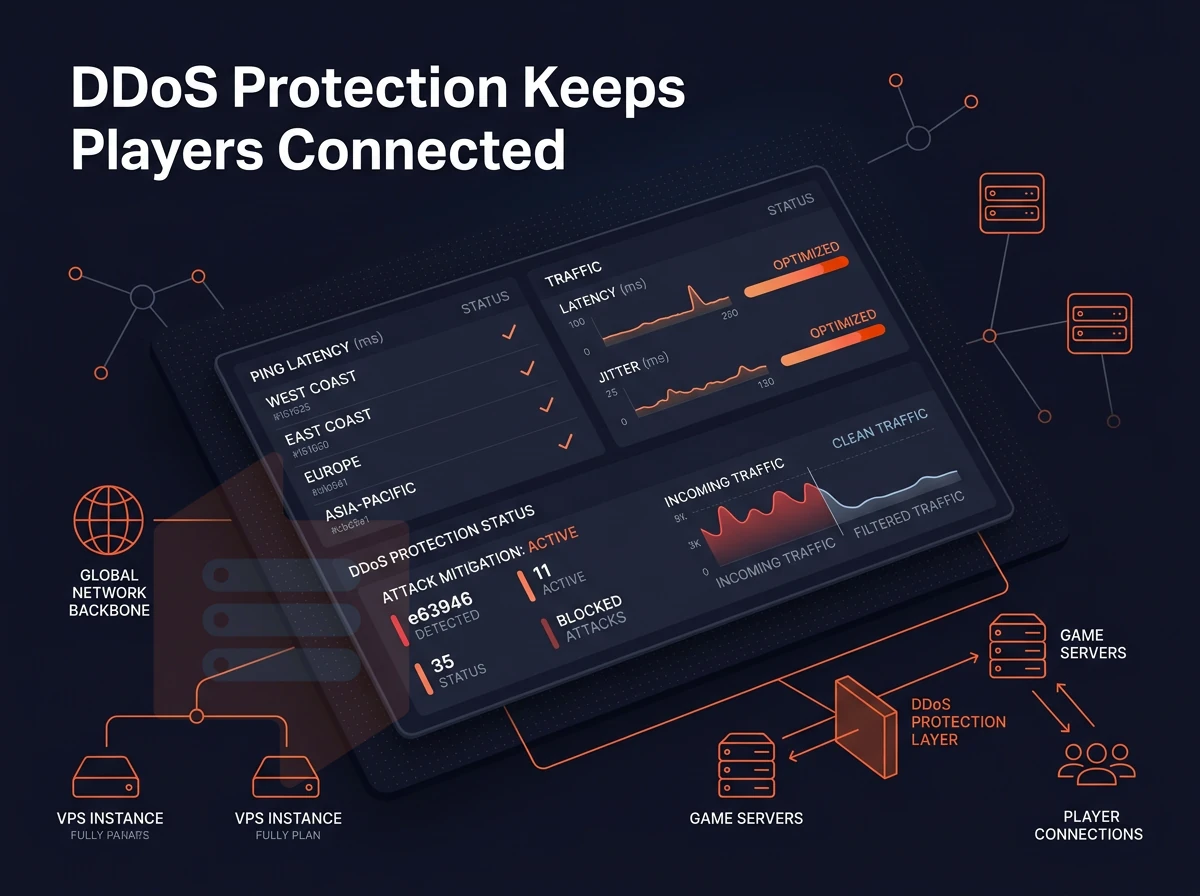
While hardware specs determine the ceiling for your game hosting performance, the actual gaming experience that your players perceive is determined by your network architecture. Multi-homed uplinks, proper filtering and a good uptime commitment are what differentiate a game server that works from one that doesn’t.
Tier-one network peering agreements between data centers directly influence route quality and jitter consistency for real-time multiplayer traffic. Reputable providers stand behind their network architecture claims with money back guarantees that let you test latency and jitter under real player loads before committing long-term.
Multi-homed data center uplinks and dual-stack connectivity
We avoid single-provider failure by using multi-homed uplinks to both our Amsterdam and New York data centers.
Does a gaming VPS come with DDoS protection?
Yes. Edge filtering is enabled at the data center level for all plans. Attack traffic is then identified and blocked at the edge of the network before it reaches your game server’s kernel. This is the correct architecture to implement edge filtering at the data center level vs. at the OS level to prevent consuming CPU and memory to absorb malicious traffic.
An abuse-policy-based firewall for your private server, configurable via the control panel, sits alongside the edge filtering, blocking the known abusers and enforcing limits on undesirable use of protocols subject to amplification abuse. The most common of these is UDP reflection, with abuse of game servers of particular concern. Providers confident in their edge filtering capabilities typically back their service with a money back guarantee if protection fails to mitigate attacks within the first billing period.
Uptime SLA and what it means in practice
BuyVPS offers a 99.8% uptime guarantee. To the owner of a game server, unexpected down time between sessions is far worse than planned down time for maintenance. The SLA covers the network and infrastructure layers, giving you a baseline to work with. If we fail to meet this commitment, you're entitled to service credits or a prorated money back adjustment calculated against the affected billing period.
A noisy VPS or compromised neighbor does not affect your network queues. Because every VPS runs its own kernel, a network stack problem stays within a VPS and does not affect others.
By colocating multiple uplinks, edge DDoS protection, and KVM isolation, the attack surface is reduced and latency kept to a minimum. Even more important is the choice of the data center where you will host your app. Geographic distribution of data centers allows providers to position game servers closer to player populations, reducing the physical distance packets must travel and improving responsiveness across regions.
Server locations: amsterdam and new york for european and US players
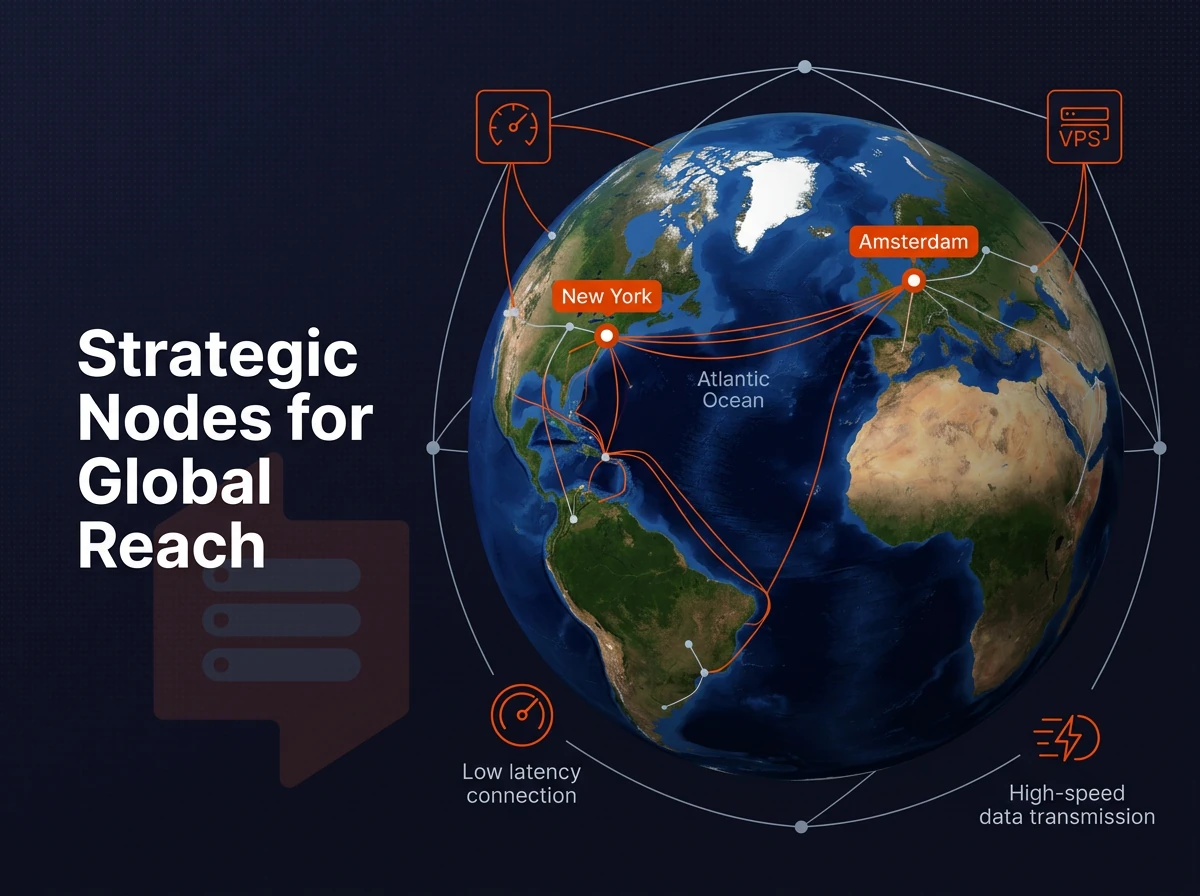
The location of your game server has a huge impact on your game experience and on how your matches are played. We currently run 2 data centers, one located in Amsterdam which serves as the central hub for all European based gaming communities. Our other datacenter is located on the US East Coast and serves all players within the United States.
There is one major factor that can help influence a better gaming experience for your players. Strategic placement of data centers in these regions ensures minimal hop counts and optimal routing paths for the majority of competitive gaming traffic originating from high-population metropolitan areas.
Amsterdam data center built for european player communities
Our Amsterdam data center is at the heart of European Internet infrastructure. Clients with servers in our Amsterdam data center have low latency to all Western and Central European countries. It is the obvious location for a private server targeting a EU audience.
- Ideal for EU-based Minecraft, Rust, or ARK communities.
- Strong peering across European backbone networks.
- GDPR-friendly jurisdiction for player data.
New york: covering the US east coast
Our New York data center puts your game server close to the US East Coast, a densely populated area of the US with lots of players. If you have players in Boston or even Miami, they will experience low ping. As a transatlantic hosting location for games where the majority of players are from the eastern United States, it’s also very well positioned.
What operating systems can i run on a game server VPS?
All our data centers offer the same OS list: Ubuntu, Debian, AlmaLinux, Rocky Linux, CentOS Stream, Fedora. Upload a custom ISO is possible for all plans. Most game server software is optimized to run on Ubuntu LTS or Debian servers and can be installed by BuyVPS with one click for both OSes.
The hardware, control plane and billing are identical in both locations.
Full root access, custom ISO, and game server control
While raw compute power is required for game servers, complete control of the system is also required. With full root access on a KVM VPS you can install any game server binary, add custom mods as required and even configure firewall rules as needed.
Data center operating system and custom ISO flexibility
We support Ubuntu, Debian, AlmaLinux, Rocky Linux, CentOS Stream and Fedora out of the box. You can also upload your own ISO file to boot a specialized game server or a hardened base OS that matches your other servers.
Self-service data center control and API access
Our web hosting control panel provides an in-browser VNC console should you ever require direct access to a server when SSH is unreachable, such as with a misconfigured firewall. Our full API enables you to automate provisioning, restarts and even full OS reinstalls across all of your game server nodes.
Will my server IP change if i upgrade my VPS plan?
No.
Upgrading an IP address is not simple even in a high performance hosting game setup, as it requires all community members to update their connection settings, which can even cause complete failure to connect if the IP address is whitelisted in a config. BuyVPS removes 2 major problems of game server management with its root access and upgraded server IP addresses. This makes BuyVPS a purpose-built solution for serious game server operators.
Why choose BuyVPS for game server hosting
Game server hosting demands consistent CPU, fast storage, and zero noisy-neighbour interference. BuyVPS is built for exactly that.
- No-oversell, hard memory caps. Low node density means your gaming VPS gets the CPU RAM it was allocated, every time, under real load.
- Pinned cores on the Dedicated tier. Predictable tick-rate performance for game servers that can't tolerate scheduling jitter.
- NVMe RAID10, PCIe-direct storage. 122,959 measured 4K read IOPS. World loads and player joins are fast. NVMe SSD-class speed, with published benchmarks to prove it.
- Full root access + KVM isolation. Get full control over your operating system and server environment. A separate kernel per VPS keeps your game server isolated from every other tenant.
- Amsterdam and NY data centers. Deploy your gaming VPS hosting close to your player base, EU or United States East Coast, on identical hardware.
- In-place upgrades, no IP rotation. Scale without breaking whitelists or DNS. Your game server hosting stays stable as your community grows.
We operate both data centers on the same control panel, the same high performance hardware, and the same no-renewal-hike pricing model, so your server hosting budget stays predictable year after year.
Compare our VPS hosting plans or reach out to our engineering team at support@buyvps.com to find the right fit for your game server.
Game server performance, much like web hosting, comes down to three things: dedicated compute resources, low-latency network paths, and storage that doesn't bottleneck under real player load. A standard shared environment fails on all three counts. VPS web hosting across united states data centers, built on pinned CPU cores, NVMe RAID10 storage, and multi-homed uplinks, gives you the consistent frame rates and tick rates that players actually notice.
Location matters just as much as hardware. Routing your European players through Amsterdam and your North American players through New York cuts latency at the source, and no control panel setting or clever software fix can replace that physical proximity.
BuyVPS runs KVM-isolated VPS plans on AMD EPYC hardware across both regions, with full root access and in-place upgrades that won't rotate your server IP mid-season. Browse the available plans at BuyVPS.com and pick the tier that matches your player count.