

Debian VPS hosting has a nice balance of stability and control to it. When you are running production servers, you can’t afford any surprises. Debian packages well and has good long-term support which is why Debian VPS hosting is typically offered. The challenge is finding a good VPS host with good underlying infrastructure to match.
This guide explains the key differences that define a well-architected Debian VPS from generic Linux instances. Including the Hypervisor stack, Storage performance, Network configuration and the Operational details, such as root access, kernel choices and upgrades. In addition, this guide helps those who choose Debian outline the optimal hosting configurations for a variety of tasks, including lean web servers and memory-intensive databases. It helps users pick the right hosting plan for their specific needs.
What is a Debian VPS and why it stands apart
A Debian VPS is a Virtual Private Server that uses two of the most proven technologies available today: the Debian operating system and KVM hypervisor. The Debian VPS provides a fully isolated and very reliable virtual server with very little overhead and very stable behavior.
First month $1
Then the normal monthly price. One per customer. No setup fee, and a 30-day performance guarantee on your first order.
See the plans“Excellent experience from start to finish! The server was delivered promptly, and the service was reliable and efficient. I m very happy with the results and would definitely recommend them.”
What makes Debian different from other Linux distributions
Debian has a ‘stability-first’ approach to its release cycle. All packages have to go through the Unstable and Testing branches before they can be promoted to the current Debian stable version. This process takes years, not months, and hence Debian is an operating system that rarely surprises you in production.
A rolling-release distribution continuously delivers updates. A Debian distribution is released when it is ready and afterwards only gets security fixes until the end of life. Each debian release undergoes extensive testing in unstable and testing repositories before promotion to stable, ensuring production-grade reliability. Once promoted to debian stable, packages receive only critical security and bug fixes, preserving system behavior across the entire support window.
Which Debian VPS versions offer full root access?
We currently support the latest Debian stable releases. The preferred OS for new orders is Debian 12 (Bookworm) while Debian 11 (Bullseye) is also available to cater for customers who require specific older packages to be running on their workloads. Both OS’s can be instantly deployed from the client area.
What storage type does a Debian VPS use, SSD or NVMe?
Our Debian VPS servers are provisioned on NVMe RAID10 storage over PCIe. We’re able to measure 122,959 4K read IOPS using fio benchmarks. This far outstrips typical SSD storage for high I/O server workloads such as databases. The nvme storage architecture delivers consistent sub-millisecond latency under sustained random workloads, making it ideal for transactional applications that demand predictable disk response times.
This means each guest gets its own Linux kernel when using KVM virtualization. Unlike with containers your kernel scheduler and memory are not affected by a noisy neighbor. The minimal Debian install by default amplifies this huge advantage for you over shared-kernel distributions. The less bloat the better for your application. The storage performance plus the true kernel isolation of the underlying windows VPS infrastructure is what makes the distribution comparison in the next section so relevant.
Why Debian VPS hosting outperforms other Linux distributions
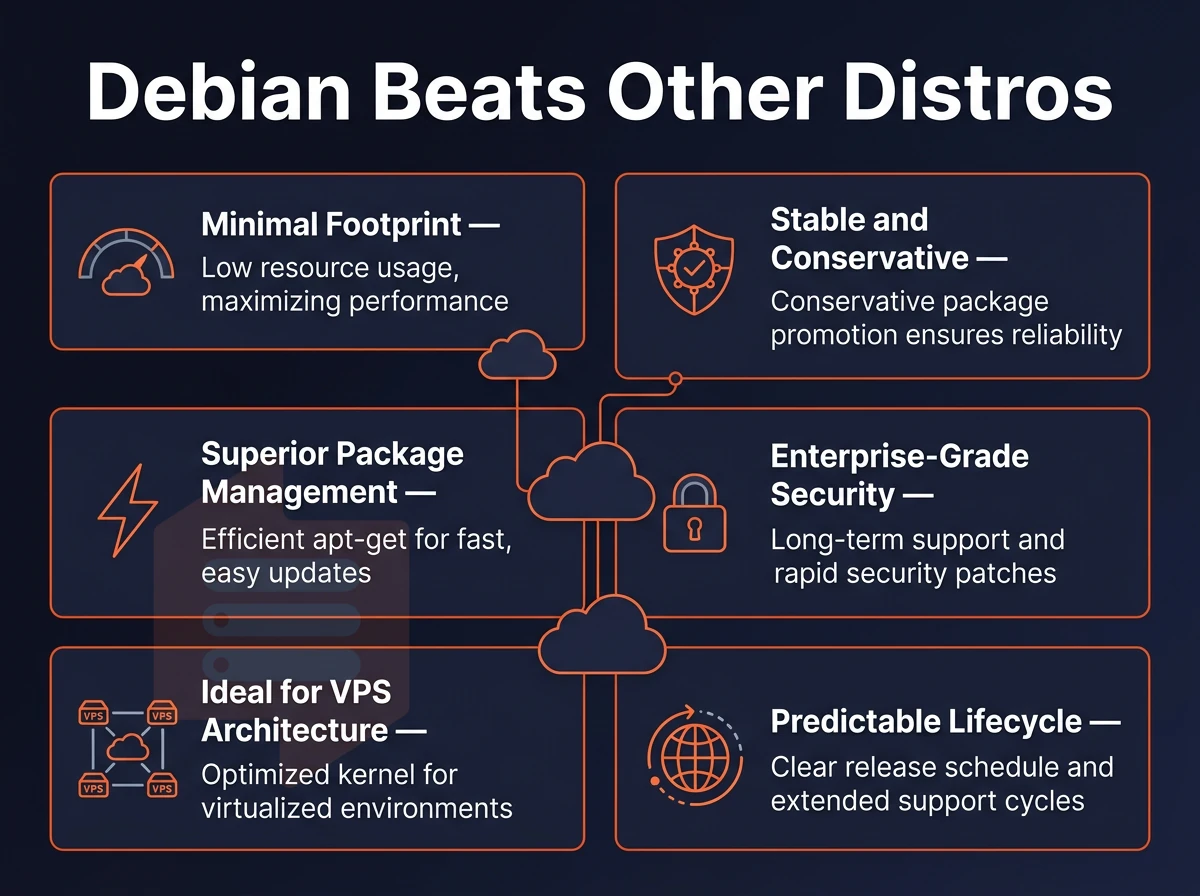
Most Linux distributions are not suited for a VPS. The architecture of Debian (minimal footprint, very conservative promotion of new packages, long support periods) makes it the preferred distribution for production servers as opposed to distributions like Ubuntu or CentOS.
Debian versions and server upgrade predictability
Debian is released on a two-year cycle with five years of security fixes for a particular release. Ubuntu's six-monthly releases are much more rapid but less stable in the medium term. CentOS went the other way and no longer has releases in a stable pattern, so unlike with debian VPS plans you have to migrate in the middle of a lifecycle.
A secure and stable environment for production workloads
Debian's security team backports patches to the current stable branch rather than forcing version bumps. Automatic security updates can be enabled via unattended-upgrades, closing CVEs without manual intervention. Combined with the breadth of debian repositories, over 59,000 packages, advanced users get a hardened base without sacrificing software availability.
| Distribution | Support cycle | Upgrade path | VPS footprint |
|---|---|---|---|
| Debian | ~5 years | Predictable, in-place | ~170 MB base |
| Ubuntu LTS | 5 years | Frequent interim releases | ~220 MB base |
| CentOS Stream | Rolling | No stable snapshot | ~300 MB base |
Can i upload a custom ISO to run a non-standard Debian build?
Yes. Custom ISO’s can be uploaded for all of our plans. This means you can upload a hardened Debian variant, a very stripped down minimal Debian image or even a fully pre-configured image for use with web hosting pipelines.
As our VPS's are KVM based, each VPS runs under its own kernel with pre installed isolation, and so, even with a custom image, you have no fear of other tenants interfering with you. Our automatic failover at the infrastructure level also means that you will always be online regardless of the Debian variant that you have chosen to run.
This isolation extends through the entire infrastructure layer, ensuring tenant separation at the hypervisor, storage, and network levels. Each instance receives dedicated network bandwidth allocation to prevent noisy neighbor effects during traffic spikes.
Is Debian hosting the right fit for your server
We recommend Debian for projects where stability and long-term maintainability, much like reliable ddos protection, are more important than having the latest upstream version of a package. Teams managing long-running applications or multi-year project lifecycles benefit from Debian's predictable update cadence and extended support windows.
Debian is available on both our Amsterdam and New York nodes, all equipped with the same hardware and featuring NVMe SSD storage in a RAID10 configuration on all plans. Once you've chosen Debian as your preferred Operating System, you can select from a range of plans, each designed to provide the right amount of power for specific workload types.
Choosing debian hosting on either location ensures you benefit from enterprise-grade infrastructure with consistent performance characteristics across both data centers. Each location provides unmetered bandwidth on all plans, ensuring your Debian server can handle traffic spikes without incurring overage charges or throttling.
How to choose Debian server VPS plans that fit your workloads
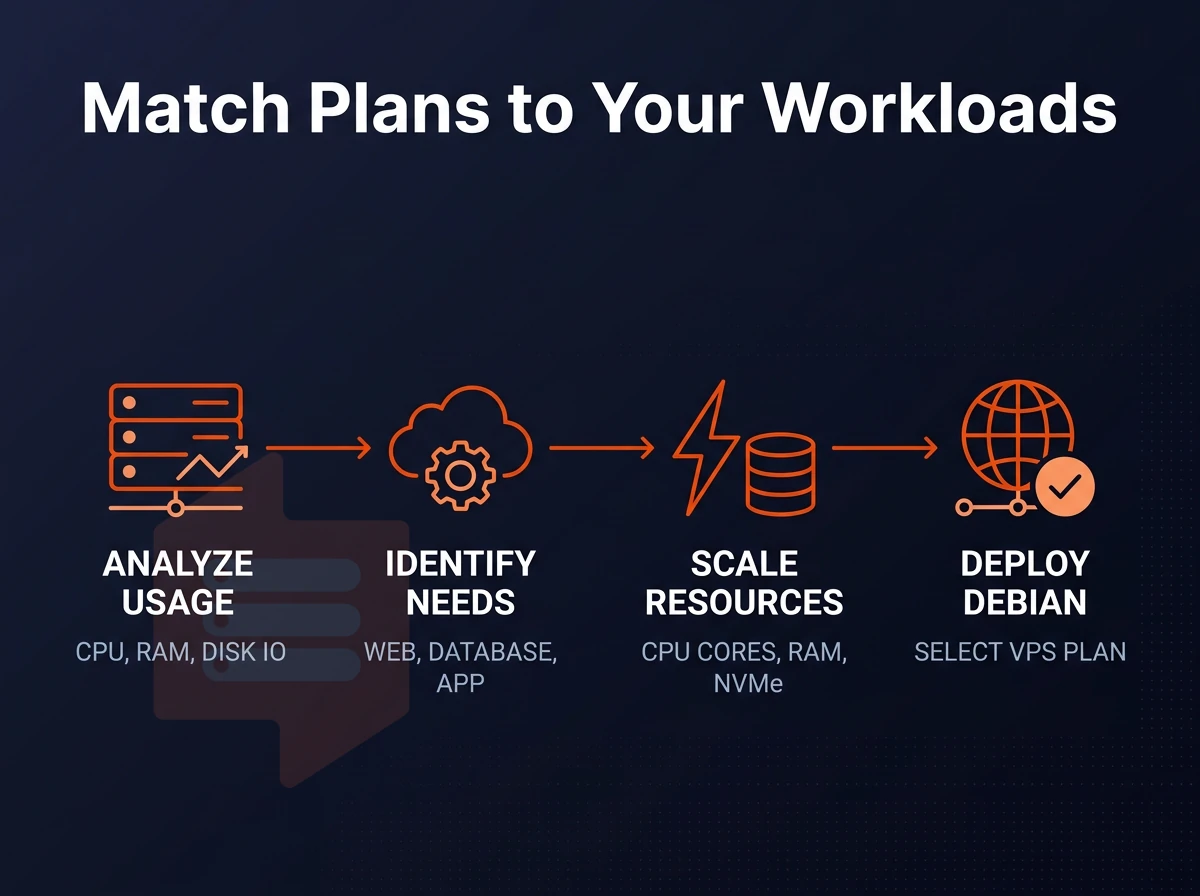
Don’t spend too much or have too little power by picking the correct Debian VPS configuration for your load before you decide to buy it. Matching your application's resource profile to the right tier ensures you extract maximum value from debian VPS plans without overspending on unused capacity.
Compare Debian VPS plans by workload type
- Start with estimating the amount of RAM you need. Mail servers can run with 2-4 GB of RAM, web applications with a PHP stack typically need 4-8 GB of RAM when under load. Databases, especially PostgreSQL or MySQL, love to get more RAM.
- Matching the storage type with the I/O pattern, the lowest latency for database writes and for high traffic sites is delivered by NVMe SSD storage. For lower traffic sites with large amount of sequential reads standard SSD storage is sufficient. All BuyVPS plans are equipped with NVMe RAID10 SSD storage, so the performance of the SSD storage is always the same.
Virtual private server guaranteed resources vs. Shared vcpu
A shared vCPU is allocated from a pool of CPUs and borrows CPU time from other VPS instances on the same host. A pinned, dedicated core in a self managed VPS allocates 100% of that core to your instance and is not affected by other VPSes. Unlike bare metal servers where you own the entire physical machine, dedicated cores in a VPS environment give you predictable CPU performance without the cost of full hardware ownership.
What is the difference between a shared vcpu and a dedicated-core Debian VPS?
Shared vCPU VPSes are cost-effective for bursty or low-sustained-load workloads, while dedicated-core VPSes pin physical cores to instances. In practice, this means that while shared vCPU VPS hosting plans may throttle during periods of sustained load, dedicated-core VPSes do not.
NVMe storage and when your plan fits a VPS upgrade
- Three signals to watch: CPU% consistently above 80%, RAM’s swap usage up, or disk queue length up, any of these signals that your current VPS plan is undersized.
- Upgrade in-place. We perform in-place upgrades of your servers with zero migration and no change to your IP address. Upgrade prior to your next traffic spike.
Note: Upgrading RAM without addressing CPU (or vice versa) rarely fixes a bottleneck. Profile your workload first, identify the actual constraint before selecting a larger plan. With the right plan sized and provisioned, the next step is taking full ownership of the environment through root and SSH access.
Deploying Debian virtual private servers with pre-installed images
Provision a fully configured Debian VPS in minutes. Developers can get up and running fast with a clean, stable Linux base. The environment supports popular web stacks including apache, nginx, and other server software that benefits from Debian's long-term stability guarantees. Root access grants full control over system configuration, package installation, and service management without restrictions imposed by managed hosting environments.
With full root access, administrators can compile custom kernels, modify system libraries, and deploy containerized workloads without vendor-imposed limitations. This self managed approach appeals to DevOps teams and system administrators who prefer direct control over their infrastructure rather than relying on vendor-managed services.
Choosing between Debian server images
Our self-service control panel offers a number of pre-installed OS templates. In addition to Debian 11 (Bullseye), our VPS plans also offer Debian 12 (Bookworm), the current stable version. For new servers we recommend Debian 12 as the default OS. However, for specific projects with fixed dependency chains Debian 11 can still be selected as the OS. Upgrading to the current version ensures access to the latest security patches and performance improvements that Debian's maintainers have validated through their rigorous testing process.
Both debian images ship with minimal bloat, allowing administrators to build their server environment from a clean foundation tailored to their specific requirements. Each template includes pre installed base utilities and network configuration, reducing initial setup time while maintaining the flexibility to customize the environment post-deployment. Teams managing multiple environments often clone a baseline Debian 12 template across development, staging, and production tiers to ensure consistency throughout the project lifecycle.
We offer Ubuntu too where your stack needs it but Debian is our strongest flavor for teams focused on security and longer release cycles.
Virtual private server KVM virtualization and container support
Each and every one of our BuyVPS web hosting servers are set up as full KVM virtual servers with their own dedicated kernel and operating system. This means that you are able to install and run custom kernel modules, run Docker containers, and even mount extra file systems. The Ubuntu user will also find that he has KVM isolation just like his counterparts running other Linux distributions.
How do i upgrade my Debian VPS plan without losing my IP address?
In-place upgrades for plans are supported by BuyVPS, meaning your assigned IPv4 and IPv6 addresses and ssh access credentials will remain unchanged. You can resize your virtual server by changing to a different plan via the control panel API or browser UI interface, and it will remain on the same virtual server.
Debian cloud servers and custom ISO options
Power users can upload their own custom ISOs via the control panel as well as get in-browser access to the VNC console. So users who need to run things like hardened Debian versions or special pre-configured appliances can do so while standard users with debian cloud servers will not need to upload anything.
All of this is available in a single hosting environment. We recommend checking out BuyVPS as your Debian host. This flexibility makes the platform suitable for both development environments and production server hosting scenarios where custom configurations are essential.
Why choose BuyVPS for Debian VPS hosting
BuyVPS runs every Debian VPS on KVM-based virtualization with a separate kernel per VPS, true isolation, not a shared container. Our NVMe RAID10 storage delivers measured 122,959 4K read IOPS, so Debian server workloads stay fast under real load. Every plan includes full root access, SSH access, and custom ISO upload, giving you complete control over your Debian environment from day one.
- Three tiers for every workload: Standard CPU (AMD EPYC Milan), Dedicated CPU with pinned cores (EPYC Genoa), and High Memory, each a self-managed Debian virtual private server with guaranteed resources.
- No-oversell policy: hard memory caps and low node density mean your RAM stays yours.
- Two data centers: Amsterdam (EU) and New York (US East Coast), identical hardware and pricing at both sites.
- In-place upgrades: move to a larger plan with no IP rotation and no migration downtime.
- IPv4 + IPv6 dual-stack on every Debian VPS plan, plus DDoS protection at the network edge.
Founder-run since 2002, with no renewal price hikes. Reach our engineering team at support@buyvps.com to discuss which Debian VPS plan fits your project.
Debian's stability, minimal footprint, and predictable release cycles make it one of the strongest foundations for VPS workloads, from lean web servers to production databases. Choosing a host that pairs Debian with full root access, KVM isolation, and NVMe storage means you get the OS's reliability without hardware bottlenecks undermining it.
The other factor that matters as much as the distribution is where and how the VPS runs. Hard memory caps, no-oversell node density, and in-place upgrades without IP rotation keep your Debian virtual machine environment stable long after initial deployment.
BuyVPS runs Debian with full root access on KVM hypervisors backed by AMD EPYC processors and NVMe RAID10 storage across Amsterdam and New York. If you're ready to deploy, browse the Standard, Dedicated, and High Memory plans at BuyVPS.com and pick the tier that fits your workload.