


For companies that are looking to scale a hosting business but do not have any physical infrastructure, VPS reseller hosting is a solution that can be scaled extremely well without excessive overhead.
By offering reseller VPS hosting, you can give your customers fully functional root access servers isolated from other users and tailored to their needs.
Most of these differences are determined by the core platform on which you've built your business. Shared-vCPU plans that look cheap at first often implode under the weight of real clients. Hidden price increases at renewal destroy the margins you set when you established your pricing. And data center diversity suddenly becomes very important the moment a client asks to host a specific workload in a specific region.
VPS reseller hosting, a powerful hosting solution for companies and organizations that offer hosting services to their customers. In this guide we will explain what makes a good VPS reseller hosting and how we have built BuyVPS as a reliable VPS reseller services solution. The most important aspects of a good virtual private server reselling are the hardware that is used, the network and the Service Level Agreements (SLA) that a provider commits to.
In addition, the control panel is an important aspect that needs to offer the right features for your customers. We explain it all and show you how BuyVPS is built for reseller VPS hosting and why we are different from other hosting providers. We start with the basics: what is VPS-based reseller hosting and how is partitioning implemented? Popular options include cpanel for Linux-based environments, which simplifies account management and provides clients with familiar interfaces for email, databases, and file management.
What is VPS reseller hosting and how this hosting solution works
VPS reseller hosting refers to a model in which you as a individual or company purchase a bunch of Virtual Private Servers from a hosting provider and then offer these VPS’s to your customers as part of your own hosting offer. Each customer will get his very own full-fledged server and not just a slice of some shared account.
First month $1
Then the normal monthly price. One per customer. No setup fee, and a 30-day performance guarantee on your first order.
See the plans“Very satisfied with the service. The server was provided quickly, and everything worked perfectly. Fast response, reliable service, and great overal experience!”
How advanced configurations partition a single parent server
Each Virtual Machine (VM) for a customer can run its own Operating System and has assigned resources and a network stack.
Here's how you might provision a large VPS plan and carve it into individual VPS servers for 5 clients of an agency.
Full root access and what it enables
All of our resold environments come with full root access. This allows our clients to install any software they desire, modify any kernel parameters, and run any OS that we support. This is the main reason that agencies opt for a VPS over a shared environment, true isolation as opposed to just directory isolation.
Root access provides advanced control over system configurations, enabling resellers to customize security policies, optimize performance settings, and deploy specialized applications that shared hosting environments cannot support. Many resellers also integrate cpanel or similar control panels to simplify routine administrative tasks for clients who prefer graphical interfaces over command-line management.
VPS vs shared reseller hosting services: what is the difference?
The biggest difference between shared reseller hosting and virtual server reseller hosting is how accounts are partitioned.
In contrast, VPS reseller solutions creates completely separate environments for each account, with each account having its own kernel and memory space. At BuyVPS, where we sell hosting through reseller servers powered by KVM virtualization, each KVM node managed through the control panel has a fixed amount of memory, which prevents resource contention between accounts. This architecture delivers a greater degree of reliability and predictability compared to shared environments where memory overcommitment can cause unexpected performance degradation.
KVM's hardware-level isolation ensures that high performance remains consistent even under load, as each virtual machine operates with dedicated CPU cycles and I/O channels that cannot be borrowed by neighboring instances. When client demands grow, resellers can seamlessly allocate more resources to individual VPS instances without migrating data or reconfiguring the underlying infrastructure.
This is all good to know about the mechanics of how reseller virtual hosting can work, but it doesn’t necessarily tell you whether or not this will work for your business. In the next section we explore the specific profiles and scenarios in which a clear return on investment is made possible by VPS reseller platform.
When VPS reseller hosting makes sense for your business
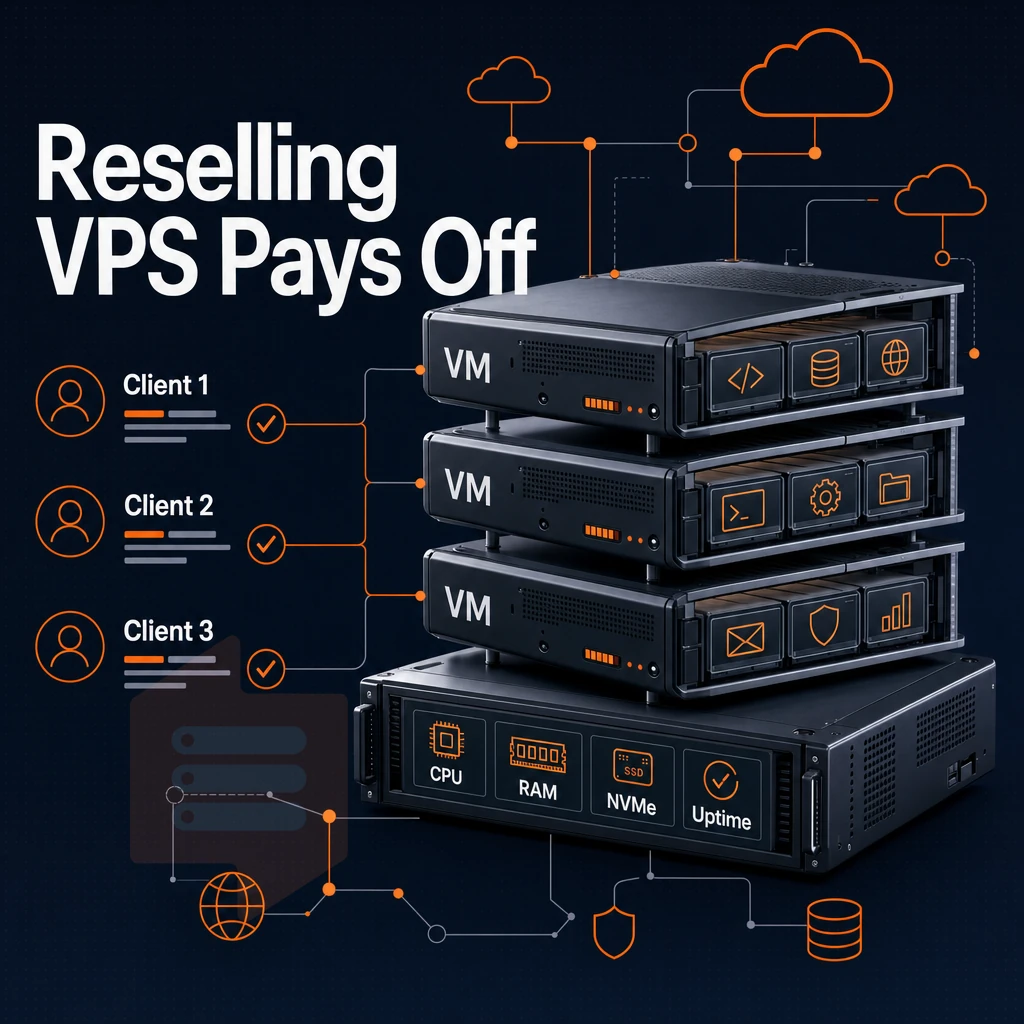
Virtual server reselling is a way to host multiple clients on one server without purchasing the actual hardware. You create isolated environments or VPS's on a single parent server and charge your clients for the space they need under your own reseller name. Many resellers choose this model because it enables them to operate as a white label provider, delivering services that appear entirely under their own company identity.
By positioning yourself as the primary point of contact, you can bundle additional services such as managed backups, security audits, or custom application deployments to increase revenue per client. This approach gives resellers the flexibility to segment their customer base by technical sophistication, offering managed services to less experienced users while providing self-service portals to advanced clients. When you resell VPS capacity, you control pricing tiers and service packages, letting you capture margin on every renewal and upsell opportunity.
Who benefits most from virtual private servers
In summary, three types of customers can derive a lot of value from this offering.
The business case for virtual private servers
White-label branding lets you present hosting under your own brand name, so clients see your branding in the client area, on invoices, and in support interactions.
Retaining a customer who has complete control of their site through your VPS services is far easier than one you set up and left to manage alone.
You never have to touch a physical server. This helps to remove a significant capital barrier for growing businesses that need to scale their client base quickly without scaling their staff.
Do i need technical skills to start a VPS reseller hosting business?
Knowing basic Linux administration is enough to set up multiple accounts, set up limits for resources, troubleshoot DNS problems etc. Most of the provisioning with control panels is done for you. BuyVPS offers full root access and KVM isolation per VPS, so you can work with each client environment from day one as you see fit. Many resellers install cPanel on each VPS instance to provide clients with a familiar graphical interface for managing domains, email accounts, and databases without requiring command-line expertise.
Virtual private servers decision guide
Most people who manage 3+ client sites and get pulled into random hosting fixes would benefit from reselling structured VPS capacity (e.g.
Now that you know whether your VPS hosting model will work, compare VPS hosting to shared hosting and dedicated servers so you can better market reseller VPS hosting to your customers.
Choosing a hosting provider: VPS vs shared vs dedicated server
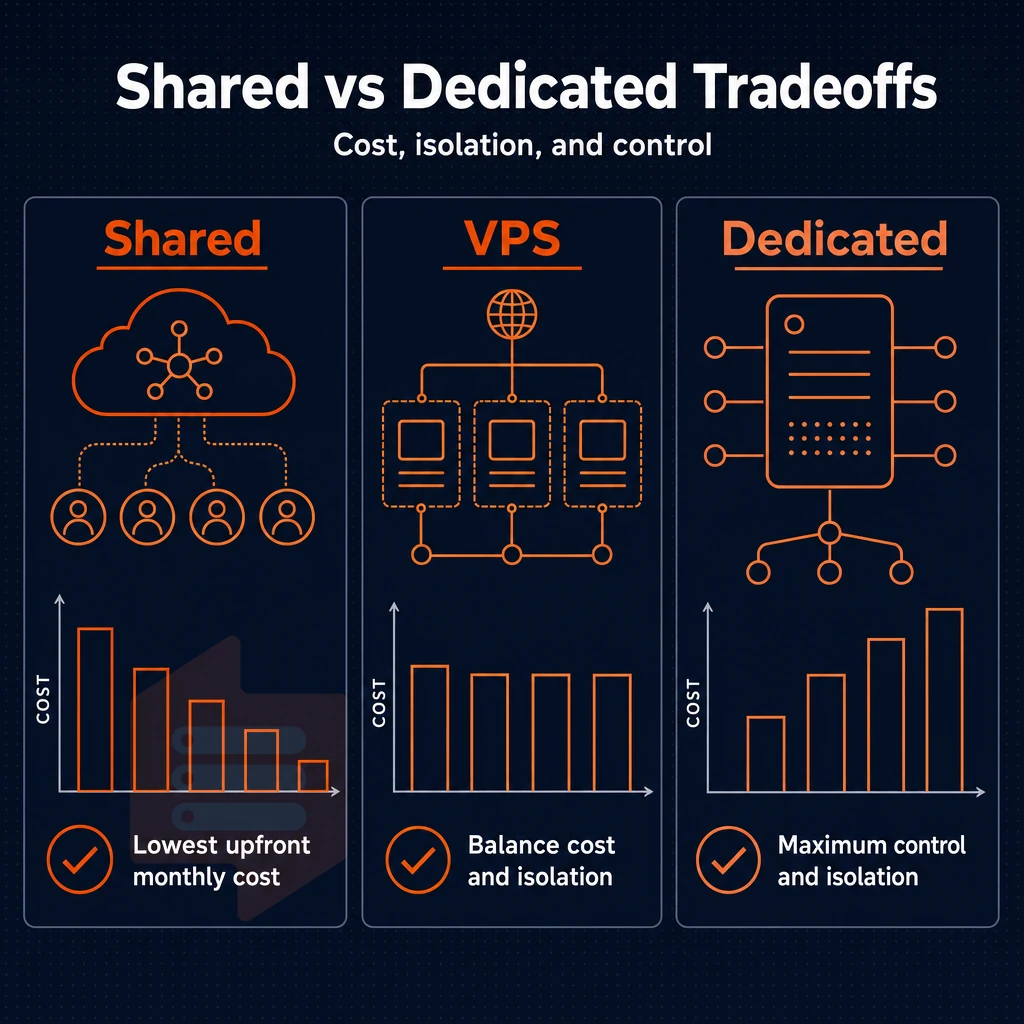
When deciding between shared hosting, reseller VPS services and a dedicated server there are three main factors to consider: isolation, control and clients. Here is a comparison of the three models.
Understanding virtual private servers and each hosting solution
Multiple users are hosted in one server environment on shared hosting. In this type of setup, users have no root access and have to share resources that are pooled together on the server. This means that even one “noisy neighbor” can cause problems for everyone.
Users on shared hosting lack the flexibility to deploy self managed configurations, which limits their ability to customize server environments or install specialized software stacks. Because shared hosting pools system resources across many users, performance bottlenecks and security vulnerabilities can propagate quickly throughout the entire server environment.
Each client gets their own isolated virtual server (VPS) that runs independently with its own dedicated resources. As a reseller you can provision, brand and bill the VPSes independently from your own servers. This white label approach enables resellers to maintain complete brand consistency across all customer touchpoints, from provisioning interfaces to technical support interactions.
When you resell VPS capacity at scale, you gain predictable margins because each instance carries fixed resource costs that don't fluctuate with traffic patterns. Many resellers integrate cpanel or similar control panels to simplify server management for clients who prefer graphical interfaces over command-line administration.
A dedicated server is a single-tenant physical machine.
| Factor | Shared hosting | VPS reseller | Dedicated server |
|---|---|---|---|
| Isolation | None | Full KVM isolation per client | Single tenant |
| Root access | No | Yes, per VPS | Yes |
| Resource allocation | Shared, burstable | Dedicated per slice | Entire machine |
| Scalability | Limited by plan | Add VPS instances on demand | Fixed until hardware changes |
Can i use white label branding with VPS reseller hosting?
Reseller VPS hosting can be offered in a white-label configuration, so you can sell it under your own brand name and clients will never know you're buying it from us.
Note: Reseller hosting only works cleanly if your upstream provider enforces hard resource caps. Without them, one client's traffic spike bleeds into others. BuyVPS uses hard memory caps and low node density to prevent exactly that. When you resell VPS capacity with guaranteed resource isolation, clients experience consistent uptime and performance that builds trust in your brand.
In the next section, we’ll be focusing on the top most visible layer to your clients: storage performance.
High performance NVMe storage and why it matters for resellers
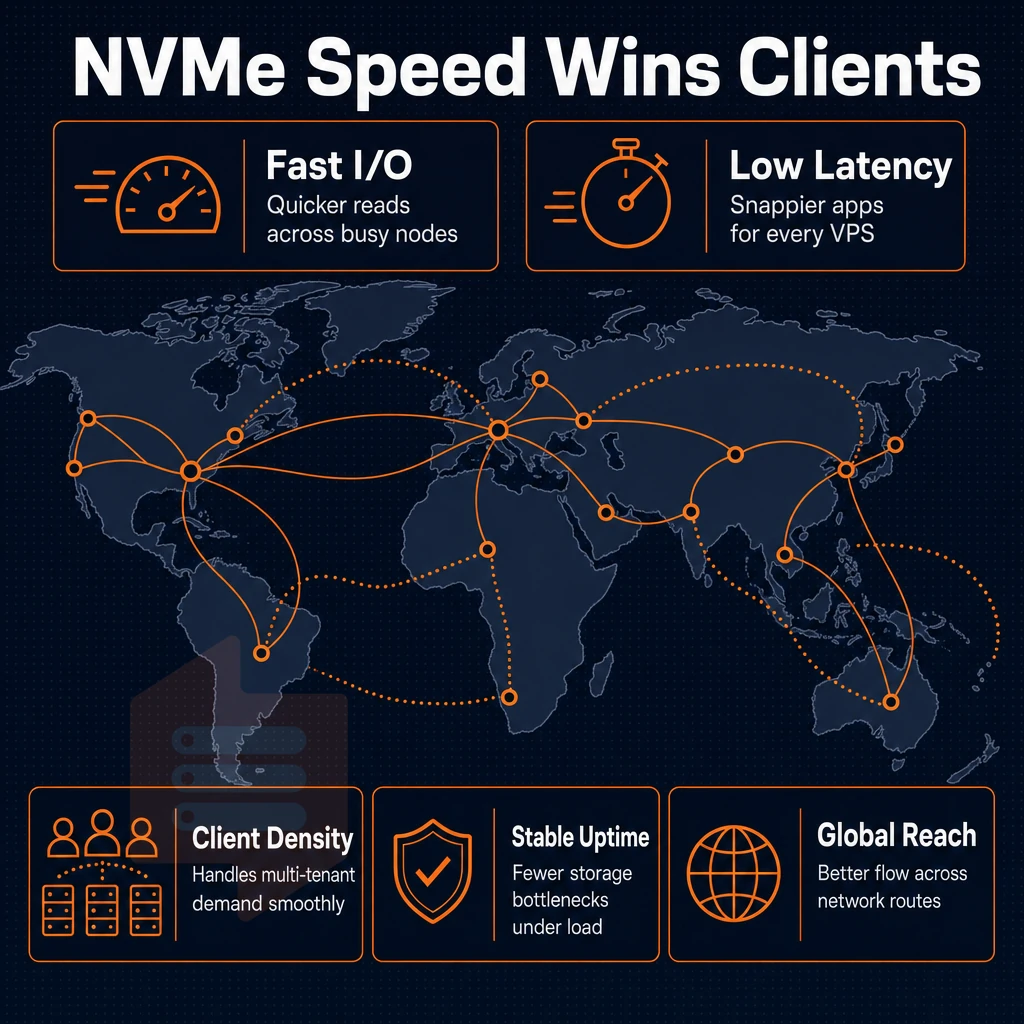
The most common bottleneck in a multi-client VPS hosting environment is Storage I/O.
NVMe storage architecture: why pcie-direct matters
NVMe storage uses PCIe to communicate directly with storage, bypassing the intermediate steps of a SATA/SAS controller.
BuyVPS fio benchmark: 122,959 4K random read IOPS (PCIe-direct, median result). It’s been measured, not estimated.
For a reseller, superior performance at the storage layer means that your client’s websites load quickly under high levels of concurrent traffic. When you resell these high-performance environments, your clients benefit from consistently fast page loads that directly improve user experience and search rankings. Fast storage directly impacts how quickly databases serve dynamic content, ensuring that e-commerce platforms and content-heavy websites remain responsive even during peak traffic periods.
KVM isolation as a performance complement for virtual private servers
KVM virtualization ensures high-throughput storage benefits each virtual machine with dedicated resources, free from noisy-neighbor interference.
What operating systems can i offer my clients through VPS reseller hosting?
Controlling the OS stack is a major advantage that resellers have when using BuyVPS. In addition to Ubuntu, Debian, AlmaLinux, Rocky Linux, CentOS Stream and Fedora server Operating Systems, customers can upload their own custom ISO images to create just about any server environment required for their growing business.
Many environments require specific runtime environments easily created and managed by BuyVPS and Resellers.
In this chapter we will cover the full hardware stack for a scalable reseller business: processors, memory and networks.
Cloud VPS infrastructure: the foundation of a scalable reseller business
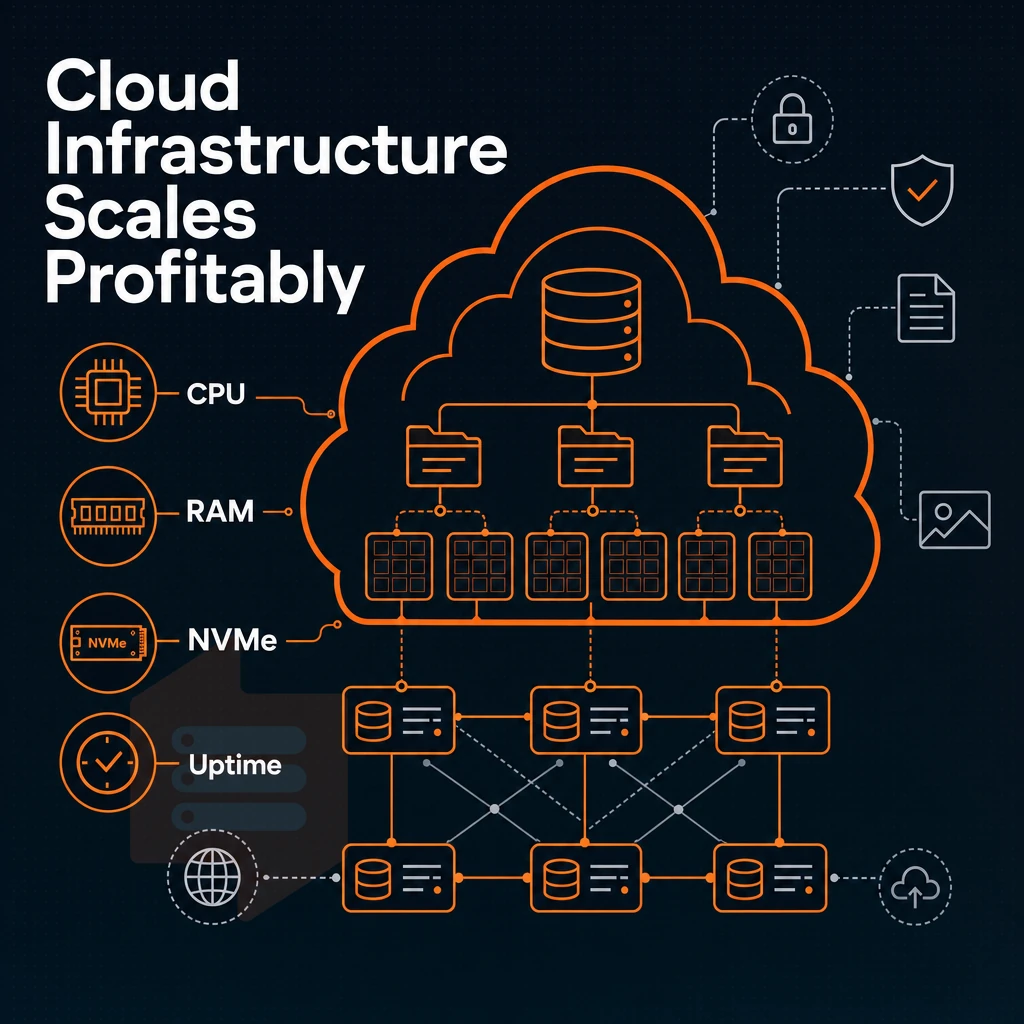
Unlike the legacy shared-hosting stacks which run hundreds of accounts on the same kernel (often poorly optimized for performance andsecurity). Cloud VPS are set up as individual virtual machines, with fully dedicated resources and their own kernel. KVM (Kernel-based Virtual Machine) hypervisor forces this isolation. The reason a reseller can offer a reasonable SLA to their customers is because they’re running on cloud VPS.
Cloud VPS hardware: what sits beneath your reseller business
Storage is NVMe RAID10 over PCIe in a direct-attached configuration.
When offering hosting to businesses with databases, CI/CD pipelines, or high-traffic websites, hardware profile matters.
How does full root access benefit my reseller clients?
Full root access lets clients configure their own optimized software stacks and harden their server OS to whatever level of security and control they need.
Our self-service panel for resellers can be accessed via API as well. By means of the API, resellers can provision and manage their VPS instances.
In-place upgrades: scaling without disruption
When a client’s business is growing and needs more power we upgrade in place, no need for a migration or for IP’s to be rotated. The VPS remains online with all of the original IP addresses. The ability to scale a reseller's virtual server directly from the control panel is operationally significant, avoiding the need to coordinate a node migration for a client's workloads.
Then comes the operational challenge of managing multiple virtual private servers and environments for different clients on a day-to-day basis and keeping a lid on complexity, especially without a reliable control panel, so that it does not get the better of your team.
Setting up and managing multiple client management environments
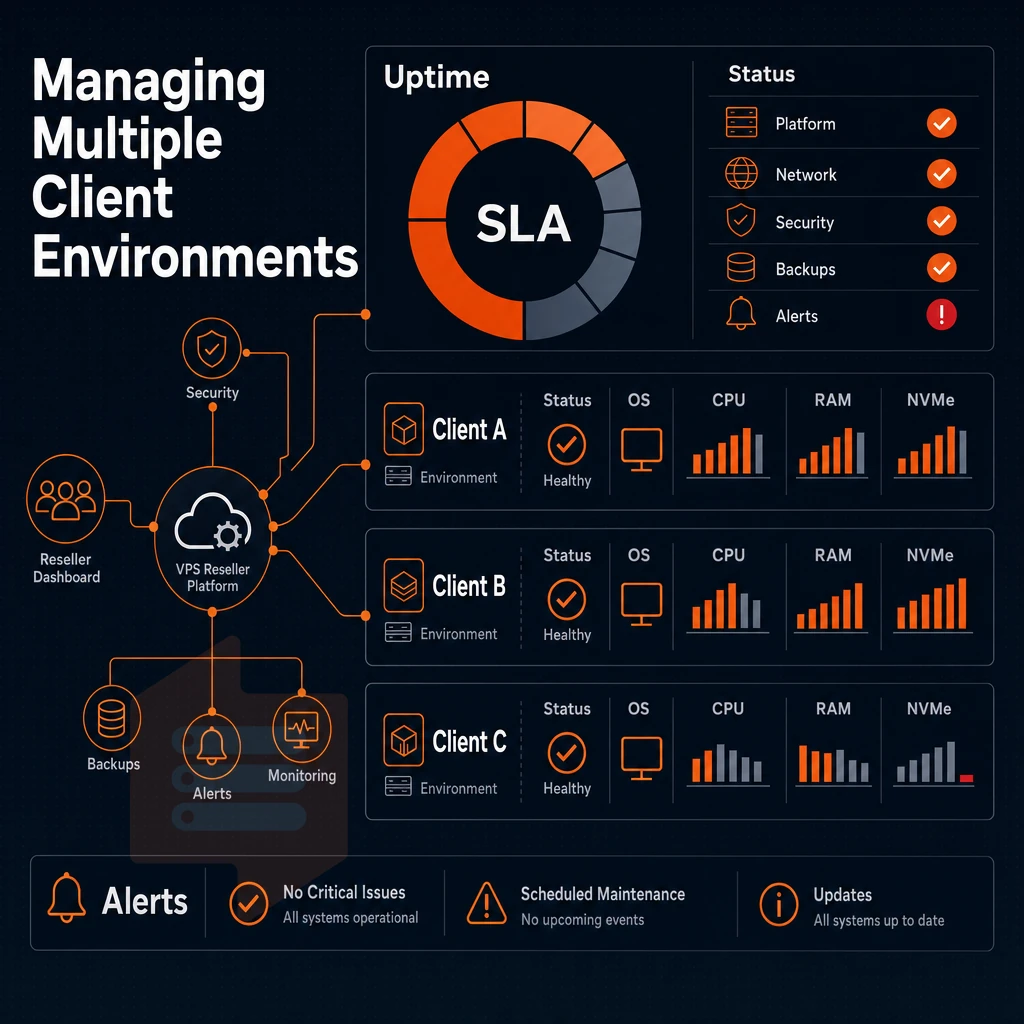
As a VPS reseller, you manage multiple client environments on a single server, with each environment running its own OS and having its own set of access credentials.
Client management: provisioning and resource allocation
You create a dedicated KVM environment for each of your clients and, thanks to the separate kernel that BuyVPS sets up for each VPS, your clients’ workloads will not ‘spill over’ into each other’s servers. During each client's server setup, you allocate RAM and storage in line with the terms and conditions of their contract, with the hard memory limit enforced at the hypervisor level.
Choose an OS for the initial setup from the OS list on the self-service panel (e.g. Ubuntu, Debian, AlmaLinux, Rocky Linux, CentOS Stream or Fedora). Customers running specialized stacks (e.g. older applications, non-standard kernels) can upload a custom ISO via the custom ISO upload path instead.
Virtual private servers control panel access and delegation
Full root access to all server settings, i.e. you can install any control panel as well as system users for your clients with restricted sudo access. You can also set up access to whatever interfaces you need for your clients. No restrictions on server configuration.
The BuyVPS self-service panel has API access as well as an in-browser VNC console.
What is the difference between self-managed and fully managed VPS reseller hosting?
Self-managed hosting means every server setup is your responsibility, including the standard operational tasks of hardening, patching, monitoring, and troubleshooting of OS and applications. It requires real technical skills and you should be comfortable with basic shell access (via SSH), firewalls and package management (e.g. apt, yum, etc.).
A fully managed VPS shifts the responsibility of maintaining your server to the provider. You sacrifice flexibility for the added cost. While fully managed VPSes are great for resellers with plenty of technical knowledge, they offer little control and low margin for less technical resellers. Such resellers should consider adding managed services or even hiring a sysadmin on a contractor basis instead of assuming the provider will handle all the operations.
| Dimension | Self-managed VPS | Fully managed VPS |
|---|---|---|
| OS & patching | Reseller's responsibility | Provider handles it |
| Root access | Full, unrestricted | Often restricted |
| Customization | Unlimited, any stack, any ISO | Limited to approved software |
| Cost efficiency | Higher margin for reseller | Lower margin, higher overhead |
| Skill requirement | Intermediate to expert Linux | Minimal, provider abstracts ops |
Self-managed KVM VPS on BuyVPS is generally the best solution for most resellers, as it allows for in-place upgrades of your VPS and does not involve IP rotation. On top of this you can then build a lightweight automation layer to grow your client environments as required, without growing your support requirements.
Why choose BuyVPS for VPS reseller hosting
Resellers need infrastructure that won't embarrass them in front of clients. BuyVPS is built for exactly that: predictable, provable VPS hosting with no oversell and no surprises.
- No-oversell policy. Hard memory caps per node and low node density mean every virtual private server delivers its allocated resources under real load, making client SLAs defensible.
- Dedicated CPU tier. Pinned cores on AMD EPYC Genoa give individual clients consistent latency. Shared hosting can't match it; reseller VPS hosting built on dedicated resources can.
- Published benchmarks. Geekbench 6, fio, and pgbench results are on record, 122,959 4K read IOPS on NVMe RAID10 storage. Show clients real numbers, not marketing copy.
- Full root access + KVM isolation. Every VPS instance runs a separate kernel. Resellers get full root access and custom ISO support for any server configuration or Linux environment.
- In-place upgrades, no IP rotation. When a client's business grows and needs more resources, we upgrade in place, no migration, no disruption to their hosting environment.
- Dual data centers. Amsterdam and New York cover EU and US East Coast clients from a single hosting provider relationship, with identical hardware and no renewal price hikes.
If you're evaluating BuyVPS as your reseller VPS hosting infrastructure, reach out to our engineering team at support@buyvps.com or call +31 85 369 6285 to compare plans against your client base requirements.
Key takeaways: building a hosting business with VPS reseller hosting
VPS reseller infrastructure gives agencies, developers, and small agencies a scalable alternative to shared hosting. Each client gets an isolated virtual server with dedicated resources, full root access, and NVMe storage, not a crowded shared environment. KVM virtualization means every virtual machine created runs its own kernel, so one client's workload never disrupts another.
The business model is straightforward: resell hosting services under your own brand, manage multiple client accounts from a single provider relationship, and scale as your business grows without migration pain or IP rotation. BuyVPS delivers that foundation across Amsterdam and New York, no-oversell guarantees, in-place upgrades, and engineer-led support baked in from day one.
virtual private server reseller hosting works when you need real resource isolation, predictable performance, and the flexibility to grow without migrating clients. Shared hosting ceilings and dedicated server overhead make VPS the practical middle ground, especially when NVMe storage and KVM virtualization back every instance.
The infrastructure underneath your reseller business determines what you can promise clients.
BuyVPS runs KVM VPS on AMD EPYC hardware across Amsterdam and New York, with full root access, in-place upgrades, and engineer-led support, the foundation a reseller business can actually build on. Explore the plans at BuyVPS.com and pick the tier that fits your client roster today.