
Milliseconds matter when it comes to algorithmic trading. VPS providers offer forex VPS solutions that host your execution engine (be it a MetaTrader EA, a Python trading strategy or a FIX-protocol trading bridge) on a dedicated server close to the matching engine of the exchange. Rather than on your shared desktop computer where your trading connection can drop at peak hours. The difference between 2ms round-trip times and 200ms round-trip times is real, and the difference between a filled trade and a missed trade.
What matters most to a trader is a high performance forex VPS that delivers the most consistent CPU processing power, storage I/Os, and network connectivity possible.
We will go over the hardware, network, and deployment options (location, tier, configuration) that really matter to a trader, and help the trader choose the right VPS from the available VPS providers for his/her trading strategy. We will also test out various VPS es to see how they really perform in live trading and compare the results to backtesting results. See also: cloud hosting.
What is a trading VPS and how does it work with trading platforms?
A Virtual Private Server (VPS) is a Virtual Server that is a partitioned section of a server. It is a Virtual Machine with a dedicated CPU, Memory, Disk Space, and Operating System. This means that a trader’s software setup will function independently of all other users hosted on the same server. Additionally, There will be no interference with timing of trades caused by shared processes running on the server. See Virtual private server on Wikipedia for background.
First month $1
Then the normal monthly price. One per customer. No setup fee, and a 30-day performance guarantee on your first order.
See the plans“Great service! Everything was delivered quickly and worked exactly as expected. the process was smooth, reliable, and professional. Highly recommended!”
If your bot runs on Linux, Freqtrade or Hummingbot for example, we wrote a separate guide on running a trading bot on a VPS near New York, with the time sync and key hygiene that matter more than raw speed.
How a forex VPS differs from a personal computer
A VPS however will keep running 24/7 in a data center with redundant power supply and network uplinks. You can access your VPS from any location and on any device using remote desktop protocol (RDP) with low latency, as if you were sitting in front of the server. This continuous operation ensures that your trading algorithms remain active during overnight sessions and across different market time zones without manual intervention.
Choosing a dependable VPS means selecting infrastructure with proven uptime guarantees and enterprise-grade hardware that won't fail during critical market hours. Trading depends on this infrastructure reliability: orders have to execute without disruption regardless of local conditions or time of day. Uninterrupted trading becomes possible when infrastructure eliminates single points of failure through redundant systems that maintain connectivity even during hardware maintenance or network events.
After connection, you install any trading software on the server that you like best. The trading platforms are always running and send out all orders even when your laptop is switched off and you have no internet connection from home. This flexibility allows traders to switch between different software solutions as their strategies evolve, since most trading platforms are compatible with standard Windows Server environments.
KVM isolation and why it matters
We run all of our VPS’s off of KVM virtualization. KVM ensures that each forex VPS instance operates with hardware-level isolation, preventing resource contention that could disrupt time-sensitive order execution. This architecture guarantees optimal performance by dedicating CPU cycles exclusively to your trading instance, eliminating the resource sharing that causes unpredictable execution delays in shared environments.
Forex trading platforms in an always-on environment
Trading Automated Trading Programs Require Uptime 24/7. The trading programs such as Expert Advisors and Algorithmic Bots are set up to monitor low latency price feeds and make trading decisions on an automated basis. Once a decision is made to enter or exit a trade, the program issues a trade order.
A Virtual Private Server (VPS) provides a number of advantages to traders of automated trading programs. A virtual private server VPS delivers the dedicated computing environment necessary for these programs to operate continuously without the resource limitations of shared hosting.
The computer and Internet connection run 24 hours a day, 7 days a week without failure. This means that on forex VPS servers, expert advisors or other automated trading programs continue to function without any interruptions caused by a local computer shut down or loss of Internet connection. These advantages are why most traders rely on a VPS to host their trading programs as opposed to running them on their local computers.
Unlike a personal computer that may experience power outages or require restarts for updates, a VPS maintains uninterrupted operation in a professionally managed environment. Maintaining uninterrupted trading operations becomes especially critical during volatile market conditions when every second of downtime can translate into missed opportunities or unmanaged risk exposure.
Forex VPS services explained: what to look for in a provider
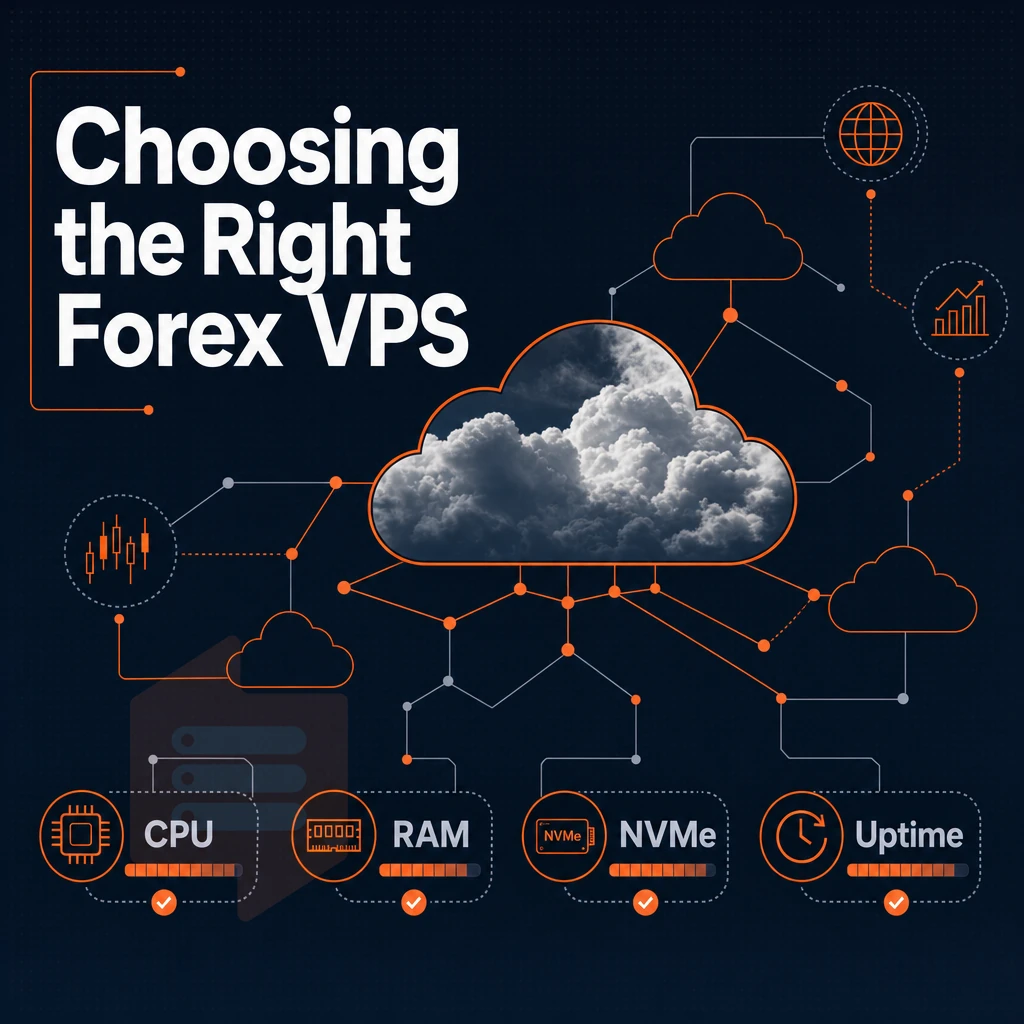
When choosing a VPS to host your forex trading software, not all are equal. A generic VPS server, designed to host a single WordPress site, will not be sufficient to run a forex trading strategy in financial markets that relies on millisecond execution. Here’s a guide to help you evaluate your options before committing.
Comparing VPS providers on the basis of hardware specifications, network architecture, and proximity to trading venues helps narrow down which services can genuinely support low-latency execution requirements. Beyond technical specifications, evaluating competitive pricing across providers ensures you receive optimal value without sacrificing the performance characteristics essential for algorithmic execution.
Execution speed and proximity
- First, mark on the world map where your broker’s matching engine is located. Most large brokers send trades to NY or London. That is where you want your VPS to be located. We have VPS servers in Amsterdam and New York, both are within a few miles of the largest FX liquidity centers in the world.
- Published benchmarks for demand. Marketing specs are to be taken with a grain of salt. Publish fio or latency results for serious traders. The numbers for NVMe RAID10 from performance tested servers at BuyVPS are published and verifiable, 122,959 4K read IOPS for example.
Forex VPS hosting infrastructure requirements for forex traders
- We can confirm if you have dedicated resources allocated or if you’re on a shared vCPU plan better suited for lower frequency trading strategies. Pinned-core dedicated plans of course remove any risk of CPU contention for latency-sensitive black box trading algorithms. BuyVPS offers both tiers on the exact same hardware.
- When choosing a forex VPS hosting provider, check their uptime SLA. BuyVPS for example runs edge-layer DDoS protection on every server. Make sure the provider writes this down for you though.
Note: VPS providers that advertise uptime without a written SLA are offering a marketing claim, not a contractual commitment.
Forex VPS solutions and OS flexibility
- Evaluating OS options for forex VPS. Most forex VPS providers offer Windows Server option. However, BuyVPS offers Linux-based KVM VPS servers with root access, i.e. Ubuntu, Debian, AlmaLinux, Rocky Linux and many more other Linux distributions. Our forex VPS solutions for algorithmic traders and developers give them full control of their server environment without any extra licenses.
The question is whether a VPS is the right architecture for you at all or if you need cloud hosting for your applications. Understanding whether a virtual private server VPS architecture suits your execution model requires evaluating your latency tolerance, resource predictability needs, and whether your strategy benefits from dedicated infrastructure or elastic compute capacity.
Cloud hosting vs VPS for trading: which is right for you?
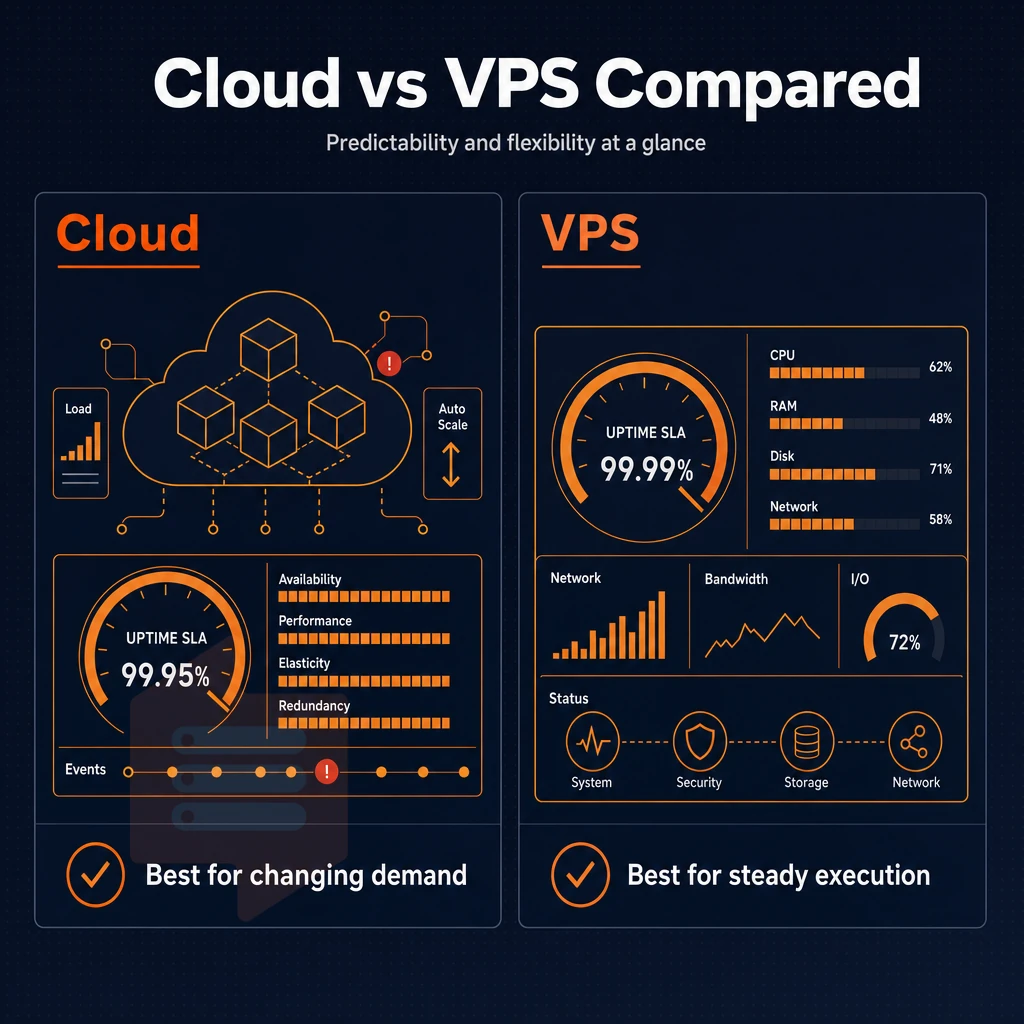
When choosing between cloud hosting and a VPS for trading, the key factor to consider is predictability. Cloud platforms offer elastic scaling, but that elasticity also brings variable latency with it. Latency that can change from one second to the next is bad when the timing of your trades is critical.
Traders executing scalping strategies or high-frequency algorithms require ultra low latency connections that remain stable throughout the trading session, making dedicated VPS infrastructure the preferred choice over elastic cloud environments. A stable trading environment depends on consistent network performance, which dedicated VPS infrastructure delivers more reliably than variable cloud architectures.
Trading platforms and the noisy-neighbor problem in automated trading strategies
Public cloud VMs share physical CPU’s among many tenants.
You don’t need pinned cores for your algo trading. A shared vCPU VPS running lighter algorithmic trading strategies such as end-of-day trading signals or swing trading bots can perform just fine. What you need is guaranteed RAM and isolated storage space, not a dedicated core of silicon. Traders deploying automated trading strategies with moderate frequency can benefit from this tier's balance of cost efficiency and reliable execution speed.
Shared vCPU vs. Dedicated-core VPS solutions
The Standard CPU tier is a cost-effective, low latency forex VPS for lighter usage, shared on a vCPU basis on an AMD EPYC Milan processor with NVMe RAID10 storage. This means to run execution-sensitive trading strategies on this tier to the best of your ability. This tier combines competitive pricing with enterprise-grade NVMe storage, making it accessible for traders who need reliable execution without the expense of dedicated cores.
Pinned cores ensure that the thread scheduler never has to compete for cores, so latency remains constant under load and is not worse than idle thread scheduling.
Matching trading platforms to your execution model
High performance Forex VPS is typically co-located next to exchange matching engines. Proximity to exchange is important, however isolation of resources on the VPS is equally important.
A free VPS service is often provided by brokers to futures traders with accounts, but the VPS is typically running on extremely over sold shared servers (ok for monitoring, not ok for latency sensitive trading execution). While a free VPS may seem attractive for initial testing, traders should evaluate whether the resource limitations and potential performance throttling align with their execution requirements.
Our BuyVPS nodes are running at low density and are equipped with hard memory caps. Both our Amsterdam and New York deployment features identical hardware. So you will select to deploy in the region where your broker’s matching engine is geographically closest to you. And without giving up on specs. Next up, matching a BuyVPS plan tier to your very own specific trading style.
Choosing the right VPS plan for your trading platforms and style
Not all traders require the same level of infrastructure.
Light signal runners: standard CPU tier
Retail traders in this category run a few forex signals or a couple of copy trading accounts, and their overall trading activities require minimal resources to keep their trading platform running. Many forex traders in this segment prioritize simplicity and cost over raw speed, making shared infrastructure an ideal match for their operational needs. Beginners with limited forex trading experience often find this tier sufficient while they develop their strategies and learn market dynamics before scaling up.
No need to pay for pinned cores you haven’t yet required.
Active algo traders: dedicated CPU tier
However, when forex traders run trading bots over multiple accounts, the same vCPU which you paid for shared can become noisy-neighbor introducing large spikes of latency at the worst moment, a fast market move.
Our Dedicated CPU VPS (D-tier) “pins” specific cores to your instance. This provides professional traders with a very stable & predictable trading environment, where no other node on the platform can consume CPU resources of your pinned cores, even those right next to your instance. This architecture is particularly valuable for active traders who execute high-frequency strategies and require consistent microsecond-level response times throughout volatile market sessions.
Pinned cores eliminate resource contention entirely, ensuring optimal performance even during periods of extreme market volatility when execution speed becomes critical. Maintaining a stable trading environment becomes essential when executing strategies that depend on predictable latency profiles and uninterrupted computational availability during critical market windows.
A right Forex VPS for people who manage trading strategies on automatic and use several brokers at the same time. Professional traders who manage multiple accounts benefit from dedicated resources that prevent cross-account interference and maintain execution consistency across all positions simultaneously. Institutions offering managed services to clients also rely on this tier to ensure consistent performance across diverse portfolios and trading styles.
Quantitative and futures strategies: high memory tier
Unlike most VPS providers, our H-tier High Memory VPS's support remote desktop protocol access and feature a 1:8 vCPU-to-RAM ratio to cater for the Futures Trader with In-Memory Datasets and/or running large tick-history backtests and/or models with many markets.
As your workloads grow our in-place upgrades allow you to move your trading servers up a tier without migration or IP changes.
Setting up your trading VPS with trading platforms and software
Every plan on BuyVPS comes with full root access, so you can start using your new server from the first login.
Preparation for low latency performance
- Choose your operating system. Pick Ubuntu or Debian for the widest package support. AlmaLinux, Rocky Linux, CentOS Stream, and Fedora are solid choices for stability-focused setups. Need a proprietary image? Upload a custom ISO directly from the self-service panel. Note: if your trading software requires Windows Server, use the custom ISO path to bring your own licensed image.
- Provision via the self-service panel (including API access for traders who run multiple strategies / accounts and thus would like to automate the provisioning of accounts).
Installation
- You access your VPS by connecting to it. For graphical applications you use a remote desktop connection. In your browser an in-browser VNC console is automatically available for you without the need to install a local client. All access to the internet is then done from within your VPS, thus being completely separated from your local internet access.
- First, install your favorite trading platform on your VPS. You should download the appropriate installer for your trading platform from the vendor’s website or download from your Linux distribution’s software package management system. We strongly recommend that the VPS be hosted in the same region as the servers of your brokerage’s (i.e. Amsterdam for European markets or New York for US markets) in order to achieve the lowest possible latency for order routing.
Verification
- Test broker connectivity. Make sure the feed is live and the latency is within the acceptable bounds before you enable any algorithmic trading system strategies. Also, the reliable trade execution is dependent on the stable and low-latency connection to your broker.
- Schedule your automated strategies to run as the market opens. Use your favorite scheduler, such as cron or the scheduler built into your backtesting/algorithmic trading system platform, to launch the job. Also test to confirm the job will continue to run after a reboot before activating it for live trading.
Now that you have a verified environment with strategies running, let's take a look at why BuyVPS was designed specifically for this kind of low latency workload.
Why choose BuyVPS for your trading VPS needs
Traders need a virtual private server that holds its performance under real load. As a forex VPS hosting provider operating since 2002, BuyVPS is built around that requirement. Our VPS hosting infrastructure runs on AMD EPYC with KVM isolation, a separate kernel per VPS, so your trading platforms operate in an environment never shared with a noisy neighbor.
- No-oversell, hard memory caps: Low node density means no RAM or CPU contention during peak trade execution. Your automated trade execution runs at full allocation, every time.
- Dedicated CPU tier with pinned cores: EPYC Genoa cores are pinned to your VPS for predictable low latency, critical for algo traders and high frequency trading workloads.
- Proven NVMe RAID10 storage: 122,959 4K read IOPS measured via fio. Fast disk means trading data and trading software load without delay.
- Amsterdam and New York data centers: Deploy close to major financial hubs for ultra low latency to broker servers and financial markets.
- In-place upgrades, no IP rotation: Scale your VPS plan without migrating or reconfiguring your trading platforms.
- DDoS protection and KVM isolation: A stable and secure environment for uninterrupted trading, no shared kernel, edge filtering on every node.
Performance is published, not promised. Benchmarks are available, pricing is transparent, and our engineers reply directly. Reach out to compare VPS solutions or discuss which tier fits your trading setup. Strong infrastructure means nothing without the support and reliability to back it up.
Frequently asked questions
How do VPS providers handle futures trading data on trading platforms?
A financial trader's VPS is a low latency virtual private server that runs your trading platform or automated strategy 24/7, independent of your local machine. Traders use it to eliminate execution gaps caused by local hardware failures, power outages, or unstable home connections.
Which VPS is best for trading platforms?
The best trade execution VPS service combines low-latency network routing to your broker's servers, dedicated or pinned CPU cores, and NVMe storage for fast order-processing. BuyVPS, one of the more specialized providers of forex VPS services, offers KVM-isolated VPS plans on AMD EPYC hardware with dedicated CPU options and locations in Amsterdam and New York, two of the most broker-dense financial hubs in the world. Full root access and in-place upgrades mean you scale without IP rotation, which matters when broker whitelisting is involved.
Should i use a VPS to run trading platforms more efficiently?
Yes, if you run automated strategies, expert advisors, or any position that requires round-the-clock monitoring. A VPS removes your home internet and local hardware from the execution chain entirely. Even discretionary traders benefit: a VPS keeps your charting platform and alerts live without tying up a personal machine.
How does a VPS for trading platforms differ from regular VPS hosting?
The underlying technology is identical, both are KVM-virtualized servers with root access. The difference is workload priority. A market algorithmic trading server is sized and located specifically to minimize round-trip latency to broker execution servers for forex traders, whereas a general-purpose VPS is typically optimized for web traffic or application hosting. Choosing a VPS in Amsterdam or New York, close to major financial exchange infrastructure, is what turns a standard VPS into an effective algo forex VPS built to support serious trading activities.
Can i run automated trading platforms and strategies on a Linux VPS?
Yes. Python-based strategies, algorithmic bots, and API-driven order systems run natively on Linux without modification. Platforms such as MetaTrader can run on Linux via Wine, and most modern broker APIs have first-class Linux SDKs. BuyVPS supports Ubuntu, Debian, AlmaLinux, Rocky Linux, CentOS Stream, and Fedora, all common choices for algorithmic market trading deployments.
What operating systems and customer support options back VPS trading?
BuyVPS supports Ubuntu, Debian, AlmaLinux, Rocky Linux, CentOS Stream, and Fedora on every plan. You can also upload a custom ISO if your trading environment requires a specific OS image or a pre-configured environment. Full root access is included on all tiers, so you install and configure software exactly as needed.
How does server location affect trade execution speed?
Hosting your VPS service in Amsterdam puts you within the same network fabric as the major European financial exchanges, while New York covers US equity and futures brokers, both locations engineered for trading success.
Among all VPS solutions available for forex trading, what truly matters comes down to 3 things: the latency of the connection to the exchange, the uptime of the VPS, and the consistent allocation of resources to your strategy. A shared cloud server introduces too much noise for automated forex trading software, a dedicated server provides a consistent execution environment 24/7.
Choosing a trading plan is as important as choosing a trading platform.
BuyVPS runs KVM-isolated VPS instances on AMD EPYC hardware with NVMe RAID10 storage in Amsterdam and New York, both built to host your preferred trading software under the low-latency, always-on demands of algorithmic trading software. Browse the plans at BuyVPS.com and find the tier that matches your execution requirements.