
Pricing Linux VPS hosting cheaply seems to be easy for web hosts. But when you look at their Linux VPS hosting packages, it’s quite surprising to see the same old tricks of overselling servers, having CPUs share resources and resulting in severe performance penalty during high load.
Additionally, Then get to sock it to customers when the VPS hosting price renews by doubling the initial price in just one year. It is well known that there is a very crowded market of cheap Linux VPS services . The real task, however, is to find an Linux VPS that is not only cheap but is fast, is reasonably priced for subsequent years and allows full root access.
This guide cuts through the marketing nonsense and explains the key specs that actually matter, the realistic workloads a budget Linux VPS can handle, and the typical compromises providers with full access make on memory caps, storage, the virtualization layer, and network quality. Related: NVMe RAID10 storage.
Our own KVM-isolated VPS instances on AMD EPYC hardware with NVMe RAID10 storage in Amsterdam and New York offer excellent support for hard memory caps and zero overselling. We start from the beginning and explain the fundamentals of what a Linux VPS actually is and how it works. Each data center location is selected for low-latency connectivity to major internet exchanges and redundant power infrastructure. This infrastructure design ensures consistent performance for applications requiring low latency, such as real-time APIs and high-frequency trading platforms. See also: Ubuntu, Debian, AlmaLinux, Rocky Linux.
What is cheap Linux VPS web hosting and how does it work?
A Virtual Private Server (VPS) is a virtual slice of a physical server, with your own dedicated RAM, CPU and disk space. virtual server hosting is somewhere between shared server hosting and a bare-metal server: more power, more control and more predictability than multi-tenant hosting, but with lower overhead costs than a dedicated server.
First month $1
Then the normal monthly price. One per customer. No setup fee, and a 30-day performance guarantee on your first order.
See the plans“Great experience with BuyVPN! The service is easy to use, the connection has been smooth and reliable, and the overall experience has been really good. The pricing is also reasonable…”
The cheapest useful VPS job we know is monitoring from a second location; our uptime monitoring VPS guide runs Uptime Kuma on an S-2.
How cheap Linux VPS server hosting plans work
KVM virtualization cuts up the physical server into independent virtual servers each running its own kernel. Your processes will never compete with another tenant's workload in the data center. No noisy-neighbor RAM contention, no shared process table.
Why full root access makes Linux VPS cost less
Linux is an open source operating system, so there is no license charge per user (per-seat). That is the main reason why we can offer a very cheap Linux VPS, comparable to a Windows VPS with same specifications. Popular distributions like Ubuntu, CentOS, and Debian are all available at no additional cost, giving you the freedom to choose the environment that best fits your application stack. This flexibility makes Linux VPS an ideal choice for developers who need to test applications across multiple distributions without incurring licensing costs. browse the plans at BuyVPS.com.
Because the linux os kernel is open-source, hosting providers can optimize system configurations without vendor restrictions, passing those cost savings directly to customers. The open source operating system model also enables rapid security patching, as community-driven development cycles often deliver fixes faster than proprietary alternatives. The collaborative nature of open source software means that security vulnerabilities are often identified and patched by a global community of developers, reducing the window of exposure compared to closed ecosystems.
Linux VPS web hosting: what you get with root access
- Full superuser access: you can install any package and configure any service.
- Your choice of distro: Ubuntu, Debian, AlmaLinux, Rocky Linux, and more.
- Isolated environment: no shared PHP pools & no shared memory limits.
Every Linux VPS at BuyVPS is powered by KVM and runs with its own kernel. Our VPS nodes are provisioned with hard memory limits that are equal to the resources provisioned. This is one of the main features that separates a genuine Linux VPS from regular shared web hosting. It also clearly highlights where BuyVPS's virtual machine performance advantage is.
This isolation ensures that each instance operates independently, preventing resource contention even when multiple users share the same physical hardware node. Hard memory limits guarantee that your allocated ram remains exclusively available to your instance, eliminating performance degradation caused by memory overcommitment on the host node.
Linux VPS server hardware specs that actually matter
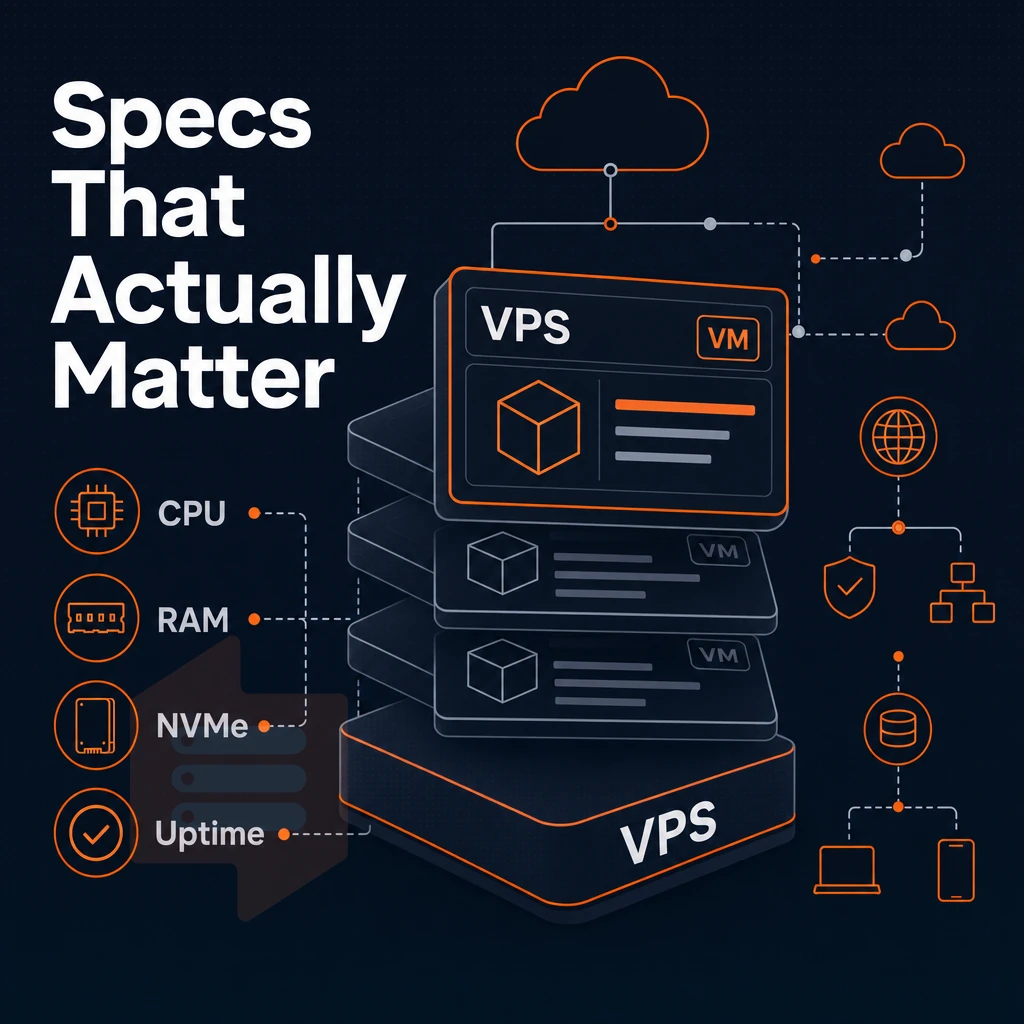
Not all high performance VPS plans are created equal when it comes to actual dedicated machine resources. Check out the hardware before you purchase the VPS to make sure it offers more performance in terms of the memory, storage bandwidth and network bandwidth that you require. When evaluating a linux VPS server, prioritize providers that publish transparent hardware specifications and allow you to verify CPU model, disk type, and network uplink speed before committing to a contract.
CPU and RAM for game servers that need more power
- What Generation CPU is it? AMD EPYC Milan processors (running DDR4 ECC memory) are very good at shared workload processing. However newer AMD EPYC Genoa processors that have pinned cores and are running DDR5 ECC memory will provide better performance for latency sensitive processing as the physical machine will not have noisy-neighbor interference.
- Check for anti-oversell signals. Hard memory caps per node and low node density are the clearest form of proof that a provider is not overselling. Ask whether the limits are enforced at the hypervisor level.
High performance storage and network with a customizable Linux kernel
- Demand NVMe RAID10 not plain SSD storage. For databases and high-traffic sites, IOPS, not capacity, is king. We published fio benchmark numbers for you already. Our highest number for 4K read IOPS so far is 122,959 IOPS. A number, not a word.
- Confirm whether the uplink model uses multiple carriers. Multi-homed uplinks with IPv4 and IPv6 in dual-stack configuration are protected against a single carrier failure. Be wary of “unlimited traffic” marketing claims. They may hide a fair-use limit which becomes a chargeable fee when exceeded. This will become apparent on the customer’s overage invoices.
Note: Ignore headline specs if the provider won't publish benchmark results. Unverified numbers are meaningless.
Linux OS management and administration
- Select from a list of supported OSes: The list of supported OSes should be comprised of distros for which there is no additional charge to the user. Such as supported versions of Ubuntu, Debian, AlmaLinux, Rocky Linux, CentOS Stream and Fedora. A custom ISO upload feature should allow users to add in custom stacks that are not currently included in the list of supported OSes.
- Evaluating Management Tools, a Self-Service Panel for Your Needs. A self-service panel, with API access, and an in-browser VNC console, means you need to call on technical support less for routine tasks, keeping you in control from the very start.
The hardware specifications of a VPS outline the maximum possible usage of its server resources. However, the ceiling can be reached to a greater extent depending on the kernel access and OS flexibility of a VPS. Administrators gain granular control over resource allocation, process priorities, and system-level configurations that directly impact how efficiently the VPS utilizes its allocated hardware.
With kernel-level privileges, users gain full control over system tuning parameters, custom module loading, and low-level networking configurations unavailable in containerized environments. This level of control enables administrators to install applications with specific kernel dependencies or compile custom software from source without restriction. Optimizing the server environment at this level allows experienced administrators to fine-tune performance characteristics that would otherwise remain locked behind managed hosting abstractions.
Why choose BuyVPS for cheap Linux VPS hosting
BuyVPS delivers cheap Linux cloud virtual physical host hosting without the usual trade-offs: no overselling and no hidden fees. Our data centers in Amsterdam and New York run identical hardware and pricing.
- KVM hypervisor technology, separate kernel per VM, full root-level privileges on every Linux virtual node, including custom ISO support.
- AMD EPYC with NVMe RAID10, published benchmarks back the performance claims; SSD storage is not a marketing term here.
- No-oversell policy, hard memory caps and low node density mean your dedicated resources stay yours.
- In-place upgrades, scale your Linux cloud instance dedicated host without migration or IP rotation.
- Engineers reply, technical support from people who manage virtual dedicated bare-metal machine infrastructure, not first-tier scripts.
Founder-run since 2002, we keep pricing stable and infrastructure honest for hosting websites. Compare our Linux VPS plans or reach out to discuss which tier fits your workload.
Linux VDS hosting gives you genuine hardware node control, predictable performance, and the flexibility to run any stack, without the overhead of a dedicated machine. The hardware underneath matters: AMD EPYC processors, NVMe RAID10 storage, and hard memory usage caps separate a real virtual private compute instance from an oversold shared environment dressed up with a different label.
And when you manage VPS workloads that demand consistent CPU time, a dedicated-core plan eliminates the noisy-neighbor problem entirely. Dedicated-core configurations guarantee uninterrupted processing power for compute-intensive tasks like video encoding, machine learning inference, and database query optimization. This architecture lets you upgrade CPU cores, RAM, and storage as your application grows without migrating to a new platform.
BuyVPS runs KVM-isolated Linux virtual hosting instance servers in Amsterdam and New York, with shared and dedicated vCPU tiers, full system access, and in-place upgrades that never rotate your IP. If you're ready to move beyond shared hosting, browse the plans at BuyVPS.com and pick the tier that matches your workload.
Each plan includes optional cPanel licensing for users who prefer a graphical interface over command-line administration. All plans support rapid deployment from a library of pre-configured server images, including the latest LTS releases of Ubuntu, Debian, and CentOS.