

AWS virtual server hosting is often one of the first options considered by developers and infrastructure teams, largely due to brand recognition and the lock-in of Amazon’s ecosystem of services.
Whilst Amazon cloud VPS offers lots of flexibility to developers, the hosting can come with complexities and hidden costs, especially when it comes to billing.
This piece delves into what you actually get with Amazon's managed service for virtual servers, including how it affects load times, security, and for which architectures it is particularly well-suited, and for which leaner systems provide comparable or even better performance at lower operational complexity. For more context, see Amazon Virtual Private Cloud.
Whether you’re looking to move a production workload to AWS, are simply evaluating virtual server offerings for a new project. Alternatively, are trying to get a better read on how your current virtual servers are performing in terms of speed, security, or cost, the ultimate goal is to match your infrastructure to your needs, not to some marketing hype.
What is Amazon lightsail VPS hosting with load balancers?
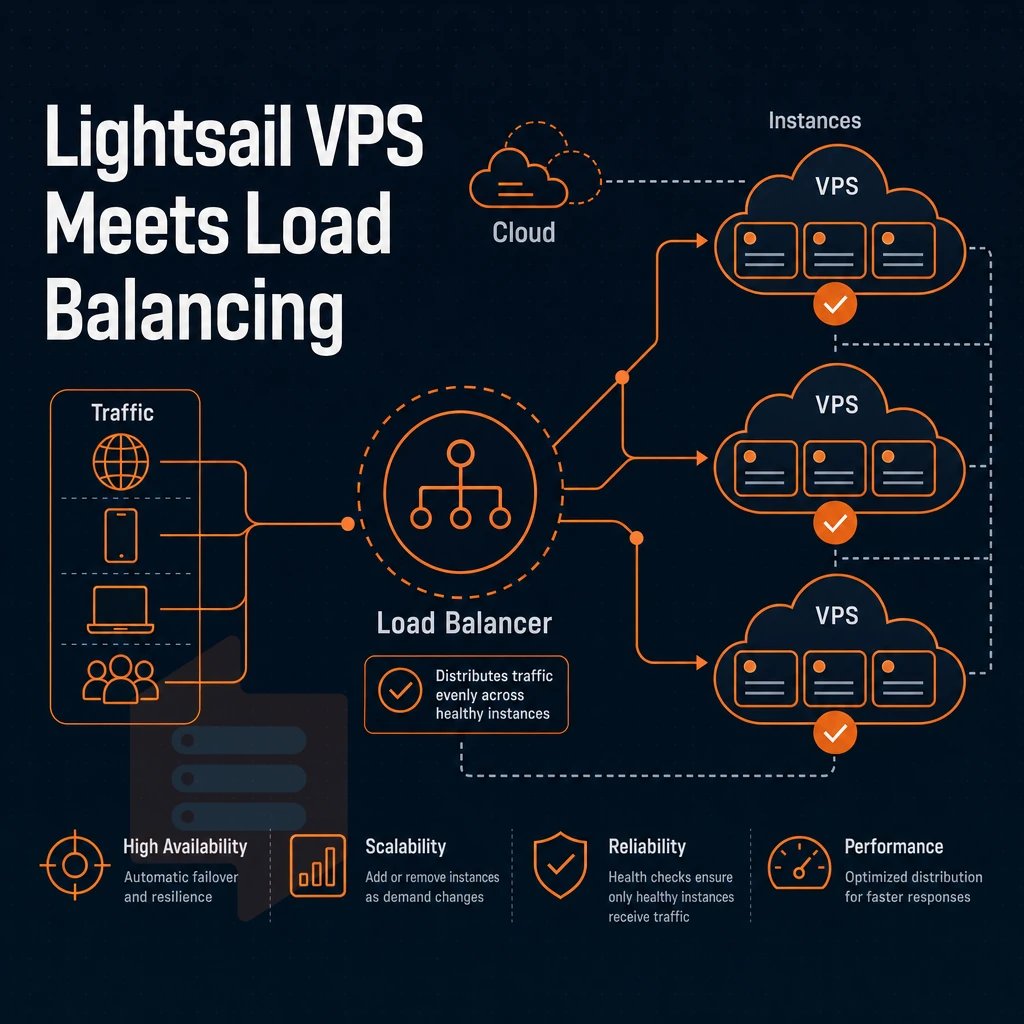
What people commonly search for as “Amazon VPS hosting” are actually two separate Amazon Web Services (AWS) products: Amazon Lightsail and Amazon EC2. It's worth learning the differences between each website before signing up for either.
What a VPS hosting provider actually gives you
Traditional VPS hosting is provided as a dedicated slice of a physical server.
AWS cloud compute is different from rented server slices. Resources are pooled across many physical servers, and because you can run many virtual machines on a single server, flexibility is high. However, The model to keep in mind is renting individual virtual machines on demand.
Amazon lightsail: the closest thing to virtual private servers
Amazon Lightsail is a simple service offered by AWS for building, deploying and managing websites, apps and services, it’s their simplest service to use.
Amazon ec2: a cloud platform for compute, not VPS hosting
So while EC2 is a full cloud compute platform offering resizable, on-demand capacity by the hour (down to the second, actually) and thus quite powerful, it is also complex.
Thus, even though EC2 is VPS hosting of a sort, it’s not really accurate to refer to it as such, as the EC2 architecture, pricing model, and management complexity differ greatly from traditional VPS hosting. With these key differences noted, however, a look at each of them as they function as VPS hosting below.
Amazon as a VPS hosting provider: pros and cons
Amazon Web Services (AWS) provides massive server power to handle very complex workloads. These capabilities extend beyond raw processing power to include advanced networking, storage orchestration, and integration with managed services that support enterprise-scale applications.
First month $1
Then the normal monthly price. One per customer. No setup fee, and a 30-day performance guarantee on your first order.
See the plans“Excellent experience from start to finish! The server was delivered promptly, and the service was reliable and efficient. I m very happy with the results and would definitely recommend them.”
Pros: instance types, cost efficiency, and ecosystem depth
- Huge global infrastructure spread across dozens of regions and availability zones. Our Content Delivery Networks are integrated by design to minimize latency at scale.
- Elastic scalability, all components (compute, storage, networking) scale independently. Users who anticipate rapid growth can quickly provision needed capacity without the typical lead time associated with purchasing new hardware.
- Managed services breadth. Database, Queue and Container Orchestration services are provided as fully managed layers to help alleviate operational burden on small teams of developers.
Cons: virtual server full control vs. Complexity
- Unpredictable billing. Although the pay-as-you-go-pricing model encourages efficient use of resources in theory, it can lead to enormous surprise bills in reality. Data transfer fees in particular become expensive at large scale.
- The console, IAM policies, and networking model all have a steep learning curve. The worst type of security mistake is a misconfiguration that results in significant financial losses.
- This level of complexity is typically overkill for most simple applications and environments such as a simple web site or development environment. Flat-rate VPS hosting often is less expensive and more predictable for such applications.
Note: If your workloads are stable and well-defined, the pay-as-you-go model can work against you.
Amazon VPS vs. Traditional VPS hosting: side-by-side comparison
Although Amazon-style cloud VPS hosting and traditional VPS hosting solve the same problem, they solve it in different ways. Therefore, it is essential to understand the differences in order to find the best hosting solution for your workloads.
Operating system comparison at a glance
| Dimension | Amazon-style VPS (Lightsail/EC2) | Traditional VPS provider |
|---|---|---|
| Pricing model | Variable, consumption-based | Flat-rate monthly plans |
| Resource allocation | Burstable or shared instances | Fixed vCPU and RAM per VPS |
| Storage | Object or block, billed separately | NVMe included in plan |
| Root access | Available on EC2; limited on Lightsail | Full root on every plan |
| OS flexibility | Marketplace images, custom AMIs | Major Linux distros, custom ISO |
| Scaling model | Auto scaling, pay-per-use | In-place upgrade, no IP rotation |
| Support model | Tiered plans, paid premium support | Engineer-led, included |
| Complexity level | High, IAM, VPCs, egress billing | Low, configure and deploy |
Where each model fits with object storage
Amazon-style instances are suitable for projects that require a lot of flexibility and can also handle the increased costs of data egress. A busy website with unpredictable traffic spikes is a good example of such a project. Scaling resources dynamically in response to traffic patterns allows the infrastructure to absorb sudden load increases without manual intervention or downtime.
Web applications that serve dynamic content or handle user sessions benefit from this elasticity, as resource allocation adjusts automatically to match real-time demand. Businesses serving global customers often rely on this model to maintain service availability during regional traffic surges or seasonal events.
Typical VPS services are configured to provide consistent performance for a fixed price. This makes for a good server for a developer to set up as a single virtual server which they can fully configure themselves, without any surprises on their bills.
Each virtual machine functions as an independent server environment, giving you full control over the operating system, installed software, and security configurations without sharing kernel space with other tenants. This approach appeals to teams that prefer managing their own software stack rather than navigating cloud-native abstractions and service integrations.
The same level of hardware, simpler to run
A typical webhost runs enterprise class hardware such as AMD EPYC CPUs and high-performance NVMe storage, arranged in complex configurations like RAID10. BuyVPS operates a portfolio of dedicated servers and shared-vCPU VPS hosts in Amsterdam and New York, with root access to all servers. Here is what our website can offer for your specific use case.
Virtual private servers frequently asked questions
Does Aws use spare capacity to offer managed VPS for quick web app deployments?
AWS does not sell a product it calls a VPS. Its closest equivalent is EC2, a virtual machine service that shares the same concept, isolated compute on shared hardware, but wraps it in a much larger ecosystem of networking, storage, and billing complexity that can connect a website or application to dozens of additional AWS services. If you want a straightforward VPS with root access, a fixed monthly cost, and no per-hour metering, a dedicated VPS provider is a more direct fit. EC2 instances can integrate with elastic IPs, auto-scaling groups, and load balancers, which adds operational overhead but enables horizontal scaling patterns that traditional VPS setups cannot match without manual intervention. EC2 instances can also connect to S3 for object storage, allowing applications to offload static assets and backups outside the instance's local disk. EC2 instances can also connect to S3 for object storage, allowing applications to offload static content and backups outside the instance's local disk.
Does Amazon sell VPS hosting for web applications?
Amazon does not sell a product labeled "VPS." EC2 instances offer similar benefits to traditional VPS, virtualized servers with configurable CPU, RAM, and data data data storage, but they are billed by the hour and layered with separate charges for bandwidth, disk space, and IP addresses. Traditional VPS hosting bundles those resources into a single predictable monthly price, which is a meaningful operational difference for teams managing budgets.
How much does Amazon VPS hosting cost?
AWS does not publish a single VPS price because EC2 costs accumulate across compute, persistent disk space, data transfer, and optional services separately. The total bill for your website depends on instance type, region, reserved vs. on-demand pricing, and egress volume for each lightsail instance, making it difficult to predict without careful planning. Providers like BuyVPS offer a straightforward alternative: a fixed monthly rate with no surprise fees, covering compute, NVMe data persistence, and bandwidth in one line item. Teams migrating from Amazon Lightsail to EC2 often encounter this billing complexity when their resource needs exceed Lightsail's bundled plans and they must transition to EC2's granular pricing model.
Is a VPS hosting provider good for your needs?
Yes, a VPS is the right choice for most production workloads that have outgrown shared hosting but do not need a full dedicated server. You get root control, isolated resources, and the ability to install any software stack, all at a predictable monthly cost. BuyVPS reinforces this with hard memory caps per node, KVM isolation with a separate kernel per VPS, and NVMe RAID10 block persistent disk space, so your website's performance benchmarked on day one holds under real load. These benefits extend to development teams who need consistent staging environments that mirror production without introducing variable cloud billing into their workflow. When your application depends on processes running quickly under consistent load, predictable resource allocation becomes more important than elastic scaling features that introduce latency variability. Customers running e-commerce platforms or SaaS applications benefit from this stability, as unpredictable resource throttling can directly impact checkout flows and user retention metrics. Retailers running online store platforms particularly value this predictability, as transaction processing and inventory systems require stable response times that directly affect conversion rates.
Amazon VPS solutions (Lightsail simple, EC2 flexible) are best suited for organizations already using AWS services. The tradeoff here is significant billing complexity, uncertainty around how all the resources get allocated across services, and uncontrolled costs under load. For most workloads, such overhead is not warranted. Organizations evaluating Amazon Lightsail should weigh its simplified interface against the limited scaling ceiling, which may require migration to EC2 as traffic grows.
Traditional VPS hosting provides fixed monthly costs and consistent performance with root privileges for a low managed services tax. When comparing file data capacity and CPU consistency to shared cloud servers, dedicated and known hardware provides better website performance for latency-sensitive applications than allocated pools of resources.
If you need a VPS with pinned CPU cores, NVMe RAID10 data repository. Additionally, no surprise fees, hosted in Amsterdam or New York, visit BuyVPS's website to explore their Standard, Dedicated, and High Memory plans and find the configuration that fits your workload. Each plan includes root access to configure your virtual server environment and store application data, backups, or databases directly on high-speed NVMe arrays without metering overhead.