


While Vultr VPS pricing receives a lot of attention for their unique hourly billing model and many locations, the 'sticker price' is often misleading.
Moreover, the hardware in the different locations is not always upgraded at the same time. As a result, it is good to exactly determine the full pricing structure of a plan before you sign up, including which services you are actually paying for. What do you have to pay for per use. Additionally, Where does the pricing model fail in practice.
We also detail the various bandwidth, storage, and compute allocations on offer, and provide some context for comparison with other providers of virtual private servers.
Note also that we contrast Vultr’s VPS pricing with that of BuyVPS, which locks in the price of a plan for the full five years of the term, with no upward revision on renewal. Ultimately, our aim is to provide a complete framework by which you can assess the value proposition of any given VPS offering, at high load.
For a complete overview, explore our vultr VPS pricing guide.
What is Vultr VPS pricing and how does it work?
When choosing a VPS, be sure to understand the typical pricing model. There are usually two types of pricing: pay-as-you-go hour-by-hour charges, and flat charges for every month you keep the server online. Make sure you know what you’re getting yourself into before you sign up for an account and start throwing resources at a server. For more context, see Vultr.
First month $1
Then the normal monthly price. One per customer. No setup fee, and a 30-day performance guarantee on your first order.
See the plans“Good support, fast VPS. Thanks!”
Hourly vs. Monthly account billing
Hourly rates are generally better for short-lived workloads that features a few hours to run a batch job on a single server. Typically, you can spin up a new instance with more RAM from within the same account without having to move any data. Spinning up instances on demand is fast, typically completing in under 60 seconds, which makes hourly billing practical for time-sensitive batch processing. Providers typically allocate ram in fixed increments per tier, so selecting the right baseline configuration avoids costly mid-cycle upgrades.
What each account plan typically includes
Most tiers offer some combination of compute, storage, and bandwidth, with many additional managed services offered as add-ons (managed databases, backups, etc.) to be charged on top of the base tier rate.
These charges show up as additional line items on your regular billing page, and without routinely reviewing your pricing and charges, they can easily get out of control. Reviewing your billing dashboard regularly gives you a clear view of which add-ons are driving costs and helps you identify underutilized resources that can be scaled down.
- Shared vCPU plans, lower base cost, variable performance.
- Dedicated-core plans, pinned resources, consistent latency.
- Bandwidth overages, charged per GB above included bandwidth allowance.
Where BuyVPS services fit
All our KVM VPS Servers are hosted in two state of the art data centers in Amsterdam and New York with strict hard no-oversell memory guarantees. We do not have any hidden add-ons that will surprise you on the invoice. Please let us know which of our VPS packages is best suited for your needs.
Vultr VPS pricing vs. Dedicated-core VPS: side-by-side comparison
But the pricing variables for these different features will change depending on whether you are on a shared-core plan or a dedicated-core plan.
Architecture: shared vs. Pinned cores services
Shared-vCPU plans are used to distribute CPU time between multiple users. Although temporary overload is possible, it causes problems due to noisy neighbors. On the other hand, dedicated-core plans reserve a physical core for a single VPS. The D-tier plan from BuyVPS uses AMD EPYC Genoa processors and pinning of cores to VPS. This Means that your VPS always gets the same amount of CPU time, regardless of whether the server is idle or loaded.
Side-by-side account comparison across data centers
| Dimension | Shared-vCPU VPS | BuyVPS dedicated-core VPS (D-tier) |
|---|---|---|
| vCPU type | Shared, time-sliced | Pinned physical core, EPYC Genoa |
| RAM | Varies; soft caps common | Hard memory caps, DDR5 ECC |
| Storage type | SSD or NVMe (varies) | NVMe RAID10, PCIe direct |
| Bandwidth included | Typically metered or capped | 2 TB included on D-4 entry plan |
| Billing model | Hourly pay-as-you-go | Monthly, 1-year, or 2-year term |
| Price stability | Rates can change; renewal hikes possible | Same price in year 5, no renewal hike |
| Root access | Full on most plans | Full root on every plan |
High performance value and billing stability
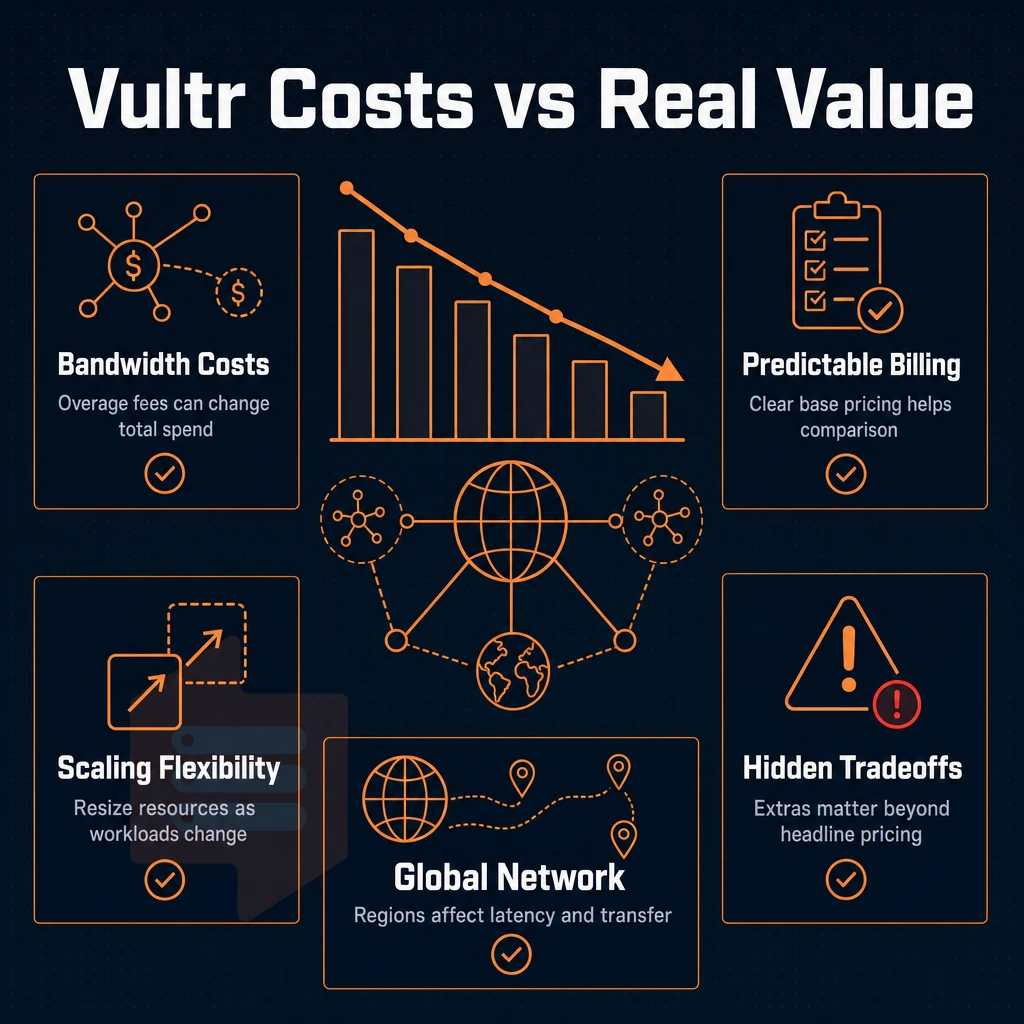
Pay-as-you-go is well-suited for very short-lived workloads. For persistent production services, however, fixed-term billing provides complete cost predictability. At BuyVPS, one of our standout features for your business is that we lock in your rate at sign-up, so the price you see on day one is the price you pay in year five. Locking in a fixed rate eliminates the risk of surprise increases when your contract renews each month or at the end of a multi-year term.
Is Vultr VPS good value? Pros, cons, and hidden costs
The architecture comparison describes what you get for your money on paper. Understanding the full cost structure, including bandwidth overages and snapshot fees, requires careful review of each provider's pricing documentation before deployment. Customers should view the pricing documentation as a living document, checking for updates each quarter to catch any tier adjustments or new overage policies.
Where Vultr pricing delivers value
Hourly billing (e.g., pay-per-gb models) is well-suited for short periods of time to handle infrequent, short work loads. Test a stack, run a one-time task and provision, run and delete the instance within a single month’s billing cycle without paying for idle time. Providers typically bill hourly usage in arrears, so you see the accumulated charges reflected on your invoice at the end of each month.
Our platform is deployed in many global data center locations.
The hidden account costs to watch
The Shared vCPU plans are subject to contention. As there is no published no-oversell guarantee, the performance under load can vary greatly based on neighboring users on the same server. Real-time monitoring dashboards let you view CPU steal percentages and memory pressure metrics to diagnose contention issues as they occur.
- Snapshots and backups are charged on top of the regular price for the plan and are not included in the base price.
- Managed add-ons actually increase the effective cost of hosting over and above the published rates.
- However, the price for renewal can change without notice and usually is not locked in for a number of years.
Who it suits, and who it doesn't
I recommend Vultr for burst workloads and experimentation. For production databases, latency-sensitive APIs, and memory-intensive applications, a no-oversell guarantee is an important feature that needs to be weighed against cost by potential buyers before they sign up.
Why choose BuyVPS for predictable, high-performance VPS hosting
If those gaps matter to your workload, BuyVPS offers a complete answer with consistent CPU, enforced memory caps, and a rate that doesn't shift at renewal. Our plans carry the same price in year five as day one, no renewal hike, ever.
- No-oversell RAM: Hard memory caps per node. Your allocated GB stays yours under real load.
- KVM isolation: Each VPS runs a separate kernel, full root access and custom ISO included on every plan.
- NVMe RAID10 storage: 122,959 4K read IOPS measured. High-performance I/O for data stores and fast workloads.
- Dedicated CPU tier: Pinned cores on AMD EPYC Genoa for predictable CPU latency.
- Dual-stack network: IPv4 + IPv6 included. Data centers in Amsterdam and New York (USA).
- In-place upgrades: Scale your plan without IP rotation or server migration.
Compare our Standard and Dedicated CPU plans, or contact support to find the right fit for your workload. You can also contact our sales team directly through the website to discuss custom configurations or enterprise requirements. Our support team can walk you through the full range of services available on each tier, including optional add-ons for backups, monitoring, and custom networking configurations. Customers can view detailed specifications for each plan tier directly on the website before making a purchasing decision.
Frequently asked account questions
Where can i find a complete breakdown of vultr's VPS pricing?
They provide suitable KVM-based virtualization with root access across a wide range of global locations. Their lineup features shared CPU, high-frequency, and dedicated CPU tiers, covering most standard VPS use cases. Their infrastructure supports a variety of workloads, from web hosting to crypto node deployment, with flexible scaling options across all tiers.
Does vultr's pricing make it cheaper than other VPS providers?
Vultr's entry-level plans are competitively priced, even for crypto projects, but cost alone rarely tells the full story. Providers that avoid overselling, publish real performance benchmarks, and lock in renewal pricing can deliver better long-term worth even at a similar or slightly higher monthly rate. BuyVPS, for example, offers complete transparency in pricing that guarantees the same price in year five as year one, no renewal hike, and enforces hard memory caps per node so you get the resources you pay for. Teams evaluating total cost of ownership should calculate projected expenses over a 12-month period, factoring in potential bandwidth overages and snapshot storage fees that accumulate during normal operations.
Is Vultr VPS pricing and performance good enough for production workloads?
Vultr can handle many complete production workloads, particularly for teams in crypto and other sectors that need rapid global deployment across many regions. For workloads where consistent CPU performance and storage throughput are non-negotiable, a provider with pinned dedicated cores, NVMe RAID10 storage, and transparent pricing is a stronger fit. BuyVPS's Dedicated CPU tier, competitive in pricing, uses AMD EPYC Genoa with pinned cores and has measured 122,959 4K read IOPS in fio testing, a concrete baseline for latency-sensitive production environments. Many crypto applications require low-latency database queries and high-throughput disk operations, making storage performance a critical factor when selecting infrastructure. Configurations with adequate ram allocation ensure that in-memory caching layers and node software can operate without swap pressure during peak transaction volumes. Plans offering 16 gb or more of RAM are typically sufficient for mid-sized blockchain nodes, while larger validator setups may require 32 gb configurations to handle peak synchronization loads.
What is the monthly pricing for a VPS server?
VPS pricing varies widely built on on CPU type, RAM, storage, and whether cores are shared or dedicated. Entry-level shared-CPU plans from most providers are cost-effective for lightweight workloads, while dedicated-core and high-memory configurations carry a higher monthly cost that reflects the reserved resources. For exact figures, check each provider's current plan page directly, BuyVPS publishes transparent, no-renewal-hike pricing at BuyVPS.com. Higher ram allocations typically scale pricing proportionally, with each doubling of memory often adding 50-100% to the base monthly rate depending on the provider's tier structure. Some hosts bill hourly with a cap equal to the monthly rate, so running an instance for half the month costs exactly half the advertised figure. Plans offering 8 gb of ram typically serve small to medium databases, while 16 gb or 32 gb configurations support larger application stacks with multiple concurrent services.
When evaluating VPS pricing, note that the advertised cost is influenced by the type of CPU architecture used, the number of allocated cores, the type of storage used. The above comparison highlights the significant risk of performance degradation under load with shared vCPU plans, as well as the typical "hidden" costs of overage fees for (bandwidth, snapshot storage, and varying tiers of support.
Transparent pricing structures should clearly itemize all potential charges, including backup fees, load balancer costs, and any per-gigabyte transfer overages beyond the included allocation. A clear view of the complete cost structure, including all potential overages and add-ons, helps teams avoid budget surprises during production scaling.
If predictable performance matters, the complete package of pinned cores, hard memory caps, NVMe RAID10 storage, and pricing that doesn't change at renewal makes BuyVPS worth a direct look. Dedicated CPU VPS plans run on AMD EPYC Genoa with genuinely pinned cores, deployed across Amsterdam and New York, with in-place upgrades and no IP rotation when you scale. Compare plans at BuyVPS.com and see how the specs stack up against what you've been paying.