

And will VPS be suitable for what you are going to build?
A VPS is a Virtual Private Server.
A more relevant question for potential customers of VPS hosting is: will VPS hosting work for you? There are many scenarios in which developers use VPS hosting: for web applications, to run Continuous Integration / Continuous Deployment (CI/CD) scripts, as databases, etc. Other users of VPS hosting are teams that run game servers, private VPN servers, and want to test their applications in a controlled environment before moving them to production.
Businesses use it to host backends of online stores, APIs and even containerized microservices. VPS infrastructure also powers email servers, development environments, and other online services that require reliable uptime and dedicated resources.
For a complete overview, explore our what is VPS used for guide.
What is VPS used for and how does it work?
A Virtual Private Server (VPS) is a virtualized server within a physical server and functions as a dedicated server for all practical purposes. You get to utilize a portion of the physical server’s CPU power, RAM, and storage. Additionally, Are provided with full root access, just as you would have with a dedicated server, but without the need to rent an entire physical server. For more context, see Virtual private server.
First month $1
Then the normal monthly price. One per customer. No setup fee, and a 30-day performance guarantee on your first order.
See the plans“Good support, fast VPS. Thanks!”
How virtualization splits one machine into gaming servers
The hypervisor enables a single physical server to be partitioned off into fully isolated environments or virtual servers.
We use KVM at BuyVPS, where each VPS runs as its own virtual machine with a separate kernel, operating as a completely isolated server just like a dedicated server rather than a container or partition sharing an OS.
How VPS hosting compares to shared and dedicated hosting
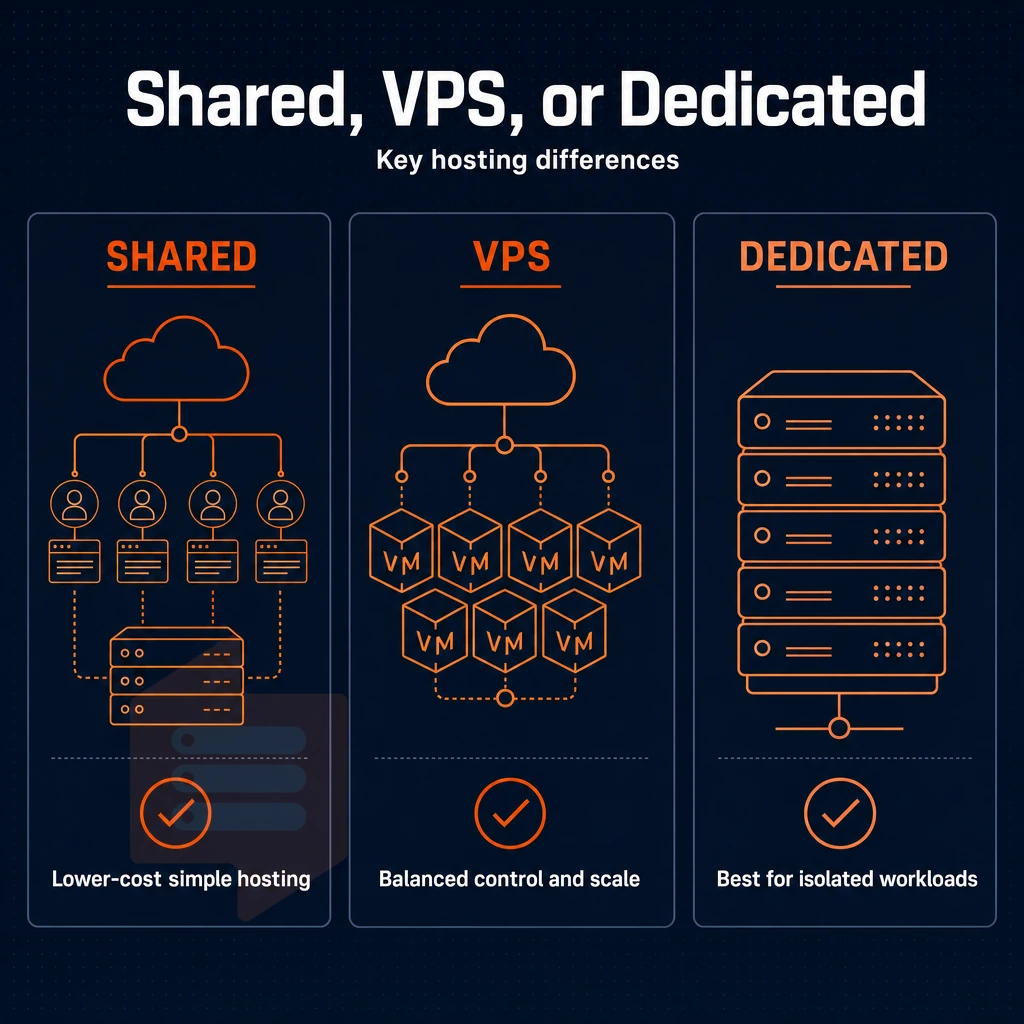
Shared hosting typically puts many users on one server and does not guarantee any resource isolation between them. One noisy neighbor can affect the performance of all other users on the same server. In contrast, VPS hosting ensures that even when multiple users share the underlying physical hardware, each tenant receives guaranteed isolated resources through virtualization technology. Unlike traditional VPS setups that may allow resource contention, modern hypervisor-based virtualization enforces strict boundaries to prevent any single tenant from impacting others.
Dedicated hosting means you rent the entire server, but it’s very expensive. This type of web hosting allows users to configure their virtual machine to some extent while still being cost-effective compared to dedicated hosting, without having to purchase the entire machine. With VPS, you gain many of the configuration benefits of an entire dedicated server while sharing the underlying hardware with other isolated tenants.
Selecting the right hosting plan depends on your specific resource requirements, technical expertise, and budget constraints for your project. Many businesses migrate from shared hosting to a traditional VPS when they need guaranteed resources and greater control without the premium cost of leasing an entire physical machine.
What root access actually means
By granting root access to your VPS server, we allow you to install any software, change kernel parameters and set up your environment in whatever way best suits your needs. Every BuyVPS VPS server plan comes with full superuser access and dedicated hardware resources by default, and a comparison with other types of hosting (shared, dedicated etc.) along various criteria can be found below.
This level of control enables system administrators to customize their server environment, install software packages from any repository, and configure services according to their specific application requirements. Managing your own VPS requires technical knowledge but provides the flexibility to tailor every aspect of the server configuration to match your application's unique performance and security requirements.
VPS hosting vs. Shared hosting vs. Dedicated server: key differences
Most of the market is covered by three hosting layers.
How resources are divided among multiple users
With shared hosting, lots of accounts are hosted on the same server. Accounts on shared hosting all compete for the same server resources (like CPU time, RAM, I/O operations). Thus, a sudden increase in traffic for one of your neighbors could impact performance for everyone. This is known as the noisy-neighbour problem. Organizations outgrow this shared hosting environment when they need predictable performance, dedicated resources, or the ability to install custom software configurations.
In a VPS (Virtual Private Server) environment, a physical server is carved into individual virtual servers, each guaranteed its own RAM and I/O to pinned storage.
Isolated at maximum cost and far removed from any shared hosting environment, dedicated servers are typically used when a single tenant's workloads max out the server's hardware or, more likely, when compliance reasons demand a physical separation of servers for certain tenants. Unlike VPS hosting where multiple virtual instances share hardware, dedicated servers allocate the entire physical machine to a single customer, ensuring complete hardware-level isolation.
| Dimension | Shared hosting | VPS | Dedicated server |
|---|---|---|---|
| Resource isolation | None, pooled | Guaranteed per VM | Full machine |
| Root access | No | Yes | Yes |
| Cost tier | Lowest | Mid-range | Highest |
| Scalability | Limited | In-place upgrades | Hardware-bound |
| Performance predictability | Low, noisy neighbours | High, hard caps | Highest |
Managed VPS hosting vs. Unmanaged
At one end of the spectrum is fully managed hosting, where a provider manages the stack for you.
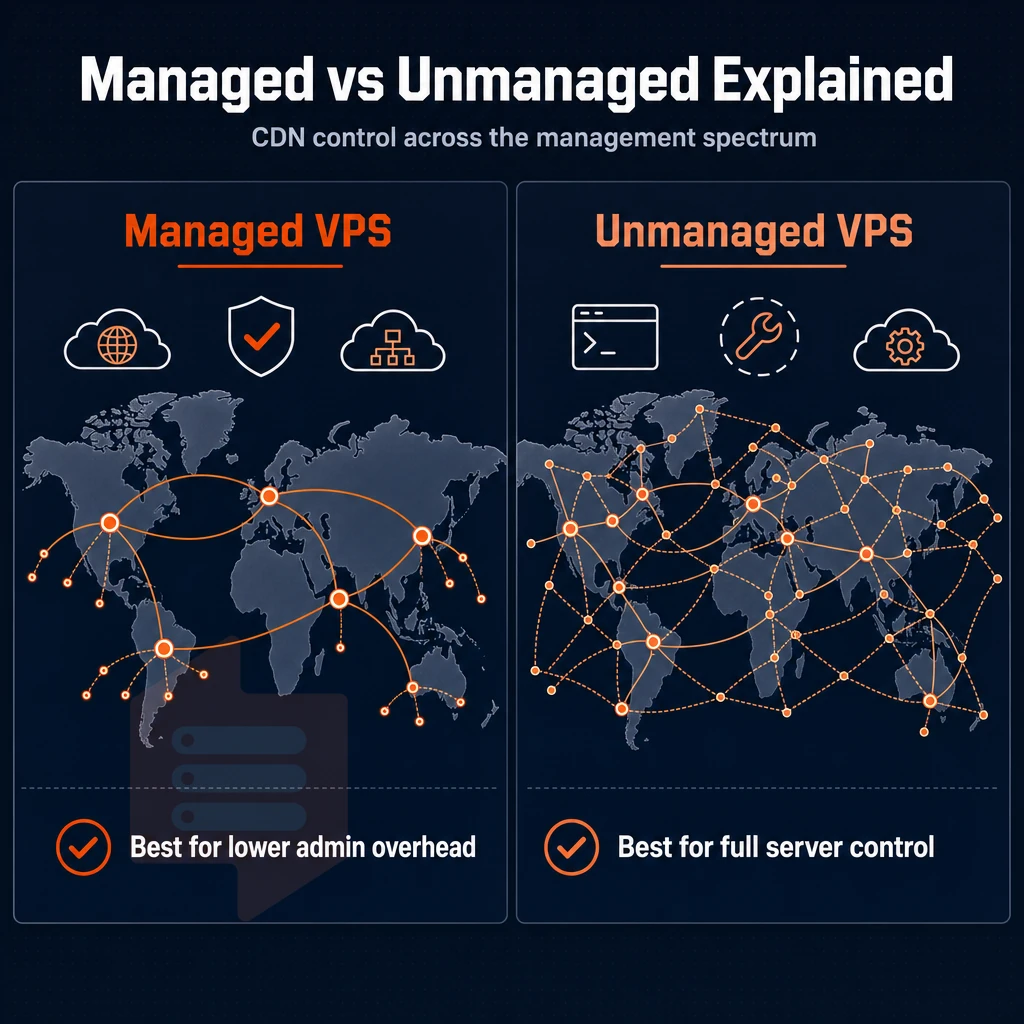
Additionally, at the other end of the spectrum from semi managed VPS hosting is bare metal, unmanaged hosting where you have full control over the server and can configure everything from scratch. Most developers and ops people prefer an unmanaged virtual private server VPS for the control it provides, whereas smaller teams may prefer the managed option in order to keep overhead down.
Semi managed VPS hosting
There is a middle tier of semi-managed VPS hosting. The customer manages the OS, the software stack, and the configuration of the application.
BuyVPS is a semi-managed VPS hosting company offering KVM isolation, full administrative access, engineer-led support, and no-oversell hardware in Amsterdam and New York.
The most common uses of VPS hosting
A VPS handles far more than shared hosting can.
Websites, apps, and server management
- Many websites outgrow shared hosting and if there is a spike in traffic then shared hosting will throttle your site as it uses the same physical servers and uses up all the available resources. With a VPS you can guarantee the amount of CPU and RAM your site needs to run smoothly.
- Running content management systems and web applications. With a VPS you have administrator privileges, so you can fine-tune PHP, set up caching layers and install additional software as needed, unlike fully managed hosting environments that usually restrict these features.
- Building test and dev environments. This is the safest way to test changes before they are put into production by creating a clean server and installing software to test and to break and then to roll back in the test environment.
Note: Keep dev and production on separate VPS instances.
Services, automation, and privacy for multiple users
- Gaming servers. With dedicated resources and a low-latency network connection, a VPS is perfect for hosting games. Lagging can ruin player experiences very quickly.
- Bots and scheduled scripts. Run your automated tasks 24/7 from the cloud without having to maintain a local machine. Minimal server management: deploy, schedule, monitor.
- Self-hosted services: Email, file storage, and internal tools hosted on your own servers. You control the data and the stack.
- VPN and proxy infrastructure. Route traffic over Amsterdam or New York with a private IP you control.
The only decision you need to make is how much control over your server environment, from the operating system up, you wish to retain and how much you are willing to give to a provider, through the management model that you choose.
Managed vs. Unmanaged VPS hosting: which do you need?
Where VPS hosting falls on the management spectrum determines how much time your team spends configuring server settings versus building product.
Managed VPS hosting: the hosting provider handles operations
In managed VPS hosting, the hosting provider handles updates to the Operating System, security patches and any configuration changes to the server. Your team then logs in and starts to deploy applications. This type of hosting is ideal for businesses that do not have a dedicated sysadmin on staff.
This convenience comes at the cost of control over the typical management tiers of a single physical server, which can limit the tweaking of kernel parameters, customized firewall rules, and low-level performance tuning.
Semi-managed VPS hosting: shared responsibility
Semi-managed splits the duties of your VPS hosting provider and yourself. The hosting provider takes care of the infrastructure (hypervisor, network, servers) and you handle the OS and upper layers. Many teams have people with some Linux experience but no full-time operations staff. Semi-managed hosting is often the best option for them.
However, the host handles issues with the server's hardware and those related to the network.
Unmanaged VPS hosting: full root access, full responsibility
Un managed VPS hosting is provisioned as a bare VPS server with full system access enabled, with no additional services included.
Technical expertise: ability to work with SSH, package management (apt/dnf), firewall (iptables/nftables) and log monitoring. Knowledge of systemd and kernel tuning is a plus.
We offer hosting at the VPS tier. All of our plans come with full privileged access and KVM isolation, so developers and engineers can run their own operating system in a completely clean and untainted environment. The isolation is only as good as the underlying hardware however, which is where the main benefits of VPS hosting really lie.
Key benefits of VPS hosting
Virtual Private Server (VPS) hosting is generally more powerful than shared hosting and even more so than a dedicated server. Since each customer has their own slice of the physical server (guaranteeing a set amount of CPU power, RAM and disk space). It is typically ideal for applications that require a fixed, constant amount of server power to run properly and continuously.
Dedicated resources and isolated performance
As opposed to shared hosting where all accounts on a server are competing for the same server resources, a VPS account has fixed allocations of resources which are enforced at the hypervisor level. This means that even a very busy “noisy neighbor” account will not be able to spike your latency.
Our NVMe RAID10 storage delivers 122,959 4K read IOPS (fio median), a published benchmark, not a marketing number.
Full control over your environment
With full sudo access you can install, configure and remove software as needed. This also means that, unlike many standard web hosting services, your virtual server can run a variety of Operating Systems, such as Ubuntu, Debian, AlmaLinux, Rocky Linux, CentOS Stream, Fedora, and you can even upload your own custom ISO. Unlike shared hosting accounts, this type of server access is simply unavailable.
When you need to add capacity, we simply upgrade the resources within your existing VPS environment, which can support multiple virtual machines, with no migration and no change to your IP address.
Isolation and virtual private server security
This means that even if there's a compromise on one of your instances, the isolation that VPS hosting offers ensures the attacker will not be able to get to the other tenants on the same server.
But these features only matter if you're ready to stop sharing a physical server's resources and move to a VPS, and you should know exactly when that moment is.
When to upgrade from shared hosting to VPS hosting
Most sites start life on shared hosting.
Virtual private server vs. Shared server resources
When you’re on shared hosting, all accounts on the server share the CPU, RAM and I/O. A VPS gives you a slice of the physical server and allocates you a fixed amount of RAM and allocates you a fixed number of CPU cores.
Your own operating system and software control
The biggest advantage of a VPS over shared hosting is that you’re locked into nothing with a VPS, you can run whatever OS you want.
When to make the move to a high traffic website
| Signal | Shared hosting | VPS fix |
|---|---|---|
| Traffic spikes slow page load | Throttled by neighbors | Isolated CPU + RAM |
| Custom software needed | Blocked by host restrictions | Full root, any package |
| Security or compliance isolation | Shared and dedicated hosting differ here | KVM-isolated environment |
| Unpredictable uptime | No SLA guarantee | 99.8% SLA, cloud VPS hosting |
If two or more rows above describe your situation, you've outgrown shared hosting.
Why choose BuyVPS for your VPS hosting needs
BuyVPS is a founder-run VPS hosting provider operating since 2002. We operate managed and unmanaged hosting on virtual private server infrastructure across two data centers, Amsterdam (EU) and New York (US East Coast), with identical hardware, control plane, and pricing at both sites. Every virtual server runs on KVM with a separate kernel, giving you true isolation from other users on the same physical server.
- No-oversell policy: Hard memory caps and low node density mean your dedicated resources stay yours under real load.
- AMD EPYC + NVMe RAID10: PCIe-direct storage with published benchmark results. The Dedicated CPU tier adds pinned cores for predictable latency.
- Full full server control + custom ISO: Install any operating system, install custom software, and take full control of your server environment from day one.
- In-place upgrades: Scale your virtual private server VPS without migration or IP rotation.
- No renewal hike: Same price in year five as year one, predictable cost for long-running web applications and gaming servers.
- IPv4 + IPv6 dual-stack on every plan, across both regions.
Whether you need unmanaged VPS hosting with full administrative control or prefer a managed VPS arrangement, explore our Standard CPU, Dedicated CPU. Additionally, High Memory tiers at BuyVPS.com/VPS, or reach out to our engineering team to compare options for your workload.
Frequently asked questions
What can virtual servers with own dedicated resources do that a full dedicated plan cannot?
A VPS handles almost any server workload: web hosting, application backends, game servers, databases, CI/CD pipelines, private APIs, and scheduled batch jobs. Because hosting websites and other workloads on a VPS gives you full administrative root privileges, a dedicated kernel, and exclusive hardware resources, you can install any software stack and configure the OS exactly as your workload demands. Teams commonly run multiple isolated services on a single VPS virtual machine rather than dedicated hosting, for example, a production web app alongside a staging environment and a monitoring agent, without the services interfering with each other.
Is a virtual private server VPS better than a VPN?
A VPS is a virtual server you control, you deploy applications, host websites, and run backend services on it.
Many teams use both: they run a self-hosted VPN server on a VPS.
What is VPS and why do i need it?
A VPS, Virtual Private Server, is a virtualized slice of a physical server running its own OS kernel, dedicated RAM, and NVMe storage, isolated from every other tenant on the same hardware. You need one when shared hosting is too constrained (no unrestricted server access, no custom software, unpredictable neighbors) but a full dedicated server is more than your workload justifies.
BuyVPS uses KVM virtualization with a separate kernel per VPS, hard memory caps, and NVMe RAID10 storage, giving you a server configuration and software installation isolation that is real, not just a marketing claim.
How much does a VPS cost per month?
Entry-level shared-vCPU plans are the most cost-effective option for low-traffic sites and dev environments.
Visit BuyVPS.com for current plan pricing across the Standard CPU, Dedicated CPU, and High Memory tiers.
Virtual Private Servers (VPS) are ideal for most production workloads that have outgrown shared hosting. VPS’s offer dedicated resources, full root privileges and real isolation in a cost effective package compared to bare metal servers. Typically used for production web applications, databases, development environments, game servers and more. The only real decision is whether to go for a managed VPS or an unmanaged VPS, i.e. do you want to manage the entire server ‘stack’ or just your application?
If you're ready to move beyond dedicated hosting to a VPS, BuyVPS runs each virtual machine on KVM-isolated servers powered by AMD EPYC hardware across Amsterdam and New York, with no-oversell guarantees and in-place upgrades that won't rotate your IP. Browse the plans at BuyVPS.com and pick the tier that matches your workload.