

What kind of server do you need for your application? Virtual Private Servers (VPS) are often described differently by developers, accountants and system administrators. To the developer it means isolated compute resources with root access.
A VPS is between shared hosting and dedicated servers . You have dedicated resources in a Virtual Private Server. You have your own OS environment and you have full administrative control over the server. But you don’t have to manage the physical server itself.
Knowing where to run your production databases or containerized APIs with high traffic is important. This guide explains how VPS virtualization really works and what distinguishes a good VPS from an oversold one, so your website stays responsive and secure as demand scales.
For which applications a VPS is particularly suitable and which points you should pay attention to when choosing a provider for your VPS. By reading this guide, you will get a better idea of whether a VPS is the right choice for you and what you should expect from your provider.
What does VPS mean? The full definition
The abbreviation VPS stands for Virtual Private Server. A VPS is a hosting environment. A physical server is divided by means of virtualization software into virtual servers. Every virtual machine acts as a full independent server with its own OS and the allocated resources. For more context, see Virtual private server.
First month $1
Then the normal monthly price. One per customer. No setup fee, and a 30-day performance guarantee on your first order.
See the plans“Sjoerd helped me with the setup of my VPS, super helpful team, smooth onboarding, and overall a great experience, thanks again”
How virtualization splits a server
The main function of a hypervisor is to partition the server hardware so that multiple virtual servers can run on the same physical server without interfering with each other. This type of isolation is difficult to achieve, but it is one of the primary characteristics of a well run VPS hosting environment. By ensuring that each tenant operates within strict boundaries, the hypervisor prevents any single machine from being monopolized by one user's workload.
At BuyVPS we use KVM to create VPS servers. Each virtual server has its own kernel, giving true OS-level isolation rather than virtual containers.
What "private" actually means
You get dedicated RAM, CPU and storage not shared with other users, a huge difference from shared hosting, where all accounts draw from the same pool of resources.
- Guaranteed RAM and vCPU allocation per plan.
- Isolated file system, data of other tenants is not readable.
- Independent reboot and kernel configuration.
VPS vs. A dedicated server
While a dedicated server would provide you with your very own physical server, a VPS is a partitioned section of a server held together by a virtualization layer. While offering similar control to a dedicated server for a lower price to commit, a VPS is typically ideal for most types of workloads and doesn’t provide the user with single-tenant hardware.
How a virtual machine powers a virtual private server VPS
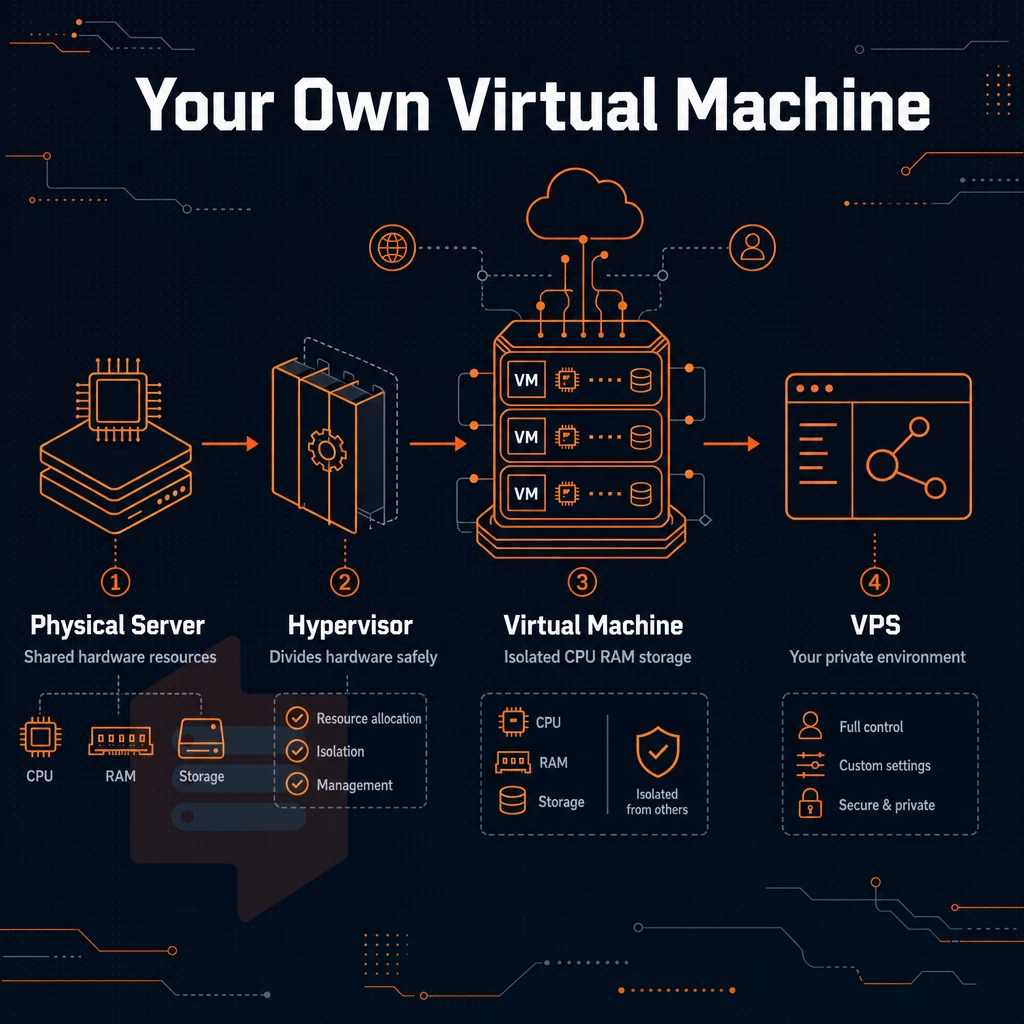
A physical server is a piece of hardware with a fixed set of resources. A virtualization platform (a hypervisor) divides up that hardware into multiple virtual servers, each of which acts as a completely separate physical server. The hypervisor that we use here at BuyVPS is KVM (Kernel-based Virtual Machine), which means that each VPS runs as a completely isolated environment at the kernel level.
How the hypervisor divides resources
A hypervisor strictly controls the CPU cores, RAM, and disk space each VM gets as a hard limit enforced by the physical hardware. Users get isolated servers to run any workload without knowing the other users exist.
In practical terms, no single tenant can ever consume more resources than allocated to them on a given node.
The own operating system layer
Since each VPS runs its own completely independent Operating Systems (for example Ubuntu on one VPS and AlmaLinux on another VPS on the same node). Other users on the same server have no access to your OS, files or processes. Since KVM is a kernel module it can ensure complete isolation at the kernel level, as opposed to software-based partitioning (containers).
What this means for your workload
Dedicated resources for your workload without the high cost of bare metal servers. Online stores, database clusters and web applications with heavily varying loads will all benefit from fixed CPU and RAM. BuyVPS run KVM, each VPS has its own separate kernel, running on either the Amsterdam or New York locations. With the mechanics of KVM and the BuyVPS architecture explained, a comparison can now be made with other forms of hosting including Shared and Cloud hosting.
VPS unlike shared hosting or a dedicated server
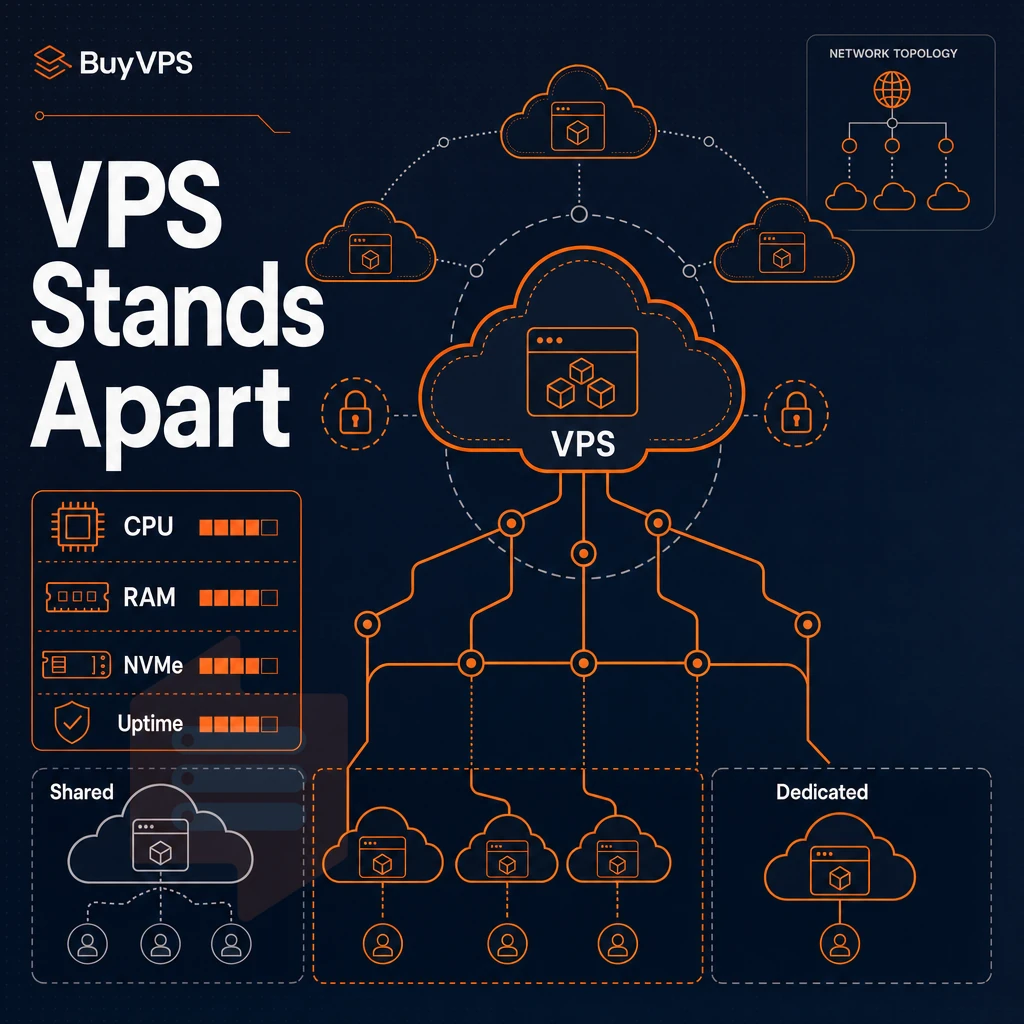
Deciding on the correct hosting package depends on the amount of isolation and control you require as well as how the hosting provider allocates resources. This means that shared hosting, VPS hosting and dedicated hosting all have to be considered when making a choice. Beyond isolation and control, cost factors play a significant role in determining which hosting tier aligns with your budget and performance requirements.
Shared hosting: pooled resources, no isolation
Shared hosting puts dozens to hundreds of accounts on a single server, using the CPU, RAM, and disk I/O of the server to service all of the accounts on the server.
No root access, no custom OS and no additional software outside of what the host has allowed can be installed in the shared web server entry-level tier account.
VPS: your own isolated environment
Unlike shared hosting, each VPS has a fixed amount of CPU time, and a fixed amount of RAM and storage space, all guaranteed by the hypervisor (not just by policy).
You get full root access and a full Operating System. Resources allocated to other customers on the same host have no effect on your VPS. VPS hosting is priced between shared and dedicated hosting and is typically the best option for production workloads. As your traffic grows, you can easily upgrade your plan by adding more CPU cores or RAM without migrating to a different hosting platform.
Dedicated hosting: choosing the right web hosting provider
Dedicated hosting offers one tenant one physical machine, no virtualization, no neighbors, no shared kernel.
| Factor | Shared | VPS | Dedicated |
|---|---|---|---|
| Resource isolation | None, pooled | Hard limits per VM | Full, no neighbors |
| Root access | No | Yes | Yes |
| Cost tier | Lowest | Mid-range | Highest |
| Control level | Minimal | Full OS control | Full hardware control |
Note: Providers that oversell VPS nodes can erode the isolation advantage. BuyVPS enforces hard memory caps per node and keeps node density low, so the resource guarantees listed above hold under real load. Those guarantees only matter, of course, if the workload is a good fit for VPS in the first place.
What is a VPS used for?
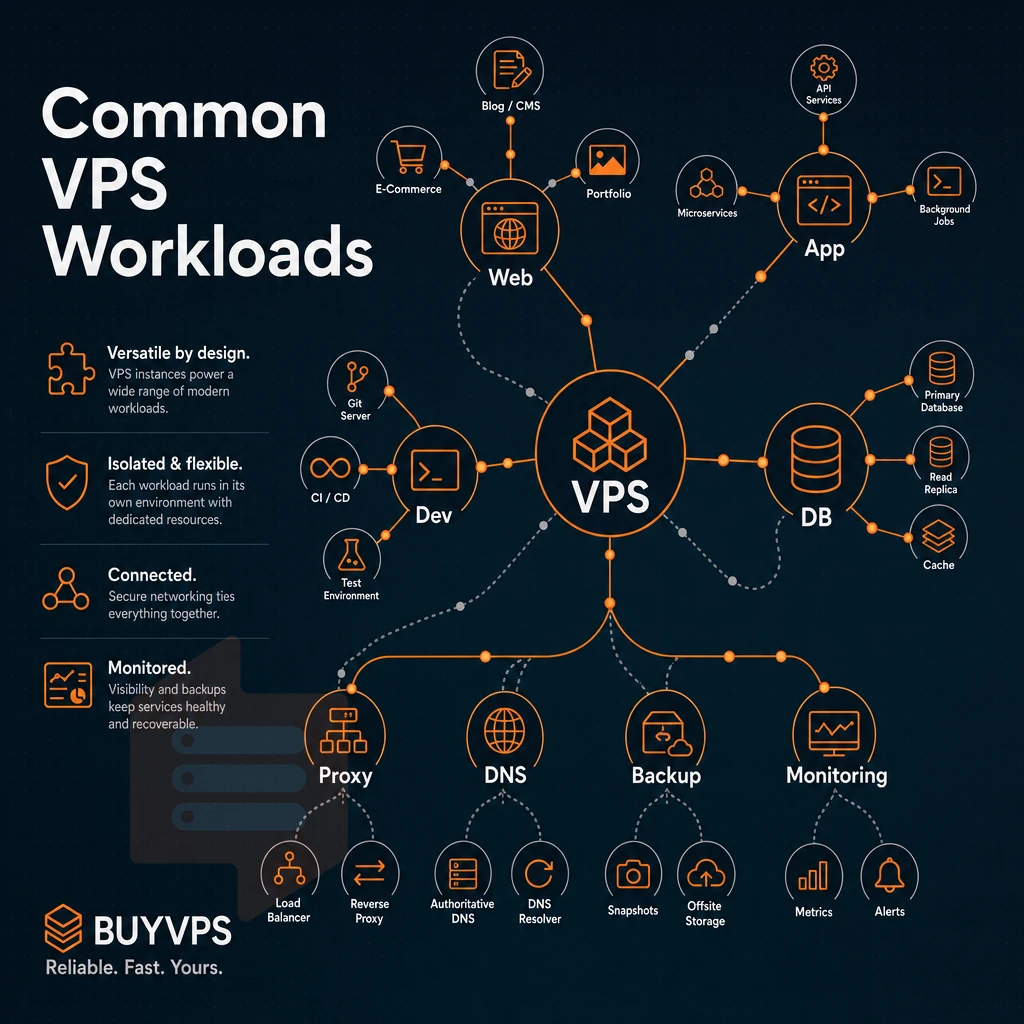
A VPS is a general-purpose computing environment. It can be used for a variety of production and development work and is granted root access, dedicated resources, and a configurable web server, thus distinguishing it from mere shared web hosting services.
Common production workloads
Web apps and high-traffic sites.
VPS hosting ensures that your virtual server's CPU and RAM are completely isolated from those of another tenants on the same server. This is why, when a dynamic application begins to receive a lot of traffic, it is moved to a VPS hosting plan from a shared account.
This isolation translates directly into better performance under load, as your application's response times remain consistent regardless of neighboring tenant activity. Handling traffic spikes becomes far more predictable when your application isn't competing for CPU cycles with dozens of unpredictable neighbors.
Host multiple websites as online stores
With a VPS you can fine-tune every layer of the stack: database buffer pool, PHP opcache, PHP memory limit, etc. as well as external services like TLS termination. This level of customization gives developers and system administrators greater control over performance optimization and security configurations than any shared hosting environment could offer. Administrators gain more control over security policies, allowing them to implement custom firewall rules and intrusion detection systems tailored to their specific application requirements.
Implementing regular backups becomes straightforward when you control the entire stack, letting you schedule automated snapshots at the filesystem or database level. Controlling the entire stack also enables you to respond quickly to security breaches by patching vulnerabilities or isolating compromised services without waiting for a hosting provider's intervention. Developers can also configure custom caching layers and CDN integration points that optimize how their website delivers content to end users across different geographic regions.
Game servers.
Multiplayer sessions are comprised of low-latency, always-on processes that require full control of the network. A VPS provides the kernel access and port flexibility that managed game-hosting panels just can't provide.
Development, multi-site hosting, and site security
We use a VPS to create a 100% mirror of our production environment, same OS, same runtime versions, same firewall rules. Staging and CI environments run on isolated VPS instances so they don't interfere with live traffic, letting developers test code changes against a production-like setup before pushing updates to the live website.
Hosting multiple websites from a single VPS is a cost-effective solution for web agencies, running multiple client domains from one server instance. Each client website operates in its own directory structure with separate configuration files, allowing agencies to manage distinct domains while maintaining centralized server administration.
Custom software stacks
Most specialized workloads (like custom compiled applications, or proprietary daemons) require their host to be running strange software that most shared web hosting accounts wouldn’t allow. Knowing how VPS hosting work s, you can understand why root access is king: because on a VPS you run the entire software stack on that server, not just in some directory.
KVM at BuyVPS is set up to run with a separate kernel for each VPS. Therefore custom kernel modules and parameters can be applied without afffecting other VPS instances.
Once you know a VPS suits your applications, the next question is how much server administration you want to handle yourself.
Managed VPS vs unmanaged VPS
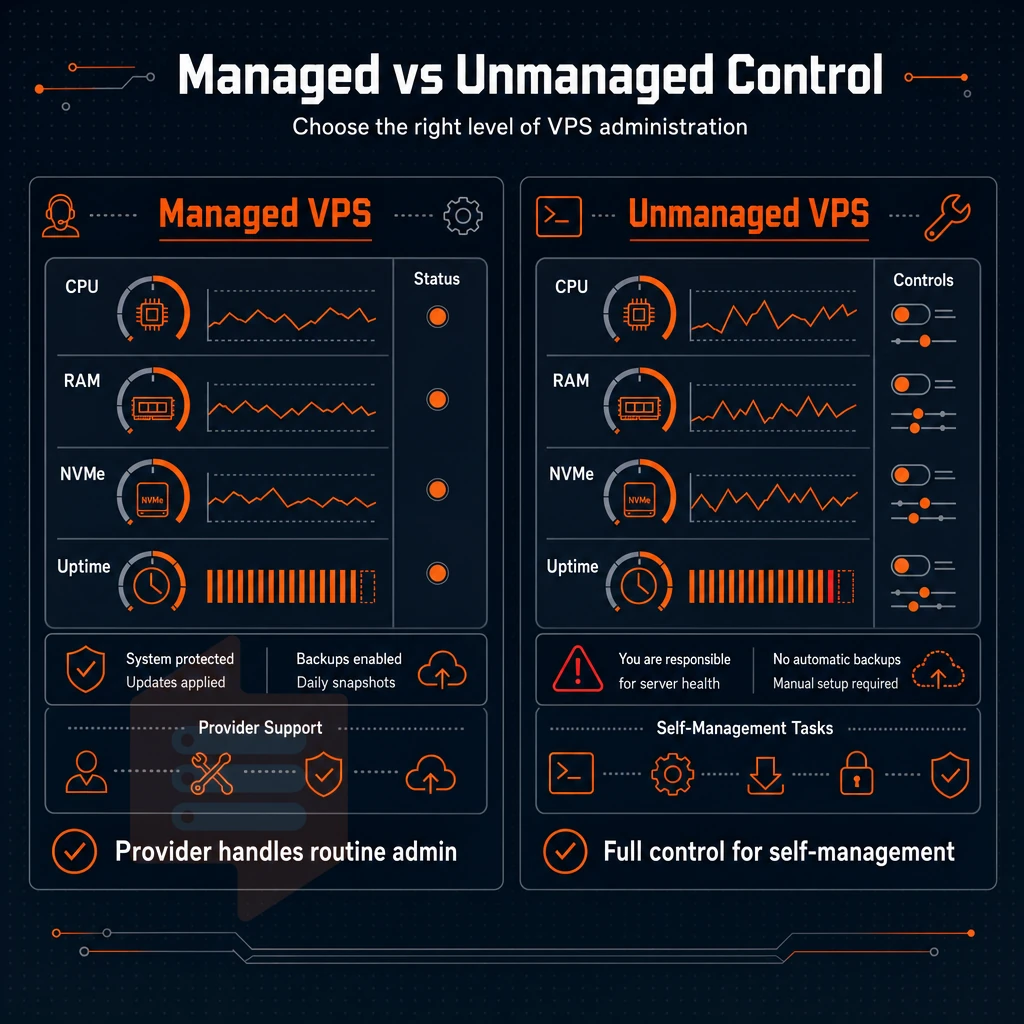
Understanding the difference between managed and unmanaged plans is critical to choosing the right VPS hosting provider.
Managed VPS: your VPS provider handles operations
Managed hosting includes OS updates, security patches, and maintenance on your servers. You will primarily use a control panel instead of a command line interface to perform tasks.
A good example for this model is an e-commerce company that requires a stable IT environment but cannot justify the costs of a full time server administrator.
Unmanaged VPS: full control, your responsibility
The VPS provider is only responsible for allocating resources above the hypervisor layer.
This could involve building a custom version of Nginx, a particular kernel module or even a hardened security configuration.
Root access and what BuyVPS gives you
All BuyVPS plans are delivered with Full Root Access and custom ISO upload capability. This hosting solution gives you full control over your server from the word go, with no restrictions placed on the software you can install, and no locked-down configurations to restrict your management of the server. There are a number of advantages that VPS hosting has over shared hosting for a start.
VPS vs VPN, what's the difference?
VPS and VPN are two totally different solutions to two totally different problems. The VPS gives you a server and the VPN hides your traffic.
What a virtual private server offers and how it works
Virtual private servers are split up from physical servers and offer a customer a dedicated set of compute resources. Such as a full server environment (OS, files, processes, etc), often hosting several websites, applications or services within one server instance.
Virtual private servers are rented computers where you deploy code, configure software, and use the machine as your own. You have full root access, meaning you can configure the server from the kernel up. Renting a VPS server is much like renting a dedicated server, minus the cost of physical hardware.
What a VPN is
A Virtual Private Network, or VPN, is one of the most popular dedicated utilities for privacy, not to be confused with a virtual private server VPS.
A VPN is not a host. It does not host sites, databases, etc.
Why they get confused
Both references use the term “virtual” and virtualization is key to both using remote resources.
Note: Some users run a VPN on a VPS, hosting their own VPN server on a BuyVPS instance, for example. That is a valid use case, but the two concepts remain distinct. The VPS is the server; the VPN is the software running on it.
Once you have learned the lingo, we can explain what you need to look for when choosing a VPS provider.
Why choose BuyVPS for your virtual private server
BuyVPS has been a founder-run VPS hosting provider since 2002. We operate data centers in Amsterdam (EU) and New York (US East Coast), giving you a virtual private server close to your users on either side of the Atlantic. Every plan runs on KVM virtualization technology with a separate kernel per VPS, so your isolated environment stays genuinely isolated from fellow tenants on the same physical server.
- No-oversell policy: Hard memory caps per node mean your guaranteed resources are always available, unlike on a shared server where multiple users compete for the same pool.
- Full root access on every plan: Install any operating system, load a custom ISO, and deploy custom software without restriction.
- Three VPS tiers: Standard CPU (shared EPYC Milan vCPU), Dedicated CPU (pinned EPYC Genoa cores for predictable latency), and High Memory, each with NVMe RAID10 storage and measured 122,959 4K read IOPS.
- In-place upgrades: Scale to more resources without migration or IP rotation.
- No renewal hike: Your VPS cost stays the same in year 5 as it did on day one.
- Engineer-staffed support: Real engineers reply, not first-tier chatbots.
If you're evaluating VPS hosting and want a hosting provider with provable benchmarks and transparent pricing, explore our virtual private server plans or reach out to compare options.
VPS meaning: key takeaways
A virtual private server VPS sits between shared server hosting and a dedicated server. Virtualization technology partitions one physical server into several virtual machines.
VPS hosting suits any workload that needs a stable, controlled server environment: online stores, web apps, game servers, or numerous sites. Managed VPS and unmanaged VPS options let you match support level to your skill set. Ready to choose a plan? Visit BuyVPS.com/VPS for full details.
Frequently asked questions
How does a VPS hosting service provide dedicated resources, and what is it used for?
A VPS is used to host websites, run application servers, manage databases, operate gaming servers, and handle scheduled background tasks, all workloads that require a persistent, always-on Linux environment that can provide isolated resources and full superuser access. Developers use VPS instances to run staging environments, CI/CD pipelines, and containerized workloads.
Businesses deploy VPS servers for email, VoIP, and internal tools that require exclusive resources without the cost of a full physical machine. BuyVPS customers on the Dedicated CPU tier, for example, use pinned cores for latency-sensitive workloads like real-time APIs and high-frequency database queries.
How does a VPS hosting solution differ from a VPN?
A VPS is a virtual private server, a cloud-hosted machine you control, run software on, and connect to over the internet. A VPN is a virtual private network, an encrypted tunnel that routes your internet traffic through a remote server to mask your IP or secure a connection.
You can, however, install VPN server software on a VPS, which is a common use case for teams that want a self-hosted, private VPN endpoint rather than a third-party service.
Is a single VPS legal?
Yes, renting and using a VPS is entirely legal. It is simply a form of server hosting, the same category as shared web hosting or a dedicated server. Legality depends on what you run on it, hosting lawful websites, applications, and services is straightforward. Illegal activity on a VPS is subject to the same laws as illegal activity on any internet-connected server, and reputable providers enforce acceptable-use policies to prevent abuse.
Is a VPS just a vm?
A VPS is a VM, but not every VM is a VPS. The term "VPS" specifically describes a commercially hosted virtual server sold as a standalone server product with its own IP address, storage, and OS.
The underlying technology is the same, hypervisors like KVM carve a physical host into isolated virtual machines. BuyVPS, a hosting service that uses KVM with a separate kernel per VPS, ensures each instance is fully isolated at the kernel level rather than sharing a kernel with neighboring tenants, as container-based virtualization does.
allocated resources, superuser access and full isolation, all for a fraction of the price of a powerful bare-metal server. As a result, VPS hosting is now often the best choice by default for most applications that have outgrown communal hosting, whether they’re used for production, for databases, or as development environments.
Managed hosting takes care of a lot for you, but unmanaged hosting gives you full control of the entire stack.
If you want predictable performance backed by hard memory caps and no-oversell infrastructure, explore BuyVPS's Standard, Dedicated CPU. Additionally, High Memory VPS plans, hosted in Amsterdam and New York, on AMD EPYC hardware with NVMe RAID10 storage. Browse the plans at BuyVPS.com and find the tier that fits your workload.