

Many teams pick Google Cloud Platform VPS offerings because they're already familiar with Google Cloud Platform, it's heavily marketed by Google, and it integrates with tools they use daily, including cloud cdn endpoints and other infrastructure.
Compute instances in GCP are highly scalable and are offered in many regions around the world, but these “benefits” come with many trade-offs including unknown cost, contentions with other shared resources.
This article explores Google Cloud Platform VPS compute in depth, where Google Cloud Platform, backed by google's vast fiber network, excels, and where its architecture struggles with consistent performance, fixed costs, and real technical support.
What is Google cloud platform VPS, storage, and cloud monitoring?
Google Cloud Platform is a set of infrastructure services offered by Google on exactly the same basis as it uses internally for its own services. For users who need a virtual private server, Google Cloud’s Compute Engine offers a range of virtual machines created on demand that can be configured with full control over the operating system and root access.
First month $1
Then the normal monthly price. One per customer. No setup fee, and a 30-day performance guarantee on your first order.
See the plans“Sjoerd helped me with the setup of my VPS, super helpful team, smooth onboarding, and overall a great experience, thanks again”
Compute engine as a VPS that distributes web traffic
Compute Engine brings virtual machines to Google’s infrastructure, provisioning completely isolated VMs on its global network. Users select an operating system and configure resources as desired, connecting to instances via SSH just as with a VPS. The primary way Compute Engine differs from typical hosts is that billing is by the second, and significant physical hardware resources are virtualized on behalf of users. Beyond predefined machine shapes, users can specify custom machine types to tailor vCPU and memory allocations precisely to their application requirements.
How VPS hosting scalability differs from classic VPS hosting
GCP is a hyperscale cloud platform, not a VPS provider (even a purpose-built one).
Where a dedicated VPS provider fits
We provide KVM VPS hosting in Amsterdam and New York. It provides same level of predictable performance as a cloud compute service, without the complex cloud platform, and without being charged per API call, as you would with a Compute Engine VM. We describe the key differences with a traditional VPS hosting service below.
How gcp compute engine vms differ from a traditional VPS
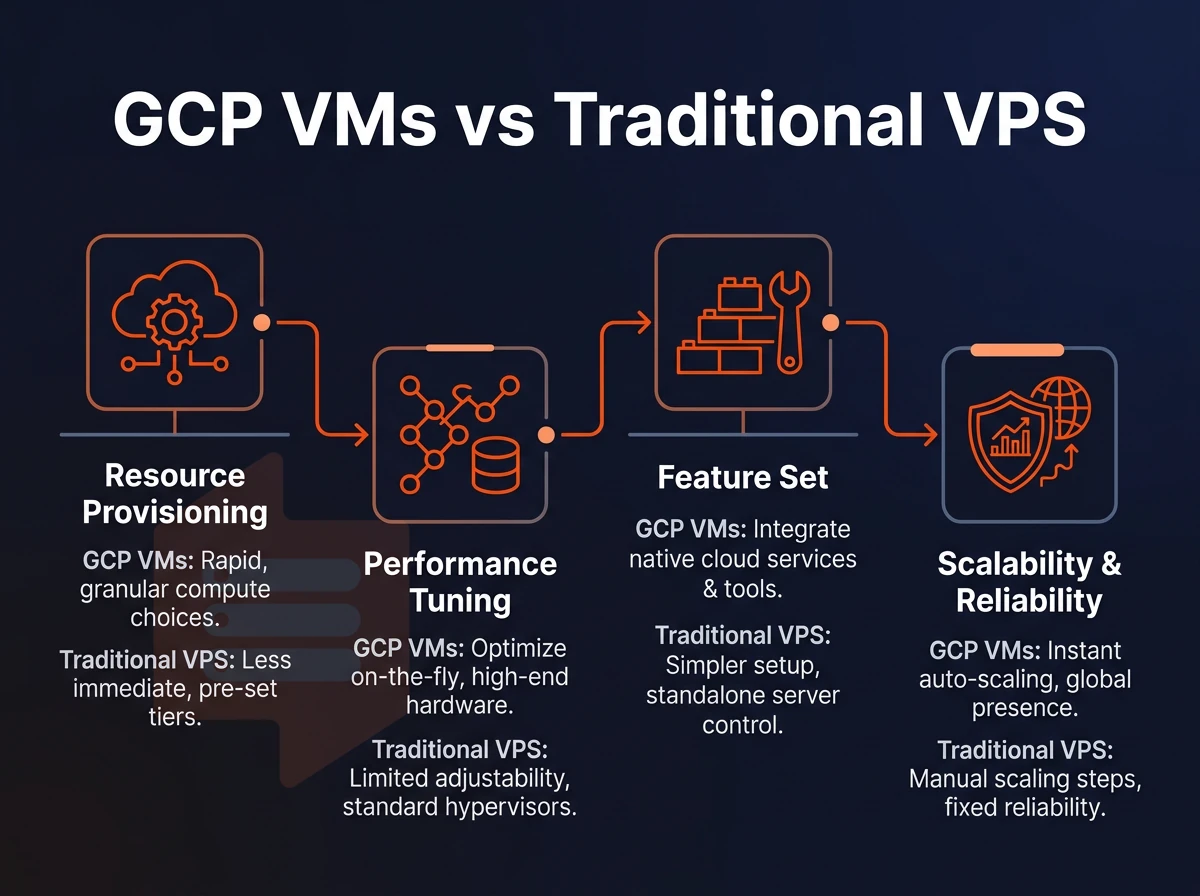
Compute Engine VMs and traditional VPSes start from the same premise of isolated virtual compute but then differ greatly in terms of flexibility, cost and complexity of use.
Custom machine types vs. Fixed plans
Custom machine types on GCP allow any combination of vCPUs and RAM, unlike traditional VPS plans, which come in fixed tiers (2 vCPUs + 4GB RAM, 4 vCPUs + 8GB RAM, etc.).
Machine configuration and elementor hosting support resources
For the shared-core instances, GCP seems to treat them as shared hosting (i.e. burstable, not guaranteed). The dedicated-core instances on the other hand seem to behave more like a traditional VPS (virtual private server) with pinned resources for you. For example, BuyVPS’s Standard CPU plans are shared on EPYC Milan cores, whereas the Dedicated CPU plans are pinned on EPYC Genoa cores with DDR5 ECC memory for consistent low latency.
Networking: configure networking vs. Dual-stack simplicity
You have to configure networking (subnets, VPC peering, firewalls and routes) which is overkill for most cases, good for large multi-region projects though. Name resolution for your instances and services can be handled through cloud dns, which provides authoritative domain serving and low-latency lookups across regions. For teams managing infrastructure as code, configuration management tools like Ansible, Puppet, or Terraform can automate the provisioning and maintenance of these network components across environments.
Each subnet you define operates within a distinct ip address range, ensuring logical separation of resources and enabling fine-grained access control policies across your infrastructure. Building your own private network topology within GCP gives you complete control over IP addressing, routing policies, and inter-service communication patterns.
| Dimension | Compute Engine VMs | Traditional VPS (BuyVPS) |
|---|---|---|
| Resource model | Shared or dedicated, configurable | Fixed tiers, hard memory caps |
| Billing | Per-second, variable | Flat monthly, no renewal hike |
| Networking setup | VPC, subnets, manual routes | IPv4 + IPv6 ready out of the box |
| Uptime SLA | Varies by VM type | 99.8% |
GCP is best used for multi-region architectures, a traditional VPS like those offered by BuyVPS in Amsterdam and New York are best used for cost predictability and easy setup over limitless customisation. Selecting the primary VPS location based on user proximity ensures lower latency and better performance for region-specific applications.
Pros and cons of cloud computing services built on Google cloud
Google Cloud Platform provides powerful and flexible infrastructure and services. It is very powerful, but there are significant trade-offs. The primary trade-off is that Google Cloud Platform can be very complex to use for simple workloads. Therefore, you should consider whether using Google Cloud Platform or a simple VPS is best for your workload.
Pros: global reach and ecosystem depth
- We support fault-tolerant, enterprise workloads. Google Kubernetes Engine (GKE) is a production-grade container orchestration service for large scale deployments. Multi-region deployments and managed services for common components help avoid single points of failure.
- Cloud CDN is integrated with Compute Engine. It can be combined with Cloud Armor for DDoS and WAF protection without the need for third-party tools.
- Scalability for VPS hosting is virtually unlimited. VPS hosting can make use of Autoscaling groups and managed instance templates to scale automatically without human interaction.
Monitoring cloud console services and billing complexity
- There is no fixed monthly price for using Microsoft Azure. Instead, it charges by the second and there are dozens of add-on services, which makes cost forecasting very hard for small teams and they often end up overspending.
- The monitoring cloud console is very dense with dashboards, alerting policies and log sinks that require an ops engineer to monitor effectively.
- Overkill for simple web servers. If you need a reliable Linux server with root access and reasonable pricing, then our KVM VPS on AMD EPYC hardware in Amsterdam and New York is the answer. No cloud, just straight forward VPS. No hidden fees.
Note: Always set billing alerts before provisioning. GCP has no hard spending cap by default; a misconfigured instance can generate unexpected charges overnight.
Knowing the strengths and weaknesses of your abstract instance types is all well and good, but the real test is mapping your instance types to your actual workloads.
Common use cases: when gcp acts as a dedicated server vs. A shared resource
Not every workload is best served by the same resource model. You need to understand where each of GCP’s instance types will succeed and where they’ll fall short.
When a dedicated server model makes sense
Pinned resources such as production databases, high traffic web servers and large enterprise workloads require sole-tenant nodes or high memory instances in order to have the hypervisor provision exclusive capacity for their use. High performance is a non-negotiable in these scenarios and a shared server will suffer from CPU steal and memory pressure from other tenants. Managed database services like cloud sql can offload administrative overhead, but for maximum control and performance isolation, self-hosted databases on sole-tenant nodes remain the preferred choice.
This category includes web server configurations for latency sensitive APIs and other real-time applications. Although Google’s fiber network is huge and efficiently distributes all web traffic, noisy-neighbor CPU contention on servers can still severely impact p99 latencies, regardless of network quality. When paired with a content delivery network, cloud cdn integrates seamlessly to cache static assets closer to users and reduce origin load. Organizations requiring advanced DDoS protection and global traffic management often evaluate cloudflare enterprise plans alongside Google's CDN offerings for comprehensive edge security.
Sites expecting massive traffic spikes during product launches or seasonal events benefit from autoscaling groups that can provision additional instances automatically based on load thresholds. Monitoring tools and real-time dashboards help teams track network performance metrics such as throughput, packet loss, and latency across all regions to identify bottlenecks before they affect end users. Proper firewall rules and VPC configurations ensure that network traffic is routed securely between application tiers while maintaining low latency for user-facing services. When an instance becomes unhealthy or unresponsive, traffic automatically shifts to healthy replicas within the load balancer pool, ensuring continuous availability.
When shared or burstable instances are the right fit
There’s little need for dedicated capacity for development sandboxes, staging environments and low traffic sites. A web development workflow of isolated environments for testing different configurations and containerized workloads for development work in particular maps well to shared compute. Teams can create isolated sandbox environments quickly without the overhead of provisioning dedicated hardware, making shared instances ideal for experimentation and CI/CD pipelines. Shared-core instances also work well for fault tolerant workloads that can gracefully handle occasional performance variability without impacting overall system reliability.
BuyVPS as the dedicated hosting alternative
For those who require pinned cores and low latency, our BuyVPS Dedicated CPU VPS hosting uses the AMD EPYC Genoa processor with hard-pinned cores and very dense no-oversell nodes. The necessary deployments are available from our Amsterdam and New York locations and can be upgraded in-place. All without IP rotation which is so much simpler than re-provisioning a cloud server to get more power when needed. The key points of all these options are listed below for easy comparison.
Gcp vs. Traditional VPS: side-by-side comparison table
GCP Compute Engine and conventional VPS hosting solve similar problems through very different architectures.
Side-by-side operating system comparison
| Dimension | GCP Compute Engine | Traditional KVM VPS |
|---|---|---|
| Resource model | Elastic, per-second billing | Fixed vCPU, RAM, storage per plan |
| Root access | Available, with IAM overhead | Full root access, no IAM layer |
| Operating system | Curated images; custom ISO limited | Any OS; custom ISO supported |
| Network setup | Subnets virtual private cloud, cloud CDN's edge network | IPv4 + IPv6 dual-stack; virtual private networks via VPN software |
| Storage | Manage cloud storage buckets or persistent disk | NVMe RAID10, PCIe direct |
| Network performance | Variable; egress billed separately | Consistent; included bandwidth |
| Support model | Tiered paid support plans | Engineers reply directly |
| Typical use case | Burst workloads, multi-region apps | Predictable workloads, databases, APIs |
Where dedicated hosting wins over traditional shared hosting
For steady workloads like databases, API servers and other long running services, VPS hosting offers predictable cost and consistent I/O performance.
When gcp makes sense for elementor hosting bundles
GCP is best for projects with unpredictable bursts of traffic or organizations that are already heavily invested in the GCP ecosystem. For any other type of project, a fixed amount of space on a well-benchmarked server in a VPS hosting platform like BuyVPS is far easier to manage and cost to understand. Take a look at what we offer if this description of your needs sounds familiar.
Frequently asked questions about data centers
How does a cloud CDN storage bucket boost VPS performance for traffic
A VPS (Virtual Private Server) is a virtualized machine carved from a physical host using a hypervisor such as KVM. You get full root-level access, your own kernel, and the ability to install any software you need. It sits between shared hosting (no isolation) and a bare-metal server (no shared hardware at all). This level of control allows administrators to configure specialized software stacks, custom kernel modules, and security policies tailored to specific application requirements. Organizations with strict compliance requirements can implement custom security measures at the kernel level, including mandatory access controls and audit frameworks that meet industry-specific regulations. For organizations outgrowing shared hosting environments, a VPS provides the necessary isolation and performance headroom without the complexity of scaling traditional shared hosting infrastructure across multiple physical servers.
Is gcp better than Aws for VPS workloads?
Neither platform is a clear winner for every workload.
Does Google cloud platform offer a free tier for virtual machines?
Yes, GCP includes an Always Free tier with one e2-micro instance per month in select US regions, with limited CPU, memory, and a monthly egress cap.
What is the difference between a dedicated server and a cloud VPS?
A dedicated server gives you an entire physical machine, no shared CPU, RAM, or storage with other tenants.
A high-quality VPS, such as BuyVPS's Dedicated CPU tier, which gives you complete control over pinned cores on AMD EPYC Genoa hardware with hard memory caps and low node density, closes much of that performance gap for massively scalable data warehouse workloads while remaining faster to deploy and easier to scale.
While flexible, scalable infrastructure in GCP Compute Engine can be valuable, the variable cost, additional complexity, sharing of resources even when paying for single-tenant nodes.
A comparison of these two products side by side will reveal that GCP is designed for elastic cloud native applications.
If that tradeoff resonates, explore BuyVPS's Dedicated CPU VPS plans, AMD EPYC Genoa with pinned cores, NVMe RAID10 storage, and deployment in Amsterdam or New York. See the full plan specs at BuyVPS.com and find the configuration that fits your workload.