

Picking a cloud VPS for Linux web hosting is one of the biggest decisions a developer or IT person can make.
Get it wrong with your linux VPS operating system and you'll be stuck dealing with random slowdowns caused by nearby 'noisy neighbors', surprise price hikes and long queues of fractious customers fought over by clueless chatbot 'support'.
This guide explains what a real Linux cloud VPS hosting service is and how it differs from shared hosting masquerading as cloud hosting.
Finally, we try to map the most common Linux distributions to specific use cases so that you can immediately pick the right Linux distribution for the right VPS hosting plan. We also look at a number of providers who are doing Linux VPS hosting well these days, including BuyVPS. Who run dedicated servers on AMD EPYC hardware in Amsterdam and New York data centers, guarantee a number of parameters and cap hard memory to prevent overselling.
These data centers feature redundant power supplies, climate control systems, and direct fiber connections to major internet exchanges for optimal performance. Providers like digital ocean have popularized the cloud VPS model with straightforward pricing and developer-friendly APIs, though specialized hosts often deliver better price-to-performance ratios for production workloads. Selecting the appropriate linux hosting plan requires evaluating not just the underlying hardware specifications but also the provider's track record with uptime guarantees and technical support responsiveness.
What is a cloud Linux virtual private server?
A cloud VPS Linux server is a virtualization-based on-demand hosting solution. It allows you to have a dedicated portion of a physical server as a VPS. Complete with root access to a full Linux operating system installation, on top of virtualized hosting infrastructure without having to manage raw servers.
First month $1
Then the normal monthly price. One per customer. No setup fee, and a 30-day performance guarantee on your first order.
See the plans“Great experience with BuyVPN! The service is easy to use, the connection has been smooth and reliable, and the overall experience has been really good. The pricing is also reasonable…”
What a Linux OS VPS actually is
A hypervisor virtualizes a single physical server and runs multiple independent virtual servers. Each virtual server runs its own kernel, has its own storage and its own network stack. This is in contrast to shared hosting where all virtual servers share resources of a single physical server and thus resources of all tenants are pooled together. KVM provides true hardware-level virtualization, ensuring each tenant operates in an isolated environment where resource contention from neighboring instances is architecturally impossible.
How KVM isolation works on a Linux VPS
All our VPS servers are set up using KVM virtualization. This means every server has its own kernel. You can also run almost any Linux distribution on your server. This flexibility allows you to host multiple websites on a single VPS instance, each with its own configuration and resource allocation tailored to specific application requirements.
Why Linux VPS dominates this category
We provision our linux cloud servers with open, auditable software. Developers love linux cloud servers because they integrate very well with automation, containers as well as with CI/CD pipelines. Within minutes, you deploy a cloud server in Amsterdam or New York via your cloud service provider, such as BuyVPS. These servers are particularly well-suited for development environments where teams need isolated, reproducible infrastructure that mirrors production systems without the overhead of managing physical hardware.
The provisioning process is streamlined through intuitive control panels, allowing you to configure your server specifications and launch production-ready instances in just a few clicks. The reliance on open source software throughout the stack ensures transparency, security auditing capabilities, and freedom from vendor lock-in that proprietary alternatives cannot provide.
Now that you have a good grasp on the fundamentals of VPS architecture. Let's explore the different Linux distributions you can run as a server operating system and why this choice typically matters more than most people anticipate. Even with basic knowledge of server administration, choosing the wrong distribution can lead to compatibility issues, security gaps, or unnecessary complexity in your workflow.
Server administration also includes tasks like configuring firewalls, managing user permissions, and keeping software packages updated to maintain a secure and stable environment. The distribution you select fundamentally shapes your hosting environment, determining everything from package management workflows to kernel update cycles and long-term support availability. Understanding how your linux server handles system updates, security patches, and resource allocation under load becomes essential before committing to any distribution for production use.
How a Linux VPS server powers your virtual private server
Linux is the dominant OS for cloud VPS servers. Every cloud workload running on a Linux VPS benefits from the huge range of tools, packages and community support that this open-source operating system offers, something no proprietary OS can match. A linux cloud server typically runs distributions like Ubuntu, Debian, or CentOS, each optimized for different performance profiles and administrative workflows.
Choosing your cloud VPS Linux distribution
Each distribution is used for different scenarios and cases.
| Distribution | Best for | Release cadence |
|---|---|---|
| Ubuntu | Developers, rapid deployment | 6-month + LTS every 2 years |
| Debian | Stability-first production servers | ~2-year stable cycle |
| AlmaLinux / Rocky Linux | RHEL-compatible enterprise apps | Tracks RHEL point releases |
| CentOS Stream | Upstream RHEL testing | Rolling preview |
| Fedora | Cutting-edge kernel features | ~6-month releases |
Linux VPS vs. The Windows operating system
Per-seat licensing for Windows hosting means additional cost and ineffectiveness when trying to allocate VPS resources on a number of nodes. Linux hosting has no such overhead and is set up much faster than a Linux VPS, boot up, connect to the server via SSH and you’re away straight away with a fully working server environment.
Root access and full control with Linux VPS
You get full root access from the very first login. This level of privilege gives you complete control over your server environment, allowing you to install custom software, modify system configurations, and optimize performance for your specific workload requirements.
The level of control you receive with VPS hosting compared to shared hosting is one of the biggest differences, and one that you should consider carefully before signing up for any hosting plan.
Linux VPS vs shared hosting: key differences
Shared hosting and a Linux VPS server are on opposite ends of the control spectrum. Knowing this will help you choose the right environment to start with to avoid having to switch too quickly.
What shared hosting limits that Linux VPS overcomes
Hundreds of accounts share the same kernel, memory and CPU time on a shared Linux hosting account.
Install custom software and control your virtual private server
A Linux VPS gives you root access, just like a dedicated server.
Note: Linux VPS hosting costs more than shared tiers, but far less than dedicated servers. It is the practical middle ground for teams that need real isolation without rack-level spend.
BuyVPS runs each Linux VPS on KVM with a separate kernel, with hard memory limits and NVMe RAID10 storage. So isolation is not a policy but rather is enforced at the hypervisor level.
Look closer at the storage architecture here.
High performance storage: NVMe SSD and raid10 explained
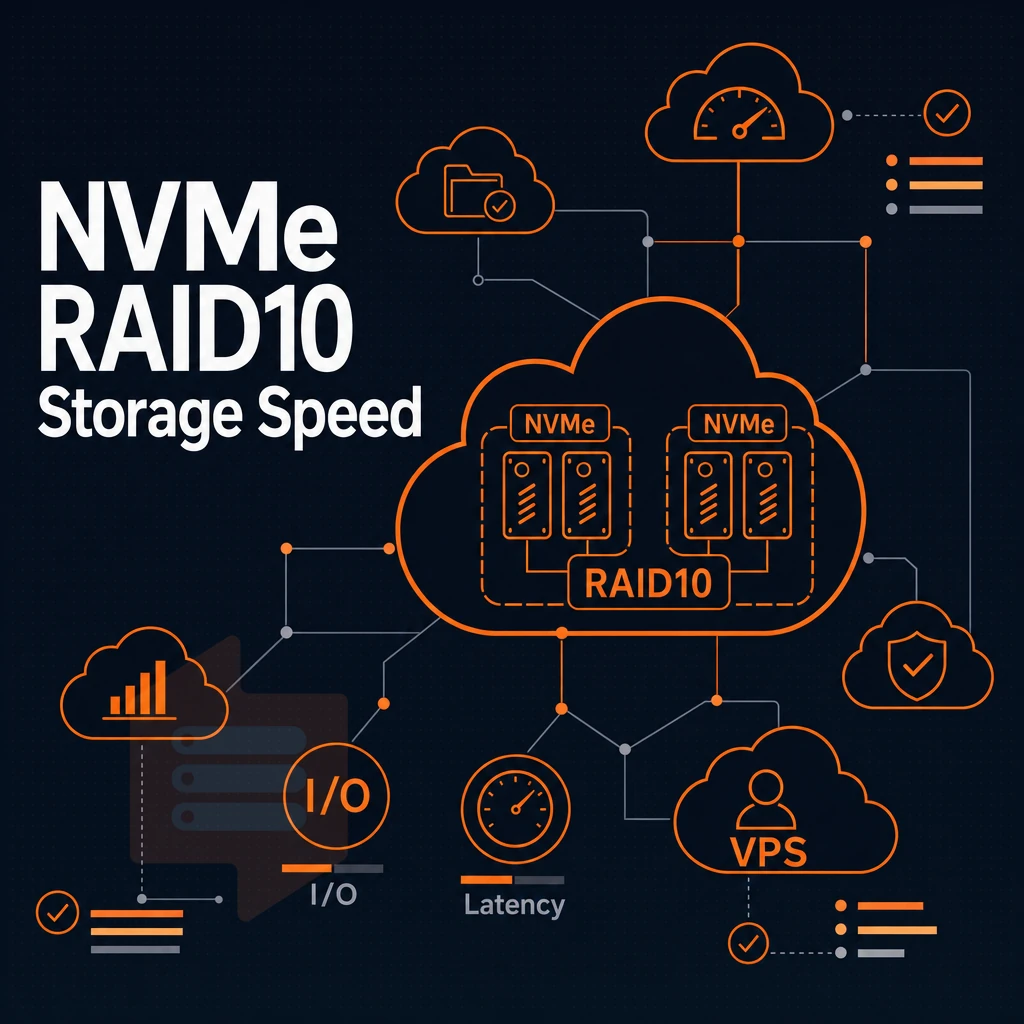
Storage is typically the biggest performance bottleneck in a cloud VPS Linux hosting environment. The protocol, the physical media, and the redundancy architecture all impact the storage read and write I/O of your applications on a linux VPS, and whether a storage failure is going to bring down your site for the day.
Why NVMe SSD storage outperforms legacy options
Most traditional SATA SSDs top out at around 100,000 IOPS under perfect conditions.
The key here is to provide dedicated resources. Scaling vertically by allocating more resources to a single VPS instance often proves simpler than horizontal scaling across multiple nodes for workloads with tightly coupled dependencies.
Measured: 122,959 4K read IOPS (fio median, PCIe direct NVMe RAID10). A published benchmark, not a marketing number.
Raid10 and Linux VPS protection against hardware failures
RAID10 writes every change to two disks and reads from two in parallel, so a single disk failure means zero data loss and zero downtime.
For hosting solutions with production databases (e.g. PostgreSQL, MySQL and similar databases) thousands of small random writes per second are issued.
Full control inside BuyVPS data centers
Server management is made easy by in-place upgrades, meaning upgrading a server keeps the same IP and filesystem. The dedicated resources of your tenants are not shared. Modern hosting solutions increasingly emphasize automation and orchestration capabilities, enabling teams to scale infrastructure dynamically without manual intervention for each configuration change.
Comprehensive management tools streamline routine tasks such as monitoring resource usage, scheduling automated maintenance windows, and deploying configuration changes across multiple server instances simultaneously. Permission systems can be configured to accommodate multiple users with varying access levels, ensuring secure collaboration without compromising administrative control.
While fast storage and good isolation are necessary to get a linux VPS operating system running, really running in production also requires things like backups, load balancing, and solid networking.
Nightly backups, load balancer support, and cloud infrastructure features
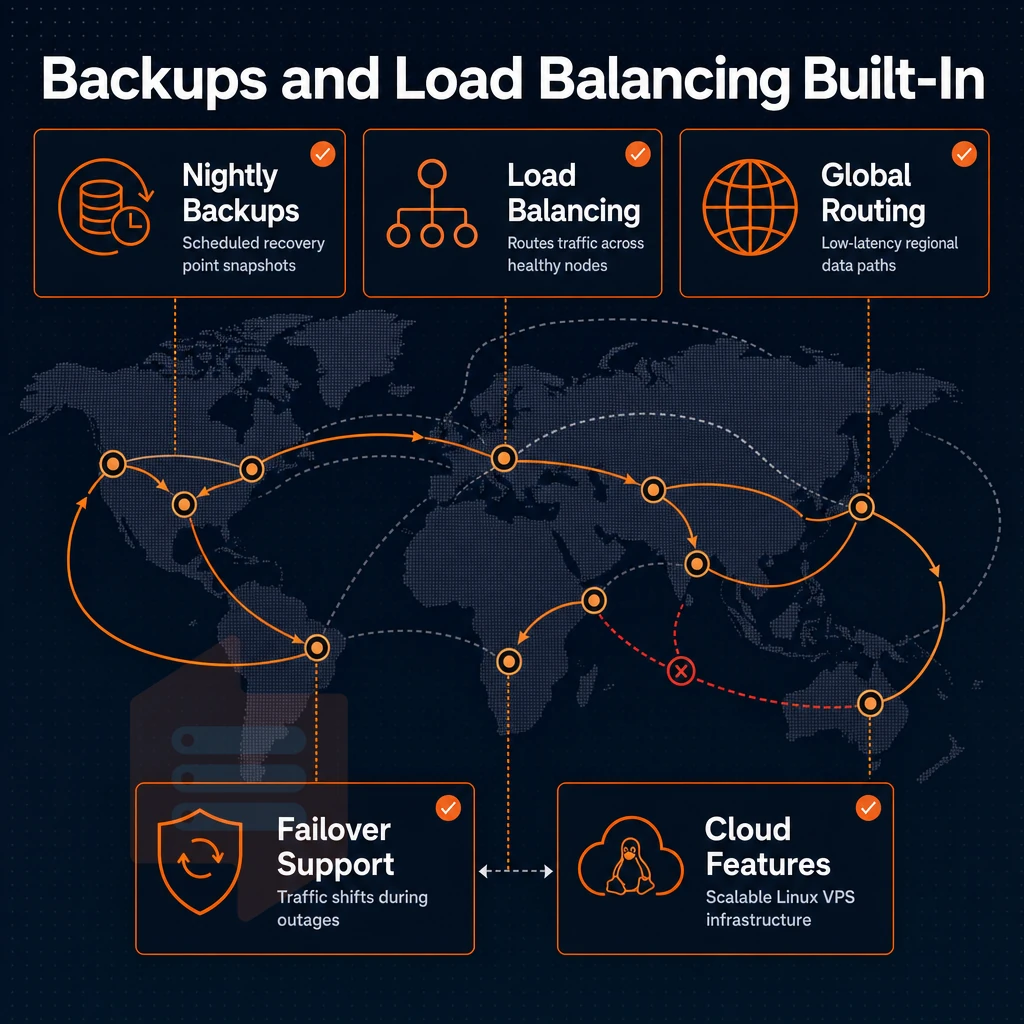
There are three key pieces of infrastructure that differentiate a well-implemented Linux VPS on cloud services from one that’s going to fall over, i.e. automated backups, load balancer support and private networking. Check for these before committing to a provider.
Nightly backups and data loss prevention
Cloud Server s with nightly backups are now the norm. Look for a host that takes snapshots and stores them in a secure data center apart from your main volume. A disk crash should not take your recovery point with it.
Linux VPS and load balancer support
An open source operating system such as Linux OS pairs well with software load balancers like HAProxy or Nginx. When running multiple websites from behind a single entry point, a VPS with full superuser access and a clean web interface to configure upstream pools, health checks, etc with SSL termination is essential.
Private networking and cloud infrastructure reliability
Private network options help reduce attack surface and lower latency between nodes.
BuyVPS is a provider of KVM VPS with full control over your VPS when you place your order. It provides full administrative access to your virtual web hosting server as well as IPv4 and IPv6 addresses for your use. It also provides engineering-level technical support in Amsterdam and New York around the clock.
If these requirements fit with your current workload, then why not proceed with BuyVPS?
Why choose BuyVPS for Linux VPS hosting
BuyVPS delivers linux VPS hosting built on verified hardware, no marketing fluff, no overselling. Our dedicated web hosting servers in Amsterdam and New York run identical AMD EPYC nodes with NVMe RAID10 PCIe-direct storage and hard memory caps per node.
- Full unrestricted server access on every plan, install custom software, configure firewalls, or upload a custom ISO from day one.
- KVM with a separate kernel per VPS, true isolated environment, not a shared container.
- Dedicated resources, not promises, pinned cores on the D-tier eliminate noisy-neighbor performance drops.
- In-place upgrades, scale VPS resources without IP rotation or server migration.
- No renewal hikes, same price in year five as year one.
Founder-run since 2002, we back every linux VPS server with engineer-led technical support. Compare our linux hosting plans or reach out to discuss the right fit for your workload.
A linux VPS, built on an open-source operating system, remains the foundation of serious hosting for good reason: full root-level access, kernel-level control, and a package ecosystem that matches any workload.
The gap between shared hosting and a cloud-based Linux VPS server isn't incremental.
BuyVPS runs Linux VPS hosting on AMD EPYC hardware across Amsterdam and New York, with hard memory caps per node, no-oversell guarantees, and in-place upgrades that preserve your IP addresses. If you're ready to move past shared hosting constraints, explore the plans at BuyVPS.com and pick the tier that fits your workload.